Showing posts with label mercenaries. Show all posts

Sunday, November 13, 2016

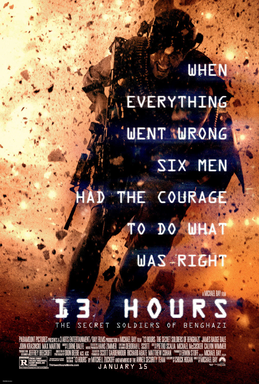
13 Hours (2016)


                “13 Hours:  The Secret Soldiers of Benghazi” is a movie by Michael Bay of “Pearl Harbor” infamy.  He based the movie on the book by Michael Zuckoff.  He interviewed several of the characters in the movie.  Three of them (Kris “Tanto” Paranto, John “Tig” Tiegsen, and Mark “Oz” Geist) vetted the script and served as technical advisers.  The movie was filmed in Malta.  The Annex and the compound were accurately recreated.  The movie ended up as Bay's least successful endeavor.  It is also his least bull shit film.  Now you know what the movie-going public wants.

                The movie begins with one of the lengthiest background information lead-ins I have ever seen.  But our current events challenged society needs the background and it is informative.  In a good sign, the intro is relatively neutral.  It makes it clear the movie will be about the “six elite military operators” that defended a covert CIA base.  “This is a true story”.  Yeah, we’ve heard that before.

                Dan Silva (a buff, bearded John Krasinski) is a contractor (mercenary to people who insist on political incorrectness) who is leaving his wife and kids to do one last job (are any of them not “the last job”?) in Libya.  Before landing, he takes off his wedding ring.  My first thought was:  OMG, Jim is going to cheat on Pam!  Actually it is to hide his status from the terrorists.  Huh?  Silva is greeted by a bud named “Rone” (a first-billed James Dale).  The ride to the compound features a Libyan stand-off that is used to establish that Silva is no longer in Kansas and his new boss CIA desk jockey “Bob” is a stereotypical war movie bureaucratic wuss/dick.  In other words, the exact opposite of Rone’s team of bon homie badasses.  Bob has the heavy burden of representing the entire bungling government, including the never mentioned Hillary Clinton.

                A visit by bleeding heart Ambassador Stevens (Matt Letscher) comes at a bad time considering Benghazi is a hell mouth.  (The movie does not cover how low a campaign contribution you have to give to get his gig.)  Mr. Chips decides he wants to stay in the Annex which is the equivalent of a listening post in the Verdun no man’s land.  But at least he has two overconfident and underqualified security guards.  And the local militia guarding the perimeter.  What could happen, right?  Certainly nothing on the anniversary of 9/11.  Right? 

                Sept. 11, 2012 opens with Silva calling his wife and finding out she is pregnant!  Why do people call their wives in war movies?  Does he want to provoke the hell mouth?  If so, mission accomplished because here the hajis come.  It’s like the Alamo, but with no Davy Crockett.  Or any other Texans.  When Rone and his boys learn the Ambassador is in danger, they want to rush to his aid.  Unfortunately, “Bob” tells them to “stand down”.  They go anyway.  Let the combat porn begin!

                The team makes a drive to the Annex that is straight out of “Black Hawk Down”.  You can’t tell the good Libyans from the bad, except that the bad ones are shooting at you.  They reach the Annex and we get a little breather before the volume goes up again.  Next, there is the Bayesque wild ride back to the compound.  Imagine “Fast and Furious” with more gunfire.  It’s now time for the “Zulu” reenactment.    We started with six mercs – the over/under is four for this particular “last stand” movie.

                “13 Hours” has no glaring weaknesses.  It tells a true story that deserves to be told and it does it in an informative and entertaining way.  It is surprisingly light on politics.  This must have disappointed Republicans as much as Oliver Stone’s “W” disappointed the Democrats.  Bay is mostly interested in lionizing the contractors who fought off the hordes. The movie is mostly about macho heroes and a FUBAR situation  He does not really take a stand on the controversies surrounding the incident.  There are some allusions to those controversies, but the movie is not heavy-handed.  It is more of a standard action picture than a political thriller.   In fact, the script cobbles together several common war movie tropes - the running gun battle, the last stand, the red-tape loving ass-coverer, etc.  There’s nothing in this movie you have not seen before, but it is done competently.  The cinematography by Dion Beebe has a nice variety.  The dialogue by Chuck Hogan can best be described as manly. The score is what you would expect from this kind of movie and is actually fairly restrained.

                The cast is not A-List, but it does not need to be.  There is not a lot of acting required.  Krasinski was the big get for the casting director and he is adequate.  He plays Silva as a morose individual who is not very enthusiastic about this job.  He is certainly not the adrenalin junkie that most soldiers of fortune are portrayed as.  There is little character development and it is sometimes hard to tell the heroes apart, especially during the night fighting.  The screenplay throws in a few tired clichés.  “Bob” is a cartoonish bureaucratic wimp.  There is also a blonde spy who starts off sneering at the warriors, but ends up respecting them.  And there is the likeable Libyan interpreter who represents the “good” natives.

                The movie will of course be most remembered for its action sequences.  You get what you expect from Bay, but it’s not like he’s the only director that has adopted the over-the-top depiction of modern combat that goes back to “Saving Private Ryan”.  Since that revolutionary opening scene in SPR, directors have tried to depict combat realistically.  Some, like Ridley Scott in “Black Hawk Down”, have been successful.  Others have adopted the mantra that extreme combat equals realistic combat.  In other words, the more hellish the action and violence, the closer you get to proving war is hell.  What they don’t understand is it is possible to go too far and veer into super hero territory.  “13 Hours” is somewhere between SPR and “Hacksaw Ridge”.  There are no moments that cause a war movie fanatic to laugh out loud, but you just know there was not nearly as much ammo expenditure, explosions, and bloodshed in the actual firefights.  The graphic wounds are certainly appropriate to war.  We do love to see human equivalents of zombies get slaughtered.

                I feel a little sorry for Bay with regard to the lack of box office success for the film.  My theory is word got out to his general audience that the movie was not a “Transformers” sequel and the rabid Hillary haters found out it was not red meat.  This is a shame for Bay because the movie is not bad.  It may exaggerate the heroics, but the men were real heroes and they get their due.  In this respect, the movie reminds of “Lone Survivor” and “American Sniper”.  Not as good, but comparable.

GRADE  =  B  
         

HISTORICAL ACCURACY:    How accurate is it?  Let’s start by assuring you that it ain’t “Pearl Harbor”.   The background information is a good summary of the situation going into Sept. 11, 2014.  Although, oddly the footage shows Gaddafi’s capture before it shows the air strikes that helped contribute to his demise.  The main characters are all real individuals with “Bob” being a representation of the actual CIA chief who remains unidentified.  The setup of the Annex and the compound are true to life.  The circumstances of Ambassador Stevens death are accurate in the big picture.  The Annex was woefully insecure and the security detail was laughable.  The "February 17th Martyr's Brigade" militia that was supposed to defend the perimeter did run away at the first sound of gunfire.   The script gives a plausible  version of what transpired when members of Ansar al-Sharia stormed the site.  Stevens did go to a safe room, but the jihadists did set the building on fire.  The movie has Bob giving a “stand down” order, thus siding with the critics of the State Department and CIA.  This theory was debunked by the Benghazi Committee, but eyewitnesses, including the technical advisers insist they were told to wait.  The movie does not really address the State Departments decision to turn down requests for more security at the Annex.  While the attack on the Annex is accurate, the ingress of the contractors to search for Stevens was by armored vehicle and was not a hellish run through a gauntlet and there were no attacks while they were there.  They did take fire on the way back.  The assaults on the compound are basically true, but shall we say “enhanced”.  There was an attack at 12:30 and one at 2:30.  Both lasted about ten minutes.  The mortar attack around 5 A.M. that killed Rone and Glen was well done.  Another controversy the movie touches on is the supposedly criminally tardy air support.  That also has been debunked. Overall, I would give the film a B for accuracy.

Monday, July 18, 2016

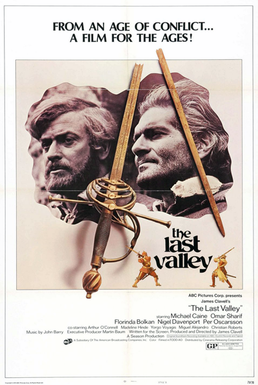
FORGOTTEN GEM? The Last Valley (1970)


                “The Last Valley” is a movie set in the Thirty Years’ War.  It was written and directed by James Clavell and is based on the novel by J. B. Pick.  It was shot in Austria.  Although you would think the public was pining for a movie about the Thirty Years’ War, the movie was a flop.  It turns out that people did not care about a complex religious war in Germany in the 17th Century.  Go figure.

                A former teacher named Vogel (Omar Sharif) escapes from a hellish landscape of raping, looting, and murder to find refuge in an isolated village in a picturesque valley that is untouched by the war.  This paradise is about to be sullied with the arrival of a mercenary band led by “the Captain” (Michael Caine).  Vogel suggests they agree to a détente with the villagers.  When one of the men questions this wimpy attitude, the Captain stabs him – end of discussion.  The villagers know the alternative to sharing their village and themselves (if they are women) is worse than any alternatives so they make the best of the situation.  Talk about dysfunction.  Throw in the religious fanaticism and you get a gooey mess.  The movie is not content to explore the obvious Catholicism versus Protestantism angle of the war.  We get a fanatical priest and a witch!  Someone (or two) are headed for a burning at the stake. 

                All this fellowship must come to an end, however.  One of the mercenaries has a dispute with the Captain and returns to the valley with another crew.  There is a mediocre battle that features uncanny accuracy from muskets.  The village sides with their thugs over these unknown thugs.  When spring approaches, it’s time for the boys to get back to work.  There is a siege going on that promises looting and killing.  This live and let live stuff has gotten old.

                I have not read the book so I cannot compare it to the screenplay.  I would hope it makes more sense than the film.  Maybe that was intended because God knows the war made little sense.  You will not learn much about the war from the movie.  You do get the accurate impression that the war was a conflict between Protestants and Catholics.  You also learn that neither religion was in the right.  The ignorant peasants are full of religious ignorance and superstition.  The mercenary nature of the warfare is also highlighted.  And the nasty nature.  At least they are using authentic weaponry.  

                This is a pretty bleak movie.  None of the characters is likeable.  I think the Captain is supposed to grow on you and he does, like a fungus.  In fact, there are several schizophrenic characters.  It does not help that the acting is poor.  Caine and Sharif are solid, but the rest of the cast is weak.  They make up for this with being incredibly well-groomed for the 17th Century.

                In conclusion, this could have been a good movie on a war that deserves at least one decent film.  Unfortunately, the movie tries to do too much and throws in too many diverse characters.  The symbolism of the idyllic valley that is eventually poisoned by the reality of human nature is a bit trite.  Hammering the theme that all religion is bad is also trite.  It also tries too hard to be anti-war.  You don’t have to try hard if you are dealing with possibly the worst war in history.

GRADE  =  D

Monday, December 21, 2015

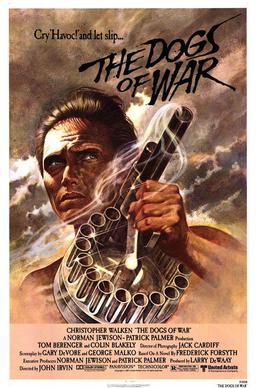
BOOK / MOVIE: The Dogs of War (1974/1980)


                “The Dogs of War” is a movie by John Irvin (“Hamburger Hill”, “When Trumpets Fade”) based on the novel by John Forsyth.  The movie was filmed in Belize and is set in a fictional African nation of Zangaro.  It is a story of an attempted coup by mercenaries on behalf of a British corporation that wants mineral rights in the country.  It stars Christopher Walken, two years removed from “The Deer  Hunter”.

                The movie begins with our anti-heroes fleeing from a botched rebellion in some Central American nation.  Their leader, Cat Shannon (Walken), returns to his seedy apartment in New Jersey and tries to reconcile with his ex-wife.  He wants to settle down and move to Wyoming or some such place.  She and the audience say “sure!”  Oh well, back to work.  Shannon gets a job from a shady character named Endean (Hugh Millhis).  His boss is the CEO of a large corporation which wants a crazy African dictator named Kimba overthrown because the tycoon wants to spread democracy.  Just kidding, he wants the mineral rights so he can add that next billion to his wallet.  Being a mercenary, Shannon takes the job and reunites the band.  First, he has to reconnoiter the capital of Zangaro.  Two things of significance happen on the scouting expedition.  He meets a comely African lass who turns out to be Kimba’s mistress.  The second thing is that because of the girl he gets tortured by Kimba’s lackeys.  In prison he meets a kindly doctor who lost the election to Kimba.  Upon return to America, Shannon begins preparation for the coup.  After acquiring the necessary weapons (including a bad-ass gun called a XM-18) , Shannon and his four buddies take a freighter to Africa.  They are joined by some Africans who will serve as cannon fodder.  The plan is to assault the Presidential compound with extreme prejudice and then Endean will bring in an equally repulsive African general to become the new Idi Amin.  Except this monster will be in corporation’s pocket.

                “The Dogs of War” is one of the more famous mercenary movies.  It bears closest resemblance to “The Wild Geese” and is part of a subgenre that continues with the recent “Expendables” movies.  “Dogs” is an above average entry in the soldiers of fortune milieu.  Like most of them, it is low budget.  And the cast is actors who are either going to be famous, or more likely, on the downside of their careers.  Usually these movies are ensemble pieces, but “Dogs” is really a one man show.  Walken dominates with his smoldering intensity.  He must have intimidated the editor because his second in command Tom Berenger got left mostly on the cutting room floor. The rest of the cast is blah.  And we don’t care because there is virtually no character development.  Technically the movie is average.  The cinematography is nothing special.  Irvin is not trying to stand out from typical merc flicks in his first feature film.  The action sequences are pedestrian.  The tired, but trusted trope of good guys firing randomly to create fireworks.  The one outside the box move was to include the XM-18 which is a multi-barreled assault weapon that can fire a variety of ordinance such as fragmentation, grenades, anti-tank, and anti-personnel.  It really livens up the party. 

                The plot is predictable and cliché-ridden.  Shannon is a war –weary warrior who only knows how to do one thing.  Naturally he loses his wife over his avocation.  He may not be a lover, but he is a killer with a heart of gold (or in this case, platinum). Endean represents the evil, greedy tycoon who is more powerful than any politician.  The movie includes some twists that the average mercenary movie fan will be surprised by, but the average viewer will see coming from a mile away.  (Oops, I think I just questioned the intelligence of merc movie maniacs.  Sorry.  Don’t get your panties in a bunch.  Oops.)  It would have been nice if the dialogue was a little tongue in cheek (like “Expendables”), but this is the young Walken, not the SNL Walken.  In fact, the funniest moment comes when the four mercenaries enter the compound and pose for a kick-ass movie poster with guns a blazin’.  The big action set piece is entertaining in a mindless way, but the buildup is boring.

                As  I have mentioned before, my theory is that any competently made movie based on a book should be better than the source material.  The only excuse is if the technology or budget is not capable of replicating scenes from the book.  There is no excuse for the plot to be worse than the book.  In this case, the plots differ in substantial ways.  The book is in many ways a tutorial for anyone who wants to overthrow an African dictator.  Forsyth was familiar with mercenaries, arms dealers, and African coups.  He spends the vast majority of the book showing off his insider’s knowledge.  Thankfully the movie just alludes to all the details that go into overthrowing an African government.  I found all the jetting around by the various team members to put all the pieces together to be tedious.  Maybe if I wanted to be a soldier of fortune someday, but the truth is that I could care less about an “end user” certificate.

                Where the book is superior to the movie is in the set-up and pay-off.  The novel gives the background that the movie is obtuse about.  Forsyth covers the geologist discovering the platinum at a mountain in Zangara and Marson’s subsequent efforts to get a monopoly on the site.  We also learn how Shannon finds out that the mission is wealth dominated.  Part of this knowledge comes from an affair with Marson’s sluttish daughter.  The book does not have the wife subplot.  (We get Jo Beth Williams instead of Bo Derek.)  The battle is also quite different, but ends up in basically the same place.  It is more realistic tactically than the film, but not as entertaining.  The aftermath of the coup is better in the book.

MOVIE =  C

BOOK  =  D

Monday, December 30, 2013

Day 6 - The Wild Geese (1978)


On the sixth day of Christmas, my true love gave to me – six wild geese a slaying


                “The Wild Geese” is sometimes referred to as the father of mercenary movies.  How proud it must be to have sired that low quality subgenre!  It was based on an unpublished novel about the rescue of an African leader by an elite force of mercenaries.  The producer dreamed of replicating “The Guns of Navarone” and “Where Eagles Dare”.  Dream big, baby!  The producer rounded up an all-star cast of codgers and took them off to South Africa for filming.   An interesting choice for a movie that has a theme of integration. 

“The Wild Geese” opens with a song that rivals “Soldier Blue” in bizarre crappiness.  Not a good start.  A veteran mercenary leader (he looks old enough to have served with Walker in Nicaragua) named Faulkner (Richard Burton - who agreed not to drink during the shoot) is contracted to rescue the African leader Limbani by a copper industrialist who oozes future betrayal.  Next comes the obligatory recruitment sequence.  Faulkner reunites with tactician Janders (Richard Harris - who agreed to not drink during the shoot), pilot Fynn (Roger Moore), drill sergeant Young (Jack Watson), and kaffir-hater Coetzee (Hardy Kruger - who agreed to stop smoking crack, just kidding).  This is followed by the corollary interviewing of the cannon fodder.  They ask each why they want to slaughter Africans, in so many words.  Oh, and are you over 50 years old?  Interestingly, their net snares a gay medic named Witty (Kenneth Griffith).  Training montage, anyone?

                In case you’re wondering what do mercenaries do to train – jumping off a tower, tossing logs, and bayonet practice.  It’s off to Africa.  They parachute in and no one gets caught in a tree!  They are startled by an exotic animal – an ostrich!  (As far as I know the only appearance by one in a war movie.)  The rescue of Limbani is suspiciously easy what with Coetzee using his crossbow and the cyanide gas used on the guards.  What a boring anticlimax!  But, wait – there are complications due to a double-cross by a copper magnate.  Imagine that.

                The movie transitions to a trek film after one badass Piper Cub strafes and napalms their jaunty victory convoy.  On the way to their alternate egress, Coetzee and Limbani debate colonialism and Coetzee sees the light while carrying his new “don’t call him kaffir” buddy.  Bodies begin to fall and not just expendables.  Even the name actors are vulnerable.  The movie posits the question:  who will survive?  And did their nursing home hold their room?  The first openly gay character in a war movie (as far as I know) gets to kick some ass before being gang-macheted.  (I am quite sure that this is the only time in war movie history that an openly gay character is killed by Africans wielding machetes.)   Get your calculator out to keep track of how many African soldiers are mowed down.  The movie looks like “Zulu” with automatic weapons.  As per war movie rules, the good guys never miss and the bad guys are never just wounded.  The mortality rate is the same as in every other war movie - 100%.  All this leads to a plane piloted by Fynn.  Janders gets his Von Ryan moment.  (I didn’t cry this time.)  Percentage of geezers still alive – 33%.  Percentage of greedy, corrupt industrialists still alive - 0%.

                “The Wild Geese” has become something of a cult classic since it bombed in the U.S. upon release.  I guess I don’t belong to that cult.  It is hard to get past the stunt-casting of old has-beens.  Not only are they too old for their roles, but they act tired.  At least “Grudge Match” is meant to be a comedy.  The film looks cheaply made.  The cinematography is that of a made for TV movie.  Check out the cheesy 60’s sets, fashions, and women in the British scenes.  The dialogue is not bad as you would expect and the movie has a large amount of action in the last 30 minutes.  If you can sit through the build-up, the payoff is pretty visceral.  That is if you consider slaughtering Africans to be action.  It does have a number of classic clichés, but that just allows you to feel good about yourself as you predict a lot of what is going to happen.

                It’s hard to be too harsh with a movie that portrays mercenaries with hearts.  It is entertaining in a mindless sort of way.  Is it a worthy successor to “The Guns of Navarone” and “Where Eagles Dare”?  Ha ha ha ha ha!

Does it spread Christmas spirit?  Fa la la la no.
P.S.  That's one great poster!

Grade =  C