Thursday, September 12, 2019

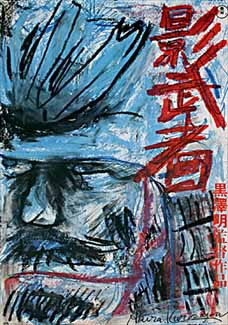
CONSENSUS #60. Kagemusha (1980)


SYNOPSIS: Kagemusha means shadow warrior and refers to the practice of some Japanese daimyo of having doubles for security. The movie is set in the same Sengoku (Warring States) period that The Seven Samurai was set in. A shogun wannabe has a double who is a petty thief. When the daimyo (Tatsuya Nakadai, who also plays the thief) is assassinated, the kagemusha takes his place and has to deal with two lords who are at war with him.  The movie climaxes in an epic battle.

BACK-STORY: Many feel that Kagemusha is Akira Kurosawas greatest masterpiece. He certainly meant for it to be. He got the idea for a samurai epic years before but career setbacks (like being fired from Tora! Tora! Tora!) and funding issues set things back and the film almost did not get made.  It ended up being the biggest budget Japanese movie up until then.  It was nominated for the Oscar for Best Foreign Language Film (losing to “Moscow Does Not Believe in Tears”). Kurosawa won the BAFTA for Direction.  It won the Palme D’Or at the 1980 Cannes Film Festival.

TRIVIA:  Wikipedia, imdb

1.  It is an example of a genre called “jidaigeki”.  These are period films set in the Edo Period (1603-1868).  These types of movies usually concentrated on the lives of samurai, farmers, craftsmen, and merchants.  A subgenre is called “chambara” which means “sword fight”.  Movies like “Kagemusha” have similar make-up, language, catch phrases (e.g., “Fires and brawls are the flower of Edo”) and plotlines.
2.  Technically, “Kagemusha” is pre-Edo, but it certainly fits the genre.

3.  George Lucas and Francis Ford Coppola were credited as executive producers because when Toho Studios could not finish the funding for the film, they convinced 20th Century Fox to put up the rest of the money.  Lucas and Coppola were big Kurosawa fans and were blown away by his personally painted story-boards for the film.  20th Century Fox got the international distribution rights, which was the first time an American studio distributed a Japanese film.

4.  Part of the expense for the movie was Kurosawa bringing in two hundred specially trained horses from America.  Many of the horses were ridden by expert female riders.

5.  Originally Shintaro Katsu was to play the main role, but he was fired when he showed up on set with a camera crew to film Kurosawa’s methods for a film class he taught.  Kurosawa brought in Nakadai because he had worked with him many times.  Nakadai took the role without even reading the script.

6.  Kurosawa used 5,000 extras in the final battle.

7.  Much of the costumes and armor were borrowed from museums.

8.  The final battle is the Battle of Nagashino (1575).

9.  No female appears in the movie until the 73rd minute.

Belle and Blade  =  N/A
Brassey’s              =  4.0
Video Hound       =  N/A
War Movies         =  N/A
Military History  =  #34
Channel 4             =  no
Film Site                =  no
101 War Movies  =  yes
Rotten Tomatoes  =   no

CONCLUSION: Not being an American director or professional movie critic, I feel I can impartially rule that Kagemusha is overrated. I can see why they fawn over it, but as an average viewer it is too long and boring. There is way too much talking (and yelling) and not enough action. There are big buildups to the battles and then little pay-off. Even the final battle is brief. It does not belong on this list and is inferior to Seven Samurai (which did not make the list).

Tuesday, September 10, 2019

BOOK / MOVIE: Regeneration (1991 / 1997)


       Regeneration was the first in a trilogy by British author Pat Barker.  The other two novels, The Eye in the Door and The Ghost Road, continue the stories of Rivers, Prior, and Sassoon.  The trilogy is firmly in the WWI novel tradition of “war is hell!”  It deals with trauma and recovery.  What better war than the Great War for that?  Barker was inspired by the experiences of her step-grandfather who was wounded in the war and never talked about it.  The seed of the story came from her neurologist husband’s interest in psychiatrist W.H.R. Rivers.  The book’s title is a reference to Rivers’ pioneering work in nerve regeneration, but the story concentrates on his work with “shell shock” victims.  Rivers works at Craiglockhart hospital which before the war was a hydropathic (water therapy) institute.  From 1916-1919 it was turned into a psychiatric hospital and Rivers became the most famous doctor there.  Barker decided to blend actual historical figures into the fictional narrative.  Wilfred Owen and Siegfried Sassoon were famous poets whose experiences in the war inspired great poetry.  Barker used their poetry and eyewitness accounts to enhance authenticity.  I must credit Barker with making an enlightened decision to write a book that combines shell shock treatment with real life figures.  Using Sassoon’s anti-war stance as the focal point was pure brilliance.  And, although a work of fiction, the novel is amazingly accurate.

                The book opens with Sassoon’s “Finished with the War:  A Soldier’s Declaration” which was an open letter condemning the war as a war of aggression.  Rather than a messy court-martial, Sassoon’s friend Robert Graves (another poet) convinces a government board to assign him to Craiglockhart as a mental case, thus discrediting his screed.  Rivers is given the case and feels it is his duty to return Sassoon to the front.  Sassoon makes the acquaintance of Owens and becomes something of a mentor to him.  Sassoon (who was already a famous poet) gets Owens to use, instead of ignore, his war experiences to inspire his poetry.  Owen comes to realize that writing can be “like exorcism”.  Barker created the fictional character Billy Prior as an antagonist to Rivers’ talk therapy.  At first, he is suffering from mutism and amnesia, but Rivers goads him into talking again.  Prior is a difficult patient, although he does want to return to the war because it is the proper British thing to do.  He had not been at the front long enough to “join the club”.   “[British men] had been trained to identify emotional repression, as the essence of manliness.  Men who broke down, or cried, or admitted to feeling fear, were sissies, weaklings, failures.  Not men.”  In his sessions with Rivers, Prior uses Rivers’ own PTSD as leverage.  Rivers is clearly traumatized by his duty of “curing” men so they can be sent back to the reason for the cure.  Returning the damaged to be damaged.  “Rivers was aware, as a constant background to his work, of a conflict between his belief that the war must be fought to the finish, for the sake of the succeeding generations, and his horror that such events as those which had led to Burns’ breakdown should be allowed to continue.”  Prior is given a fictional girlfriend.  Sarah is a munitions worker.  “Men said they didn’t tell their women about France because they didn’t want to worry them.  But it was more than that.  He needed her ignorance to hide in.”  Some of the other patients include Burns (based on an actual patient), who cannot eat food without remembering being thrown by an explosion to land face first into a rotting corpse’s stomach.  Burns gets his own storyline, but the novel is really about Rivers/Sassoon, Sassoon/Owens, and Rivers/Prior.  The main thread being Sassoon’s arc toward the medical board that will determine whether he will return to combat.  In the end, honor trumps common sense and the survival instinct.

                The movie follows the book closely, but streamlines the plot by eliminating some scenes.  It wisely adds combat scenes to emphasize the horrors that brought on the shell shock.  (Thankfully, we don’t have to see the reason for Burns’ trauma.)  These are done in the recent visceral cinematography of war films and balance the otherwise dialogue-focused events of the hospital.  For instance, the movie opens with an aerial view of no man’s land, whereas the book opens with Sassoon’s letter.  The movie, strangely, does not give the audience the full text of the letter.  It cuts the scene where Graves explains to Rivers the Sassoon situation and gives him some of his poems.  The movie, being British, makes the assumption the audience is already familiar with Graves, Sassoon, and Owens.  This, of course, does not apply to American audiences and might explain the movies tepid reception in the States (where it bizarrely was renamed “Behind the Lines” – a double-meaning that was meaningless to most). 

                In the novel, Barker is able to flesh out the stories of Rivers, Sassoon, Owens, Prior, and Burns.  Burns is virtually left out of the movie.  The movie leads off with Owens finding Burns naked in the woods amongst dead animals.  This scene was inspired by a sequence in the novel where Burns goes off in a bus, gets off, goes in some woods, and finds a tree with dead animals hanging in it.  He then undresses, but later reclads himself and returns on his own.  In the book, Rivers approves the release of Burns when clearly he is not stable.  Rivers visits him and finds him to be on the brink of another breakdown.  Rivers reaches this brink himself and gets a job with the Royal Flying Corps before Sassoon leaves.  He returns for Sassoon’s board.  The scene with Doctor Yealland (a real historical figure) takes place after Rivers leaves Craiglockhart and is well-depicted in the movie.  The visit to Yealland is better placed in the book because it comes after Rivers has left his patients and is questioning his own methods.  The Prior/Sarah romance is given more coverage in the book.  You get more of the roller-coaster ride that a relationship with Prior would involve.   For closure, the movie throws in Sassoon being wounded when he returns to the front (which actually happened) and the corpse of Owens.  I assume Barker left this for the second book of the trilogy.

                As you would expect, reading the novel will give you more perspective on why the patients, and Rivers, behave the way they do.  You get more of their back-stories.  For instance, you find out that Prior’s breakdown came when he picked up a severed eye.  Barker makes Rivers into something of a patient himself, the movie only alludes to this.  The novel’s Rivers has more of a stammer (which was a bit of literary manipulation as he stuttered since childhood) and has nightmares.  The movie has to streamline the dialogue so the book has longer and more satisfying sessions between Rivers and his patients.  On the other hand, the screenwriters were able to trim some of the flab from the book. For example, the movie eliminates Rivers’ awkward visit with the “cured” Burns.  Unfortunately, for people hoping to learn more about the poetry of Owens and Sassoon and the process that brought it about, the movie does not have time to delve into that.  Literary history takes a back seat to the history of trauma therapy.  Mores the pity.

                In conclusion, I had a hard time choosing between the book and the movie.  But, then again, one does not have to choose.  As is my policy, I recommend watching the movie first and then reading the book.  This usually works out well for me.  In this case, the movie is very well done and faithful to the book.  The cast is excellent in embodying the characters from the book.  The screenwriter, Allan Scott, has delivered more than just a Cliff Notes version of the book.  He retains a lot of the dialogue and most of the scenes.  His deletions make cinematic sense.  If you are not into reading, the movie is certainly an acceptable way to learn the remarkable story of Rivers, et al.  I beg you to follow up the movie with some reading of the poetry of Graves, Sassoon, and Owens.  Here is Owens’ “Anthem for Dying Youth” (which Owens and Sassoon discuss in the movie and tinker with in the book): 

What passing-bells for these who die as cattle?
      — Only the monstrous anger of the guns.
      Only the stuttering rifles' rapid rattle
Can patter out their hasty orisons.
No mockeries now for them; no prayers nor bells; 
      Nor any voice of mourning save the choirs,—
The shrill, demented choirs of wailing shells;
      And bugles calling for them from sad shires.

What candles may be held to speed them all?
      Not in the hands of boys, but in their eyes
Shall shine the holy glimmers of goodbyes.
      The pallor of girls' brows shall be their pall;
Their flowers the tenderness of patient minds,
And each slow dusk a drawing-down of blinds.

Saturday, September 7, 2019

CONSENSUS #61. Tora! Tora! Tora!


SYNOPSIS:  “Tora! Tora! Tora!” is the story of the attack on Pearl Harbor told from both points of view.  It is mainly the command perspective, but it does culminate in an exciting reenactment of the attack with real aircraft.  The movie covers the months leading up to the attack, so you get both the military and political machinations.  It has a docudrama feel to it with an ensemble cast that portrays mostly historical characters.  Spoiler alert:  the Japanese win. 

BACK-STORY:    It had three directors:  Robert Fleischer (“The Vikings”), Toshia Masuda, and Kinji Fukasaku (“Under the Flag of the Rising Sun”).  It was based on books by Ladislas Farago and Gordon Prange (At Dawn We Slept).  Five B-17s, two P-40 Warhawks and a PBY Catalina were available for the production.  The Japanese Zeros, Kates, and Vals were played by modified A-6 Texans and BT-13 Valiants.  Full scale mock-ups of the battleship Nagato and the aircraft carrier Akagi were built on the shore with ninety feet extending over the water.   The movie won the Oscar for Best Special Effects and was nominated for Art Direction, Cinematography, Film Editing, and Sound.  The movie was a flop at the box office in America, but a big hit in Japan.

TRIVIA:  Wikipedia, imdb, TCM
 1.  The Japanese word “tora” means either “surprise achieved”, “attack”, or “tiger”.
 2.  Darryl F. Zanuck wanted to recreate the success of his “The Longest Day”.  He also wanted to offer a revisionist view of the attack.  Specifically, he was interested in refuting the belief that Admiral Kimmel and Gen. Short were to blame for the debacle.
3.  The movie was a joint Japanese-American production.  Akiro Kurosawa was the original Japanese director, but his style did not fit an American blockbuster and he chaffed at the suits looking over his shoulder.  The suits chaffed at his slow and costly production methods.  Some think he was so miserable with the situation that he purposely aggravated the studio into firing him.  After working on the film for two years, he was fired two weeks into filming.  Only about one minute of his work made it into the film.
4.  The casting director was told to eschew big stars so the story would be the focus. 
5.  A B-17 was forced to make a crash landing because of a jammed landing gear.  With a heads up on the situation, cameras were set up and it made it onto the screen. 
6.  At one point over 30 aircraft were in the air. 
7.  The main technical adviser was historian Gordon Prange who wrote “At Dawn We Slept” (entitled “Tora, Tora, Tora” in Japan).  He had a lot of say on the script. 
8.  The U.S. Navy allowed a lot of personnel to participate off-duty.  This caused some complaints from some Americans who still held a grudge over the attack.
9.  The film credited 224 actors – 137 Americans + 87 Japanese.

Belle and Blade  =  4.0
Brassey’s              =  4.0
Video Hound       =  3.8
War Movies         =  N/A
Military History  =  no
Channel 4             =  #39
Film Site                =  no
101 War Movies  =  yes
Rotten Tomatoes  =  no

OPINION:  I do not understand the lack of love this movie got from critics.  Yes, it is not splashy entertainment, but it is as accurate as you could expect and it is not a stale documentary.  Along with “The Longest Day”, it is the best battle movie when it comes to giving fair treatment to both sides.  It has some of the best air combat footage and this without CGI.  The fact that it was a box office flop and “Pearl Harbor” wasn’t tells you a lot about what the American public wants when it comes to historical movies.   As you can see above, it is not included in three of the five expert lists.  That is a head-scratcher.  Thankfully, it is fairly treated on this consensus list.

Monday, September 2, 2019

History Anecdotes for Teachers


          I recently started a web site entitled "History Anecdotes for Teachers".  I taught American History and Western Civilization for decades and one reason I retired was to leave a legacy.  Over the years I collected a lot of stories and trivia to make my courses more interesting.  And to give me something to look forward to each school day.  I love telling historical anecdotes and found them effective in making history less boring for my students.  Through the web site I will pass on all the stories I have accumulated over the years.  And I am still looking for new ones to add.  I have included a section on "Today in History" which has facts, trivia, and birthdays to encourage people to visit daily (or just on your birthday).  

          I know most of the people who visit this blog are not history teachers, but some of you might be history buffs or simply like interesting stories.  I would love for you to check out the site and let me know what you think.