Thursday, January 16, 2020

Catch-22 miniseries (2019)


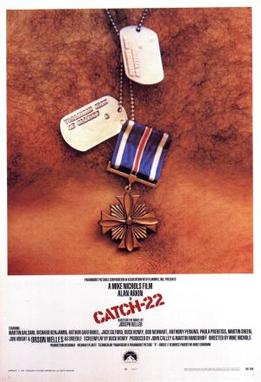
Last year I went to the WWII museum in New Orleans for a special advanced showing of Hulu’s miniseries “Catch-22”.  It was an ambitious attempt to bring the famous Joseph Heller novel to the small screen.  The 1970 film is highly respected, but the novel is massive and complicated so a two-hour movie could not really do it justice.  The miniseries is more than twice as long as the Mike Nichols’ movie.  This new version was developed and written by Luke Davies and David Michod.  They took on the difficult task of transforming the nonlinear, farcical novel that Buck Henry had ably adapted for the movie.  George Clooney got involved as an executive producer and directed two of the episodes.  He also took on a minor role.  Although a prestige production for Hulu, the rest of the cast was fairly unknown except for Kyle Chandler and Hugh Laurie in small roles.  The miniseries got good reviews, but only Emmy nods for Sound Effects and Special Visual Effects.  It was filmed in Sardinia and Italy.  The film used some authentic B-25s.

                        Davies and Michod decided to make the miniseries linear, probably as a sop to Hulu’s audience.  It opens with the main character Yossarian (Christopher Abbott) in training to be a bombardier.  He is having an affair with his commanding officer Scheisskopf’s (Clooney) wife.  He tells her that he chose the air corps because he figured that by the time his training was over, the war would be over.  So it is established early that Yoyo is a coward.  The rest of the show covers enough bombing missions to prove he would have to be very brave to handle his job without being affected by it.  Although the movie runs for 270 minutes, it basically covers two storylines.  One is Yossarian’s attempts to get sent back home and the other is the black market machinations of Milo Minderbinder (Daniel David Stewart).  There are ten missions spread out through the narrative and one montage.  Interspersed with these are some scenes that develop some of the other characters.  Col. Cathcart (Chandler) is a martinet who is constantly upping the number of missions necessary for ending your tour.  It starts at 25, but will go up throughout the miniseries.  Major Major (Lewis Pullman) is a mousy incompetent who is appointed squadron leader.  Maj. – de Coverley (Laurie) is in charge of renting rooms when new cities are occupied.

                        The writers had some options when they took on Heller’s book.  Buck Henry decided to do a greatest hits wrapped around the Yossarian / Minderbinder threads.  Snowden’s death was his nonlinear device to explain Yosarrian’s breakdown.  Davies and Michod could have simply replicated that with their own take on the characters and added more scenes and characters from the book.  They could have amped up the black humor and silliness of the novel.  Instead, they decided to play it relatively straight and concentrate on Yossarian’s efforts to get to the mission goal.  There is little added from the book and some scenes were not in the book or movie.  This was a poor decision because the movie is not so well known or recent that Hulu’s viewers would have wanted a different approach.  And then you have the fans that did not want the novel tampered with.  With 270 minutes, the logical approach would have been to cover more of the book and allow the actors to give their own takes on the books’ characters.

                           Surprisingly, the best thing about the series is the missions.  The B-25 interiors are authentic.  The CGI flak is intense.  The sound effects match.  You can see and feel why Yoyo is worried about his life expectancy.  At one point, a fellow bombardier gets splattered on his windscreen.  The problem here is the experiences do not match Yossarian’s reactions.  His is not a consistent descent into PTSD.  He remains dedicated to his bombing with some exceptions.  Bizarrely, after doing his best to avoid missions, Yoyo changes strategy and does multiple missions to reach 50 (the montage).  He is dedicated on all of them and gets off each bomber with a smile on his face.  (Unlike the Yossarian of the book, he does not care which pilots he flies with.)  By the way, even though he is freelancing, he is always the lead bombardier.  The key mission where Yoyo decides to go around a second time to bomb a bridge is placed too late to make sense.  Even more perplexing, the death of Snowden is in the last episode!  It is not used to explain why Yossarian is so motivated to get out of combat.  Instead, it is treated as a breaking point that leads to Yossarian adopting a no clothes policy.  Here is one example of the series going beyond the movie/book, but this does not happen enough to become a characteristic of the show.  The writers were too tame in this respect.

                        The critics have been kind to the series, although the Emmys were not impressed.  However, if you have seen the movie and/or read the book (which I have, twice), this miniseries is a severe disappointment.  The movie’s characters channeled the book’s well and the cast was outstanding.  This ensemble is definitely second-rate, but the script gives them no opportunity to make their characters interesting.  It was a poor decision to cast actors that mostly look alike.  And, in spite of the expanded length, the other air crewmen like Nately, Orr, Arfy, McWatt, etc. are short-changed.  Hell, we don’t even get Gen. Dreedle.  Clooney’s Scheisskopf is substituted as a mustache twirling villain.  Only Minderbinder makes an impression and only Daniel David Stewart is in a league with his cinematic equivalent (Jon Voight).  The series adds two Italian lackeys for Milo and forgoes many of the unseen characters from the book, like Hungry Joe.  Across the board, the characters are boring in comparison to the book/movie.  It is infuriating for fans to see the Chaplain depicted as a typical chaplain!   Nately’s whore likes him!  Did the writers even read the book?  Christopher Abbott is adequate as Yossarian, but his performance lacks nuance.  Yoyo is unlikeable and much more of a straight coward than Alan Arkin’s portrayal.

                        This series needed to be as black, if not blacker, than the movie/book.  There is little humor in the series.  In a telling moment, Yossarian’s scrotum surgery (not in the book) forces him to wear silly pants.  It was  too late to shift to farcical.  Why would you add a scene where Yoyo spends some time in an Italian village and skip some of the iconic scenes? You had 270 minutes!  There is no briefing with Dreedle’s WAC being the focus.  Milo does not have a cotton problem.  There is no Luciana.  Arfy does not visit Yoyo during a mission.  The key scenes that are reenacted are all inferior to the movie.  For example, Kid Sampson’s death is played for shock value and makes no reference to Doc being on board McWatt’s plane. 

                        I do not understand the critics who have complimented the miniseries.  To me, it is a big disappointment.  The decision to disregard the tone of the book and not simply expand on what the movie covered is head-scratching.  To take beloved characters and remove their quirks is inexcusable.  The changes that were made to the story dilute the satire.   There’s no verve.  Next time, use “MASH” as the template.

GRADE  =  D


Friday, January 10, 2020

NOW PLAYING: 1917 (2019)


                        Well, it finally arrived in town.  Was it worth the wait?  “1917” has been on war movie fans’ radar for some time now.  You’ve probably seen the commercials and already know the basic plot.  Two British soldiers must deliver a message halting an attack that will be walking into an ambush.  The idea came from a story director Sam Mendes’ grandfather told him.  Mendes went on to co-write the story with Krysty Wilson-Cairns.  This is Mendes’ second war film after “Jarhead” in 2005.  He shouldn’t wait so long for his next one.  “1917” recently won the Golden Globe for Best Drama.  He won for Best Director.  He owes a lot to his cinematographer Roger Deakins.  This was their fourth collaboration.  Deakins is one of the premier cinematographers and this may be his masterpiece.  He won the Best Cinematography Oscar for “Bladerunner 2049” and has won four BAFTAs and 14 Oscar nominations.  In 2011, the American Society of Cinematographers presented him a Lifetime Achievement Award.  He is the surest of bets at the upcoming Academy Awards.

                        The film opens on April 6, 1917. (I am not sure if it is a coincidence that that is the day the U.S. declared war.)  We meet mates Blake (Dean-Charles Chapman) and Schofield (George MacKay) as they walk and talk their way to headquarters.  Thus begins the soon to be legendary continuous shot that will take us through the movie.  The general needs the duo to halt an attack scheduled for the next morning.  The Germans have withdrawn from their front-line trenches and the British plan to take advantage of this.  Unfortunately, intelligence discovers that it’s a trap and two battalions of 1,600 men will be slaughtered if the attack takes place.  Blake and Schofield will have to make a trek through no man’s land to deliver the message.  As an incentive, Blake’s brother is in the doomed battalion.  At this point, the viewer needs to treat the movie like an odyssey.  Think Odysseus with his adventures.  None of that could have really happened, right?  Same with this movie.  They cross a no man’s land that checks all the boxes for the mise-en-scene -  dead horses (with flies, nice touch), dead body on the wire, rats eating dead bodies, destroyed tank, etc.  You do not want to see this movie in smell-o-vision.  Or right after eating.  The odyssey includes stops in the deserted German front-line trench for a haunted house vibe, a deserted farmhouse for an encounter with a German fighter pilot (the only CGI), crossing a bridge under sniper fire, a chase scene in a German occupied village, and riding some rapids.  There’s even a siren’s song by a British soldier (“Poor Wayfaring Stranger”).  Only one of the buddies will make it.  This needs no spoiler alert if you have seen the trailers or the first ten minutes of the movie.

                        “1917” is a movie that can be nitpicked.  The sniper angles don’t match his position, for instance.  As in most episodic war movies, no one person could have had all these experiences.  Mendes is up front about his grandfather’s reminiscences being enhanced and the movie does not start with a claim that it is based on a true story, so you will enjoy it more if you just go with the flow (like Schofield in the river).  Try not to imagine what the front lines must look like to set up the scenario, you’ll get a headache.  The central premise is flawed as Operation Alberich (February-March, 1917) was a planned withdrawal to the Hindenburg Line, but did not involve a feint to draw Allied forces into an ambush.  Plus, the British advanced cautiously, and not beyond the vacated front-line trenches.  While it is likely none of the incidents happened as portrayed, none of them is unbelievable.  It’s easy to overlook the implausibilities if you have an eye for brilliant cinematography.  It is mesmerizing.  But not in an overly showy way.  Some viewers, who don’t read up on movies before seeing them, may not even notice the continuous take.  It is so seamless.  Note the transitions from the camera following to camera leading the duo.  Non-cinephiles will probably remember the realistic sets and gruesome details of trench warfare.  The set designer deserves a lot of credit.  For the continuous take, it was necessary to have an extensive trench system.  Imagine “Paths of Glory” multiplied by ten.  No movie has depicted the trenches more accurately.  This includes the German trenches, which are shown accurately as superior to the British ones.  You will also see the most realistic no man’s land on film.

                        Nothing can match the technical virtuosity of the movie.  The plot is molded to the perspective of just two men, and then one.  This limits the narrative.  It also limits informing the audience about soldier life and behavior.  There is a soldier banter scene in the back of the truck, but the movie is much stronger on the visuals of the war than on the men.  There is some exposition between the leads and some cursory character development.  We do know that Schofield is a decorated veteran of the Somme who regrets a trip home.  He is the cautious one whereas Blake has the motivation of saving his brother.  The actors are fine, if unspectacular in these roles.  There are some showy cameos by the likes of Colin Firth and Benedict Cumberbatch.  Mark Strong makes the best impression as a captain that Schofield runs into.  In the movie’s most insightful exchange, he tells Schofield to make sure there is an eyewitness to his delivering the order because some officers just want to fight.  Other than this spot on take on command decisions in the Great War, the movie is not a typical WWI hate fest on the donkeys leading the lions.  This is not the Iliad, it’s the Odyssey, after all.

                        2019 was not a good year for war movies.  The best was probably “Danger Close” which was an excellent battle movie.  “1917” is a much more personal take on war and is more of a trek movie than a combat film.  It is superior to the last significant WWI film -  2011’s “War Horse”.  While not in the top five WWI movies, “1917” is a worthy entry into a subgenre that has a high percentage of quality.  There is a much higher percentage of good WWI combat movies than the WWII equivalents.  Probably because the war itself lends itself to a purer anti-war feeling.  “1917” will not be remembered as a great anti-war film, but it is entertaining and more a tribute to the soldiers than any recent WWI movies.  You can’t help but be moved as the fodder listens to that haunting song before going over the top.  It will certainly get Academy Award recognition and is better than “Dunkirk” as Mendes substituted dazzling cinematography for Nolan’s tri-perspective, nonlinear approach.  Two directors at the top of their game.  Put me in the Mendes corner.

GRADE  =  A


Saturday, January 4, 2020

SHORT: Cat Shit One (2010)


                        “Cat Shit One” is a war short.  It is animated using CGI.  The film is based on a manga comic set in the Vietnam War.  There it followed a recon unit.  For some reason, the film has been moved to Afghanistan.  It is a sequel to the comics.  The main characters are Packy and Botasky.  They are private contractors.  (I had to read this because it is unclear in the film.)  Their mission is to rescue a hostage and a local asset from the clutches of some jihadis.

                        The film opens with Packy and Botasky observing a village where the jihadis are holding the hostage and collaborator.  Botasky is a sniper and Packy is his observer.  But he’s more than just an observer, he’s a killing machine.  He’s a rabbit Rambo without all the emotional baggage.  This bunny is a cool customer.  That’s right, he and Botarsky are bunnies.  The jihadis are camels (with towels on their heads).  Packy goes into the ville and Botarsky does his thing from a hill.

                        This is a fun little movie.  It’s combat porn with rabbits and camels.  There is a high body count and the violence is graphic.  Blood spurts.  There are RPGs for explosions.  But it’s bunnies doing it so you can watch this with your kids (or grandkids).  Just kidding, don’t do that.  The plot plays out like a SEAL movie done in animation.  And what animation.  It is amazingly crisp.  You see the tiniest details in the terrain.  The rabbits have distinct facial expressions.  When they talk, it’s not distracting.  And there are no poorly rendered humans.  The action is non-stop.  RPG rounds come flying at you and there is slo-mo of the shells ejecting ilk.  It’s a thrill ride for 21 minutes.  This does not leave a lot of time for exposition.  But the two rabbits have personalities.  Packy is a veteran and imperturbable.  He moves like an operative would.  (All of the characters are bipedal.)  Packy uses an SR-47 (an AR-15 adapted to take AK-47 magazines).  Botasky is greener and a bit panicky at first.  This sets up his redemption arc. 

                        The movie is one action set piece.  The jihadis are simply there to be killed.  One nice touch is they speak their own language and there are no subtitles.  Not that you need to know what they are saying.  I’m guessing it is some variation of:  “Death to American bunnies!”   The soundtrack is a blend of pulse-pounding action music and there is some Middle Eastern thrown in.  Overall, the production is outstanding.  The only thing that is disappointing is if it is one of a kind.  It was released in 2010 and there has been no sequel.  Pity.

You can watch it here:  Cat Shit One

GRADE =  A


Thursday, January 2, 2020

PICTURE, QUOTE, MOVIE #75


1.  What movie is the picture from?

2.  What movie is this quote from?

"Sir, Custer was a p-ssy. You ain't." 


3.  What movie is this?


It was released in 1980 and was the first of three films made in Australia that marked the arrival of Australian cinema as a force in war movies.  The other two films were “Gallipolli” (1981) and “The Lighthorsemen” (1987).  The film was directed by Bruce Beresford, has an all-Australian cast, and was shot in Australia.  It is based on the play by the same name.  It was a box office success in America and was nominated for an Oscar for Best Adapted Screenplay.