Monday, October 11, 2021

“Kelly’s Heroes” DEEP DIVE


1.  The movie was made in Yugoslavia because of its plethora of WWII era military equipment (and parts of the country still looked like they did when they were rubbleized in the war).  Tito’s army provided a bunch of Sherman M4A3(75)Ws.  The three Tigers were converted T-34s that had been used in the movie “The Battle of Neretva”.  There are 230 Yugo soldiers in the scene where Kelly goes to see Crapgame for the first time.  That’s a Yugo SOKO 522 trainer standing in for an T-6 Texan standing in for a P-47 Thunderbolt. 

2.  Eastwood was attracted to the anti-war vibe of the script and was distressed with the final product.  He blamed it on the studio’s cuts, but director Hutton viewed the movie as a comedy from the start.  Eastwood was particularly upset with the cutting of a scene where Kelly and Big Joe discuss the incident that got Kelly demoted for refusing to order a suicide attack.  The scene included discussion of the nature of the war and was the only scene where Eastwood got to act showily.

3.  The screenwriter, Troy Kennedy Martin, was also angry with the decision to up the funny and decrease the pacifism.  He wanted a scene where the platoon boards a train that holds Jewish prisoners and they have to choose between gold and humanity.  I have to go with the studio on this one.  (By the way, “Three Kings” fulfilled Martin’s vision on this.)  Martin also was perturbed with the mine field scene because he wanted the Germans to be elderly home guard types who were sympathetic toward the men caught in the field, but still were blown away.  Again, that’s a head-scratcher. 

4.  The movie was originally to be titled “The Warriors” and then “Kelly’s Warriors”.

5.  In an interview Eastwood claimed the movie was not particularly violent.  Moviebodycounts.com puts the death total at 139 which is relatively low in comparison to all the violent movies since (it’s only #35 on the list), but still above my favorite blood bath “Where Eagles Dare”.  Eastwood specifically referenced “The Wild Bunch” and “The Dirty Dozen” (which he called “sadistic”). 

6.  There is no Movieexplosions.com so who knows how many explosions there are in the movie, but there are a lot.  Courtesy of the great Karli Baumgartner who was appropriately nicknamed “Boom Boom”.

7.  Sutherland was out for five weeks with a life-threatening case of spinal meningitis.  He came back early and the mental effects of the disease may have influenced his performance.  I mean beyond the recreational drugs.  During filming, Eastwood brought him the news that his wife Shirley Douglas (Kiefer’s mom) had been arrested for trying to buy hand grenades for the Black Panthers from an undercover FBI undercover agent.  With a personal check, as Eastwood pointed out as he rolled on the floor. 

8.  Ingrid Pitts from “Where Eagles Dare” was scheduled to be the only female character, but she was cut from the film right before she boarded an airplane for Yugoslavia.

9.  The bizarre “Burning Bridges” by the Mike Curb Congregation reached #34 on the Billboard hit list.  It made it to #1 in Australia.  Hank Williams Junior’s “All for the Love of Sunshine” (anachronistically used in the railway station slaughter scene) reached the top of the country music charts the year it was released – 1970.  Speaking of music, the music for the negotiation with the German tank commander was an homage to Ennio Morricone of spaghetti western fame.  Note the jangling spurs.  The music that builds to the assault on Claremont was reused in “Inglourious Basterds”.

10.  Mulligan (what a great name for an inaccurate artilleryman) was played by Telly Savalas’ brother.

11.  Here are the significant deleted scenes (besides the Kelly/Big Joe discussion mentioned above):

                -   after a night with local girls, Odd Ball and crew pack up to leave

                -  after the mine field incident, the men refuse to go on and Gutkowski pulls a gun on Kelly, but Big Joe and Crapgame support Kelly and cool the men down

                -  the platoon encounter a group of German soldiers skinny-dipping with some girls (if the movie had added boobs to explosions it would probably have finished above #24 at the box office)

                -  Gen. Colt is in bed with some women when he is told a unit had broken through

                -  when the truck full of gold drives off into the sunset, some GIs yell “hey, you’re going the wrong way” 

Saturday, October 9, 2021

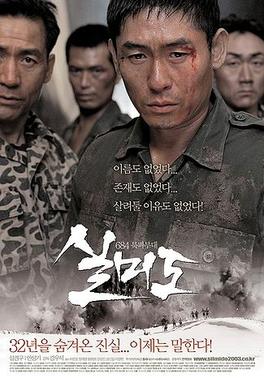
Silmido (2003)


            “Silmido” is a South Korean war movie about the legendary Unit 684.  The movie was directed by Kang Woo-suk.  It was based on the novel by Baek Dong-ho.  It had to be a novel because the true story of the mutiny was held from the public by the government.  The movie was popular and became the first South Korean film to top 10 million viewers.  Its record held until broken the next year by “Taegukgi”.  It won Grand Bell Awards (the South Korean equivalent of the Oscars) for Best Supporting Actor (Heo Joon-ho) and Adapted Screenplay.  It was nominated for Best Film and Director.  As a result of the film, the government released an official report of the uprising. 

            The movie opens with an attempted assassination of South Korean President Park by a black ops unit from North Korea called Unit 124.  Dressed in South Korean uniforms, the unit infiltrated and came close to killing the President.  As a result, a group of hardened criminals are recruited for a retaliatory assassination of Kim Il-sung.  It’s a Dirty Dozen scenario, but with 31 convicts.  They are told they are going on a mission to unify Korea.  They are taken to the isolated island of Silmido for training.  It is interesting to contrast their training to that of the Dirty Dozen.  It includes physical abuse.  They are branded.  They have barbed wire cage matches.  They have to hold their breaths under water with machine guns firing above.  The group has three leaders.  Two butt heads in typical cinematic fashion and the other is an older gangster who moderates.  With little description of the plan, the unit is finally ready to head for North Korea, with no Reisman to lead them.  The mission is aborted and they are returned for more harsh training.  Morale is low and they are ready to snap.  Mutiny is in the air.

            The movie starts off a bit confusing.  I guess because North Koreans and South Koreans look alike to me.  It is unclear that we are watching a North Korean attempt on the life of President Park.  After that, it is easier to follow because of the Dirty Dozen style plot.  Unlike that movie, this one throws in some political machinations.  As usual, the politicians are slimy and using these men.  Other than the three leaders of the convicts, the other men are not developed, but then neither were about half of the Dirty Dozen.  Some of the men are at least recognizable.  There is no comic relief character.  This is a humorless movie.  There are no female characters.

              The training takes up about half the movie and it is pretty brutal.  There is no DI, but there is a Reisman who has some empathy for his trainees.  You will feel empathy too and understand the reasons for their mutiny.  However, it is also clear that the government’s response was appropriate.  That doesn’t mean the politicians get the slime washed off them.  The coverage of the mutiny seemingly crosses the boundary into fantasy, but my subsequent research (see below) shows that the movie is close to what apparently happened.  Although clearly enhanced.  What isn’t enhanced is the action.  Although only one year earlier than “Tae Guk Gi”, the combat is not bonkers.  

         
            “Silmido” is not a first tier Korean war movie, but it accomplishes its mission well.  I would think many Koreans wondered what happened with Unit 684.  The government imposed mist surrounding this traumatic incident was ripe for examining.  The movie forced the government to lift the coverup.  Surprisingly, the movie was pretty close to what the official report admitted to. In that respect, “Silmido” is more than just a movie.  It made history.
 

GRADE  =  B 

HISTORICAL ACCURACY:  The movie opens with a reenactment of the Blue House Raid.  North Korea’s Unit 124 came close to assassinating President Park.  31 soldiers were trained and crossed the DMZ, but were discovered by four farmers.  Incredibly, they did let them off with a stern warning instead of silencing them.  The farmers informed the police, resulting in a manhunt.  The unit decided to proceed with the mission disguised as South Korean soldiers.  They managed to get to within a couple hundred yards of Park’s residence (the Blue House).  A police checkpoint stopped the attempt.  The subsequent escape attempts resulted in the deaths of all but two.  One was capture and one managed to get back over the DMZ.  Four Americans died in the chase.

            Naturally, Park decided to retaliate.  Petty criminals and unemployed youth (not death row convicts) were recruited and promised money and good jobs.  I don’t know if it was planned, but there were 31 at the start.  The South Korean CIA was in charge.  The training was on Silmido Island.  The training was so brutal that 7 were killed (above the one killed in the movie).  After three years of brutal treatment, the mission to assassinate Kim Il-sung was cancelled because relations between the two Koreas were improving.  Due to this letdown and the probably justified belief that they would never be allowed to leave the island, a mutiny broke out.  All but 6 guards were killed.  Apparently, they did manage to hijack a bus.  The bus eventually met heavy opposition and all but four of the mutineers were either killed by bullets or committed suicide with grenades.  The four survivors were given military trials and executed.  In 2010, the government was forced to pay millions in damages to the families because the men had not been told of the dangers of the training and the harshness of the treatment. 


Thursday, October 7, 2021

The Kill Team (2019)


            In 2014, Dan Krauss directed a documentary entitled “The Kill Team” about a war crime in Iraq.  He followed this up with two Oscar-nominated documentaries.  In 2019, he converted his documentary into a feature film of the same title.  He wrote the screenplay and directed it.  For some reason, he changed the names of the soldiers in the documentary.  Adam Winfield becomes Andy Briggman.  

            Andy Briggman (Nat Wolff) is gung-ho about joining the Army.  His father is proud of him.  Andy can’t wait to see the elephant and that won’t take long as he is sent to the Kandahar Valley in Afghanistan in 2007.  His sergeant is big on winning “hearts and minds”, but the men are not.  His quest to win over the Afghanis ends with a bang as he steps on an IED.  Very subtle.  He is replaced by Sgt. Deeks (Alexander Skarsgard) who is his exact opposite.  He has tons of charisma and is just the sort of leader that the men want.  He promises them payback for IED’s .  Deeks brings out their inner warriors and teaches them the tricks of the trade.  Those tricks involve getting away with murder.  Deeks is an expert in planting weapons and establishing plausibility for killing villagers.  Briggman is one of the few in his platoon who is not on board.  The other grunts are either Deeks wannabes or victims of peer pressure.  Briggman has to decide whether to stick to his principles or to be a team player.  The first route will subject him to platoon justice and the second might subject him to military justice.

            I know most people would prefer to watch a feature film instead of a documentary.  With the recent boom in streaming services like Netflix, there has been a significant rise in viewing of documentaries.  We are living in a golden age of documentaries, both making of and viewing of.  This trend has included the war genre.  I have a queue of good military documentaries to watch.  I have already seen the documentary that this movie was hatched from.  It is excellent and really did not need the drama treatment.  I fear that Dan Krauss felt his documentary did not reach a big enough audience, so a conventional film would bring his story to a mass audience.  Unfortunately, the fictionalized interpretation of the case does not improve on the documentary.

            The movie should have been able to delve more into the story than a documentary that relied on interviews to tell the tale.  Actors acting out the events of the interviews should have been more entertaining and impactful. The cast is not strong, with the exception of Skarsgard.  He was a great choice to play the amoral Deeks.  He has the requisite charisma to play a man who was able to wrap a platoon around his little trigger finger.  Deeks is at times fatherly toward Briggman and at other times menacing.  The empathetic moments don’t ring true.  The movie is weak on motivation.  It does not dig deep into what caused the soldiers to behave as murderers and/or abettors.  The question that is not answered is why did they do it?  But we are left with the question of what would you do?  Peer pressure is a bitch.

            I doubt the Pentagon cooperated in the production.  The movie gives the impression that most of our boys in Afghanistan smoked hash and enjoyed killing.  To get a more accurate view of our troops, I would recommend watching “Restrepo”.  To get a more accurate view of the actual case, clearly you need to watch “The Kill Team” documentary. 


GRADE  =  C