Tuesday, July 9, 2024

CLASSIC OR ANTIQUE? A Farewell to Arms (1932)


           I’m looking through my DVR queue and I notice I’ve had “A Farewell to Arms” on it for over a year.  But I have a sneaking suspicion that I had seen this movie and would not have wanted to see it again.  Sure enough, I had watched it in 1916 and had not bothered to write a review.  Perhaps I had postponed the review until I had read the book, but that is not going to happen.  I’m not a big Hemingway fan, ever since being forced to read The Old Man and the Sea in high school.  So, let’s just get this out of the way. 

                        A Farewell to Arms was the first movie adapted from an Ernest Hemingway novel.  He was paid $24,000.  The story was based on his experiences in the Italian Campaign in WWI. (To see a movie purporting to depict those experiences, you can watch “In Love and War”.)  The movie was directed by Frank Borrage (“Flight Command”) and was one of his over 100 films going back to the silent days.  It was nominated for Best Picture and Art Direction and won for Cinematography and Sound.  It was #3 at the box office in 1932.  Even though it was released pre-Hays Code, it still underwent censorship, especially in reference to a childbirth scene.  References to labor pains, gas, groaning, and hemorrhaging were cut.  In 1938 when it was re-released, an additional 12 minutes were cut because of the Code.  The movie was offered to theater owners in two versions – one with a happy ending.  Hemingway hated both as he felt the movie was overly sentimental.  He did however become close friends with Gary Cooper a few years later.  They never discussed the film.

                        Lt. Frederic Henry (Cooper) is an American ambulance driver in Italy.  He meets a British nurse named Catherine (Helen Hayes) at a hospital.  Their relationship gets off to a rocky start with her slapping him, but within five minutes their lips are locked and then he is telling her he loves her.  So much for courting.  So much for conflict, right?  But wait… Frederic’s friend Doctor Rinaldi (Adolphe Menjou) has been working Fergie and is a bit put upon by these developments.  So is nurse Fergie (Mary Phillips) who is the ugly friend who hates Catherine’s choice.  She threatens to kill Frederic if he gets Catherine pregnant.  Rinaldi does his best to keep the lovers apart.  He sends Frederic off to the front where he gets wounded, but guess who his nurse ends up being?  “ guess who ends up pregnant?

                        “A Farewell to Arms” is standard romance, set in a war.  It was quite the chick flick for flappers and their beaus.  To wake those beaus up, there is a war montage towards the end as Frederic goes AWOL to get back to Catherine.  He sees wounded and refugees and it builds to a crescendo of strafing and bombing.  War is hell!  And romance in war can be sorrowful.  I hope they sold tissues at the concession stand.  This movie is definitely a tearjerker.  Unless you got the happy ending.  To know which, just watch the eyes of the patrons coming out from the earlier showing.

                        As far as fidelity to the book, I’ve already mentioned Hemingway was not thrilled.  Not surprisingly, the romance evolves more slowly and thus more naturally than in the movie.  The rushed nature of the movie’s romance would be more acceptable if running time was being saved for the war scenes.  In the novel, Frederic gets caught up in the chaotic retreat from the Battle of Capporetto.  The book is more of a war novel than the movie is a war movie.  He kills an insubordinate sergeant, is arrested, and has to escape to get back to Catherine.  They spend time together before the climactic childbirth scene.  

                        The fact that this movie was nominated for Best Picture gives you an idea of what passed for great entertainment back in the day.  Hemingway was ahead of his time in considering it overly sentimental.  The fact that censors considered it on the cutting edge of morality is so quaint.  Those restored twelve minutes would not have gotten it on Cinemax After Hours, believe me.  Without them, the movie is positively Victorian.  The romance feels rushed, especially the ludicrous first kiss scene.  There is a scheming third leg and a protective gal pal to roil the melodrama, but it basically is the story of star-crossed lovers with a war in the way.  Cooper and Hayes are fine, as was to be expected.  But the romance does not ring true and the dialogue is banal.  There is some showy cinematography, which resulted in the Oscar, but the special effects are fake looking.  I know it’s 1930’s technology, but I am reviewing it from the perspective of whether it is good viewing for today.  In that context, the answer would have to be no.  Unfortunately, although I have not seen them, the 1957 (Rock Hudson/Jennifer Jones) movie and the 1966 (George Hamilton/Vanessa Redgrave) BBC version are not held in high esteem, so more modern is not always better.

                        I suppose if you don’t want to read the book, but want to be able to say you did, this movie will do the trick.  You also could watch it with your girlfriend or wife if she likes a good old-fashioned romance that will clear her tear ducts.  Be careful, she may be crying because you’re not Gary Cooper.

GRADE  =  C-

Saturday, July 6, 2024

Slaughterhouse Five (1972)


            I had not considered “Slaughterhouse Five” to be a war movie until I recently saw a list of the greatest war movies and it appeared on it.  Even though this was the first time I saw it on one of the many lists of greatest war movies, I decided I needed to review it.  The movie was directed by George Roy Hill (“The Great Waldo Pepper”).  It is based on Kurt Vonnegut’s classic novel.  Stephen Geller gets credit for bringing the novel to the screen.  Vonnegut was very complimentary about the film.  It won the Jury Prize at Cannes and won the Hugo Award for Best Dramatic Presentation and the Saturn Award for Best Science Fiction Film.  The character Howard Campbell, Jr. appears in the film and later was the main character in the movie “Mother Night” which is also based on a Vonnegut novel.

            The movie opens with Billy Pilgrim (Michael Sacks) writing a letter to a newspaper claiming that he is “unstuck in time”.  This means he jumps through time, but has no control of it. He is an optometrist in New York, but sometimes he is a prisoner of war in WWII and other times he is an abductee on the planet Tralfamadore.  The narrative is nonlinear.  In the present time, he is in a dysfunctional marriage and has a troublesome son.  He occasionally jumps to WWII where he is taken captive during the Battle of the Bulge.  He is part of a threesome that includes an asshole named Lazzaro (Ron Liebman) and the saintly Derby (Eugene Roche).  They are taken to a slaughterhouse named Slaughterhouse Five in the city of Dresden.  If that name conjures up tragedy, you’ll know that even though they have been told the city is peaceful, that won’t last.  They are there for the terrible fire-bombing of the city.  In the future, Billy is living in a human aquarium with a film starlet named Montana (Valerie Perrine).  The Tralfamadorians want them to breed and they want to watch.

            First, is it a war movie?  Clearly, it fits best in the sci-fi genre, but the WWII scenes allow one to argue it is also a war movie.  I personally would not put it in the genre.  Second, is it a good movie?  Although Vonnegut was happy with it, I was not impressed.  It is a weird film and veers between drama and comedy.  The comedy is highlighted by the slapstick demolition derby death of Pilgrim’s wife.  The film jumps the shark with this scene.  It does not recover its footing.

            Viewed as a war movie, one of the three threads is worthy of the genre.  Unfortunately, the Dresden scenes do not overcome the other two threads.  The destruction of Dresden features a good set showing the ruins of the city.  However, since Billy and the other prisoners are sheltered, we don’t get the full effect of what it must have been like for the civilians.  We do get an appropriately rubbly set.  Which contrasts with the sterile set on the planet.  The Dresden scenes are by far the most intriguing of the three.

            I have not read the book, so I can not comment on how faithful the movie is.  Based on Vonnegut’s reaction, it is worthy rendition.  Since this review is not a comparison to the book, let me just comment about how good a movie it is.  It is certainly a weird film.  The nonlinear structure makes it more memorable than it deserves.  Like Billy’s life, it jerks you to another time with no warning.  This can be jarring.  And it can be frustrating when we leave Dresden for one of the boring scenarios. 

The movie is hurt by the cast.  For such a famous book, the cast is distinctly unimpressive.  Sacks made his debut and it shows. But he is not the only wooden actor in the film.  I theorize that Valerie Perrine was cast for her breasts.  It was her screen debut and she showed what she is most known for.  They are not worth sitting through the movie.  Ron Leibman was on his third movie.  His Lazzaro is a grating character and he brings down the Dresden segments.

I know some of you will be upset that I was not impressed with the movie.  It was acclaimed, but as a science-fiction movie, not as a war movie.  I do like sci-fi and I like war movies that are different from the run of the mill.  However, I found “Slaughterhouse Five” to be overrated.  From what I researched, it does appear to be faithful to the book.  Not surprisingly, it does not have all the characters or incidents.  If you have to write a book report and don’t want to read the novel, the movie will probably get you a passing grade.

GRADE  =  C

Wednesday, July 3, 2024

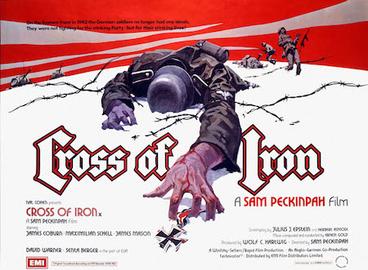
Facts About “Cross of Iron”


The following come from Stephen Prince’s commentary on the DVD.  He wrote “Savage Cinema:  Sam Peckinpah and the Rise of Ultraviolent Movies”.

The opening song is about a boy who leaves home and is so transformed by his travels that only his mother recognizes him when he returns.

Screenwriters James Hamilton (Korea) and Walter Kelley (WWII – Pacific) were both combat veterans.

In the book, Steiner is 25 years old.  Coburn was almost 50.

There is no Russian boy in the novel.  His harmonica playing is meant to reawaken innocence in the platoon.

Kiesel is more calm and focused in the novel.  He avoids alcohol.  In the movie, his alcoholism is Peckinpah’s nod to his own alcohol problems.  He directed the movie while mostly drunk (and on cocaine).

When Kiesel makes his toast:  “To the heroic horses’ asses”, Brandt mutters:  “To the patient flesh” which is a reference to the title of the novel.

Peckinpah was very opposed to the mistreatment of civilians in war.  He was a vocal critic of the handling of the My Lai Massacre.  However, he does not really make this a theme in the movie.  However, the are veiled references to Zoll being not only in the SS, but in an einsatzgruppen.  (In the book, Zoll is a jerk, but not in the SS.)  This may be confirmed later when Steiner leaves Zoll with the vengeance minded female soldiers and tells them “Now we are even”.  That might have been Peckinpah referring to the massacre of civilians by German death squads.

Steiner is clearly a stand-in for Peckinpah.  His attitude towards officers reflects Peckinpah’s troubled relations with studio suits and producers.

The book Steiner has a more tense relationship with his men.  He is not as fatherly.

The montage of death that is the first battle is a cribbing from Peckinpah’s opus “The Wild Bunch”.  In fact, there are a lot of reflections of that film, almost like Peckinpah’s stealing from himself.  This montage suddenly shifts into a montage of past and present events as Steiner is wounded.

In the novel, the convalescing Steiner has relations with three nurses and falls in love with one.  One of the others frames Steiner for stealing a watch which gets him assigned to a punishment battalion.

When Eva (Senta Berger playing a role similar to hers in “Major Dundee”) tells Steiner he was too violent when the German general visits the hospital, Steiner laughs.  This is Peckinpah laughing at critics of his violent movies.

In the book, Steiner does not want to return to the front, but Peckinpah decides to stick with the bros before hos cliché.  Or war before hos.

The Iron Cross that Steiner wears is the Iron Cross First Class. Normally, it would require your already receiving the Iron Cross Second Class plus 3-5 additional acts of valor.  And yet, Stransky expects to get one for just his supposed actions in the first battle.

When Steiner finds Kruger sitting alone in the bunker after the bombardment, it is an uncut minute and a half.  Something very rare in a Peckinpah movie.

The producer promised 15 Soviet tanks, but only got 3.  They are Yugoslavian T34/85’s.  It is very common for these to be used in war movies to depict the earlier T-34’s.

In the movie, Kiesel tells Brandt that when the war ends, they will prepare for the next one.  In the novel, he says they will start life over again.

The Germans actually despised Russian female soldiers and usually dealt with them harshly.

Dietz is not killed by one of the females in the book.  In the novel, Zoll is the only one on guard.  When he abandons this job to go rape the woman, a German male escapes.  That is why Steiner turns him over to the women.  Zoll was not castrated.

In the novel, Brandt sends Kiesel home to balance having to transfer Stransky back to France.

The return of the survivors of the platoon through no man’s land was actually the opening scene in the book.  In the book, the men killed in the movie scene are actually killed off individually.  For instance, Schnurrbart is killed by Treibig on orders from Stransky.  For this, Steiner ambushes Stransky but can’t bring himself to kill him because Stransky has his orderly with him.  It’s after this that Stransky gets his transfer.

The slow-motion killing of Triebig is similar to the killing of the general in “The Wild Bunch”.  Oddly, Peckinpah pulls away before Kruger stabs Triebig showing Peckinpah odd squeamishness for that kind of violence.

The ending was improvised because of money running out.  Schell was not supposed to trip on the railroad track.

In the book, Steiner is mortally wounded by a Soviet mortar shell.

In case you did not stick around for the closing credits, Peckinpah uses photos not only from WWII, but other conflicts hard on civilians, including Vietnam.  There is an excerpt from a poem by Bertoldt Brecht:  “Don’t rejoice in his defeat, you men / For though the world stood up and stopped the bastard,  /  The bitch that bore him is in hear again.”  It is from a play and refers to a gangster who is clearly modelled after Hitler.