Showing posts with label Cross of Iron. Show all posts

Wednesday, July 3, 2024

Facts About “Cross of Iron”


The following come from Stephen Prince’s commentary on the DVD.  He wrote “Savage Cinema:  Sam Peckinpah and the Rise of Ultraviolent Movies”.

The opening song is about a boy who leaves home and is so transformed by his travels that only his mother recognizes him when he returns.

Screenwriters James Hamilton (Korea) and Walter Kelley (WWII – Pacific) were both combat veterans.

In the book, Steiner is 25 years old.  Coburn was almost 50.

There is no Russian boy in the novel.  His harmonica playing is meant to reawaken innocence in the platoon.

Kiesel is more calm and focused in the novel.  He avoids alcohol.  In the movie, his alcoholism is Peckinpah’s nod to his own alcohol problems.  He directed the movie while mostly drunk (and on cocaine).

When Kiesel makes his toast:  “To the heroic horses’ asses”, Brandt mutters:  “To the patient flesh” which is a reference to the title of the novel.

Peckinpah was very opposed to the mistreatment of civilians in war.  He was a vocal critic of the handling of the My Lai Massacre.  However, he does not really make this a theme in the movie.  However, the are veiled references to Zoll being not only in the SS, but in an einsatzgruppen.  (In the book, Zoll is a jerk, but not in the SS.)  This may be confirmed later when Steiner leaves Zoll with the vengeance minded female soldiers and tells them “Now we are even”.  That might have been Peckinpah referring to the massacre of civilians by German death squads.

Steiner is clearly a stand-in for Peckinpah.  His attitude towards officers reflects Peckinpah’s troubled relations with studio suits and producers.

The book Steiner has a more tense relationship with his men.  He is not as fatherly.

The montage of death that is the first battle is a cribbing from Peckinpah’s opus “The Wild Bunch”.  In fact, there are a lot of reflections of that film, almost like Peckinpah’s stealing from himself.  This montage suddenly shifts into a montage of past and present events as Steiner is wounded.

In the novel, the convalescing Steiner has relations with three nurses and falls in love with one.  One of the others frames Steiner for stealing a watch which gets him assigned to a punishment battalion.

When Eva (Senta Berger playing a role similar to hers in “Major Dundee”) tells Steiner he was too violent when the German general visits the hospital, Steiner laughs.  This is Peckinpah laughing at critics of his violent movies.

In the book, Steiner does not want to return to the front, but Peckinpah decides to stick with the bros before hos cliché.  Or war before hos.

The Iron Cross that Steiner wears is the Iron Cross First Class. Normally, it would require your already receiving the Iron Cross Second Class plus 3-5 additional acts of valor.  And yet, Stransky expects to get one for just his supposed actions in the first battle.

When Steiner finds Kruger sitting alone in the bunker after the bombardment, it is an uncut minute and a half.  Something very rare in a Peckinpah movie.

The producer promised 15 Soviet tanks, but only got 3.  They are Yugoslavian T34/85’s.  It is very common for these to be used in war movies to depict the earlier T-34’s.

In the movie, Kiesel tells Brandt that when the war ends, they will prepare for the next one.  In the novel, he says they will start life over again.

The Germans actually despised Russian female soldiers and usually dealt with them harshly.

Dietz is not killed by one of the females in the book.  In the novel, Zoll is the only one on guard.  When he abandons this job to go rape the woman, a German male escapes.  That is why Steiner turns him over to the women.  Zoll was not castrated.

In the novel, Brandt sends Kiesel home to balance having to transfer Stransky back to France.

The return of the survivors of the platoon through no man’s land was actually the opening scene in the book.  In the book, the men killed in the movie scene are actually killed off individually.  For instance, Schnurrbart is killed by Treibig on orders from Stransky.  For this, Steiner ambushes Stransky but can’t bring himself to kill him because Stransky has his orderly with him.  It’s after this that Stransky gets his transfer.

The slow-motion killing of Triebig is similar to the killing of the general in “The Wild Bunch”.  Oddly, Peckinpah pulls away before Kruger stabs Triebig showing Peckinpah odd squeamishness for that kind of violence.

The ending was improvised because of money running out.  Schell was not supposed to trip on the railroad track.

In the book, Steiner is mortally wounded by a Soviet mortar shell.

In case you did not stick around for the closing credits, Peckinpah uses photos not only from WWII, but other conflicts hard on civilians, including Vietnam.  There is an excerpt from a poem by Bertoldt Brecht:  “Don’t rejoice in his defeat, you men / For though the world stood up and stopped the bastard,  /  The bitch that bore him is in hear again.”  It is from a play and refers to a gangster who is clearly modelled after Hitler.

Tuesday, May 21, 2024

100 BEST WAR MOVIES #60. Cross of Iron (1977)


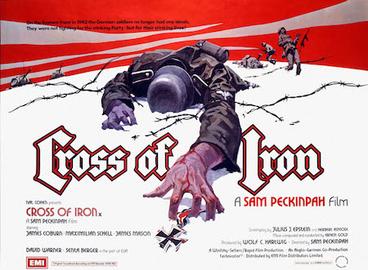
“Cross of Iron” is a war movie set on the Eastern Front in World War II. It is told from a German point of view. The action takes place in the Taman Peninsula in the Caucasus in 1943. The Germans are in the midst of their retreat from Stalingrad. The film was Sam Peckinpah’s last great feature and his only war movie. He supposedly was heavily drinking during the shoot. The movie is based on the novel The Willing Flesh by Willi Heinrich. The movie follows the book fairly closely. The movie was filmed on location in Yugoslavia with the cooperation of the Yugoslavian army. Because the production ran out of money, the ending had to be improvised. The release met with mixed reviews and it did not do well at the box office. It’s reputation has been rising over the years, however.

                The opening credits roll over German war footage with a German children’s song in the background. Corporal Steiner (James Coburn) and his squad sneak up on a Russian mortar post and kill their opponents in the slow motion typical of a Peckinpah film. Within the first two minutes there are three brutal deaths. They capture a Russian boy and bring him back. Capt. Stransky (Maximilian Schell) arrives to take command of the battalion and meets with Gen. Brandt (James Mason) and Capt. Kiesel (David Warner). Stransky is an aristocratic Prussian who has requested a transfer from France specifically so he can win an Iron Cross. Brandt is disillusioned and points out that the German soldier is simply fighting for his life, not for medals. They recommend Stransky make use of Steiner. The cynical, embittered Keisel says “Steiner is a myth. Men like him are our last hope and in that sense he is truly a dangerous man.”  When Stransky meets Steiner, he is angered by Steiner’s lack of respect for his “superior” (in rank and social status) officer. Steiner simply tolerates Stransky as the latest in a long line of clueless officers. The first epic battle scene is filled with frantic combat. There are slow motion deaths and lots of explosions. There is hand-to-hand combat and Steiner is wounded. He ends up in a hospital which results in some surreal scenes as he hallucinates and sees old comrades. He has an affair with a nurse (Senta Berger). When Steiner is recovered enough (in his opinion), he abandons the nurse in favor of a return to his unit (cliché alert).  In war movies, it’s always bros before hos. Even if the woman is Senta Berger and Steiner hates the war. He returns to his platoon (which is the size of a squad). When the Germans are ordered to fall back (I wonder if Adolf knew about that), Stransky purposely does not give Steiner the word. Steiner and his men will have to make it through the Soviet rear and then no man’s land to reach their line.

ACTING:                      A

ACTION:                      A  8/10

ACCURACY:               N/A

PLOT:                          A

REALISM:                   A

CINEMATOGRAPHY:    B

SCORE:                       average

BEST SCENE:  the tank attack


BEST QUOTE:  Brandt:  What will we do when we lose the war.  Kessel:  Prepare for the next one.


ACCURACY: Willi Heinrich was a veteran of the Eastern Front and was wounded five times so he knew of which he wrote. The book is probably partly autobiographical. It is also claimed the book is based on the experiences of the decorated soldier Johannsch Werdfeger who won two Iron Crosses.

             The movie does not claim to be a true story. The battles are generic and represent typical battles during the Taman Peninsula campaign. The fighting is realistic in a Hollywood sort of way. Peckinpah does stage chaos well. The sets are appropriately decimated. The deaths appropriately random.

              The movie is helped in its realism by the authentic weapons. The Russian tanks are T34/85’s on loan from the Yugoslavian Army. I won’t quibble with the fact that that particular model was not in use in 1943. The small arms are accurate. One flaw is the use of F4U Corsairs to represent Russian fighter-bombers. Gull wings – did they think we would not notice?

               The small unit dynamics of the squad, especially in the bunker scenes ring true. The soldier banter is realistic. The comradery is what you expect for a squad that had gone through all they went through. The attitudes of the enlisted and the officers in the German army circa 1943 are well displayed. The cynicism and defeatism is apparent.

CRITIQUE:
“Cross of Iron” is a special movie. There is no other war movie quite like it. It has the Peckinpah touch throughout – the trademark slow motion violence, the iconoclastic anti-hero, the lack of respect for authority. An American war movie concentrating on Germans on the Eastern Front is unique. And because it is the Eastern Front, we get a scene involving female Soviet soldiers. And it’s a great scene that ends with the only Nazi in the platoon getting what he deserves.

            The movie is certainly action-packed with lots of explosions. The sound effects are outstanding. It is a great combat movie and has several combat scenes that are among the best filmed. The tank scene stands out because they are real WWII tanks (thanks, Yugoslavian army). The one thing that slightly takes away from the action are the scene-chewing deaths. The stunt men do a great job, but they tend to fly in the air with their arms up when an explosion occurs nearby.  The movie is not all combat, although there is more than 90% of war movies. In between combat, it  does have its exposition parts (which are necessary to develop the conflict between Steiner and Stransky and to explain Brandt’s role in the triangle), but the movie is definitely not wordy. Each of the main characters get some choice lines and Steiner sometimes sounds like a philosopher.  A very cynical philosopher. One of the expository scenes (which is intercut with a birthday party in the bunker) is a cringey scene involving Stransky and his gay executive officer. It does reflect the 1970’s, but is offensive today.

               The movie is an excellent depiction of small unit warfare and life. The bunker is nicely authentic looking. The movie checks off some of the common features of life in a bunker. Lice, smells, mud, diarrhea, dysfunction. It also gives a taste of command. Brandt is a sympathetic soldiers-general and Keisel represents another type – the cynical staff officer. Stransky is yet another type – martinet glory hound. Steiner portrays the hardened NCO who cares more for the survival of his men than the “big picture.” The movie is refreshingly free of the stereotyped evil Nazis. Stransky is not a Nazi – he is an aristocrat who is fighting for his family honor, not Hitler. Steiner’s men have some character development. You know them well by the end of the movie, which makes the trip through no man’s land sorrowful.

               The acting is outstanding. Coburn deserved an Academy Award nomination and has one of his best performances. He is perfect as Steiner. His body language alone is masterful. He is ably supported by Mason, Warner, and Schell. I especially enjoyed Warner’s cynical Keisel. He is riveting whenever he appears. Schell is appropriately loathsome. The unknown actors who make up the squad also do a good job.


CONCLUSION: If you want a war movie that is adrenalin-fueled and well-acted, try “Cross of Iron”. It is not subtle, but it is not one-dimensional either. It is a must-see movie for war movie fans. The only thing that keeps it from being outstanding is one of the worst endings of any major war movie. Steiner’s actions at the end are completely out of character. Peckinpah really blew it.

Tuesday, July 9, 2019

BOOK/MOVIE: Cross of Iron


                This is another in my series informing you about how war movies differ from their source material.  I also take the liberty of comparing the two.  I have a belief that a movie should be better than the novel it is based on and most war movies are.  The screenwriter has the advantage of having the book as his foundation and he can make improvements to the plot and make it more entertaining.  The disadvantage is that the movie can not go into the detail that a  book can.  I am mainly arguing that movies should be more entertaining than the novel.  If you read on, be aware that I am assuming two things.  One, you have seen the movie already.  Two, you are not planning on reading the book, so you don’t care about spoilers.  I hope what you do care about is how the book differs from the movie and which is better, in my opinion.

                “Cross of Iron” is a war movie directed by Sam Peckinpah.  It is set on the Eastern Front in WWII.  A platoon led by a Sgt. Steiner (James Coburn) is part of the perimeter defense of a German salient that is threatened by superior Red Army forces.  Steiner is a great soldier, but is anti-authority and cynical about the war and the army.  His new company commander Capt. Stransky (Maximilian Schell) has been transferred to Russia so he can win an Iron Cross.  He is a martinet who realizes Steiner will be a thorn in his side and Stransky is determined to eliminate Steiner as an obstacle to his medal.  Steiner and his men have to go on a trek behind enemy lines to get back to their lines after they are left behind in the army’s withdrawal.  The movie was based on the novel The Willing Flesh by Willi Heinrich.  Heinrich served on the Eastern Front and was wounded five times.  The screenplay was written by Julius Epstein, James Hamilton, and Walter Kelley.  They changed the chronology of the book, but adapted some of the key scenes and kept most of the characters.

                The novel opens with Steiner’s platoon in the front lines of the German perimeter.  We are introduced to his men, who have pretty much the same personalities as in the movie.  For example, Schnurrbart is a mustachioed rock, Kern is a slacker jerk, Kruger is a slob, Dietz is boyish, Zoll is a troublemaker (but not the resident Nazi like in the movie).  The book has a key character named Dorn who is an intellectual that Steiner likes to discuss philosophy with.  The movie Steiner is more laconic than philosophical.  When the German army pulls back, Steiner’s group is ordered to stay by his battalion commander (unlike in the movie where the nefarious Stransky purposely leaves them behind).  In the trek back to German lines, Steiner and crew (they start with eleven men) encounter the Russian female soldiers and the scene plays out similar to the movie except that at one point Steiner decides to go off on his own.  He changes his mind and returns after an escaping Russian runs into him.  This allows Steiner to avoid the difficult decision of killing the women to protect their continued journey.  Zoll’s rape and death are essentially the same, but Dietz is not killed until a little later when he runs into a Russian patrol.  Meanwhile, Stransky gets Triebig to admit he prefers men, but Keppler is not in the room.

                When Steiner and the others reach the Russian front lines, they assault some bunkers with extreme prejudice.  They capture a Russian officer and force him to radio that they are a Russian patrol going out.  They proceed into no man’s land and Steiner goes ahead to identify them and they successfully make it in.  Nine of the eleven make it back.  Steiner meets Stansky for the first time.  He offers to promote him to Sgt., but Steiner does not react.  The conversation enrages Stransky and it doesn’t help that when he snidely asks if Steiner was an actor before the war, Steiner responds:  “Not before the war”.  (How did that line not make it into the movie?)   Brandt gives Steiner two weeks R&R.  He meets a nurse who he had an affair with when he was convalescing in a hospital thirteen months before.  It turns out that she had seduced him and when he dumped her, she framed him for robbery which resulted in his being put in a penal battalion.  At the rest area, he has an affair with another nurse named Gertrud.  Steiner is not a ladies man and the romance is awkward.  While he is gone, Dorn and Anselm are killed by a random shell. 

                When he returns, Steiner catches Triebig and Keppler in bed and beats Triebig up because he had sided with Stransky in the chewing out of Steiner earlier.  The big Russian attack featuring tanks in the movie occurs at this point.  Steiner leads the counterattack with Kruger, Hollerbach, Kern. and Faber (recruited by Steiner after their return across no man’s land).  The Russians are caught between two forces and routed.  Steiner is wounded and on the way to the evacuation station, his companion Hollerbach is run over by a tank.  Steiner is away three months and returns to Schnurrbart, Kruger, Faber, and Maag.  He finds out that Stransky is claiming to have led the counterattack and needs Steiner to sign off on his Iron Cross.  The movie covers the meeting with the skeptical Brandt, but leaves out a central section where Keisel explains that Steiner wants time to think on it because Steiner does not want to be a witness in a court-martial.  Keisel convinces Brandt to drop the matter, but threaten Stransky with consequences if he doesn’t back off of Steiner.  Steiner has guilt feelings about how he did not appreciate all that Brandt had done for him, but he did not say he hates all officers, including Brandt. 

                The big set piece in the book is an attack on a Russian factory.  This is barely recognizable in the movie in the scene where the Russian tanks break into a building the platoon had taken refuge in.  Stransky plots with Triebig to kill Steiner in the factory.  When Brandt calls to cancel the attack, Stransky does not pass the word.  Steiner and the men negotiate the maze of corridors in the dark, eliminating the defenders.  Triebig shoots Schnurrbart, mistaking him for Steiner.  Steiner then insures that Triebig is killed by the Soviets.  Upon returning, Steiner sets up an ambush for Stransky.  Brandt is aware, but does nothing to stop this.  Steiner ends up not killing Stransky and soon after Steiner is wounded by an artillery round and Faber loses his eyes.  At the end of the book, Stransky is about to be transferred.  Keisel is still with Brandt but he has told him he will be saved to help start a new Germany.  The movie ending is not even remotely connected to the book.  And since it is a poor ending to a great movie, you have to wonder what the screenwriters were thinking.

                As you can read, the book has more scenes than in the movie.  It is unclear why the screenwriters changed the order of the ones they kept.  Subtracting scenes was inevitable, but resequencing was questionable. The movie jumps immediately into the Steiner/Stransky dynamic and structures the plot around it.  The book does not really kick into this until midway through, allowing for some vignettes that develop the whole squad instead of just Steiner.  The trek is pushed all the way to the last third of the book as a way to build to the confrontation between Stransky and Steiner.  The novel is a multi-layered story of a platoon fighting a losing war whereas the movie is boiled down to a lost patrol movie with an evil brass cliché.  Steiner completely dominates the movie, but in the book he is the main character and the rest of the unit get good coverage, too.  As you would expect, the novel fleshes out the characters quite a bit more than the movie.  The movie does borrow the basic personality traits, but the novel actually puts you into the characters’ heads and Heinrich gives each member of the platoon a chance to have their moment.  Most importantly, Steiner is a multi-dimensional character, unlike the simply cynical, laconic movie Steiner.  Heinrich’s Steiner is mercurial.  He even pouts occasionally.  He is quick-tempered and unstable.  Significantly, for those of you who care about motivation, we find out why Steiner is the way he is.  He lost his fiancé in mountain climbing accident that would scar anyone.  There was also that frame-up by the nurse.  Another difference between the movie platoon and the novel platoon is that in the book the men are much more dysfunctional.  They are far from a band of brothers.  Some of them hate each other and not all are enamored with Steiner, although all recognize that without him they are doomed.

                The movie does retain the Brandt/Keisel dynamic, but obviously the book includes much more of their interesting discussions.  Keisel is one of my favorite fringe characters in war movies and Brandt is a key figure in the theme that even some of the German leaders were cynical.  It was certainly unfair when Steiner lumped him in with all officers.  At least in the book, Steiner is remorseful.  Keisel is the conscience of the book (along with Dorn).  Keisel defines courage thus:  “In 99 out of 100 cases, courage is nothing more than expression of common politeness or sense of duty.  [The other 1%] is an expression of insanity.”  Keisel gets almost as much ink as Stransky, since Stransky is a smaller character than in the movie.  However, the movie does give us the full Stransky.  By the way, there is no Russian boy-captive in the book.  I would have to give the movie that one.

                I have mentioned that in most cases I believe that war movies based on novels are better than the novel.  However, “Cross of Iron” is not one of those movies.  The main reason why the book is superior is because it is able to flesh out all the characters.  Even the main character is more multi-dimensional and less mysterious.  Clearly, a book should do this better than any movie, but the main reason why the movie is inferior is the dubious decisions on changing the sequence of events in the book’s plot.  It would have been much smarter to use the novel as an outline and then eliminate scenes due to time pressures.  The movie wisely condenses the theme to glory-hunting (Stransky) versus cynical survival (Steiner) and focuses on that aspect from the get-go.  It is pretty effective in that single-mindedness, but blows it in the end with the ridiculously unrealistic ending that sees Steiner abetting Stransky.  To have the officer-hating Steiner kill Triebig for killing his men and then have him spare the much more odious Stransky is bizarre.  Heinrich’s Steiner also spares Stransky, but in a much more believable manner.  And having Stransky get his transfer hammers Heinrich’s own cynical attitude toward the war he fought in.

BOOK = A
MOVIE  =  B+