Tuesday, July 30, 2019

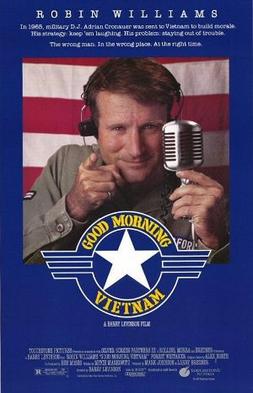
CONSENSUS #64 - Good Morning, Vietnam (1987)


SYNOPSIS:  In 1965, Adrian Cronauer (Robin Williams) arrives in Saigon to start a gig as a DJ on Armed Services Radio.  He immediately rocks the boat with his rock and roll playlist and his ad-libs which poke fun at the military.  He has a romance with a local girl and befriends her brother, who turns out to be in the Viet Cong.  Cronauer becomes very popular with his soldier audience, but greatly infuriates his boss who is determined to make him toe the line.

BACK-STORY:  “Good Morning, Vietnam” was released in 1987 and was a huge hit.  It was the fourth highest grossing film that year.  The film had its genesis from Adrian Cronauer shopping a script for a TV series or made for TV movie.  He was unsuccessful until Robin Williams got wind of the story and decided he wanted to play a manic disc jockey in Vietnam.  Barry Levinson directed from a script by Mitch Markowitz.  Very little of Cronauer’s script was used.  The movie was shot in Bangkok, Thailand.   Williams was nominated for Best Actor and won the Golden Globe for his role.  The film is #100 on AFI’s list of best comedies.

TRIVIA:  Wikipedia, imdb, TCM, History.net
1.  The movie is based on the experiences of Adrian Cronauer.  Cronauer was in the Army and was a disc jockey for Armed Forces Radio Service in Vietnam in 1965.  He did a morning show and opened with “Goooooood Morning, Vietnam” (his “gooood” was twice as long as Robin Williams).  He wrote a screen treatment that he hoped to sell as a TV series and then as a TV movie.  Although “MASH” was hot at the time, the studios were not interested in a Vietnam comedy. 
2.  Williams was made aware of the treatment and pushed for making the movie.  The script in the movie, by screenwriter Mitch Markowitz (who had written for “MASH”, used very little of Cronauer’s script.  Cronauer liked the movie but admitted that “Robin Williams played Robin Williams”.
3. The movie was filmed in Thailand.  They had trouble getting Asian extras because the movie “Off Limits” was in production at the same time.
4.  As far as accuracy, Cronauer was a disc jockey for AFRS and he did teach an English class.  That’s about it.
5.  Director Barry Levinson forbade Williams from meeting Cronauer because he was afraid Williams would imitate Cronauer in the movie.  Levinson heard tapes of Cronauer and did not think he was funny. 
6. The movie finished #5 at the box office in 1987.
7.  After the success of the film, Cronauer went to law school and became an attorney specializing in media law. 
8.  Cu Ba Nguyen (Jimmy Wah) had been a military prisoner and had escaped from Cambodia.
 
            Belle and Blade  =  4.5
Brassey’s              =  2.0
Video Hound       =  4.4 
War Movies         =  N/A
Military History  =  not on list
Channel 4             =  #31
Film Site                =  no
101 War Movies  =  yes
            Rotten Tomatoes  =   #64  

OPINION:   GMV is highly acclaimed and highly overrated.  It totally relies for its fame on Williams’ improvs on the air.  This makes Williams’ Oscar nod a bit perplexing since he was essentially playing himself.  The rest of the movie, while being admirably sincere, does not warrant the praise it got.  It is curiously tame in its criticism of the war.  Cronauer is anti-army, anti-censorship, anti-authority and anti-polka, but not really anti-war.  What is depressing is 18987 saw three significant Vietnam War movies.  GMV made $124 million, Full Metal Jacket made $46 million, and Hamburger Hill made $13 million.  Americans preferred a movie about a standup comedian dropped into the war.  Gag.


Saturday, July 27, 2019

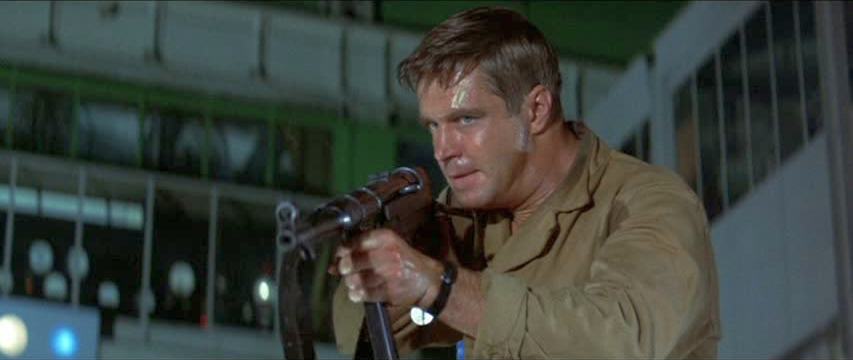
PICTURE, QUOTE, MOVIE #64


1.  What movie is the picture from?

2.  What movie is this quote from?

Me and General McAulliffe decided to move I Company up on the line. That is if you agree.

3.  What movie is this?

Many feel that it is Akira Kurosawa’s greatest masterpiece.   He certainly meant for it to be.  He got the idea for a samurai epic years before but career setbacks (like being fired from “Tora! Tora! Tora!” and funding issues set things back and the film almost did not get made.  In fact it was only intervention by fans Francis Ford Coppola and George Lucas that provided the extra funding needed to put the movie over the top (and to help pay for stuff like importing 200 American horses including numerous female equestrian riders).  Those two incredibly hot directors were blown away by the story board paintings Kurosawa did himself to outline the film.  Language Film.  Kurosawa won the BAFTA for Direction.


Tuesday, July 23, 2019

WWI DOC: They Shall Not Grow Old (2018)


                        “They Shall Not Grow Old” is the acclaimed Peter Jackson documentary on WWI British soldiers.  Jackson was inspired by the fact that his grandfather served in the war and he wanted people to investigate if they had family members who also served.  The title comes from the 1914 poem by Laurence Binyon.  “They shall grow not old, as we that are left grow old.”   Jackson examined over 100 hours of archived footage and restored large amounts for use in the film.  He had to overcome the age and deterioration of the film plus the varying speeds the films were shot in.  Jackson made the semi-controversial decision to colorize some of the footage.  His reason was that he wanted the viewer to see the war as the soldiers had.   He also combed through 600 hours of interviews of veterans conducted by the BBC and Imperial War Museum in the 1960s and 1970s.  The interviews were edited into a narration that accompanies the films images.  The movie features the memories of over forty soldiers.  It won the BAFTA for Best Documentary.

                        The movie opens with the veterans talking about their feelings about the war.  Some of them mention that they enjoyed the experience, they were enthusiastic soldiers, they had no regrets for having served, they treated the war like a job, etc.  Surprisingly, Jackson did not include any negative views of the war.  The movie moves on to cover the soldier experience from enlistment to return after the war.  The enlistment section includes vintage posters with footage superimposed.  One vet tells the story of a young lady shoving a white feather in his face to shame him into enlisting.  We learn about their uniforms (size doesn’t matter), the meals, and training (the rifle range and marching with over 100 pounds of gear).  Then its off to France.  At the 25-minute mark, the film suddenly shifts into color mode and it is eye-popping.  If you have seen any WWI documentaries, the contrast is amazing.  To add to the stunning visuals, Jackson has added sound and vocal effects.  These sync up perfectly with the footage.  He used lip readers to figure out what the soldiers were saying and then hired vocal actors to add the dialogue.  The narrators describe life in the trenches.  This is the first WWI documentary that I have seen that covers defecation.  You better pray the plank does not break.  Rats and lice get their on-screen recognition.  Other problems that get coverage include the smell from dead bodies (the movie shows a lot of dead bodies!), the mud and water, frostbite and trench feet, and poison gas.  Did you know that if you did not have a gas mask you could pee on a handkerchief and put it over your nose and mouth?    It’s not all hellish.  The soldiers manage to entertain themselves in various ways when they are away from the frontline.  Some of the vets wax nostalgic about visits to brothels.

                        The movie covers a generic battle.  Jackson did not want anything specific and the movie not only does not identify the narrators, but it has no references to time and place.  Anyone well-versed in WWI battles will be able to figure out that the battle that is featured has to be one from the latter part of the war.  A large number of tanks are involved and there are several mentions of the exhaustion and demoralization of the German soldiers.  Some of the most amazing effects involve artillery bombardments.  Jackson was able to use sound from a New Zealand artillery exercise.  Jackson’s challenge was the lack of footage of combat given the constraints on cameramen in no man’s land.  His solutions were to intercut stills of dead bodies with footage of live soldiers in noncombat situations.  That smiling face you’re looking at could be the corpse you just saw.  He also made use of illustrations from “The War Illustrated”, a magazine published in London through the war.  The drawings are lurid, but fit the narration well.

                        “They Shall Not Grow Old” has a 100% rating on Rotten Tomatoes which means not a single critic has given it a bad review.  I am not going to be the first, but I do feel it is not as good as it could have been.  Visually, it is awesome and much credit should go to the effort Jackson and his crew put in to make it.  It is very informative and teaches in an entertaining way.  It does not play like a history documentary your high school teacher forced you to watch.  Jackson has stated that the film was “made by a non-historian for non-historians.”  You will learn most of what you should know about soldiers in WWI.  Jackson does not cover every aspect of soldier life.  He only deals with the infantry.  There is nothing on the air war, the naval war, or the home front.  Although he covers some aspects that made the war less than enjoyable, he omits shell shock and diseases.  Which leads me to my main problem with the movie.  I feel it sugarcoats the war a bit.  WWI is quite possibly the worst war to have fought in and yet you do not get that impression from the film because the narrators do not feel that way.  Jackson went through 600 hours of interviews and used none where the interviewee broke down over the death of a comrade or regretted having participated in such a horrible war.  There is no balance to the narration.  You don’t finish the movie wondering how the men could have survived the visuals because they don’t wonder.  It’s still a must-see, but pair it with “All Quiet on the Western Front”.  It’s okay to watch the 1979 color version.

GRADE  =  A-   


Saturday, July 20, 2019

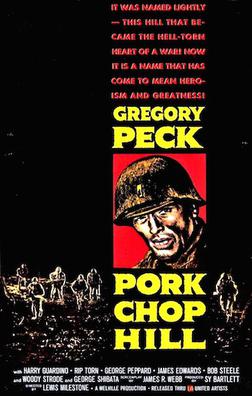
CONSENSUS #65. Pork Chop Hill


SYNOPSIS: "Pork Chop Hill" is a movie about the most famous battle in the Korean War. It takes place at the end of the war as the peace talks are winding down and both sides are fighting over real estate. One of those prime lots is an otherwise worthless hill. An American company is sent to keep and hold it. Gregory Peck plays the commander.  In some ways it is an update of the Alamo.

BACK-STORY: Pork Chop Hill is arguably the most famous and best movie about the Korean War. It was directed by Lewis Milestone of All Quiet…” fame. He also directed another Forgotten War film entitled Steel Helmet. PCH was his last war movie. It was released in 1959.  Gregory Pecks character, Joe Clemons, acted as technical adviser on the film. Clemons was awarded the Distinguished Service Cross for the battle. The movie is populated by many familiar actors from the 1960s and includes a small role by Barry McGuire of future Eve of Destruction one hit wonder fame.

TRIVIA:  Wikipedia, imdb, TCM, Guts and Glory
1.  It is based on a book by military historian S.L.A. Marshall.   Marshall later put forward the controversial theory that a large percentage of American soldiers never fired their weapons at an enemy.

2.  Director Lewis Milestone claimed that the movie was cut by 20 minutes because Gregory Peck’s wife was upset that he was not arriving on screen soon enough.

3.  Peck’s character Clemons does not fire a weapon in the movie because Peck was a committed pacifist and proponent of gun control.  Peck had also been against American involvement in the war.

4.  Producer Sy Bartlett intended for the movie to be very anti-war.  The Pentagon approved the script in spite of this because the movie shows men obeying orders and the movie refutes the image of American soldiers bugging out.

Belle and Blade  =  3.0
Brassey’s              =  4.0
Video Hound       =  3.8
War Movies         =  5.0
Military History  =  #39
Channel 4             =  no
Film Site                =  yes
101 War Movies  =  no
Rotten Tomatoes  =  no 

OPINION: Pork Chop Hill has been described as the best Korean War B-Movie. It is very good for what it is. The acting is solid. Not surprising considering the cast. Peck is Peck. Did he ever make a bad movie? Harry Guardino, Rip Torn, George Peppard, Robert Blake, the great Woody Strode. Nuf said. The cinematography is a crisp black and white. The dialogue is refreshingly cynical in its commentary on war.  It is gritty and authentic in its depiction of the randomness of death in combat. PCH is one of the best company level movies ever made. It is not a small unit dynamics movie ala Platoon. There is little dysfunctionality other than with Franklin (who is a fictional character). The biggest strength of the film is its historical accuracy. It is one of the best movies covering a battle. It reminds one of Hamburger Hill in its battles-can-be-futile theme. It also has a similar take on how command decisions based on political factors can result in unnecessary squandering of lives.

            Pork Chop Hill is underrated at #66.  It belongs in the top 50.   It is one of the most realistic battle films and one of the best small unit movies. Considering when it was made and the budget, it is clearly a classic. It also deserves credit for representing the Forgotten War well.