Showing posts with label war documentary. Show all posts

Friday, October 4, 2019

900th POST


WAR DOC:  The Fighting Lady:  A Drama of the Pacific  (1944)
                        It is hard to believe this is my 900th post.  Who would have ever thought?  I still am enthusiastic about this blog and have big plans for the future.  I certainly will get to 1,000, God willing.  For this special post, I decided to get personal. 

                        This summer I took a trip to Corpus Christi to visit the USS Lexington.  The aircraft carrier is the second Lexington.  The first was sunk in the Battle of Coral Sea.  The carrier is now a museum and an outstanding one.  It was like going back in time to a period of history that fascinates me.  I have, since middle school, been intrigued by the Pacific Theater more than any other theater of war.  I started reading military history as a teenager and have read many books about the war in the Pacific, especially the naval war.   A visit to an aircraft carrier has been on my bucket list for a while.  I have already been on board two battleships (the Alabama and the Texas), a submarine (the Drum) and a destroyer (the Kidd).   This was the cherry on top.  To walk on the flight deck and explore the ship was awesome.  To prepare for the visit, I watched the Oscar winner for Best Documentary Feature for 1944.  “The Fighting Lady:  A Drama of the Pacific” was produced by the U.S. Navy and narrated by Lt. Robert Taylor.  The popular actor, who starred in “Bataan”, was in the Navy during the war.  He served as a flight instructor and made instructional films.  This film covers the Yorktown (CV-10) from its passage through the Panama Canal.  The ship sees action at Marcus Island, Kwajalein, Truk, and the Marianas.  

                        The first half of the film covers life aboard the ship.  One theme is that everyone in the crew is there to serve the pilots of the aircraft.   The fighters, dive bombers, and torpedo bombers are the reasons for the existence of the carrier.  The ship is like a floating city.  There are a wide variety of jobs.  There are cobblers, barbers, laundrymen, dentists, and many others.  There are the men who take care of the planes and the sailors who man the anti-aircraft guns.  And there are the damage control personnel.   The narrator personalizes some of the crew, including “Smokey”.  Smokey was a veteran of Guadalcanal who became an ace.  He is held out of flight operations until the final air battle chronicled in the movie.  Another theme is only a small percent of the time is combat.  The men have to find pastimes to alleviate the boredom when they are off duty.  The main time-waster is scuttlebutt (rumors).  They also watch movies.

                         The sound of “general quarters” breaks the routine.  The Yorktown’s first action is a raid on Marcus Island.  Gun camera footage shows fighters strafing.  Sounds are edited in, including dialogue.  Then the “ballet” of recovering planes.  Next is Kwajalein and Truk.  Footage includes shooting down Japanese planes, bombing and strafing, and some crash landings.  Later, cameras on board the ship provide footage of a Japanese attack on the ship.  Some of this is from the Marianas Turkey Shoot.  Lots of Japanese planes go down.  There are more crash landings.  The film ends poignantly with a funeral at sea.

                        “The Fighting Lady” (an unusual title since the Lexington was usually referred to that way) is very effective propaganda.  Mainly because it is not overt.  It does have its moments like “these little monkeys [the Japanese] think they are fancy fliers”.  But this leads to an accurate analysis that the reason we won air battles was our discipline trumped their acrobatics.  For the most part, the narrator concentrates on explaining the roles of the men and the role of the carrier.  As a tutorial on carrier warfare in WWII, it has no equal.  You get a day in the life and some historical events.  It is better and more entertaining than its closest fictional equivalents – “Wing and a Prayer”, “Flat Top”, and “Men of the Fighting Lady”.  It must have had a positive impact on audiences in 1944.  It’s one thing to read about it in newspapers and in letters home, it’s another to see it.  The footage is amazing and the sound effects editing matches it.  Surprisingly, the footage is not repetitive.  And the faux dialogue adds to the footage, rather than coming off as hokey.  There are many air combat movies that don’t get those two things right. 

                        “The Fighting Lady” is a must-see for anyone interested in carrier warfare in the Pacific.  It certainly deserved the Academy Award.  Make sure you watch it before visiting the USS Lexington, or the actual USS Yorktown.  The actual ship is a museum at Patriot’s Point near Charleston, South Carolina.  I know that if I’m ever in the area, I’m going to go.  After watching the movie, again.  It is available on YouTube.

GRADE  =  A


Tuesday, July 23, 2019

WWI DOC: They Shall Not Grow Old (2018)


                        “They Shall Not Grow Old” is the acclaimed Peter Jackson documentary on WWI British soldiers.  Jackson was inspired by the fact that his grandfather served in the war and he wanted people to investigate if they had family members who also served.  The title comes from the 1914 poem by Laurence Binyon.  “They shall grow not old, as we that are left grow old.”   Jackson examined over 100 hours of archived footage and restored large amounts for use in the film.  He had to overcome the age and deterioration of the film plus the varying speeds the films were shot in.  Jackson made the semi-controversial decision to colorize some of the footage.  His reason was that he wanted the viewer to see the war as the soldiers had.   He also combed through 600 hours of interviews of veterans conducted by the BBC and Imperial War Museum in the 1960s and 1970s.  The interviews were edited into a narration that accompanies the films images.  The movie features the memories of over forty soldiers.  It won the BAFTA for Best Documentary.

                        The movie opens with the veterans talking about their feelings about the war.  Some of them mention that they enjoyed the experience, they were enthusiastic soldiers, they had no regrets for having served, they treated the war like a job, etc.  Surprisingly, Jackson did not include any negative views of the war.  The movie moves on to cover the soldier experience from enlistment to return after the war.  The enlistment section includes vintage posters with footage superimposed.  One vet tells the story of a young lady shoving a white feather in his face to shame him into enlisting.  We learn about their uniforms (size doesn’t matter), the meals, and training (the rifle range and marching with over 100 pounds of gear).  Then its off to France.  At the 25-minute mark, the film suddenly shifts into color mode and it is eye-popping.  If you have seen any WWI documentaries, the contrast is amazing.  To add to the stunning visuals, Jackson has added sound and vocal effects.  These sync up perfectly with the footage.  He used lip readers to figure out what the soldiers were saying and then hired vocal actors to add the dialogue.  The narrators describe life in the trenches.  This is the first WWI documentary that I have seen that covers defecation.  You better pray the plank does not break.  Rats and lice get their on-screen recognition.  Other problems that get coverage include the smell from dead bodies (the movie shows a lot of dead bodies!), the mud and water, frostbite and trench feet, and poison gas.  Did you know that if you did not have a gas mask you could pee on a handkerchief and put it over your nose and mouth?    It’s not all hellish.  The soldiers manage to entertain themselves in various ways when they are away from the frontline.  Some of the vets wax nostalgic about visits to brothels.

                        The movie covers a generic battle.  Jackson did not want anything specific and the movie not only does not identify the narrators, but it has no references to time and place.  Anyone well-versed in WWI battles will be able to figure out that the battle that is featured has to be one from the latter part of the war.  A large number of tanks are involved and there are several mentions of the exhaustion and demoralization of the German soldiers.  Some of the most amazing effects involve artillery bombardments.  Jackson was able to use sound from a New Zealand artillery exercise.  Jackson’s challenge was the lack of footage of combat given the constraints on cameramen in no man’s land.  His solutions were to intercut stills of dead bodies with footage of live soldiers in noncombat situations.  That smiling face you’re looking at could be the corpse you just saw.  He also made use of illustrations from “The War Illustrated”, a magazine published in London through the war.  The drawings are lurid, but fit the narration well.

                        “They Shall Not Grow Old” has a 100% rating on Rotten Tomatoes which means not a single critic has given it a bad review.  I am not going to be the first, but I do feel it is not as good as it could have been.  Visually, it is awesome and much credit should go to the effort Jackson and his crew put in to make it.  It is very informative and teaches in an entertaining way.  It does not play like a history documentary your high school teacher forced you to watch.  Jackson has stated that the film was “made by a non-historian for non-historians.”  You will learn most of what you should know about soldiers in WWI.  Jackson does not cover every aspect of soldier life.  He only deals with the infantry.  There is nothing on the air war, the naval war, or the home front.  Although he covers some aspects that made the war less than enjoyable, he omits shell shock and diseases.  Which leads me to my main problem with the movie.  I feel it sugarcoats the war a bit.  WWI is quite possibly the worst war to have fought in and yet you do not get that impression from the film because the narrators do not feel that way.  Jackson went through 600 hours of interviews and used none where the interviewee broke down over the death of a comrade or regretted having participated in such a horrible war.  There is no balance to the narration.  You don’t finish the movie wondering how the men could have survived the visuals because they don’t wonder.  It’s still a must-see, but pair it with “All Quiet on the Western Front”.  It’s okay to watch the 1979 color version.

GRADE  =  A-   


Wednesday, June 12, 2019

WAR DOC: The Cold Blue (2018)


                With the ending of “Game of Thrones”, people have been considering cancelling their subscriptions to HBO.  Let me assure you, there is more to HBO than GoT.  I originally subscribed because of “Band of Brothers” and stayed with it through “The Pacific” and “Generation Kill”.  Before that, HBO gave us one of the best WWII movies – “When Trumpets Fade”.   I’ll hang onto my subscription as I wait for the series on the 8th Air Force.  Meanwhile, to tide war movie fans over, HBO provides us with a magnificent documentary on the bomber crews of the 8th.  Recently, fifteen hours of footage shot by William Wyler’s cinematographers in 1943 were discovered in the vaults of the National Archives.  The footage was comprehensive and included life at the bases and in the air.  Wyler and his three cinematographers flew on many dangerous missions.  Wyler (“Mrs. Miniver”) used the footage for his acclaimed documentary “The Memphis Belle:  A Story of a Flying Fortress”, which was released in 1944 and wowed audiences with its color photography.  Director Erik Nelson restored the footage and interviewed nine veterans. 

                The documentary begins with a reference to the “Memphis Belle”, but once the connection is made, the film becomes an tribute to all the bomber crews.  It is structured around chapters on various aspects of the veterans’ experiences.  There is no narration, but Nelson does provide title cards giving interesting facts and background information.  Some of the “chapters” are on topics like pre-flight, briefing, take-off, forming up, testing guns, flak, the bomb run, fighters, and the return.  Even the ground crews get their due.  The memories of the vets are coordinated with the footage flawlessly.  And we don’t see repetitive footage like in many similar documentaries.  All of it is color, and not colorized.  The visuals are stunning, especially the aerial views.  There is an ode to contrails.  It seems incongruous that war can be so beautiful, but the shots of the ground and the bombers in formation are amazing.  Nelson’s addition of the sounds of aerial combat and the mainly orchestral score complete the picture.
                  
                 I’m sure the 8th Air Force series will be very entertaining, but it might not be as informative as this doc.  Nelson does not hammer away at the various topics, but some themes develop.  One is that war requires young men because they do not think anything will happen to them.  This despite the title cards telling us that the chances of reaching 25 mission like the Memphis Belle did were not good.  It wasn’t just death that claimed the men, the conditions included freezing temperatures that made frost bite a problem.  The vets speak movingly about mates who were wounded and killed.  Another theme is the crew were like family and they all worked together to do their duty.  The documentary makes it clear that death was random and unpredictable.  At least you were with your mates, but it was very tough to see other bomber crews go down.  One of the veterans chokes up remembering a friend who died the day his son was born.  An unexpected theme is that the men did not care about the damage they were doing.  It was a job and the German people were on the receiving end of it.  Their comments covers footage of homeless Germans and their bombed-out cities.  The documentary finishes strong with interviews with the veterans so we get to see these remarkable men.  (They are all in their nineties now.)  Naturally, they don’t claim to be heroes, but the documentary belies that.  Although one of them charmingly points out that if he was a hero, he would have reupped.

                Considering its mission statement, “The Cold Blue” could not be better.  It is as close to perfect as any could expect.  In a nice touch, the film is dedicated not only to the 28,000 men who gave their lives, but specifically Harold Tannenbaum.  He was one of Wyler’s cinematographers.  His bomber went down over France.  That footage was lost, but his and the other two cinematographers was enough to put together this great documentary.  If you have HBO, you paid for it.  It’s worth the subscription. 

GRADE =  A+


Monday, March 11, 2019

MEMPHIS BELLE (1990) vs. MEMPHIS BELLE (1943)


VS.  


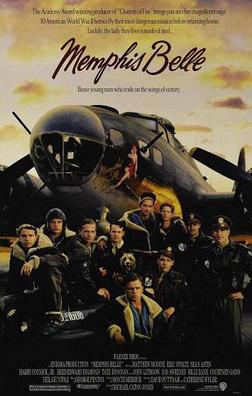
“Memphis Belle” is a war movie directed by Michael Caton-Jones loosely based on the WWII war documentary by William Wyler.  How loosely based will soon be apparent.  The movie was co-produced by Wyler’s daughter Catherine.  It cost $23 million and made $27 million.  That’s one million dollars per historical error.

The movie is set in the summer of 1943 at an air base in England.  An Army public relations officer, Lt. Col. Derringer (John Lithgow), is there to inspire the home front with a story about the first B-17 crew to complete the  25 missions tour.  He introduces us to the men via voiceover.  They are a melting pot of American warriors.  A heterogeneous unit – imagine that.  The enlisted consist of a virgin, a reform school graduate, a Catholic boy, a ladies’ man, a farm boy, and a poet.  The Captain is a clean-cut and by the book.  His co-pilot is the opposite.  The bombardier had four years of medical school, or so he says.  The navigator is morose and cowardly.   According to Derringer, the American public is questioning the idea of daylight bombing.  Since the Memphis Belle is undergoing repairs, the crew has a front row seat for a crash landing that ends up in disaster.  Could this be a portent?

The next scene is a big dance in a hangar which is a pretty good period piece with 1940s clothing and British birds.  There is a chanteuse crooning Swing music and lots of jitterbugging.  In an homage to 1940s Hollywood, Clay (Harry Connick, Jr.) gets on stage to sing “Danny Boy”.  This reminded me of Ricky Nelson in “Rio Bravo”.  The morning briefing explains that the target is Bremen.  It is emphasized that the factory is surrounded by a hospital, school, residential area, and petting zoo (I added that last one).  Thank God we had precision bombing which if applied properly would avoid hitting anything but the factory.

Montage of preparation – arming, fueling, etc.  There is a delay in take-off so Danny (Eric Stolz) can recite one of his poems ( actually “An Irish Airman Foresees His Death” by W.B. Yeats ).  Nice touch, Danny Downer.  The take-off is majestic with appropriate music.  Cinematic magic turns the five available bombers into at least eight and CGI into more for the formation shots.  The mission is the kitchen sink of anything that could possibly happen to a bomber in WWII Europe plus a few that could only happen in a Hollywood film.  Perhaps a list would make this clear.

1.        The Memphis Belle almost collides with another B-17 in a cloud.  This movie would have sucked if the collision would have occurred!
2.       A small number of German fighters (actually Spanish Ha-1112’s masquerading as Me-109’s) attack and then run away so we can move on to the next problem.
3.       The lead bomber is shot down so the MB has to take the lead.  How cinematically convenient!
4.       There is a hole in the wing which causes them to lose a lot of fuel.  Start the clock.
5.       The target is obscured and Capt. Deerborn makes the decision to bring the entire squadron back around to avoid hitting the petting zoo.
6.       Rascal’s (Sean Astin) ball turret gets shot out from under him and he is left dangling.
7.       There is a fire on board.
8.       Danny is wounded and only med school volunteer Val (Billy Zane) can save him.
9.       A fire in an engine forces Deerborn to crash dive to put it out.
10.    One wheel won’t come down (hey, isn’t that what happened to the crash-landing bomber from the opening?)
11.    The fuel runs out so they are down to one engine.
12.    Virge almost falls through the bomb bay.

Here is another list – clichés in “Memphis Belle”.
1.        There are command issues between Deerborn and his co-pilot Luke (Tate Donovan).
2.       Virge talks about his future plans of opening a chain of hamburger joints.
3.       Virge has sex in the plane.
4.       The crew rags some rookies from “Mother and Country” – can I have your stuff when you get shot down?  Ha! Ha!
5.       Phil (D.B. Sweeney) thinks his number is up.
6.       The ground crews wait for the bombers to return and count them as they do.

This is one of the corniest war movies ever made.  At one point, Deerborn talks to the “Memphis Belle” in a  schmaltzy and wooden way.  Wooden would be the best description of Modine’s performance.  The rest of the cast reminds of “Platoon” in its potential, but does not stand up to the comparison well.  The script does not help them.  The dialogue is sappy and the performances are too sincere.  After bombing the target (perfectly), Deerborn says “Okay boys, we’ve done our job for Uncle Sam, now we’re flying for ourselves.”  Modern actors dropped into a cliché-ridden 1940s war movie plot.  They did buy into it and I bet some of them are embarrassed by their participation.  I imagine they had fun filming it and it sure was more pleasant for them than the “Platoon” cast.  No boot camp for these pretty boys.

The effects are a mixed bag.  The five B-17s add a lot of authenticity (one of them was destroyed in a take-off when it clipped a tree and burned completely).  The interior of the bomber looks like the real deal and the routines are proper.  The air combat is fine with decent radio chatter (unlike “Red Tails”, to name but one).  There’s lots of action which fits the goal of mindless entertainment.  Unfortunately, the CGI is inferior and jarring.  The word “fake” comes to mind.  One bit of corn that works effectively is narration of some letters from relatives of lost men over actual footage of bombers going down.

In conclusion, “Memphis Belle” is the “U-571” of air combat movies.  Corny.  Cliché-ridden.  Predictable.  Tactically farcical.  More importantly, I would describe both of them as obstacle porn.  A continuous string of problems to be overcome by the heroes.  If you are into that kind of entertainment and could care less about accuracy and realism, break out the pop corn and turn off your brain.

“Memphis Belle:  A Story of a Flying Fortress” is the celebrated documentary about the first bomber to complete 25 missions in the 8th Air Force.  It was directed by William Wyler (“The Best Years of Our Lives”) who at the time was a major in the U.S. Army Air Forces.  He bravely flew on several missions and ended up losing hearing in one ear.  One of his cinematographers was killed in action.  Wyler won best documentary for “The Fighting Lady” which was about an aircraft carrier.

His “Memphis Belle” is in Technicolor which must have enhanced the message intended by Wyler.  The purpose of the documentary was to bring the air crew experience home to the home front and inspire the public at a time when support for the bombing campaign was waning.  The narration is very propagandistic and anti-German.  Where the movie is dedicated to all the airmen who fought in the skies over Europe, Wyler dedicates his film to only the 8th Air Force. 

The doc covers the last mission from briefing to kissing the ground on return.  The basic arc is used in the movie, but obviously the 1990 reenactment adds a lot of Hollywood.  The doc does take a few liberties of its own.  The MB was not the first bomber to complete 25 missions.  It was chosen early on as the potential first because Wyler felt that Capt. Robert Morgan had a reputation for competency (and survivability) and he liked the name of the bomber (Morgan’s girl-friend).  Ironically, the back-up plane in case the MB did not make it (Hell’s Angels), actually won the race to go home after 25 missions.  As far as the last mission, in the doc it is against Wilhelmshafen and is fairly hairy.  The flak and fighters variety.  Most of the footage seen in the film (parts come from at least six other missions) was shot on a B-17 named Jersey Bounce because the MB was under repair.  It was the MB crew on board, however.  Speaking of which, none of the characters in the movie match the names or backgrounds of the actual crew.  Most importantly, the last mission of the MB was a milk run (against submarine pens at Lorient, France) which would have been boring for a documentary and death to a feature film.  Wyler was a Hollywood director, after all.  It does strike me as a bit unethical for a documentarian.  The documentary is much better quality than the movie, but you have to get past the jingoistic narration.

MOVIE  =  C
DOCUMENTARY  =  B


THE DOCUMENTARY