Thursday, August 19, 2021

The Breadwinner (2017)


       If you have been following the recent events in Afghanistan, you may have heard that people are concerned that history will repeat itself.  The people most concerned with this are Afghani women.  If you are wondering what they are worried will repeat itself, you might want to watch “The Breadwinner”.  It was a Canadian, Ireland, and Luxembourg production, which proves not just the U.S. was interested in Afghanistan.  The movie is an animation drama directed by Nora Twomey.  She is an Irish animator who co-directed the Oscar-nominated “The Book of Kells”.  This film was also nominated for Best Animated Feature.  Angelina Jolie was a co-executive producer.  It is based on the best-selling young adult novel. 

                Parvana (Saara Chaudry) is an eleven-year old girl who lives in Kabul after the Soviets have been driven out and the Taliban has taken over.  Her father lost a leg in the Soviet-Afghanistan War and has trouble providing for his family.  He tells his children that Afghanistan was once great before it became the battleground for empires, starting with Cyrus the Great.  He ends up being sent to prison by an ex-student named Idrees who is now in the Taliban.  The same little shit wants to marry Parvana.  Parvana must step up and become the breadwinner of the family, but since women could not sell goods in the street, she has to cut her hair and disguise herself as a boy.  It was bad enough that she was having to sacrifice her childhood to marry a wifebeater, but instead she has to step into adulthood as the other gender.

                This is a unique movie, and not just because of the subject matter.  Twomey, early in her animation career, decided that animation was not just for children’s tales.  “The Breadwinner” is a good example of recent animated films (like “Persepolis”) that are aimed at adults.  So that’s not the unique part.  Interwoven into Parvana’s arc is her father telling a traditional Afghani tale about a little boy who must defeat the Elephant King to retrieve some magic seeds.  (If you don’t think your kids are ready for the seriousness of Parvana’s story, fast forward to just the Elephant King story parts.)  This tale is animated in a different style than the rest of the movie, but the transitions are great.  Both stories are fascinating and the animation for each is mesmerizing.  We need more animated war movies.  They are a good alternative to excessive CGI.

                The movie has three great characters.  Parvana is a plucky girl heroine/hero.  She befriends an elderly Afghani named Razaq who represents the pre-Taliban male mentality, which was anti-female, but not medieval.  In contrast with his relatively enlightened attitude, Idrees represents how much worse a patriarchy can get.  He is one of the most loathsome war movie characters that I have encountered.  It is chilling to realize he would be a mullah today.

                The book came out in 2000, which means it predated the American invasion of Afghanistan.  The Taliban was firmly entrenched and had no inkling that their guest Osama Bin Laden would cause their world to be rocked the next year.  The screenwriters Deborah Ellis and Anita Doron deftly added an ending that foreshadows the American takeover.  The movie ends with the future of Parvana unclear as the American intervention begins.  Moviegoers would have known that her future was relatively bright with the fall of the Taliban.  Watching the movie now makes it clear that the future of her female children will probably be like her early years.  Besides that adjusted ending, Ellis and Doron made other changes that improved the story, in my opinion.  I have not read the book yet, but apparently they added the characters of Razaq and Idrees.  That was brilliant.  I am very curious if they also added the folk tale.

                If you don’t care what happened in Afghanistan, watch this movie.  I’m not arguing we should have stayed.  I’m just saying to spare some time to empathize for the women of Afghanistan.  Not all of them will be able to disguise themselves as men.

GRADE  =  A  

Wednesday, August 18, 2021

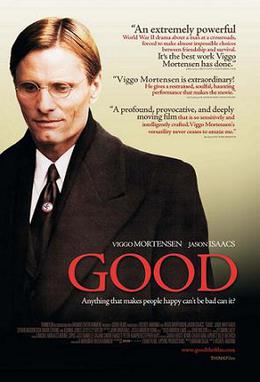
Good (2008)


                “Good” is based on the play of the same name by C.P. Taylor.  Note to movie-makers, you don’t have to keep the name of the play when you make a movie out of it.  The movie did poorly at the box office and some of that has to have been the terrible title. (I know someone will comment that there was a reason for the title, but come on!)   Producer Miriam Segal first saw the play when it premiered in 1981 and it took a while for her to put it on film.  Viggo Mortensen had also been impressed with the play as a young actor.

                The movie opens in Berlin in 1937.  University literature professor John Halder (Mortensen) is called to the Reich Chancelllery to meet Reichsleiter Philipp Bouhler (Mark Strong).  The Nazis are impressed with Halder’s novel about euthanasia.  Bouhler wants Halder to write a paper justifying the “humane” practice of eliminating the mentally and physically disabled.  The movie flashes back to 1933 when Halder’s lecture on Proust is interrupted by a book burning incident.  Halder is disgusted and his best friend is a Jewish psychologist named Maurice (Jason Isaacs), but he is from that group of snobs who feel “Hitler is a joke, he’ll never last.”  But he does last to 1937 and now Halder’s future can benefit from association with non-intellectuals.  He not only joins the Nazi Party, but becomes the resident egghead of the SS department of implementing euthanasia.  Meanwhile, he gets an Aryan poster girl for a mistress.  Anne (Jodie Whittaker) seduces her professor and then becomes a Nazi trophy wife.  Will Halder trade Proust for Faust?

                “Good” reminds of a Masterpiece Theater production.  It is low budget, but sincere. The cast is good and Mortensen is fine as Halder.  Surprisingly, he plays Halder more as a wimp than a tortured soul.  Jason Isaacs is better as Maurice.  His transition from a caddish Freud to Jewish everyman is more compelling than Halder’s story.  Unfortunately, the movie is rife with clichés to go along with the stereotypes.  It is best enjoyed as an introduction to the Holocaust subgenre of war movies.  If you have seen a number of Holocaust movies, you’ve seen this one.  Halder is the anti-Nazi intellectual who is corrupted by contact with his lessers.  He has to turn his back on his conscience, represented by his Jewish friend.  He fools himself into believing his promotion and placement in the in-crowd is a strategic ploy to improve the abhorrent by infiltrating their clique.  How does that usually work in cinema?  You’ve also seen Anne before.  She’s the seductive student who feels sex will trump the professor’s stodgy conscience.  The climax (sorry) of this theme is an egregious scene where the sight of Halder in his black SS uniform has her literally on her knees.  This is the moment where the movie jumps the skull.  When the little head gets big, the big head forgets its principles.

                The biggest weakness of the movie is it is tone deaf.  The SS are portrayed as frat boys who run the campus.  They don’t have to wait in lines for railway tickets!  Halder is the nerd who is recruited to raise the GPA of the fraternity and write their essays.  He marries a sorority sister who wants to attend all the cool parties.  He abandons his old friends and relatives.  That is about how deep it is.  The movie floats the idea that it will delve into the euthanasia program, but then drops it.  Halder’s mother represents the potential victims.  But there is little about Halder justifying the program and then having to see the consequences.  By 2008, wouldn’t it have been a good idea to go off the beaten path and concentrate on the euthanasia program?  Maurice stands in for the Holocaust and although that theme is pursued, it is scarcely ground-breaking.  The movie concludes with a scene is meant to be the big payoff, and it is, if this is your first Holocaust movie.

GRADE  =  C-

HISTORICAL ACCURACY:  The movie does not even claim to be “inspired by a true story”,  but there is some relation to the truth.  Halder reminds of Martin Heidegger.  Heidegger was a famous German philosopher who taught at Freiburg University.  He was elected rector in 1933 and not coincidentally joined the Nazi Party that same year.  He envisioned that he would become the resident philosopher, but he was given a limited role and was ridiculed by many in the Party.  He soon realized that compromising his principles had been a mistake and resigned his position, but he remained in the Party.  Interestingly, he had affairs with two students and one was Hannah Arendt.  Bouhler is an actual historical figure.  He was the Reichsleiter in charge of the Aktion T4 euthanasia program that was responsible for the murder of at least 70,000 handicapped and mentally disabled adults and children.  He also was in charge of vetting literature to ensure it met Nazi “standards”.  He was captured after the war, but committed suicide before the inevitable execution.  The movie includes a reference to the assassination of a Nazi diplomat in Paris by a Jewish man.  This was the excuse for Kristallnacht which is depicted in the movie as the last straw for Maurice.  As far as the song that the movie clumsily uses to imply Halder’s stress, it is called “Die zwei blauen Augen” (“The Two Blue Eyes”).  

Saturday, August 14, 2021

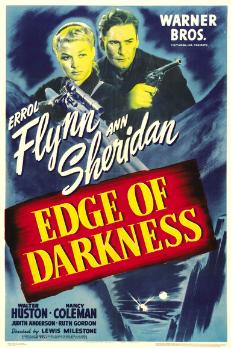
Edge of Darkness (1943)


                Errol Flynn wanted to serve in WWII.  He volunteered for all the branches, but was turned down because of a heart condition, tuberculosis, malaria, and a bad back.  Since he couldn’t fight, he made films like “Edge of Darkness” and “Objective Burma”.  “Edge” is based on the novel by William Woods.  It was directed by Lewis Milestone (“All Quiet…”).  The production was plagued by various a problems.  Originally  the lead was going to be Humphrey Bogart.  When he bowed out Warner Brothers put pressure on Flynn to make the film.  He was a bit distracted by a rape trial, for which he was acquitted.  Production was postponed for three weeks because of a persistent fog.  The movie was one of several movies set in occupied Norway.  The others were “They Raid By Night”, “Commandos Strike at Dawn”, and “First Came Courage”.  “Edge of Darkness” is also known as “Norway in Revolt”.              

                The movie does not start of well.  We get one of the fakest looking bombers in history, followed by very faux ships.  It is October, 1942 in Norway.  Germans enter a town where everyone, including the Germans, are dead.  There are enough corpses than any ten war movies.  We want to know what happened here.  A flashback will tell us.  The Germans control the town.  The German commander knows there is an active resistance movement, but he has no worries because the German position is invulnerable.  The leader of the underground is a fisherman named Gunnar (Flynn).  He is in love with Karen (Ann Sheridan) whose father (Walter Huston) is the town doctor.  Karen’s brother is a quisling, but most of the town is in favor of a revolt.  There is a scene in a church where the townspeople debate whether they should revolt.  It’s a great scene, but it makes you wonder how the patriots can trust the others not to talk.  Not to talk about the arms shipment which will lead to a rousing battle for control of the town.  I don’t need to tell you that the evil Nazi who rapes Karen will get his just reward.

                “Edge of Darkness” was much better than I expected.  I am an Errol Flynn fan, but he made some bad movies.  This one is up there with “Objective Burma” as one of his good WWII movies.  He actually does not dominate the film as Gunnar is just one of a number of solid characters.  Ann Sheridan makes a bigger impression as the feisty Karen.  The evil German is not a caricature, but he is appropriately arrogant.  He talks tough, but weirdly does little to prevent the revolt.  There is no torture of resistance members in this movie.  This is just one of several unrealistic aspects of the film.  Another is that none of the townspeople rat out the revolt.  Maybe Norwegians are more tight-lipped than most people.  And trusting.  The movie is clearly a propaganda film, but I would put it at only a 6 on a scale of 1-10.  Since it was released in 1943, it is not an intervention film.  It is resistance movie that uses the situation in Norway to satisfy audiences with some good old Nazi killing.  The movie does build to a rousing last act.  And we find out what was up with all  those dead bodies.

GRADE  =  B