Saturday, July 22, 2023

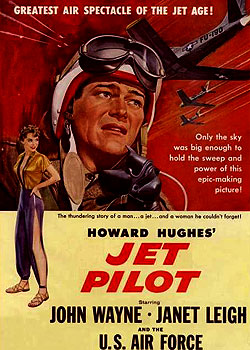
FORGOTTEN GEM? Jet Pilot (1957)


                        In the early 1950’s, the U.S. was deep into the Cold War.  Howard Hughes felt the patriotic thing to do was to make a film that would help us win that war.  He envisioned “Jet Pilot” as a jet version of his “Hell’s Angels”.  John Wayne was conned into making it after being told it would be a take-down of Communism.  The production took 18 months and was finished in 1953.  Officially, it was directed by Josef von Sternberg, but there were several uncredited directors, including Hughes.  Hughes kept tinkering with the film during the editing process which was part of the reason why the movie was not released until 1957.  By that time, most of the jets were either obsolete or obsolescent.  All those jets were provided by the U.S. Air Force which also gave access to two bases.  Chuck Yeager was provided as a stunt pilot.  He flies the X-1 and one of the F-86’s in the film.  He almost crashed when an acrobatic stunt went wrong.  The cinematographers were given a B-43 Tornado bomber as a camera aircraft.   The Air Force did not get much of a boost in enlistments because the movie was an expensive box office flop.  However, it was Hughes’ favorite movie and he watched it many times.

                        The movie opens with some nifty shots of F-86 Super Sabers (our main jet fighter in the Korean War).  You have just seen the best actors in this movie.  An F-86 forces a Soviet jet (actually an F-80 painted black) to land at a base in Alaska.  The pilot is a dame!  Lt. Anna Marladovna (Janet Leigh) is defecting and fetching.  Col. Jim Shannon (Wayne) is put in charge of this hot potato.  She may not be a potato, but she sure is hot.  She takes off her flight suit like she is doing a strip tease.  Shannon immediately decides he can overlook her being a communist.  He comments about her breasts (which must have interfered with her instrument panel):  “This may be some new form of propaganda.”  Their first date is a flirtatious jet ride.  And I’m not talking about him taking her up in his plane.  They are each flying F-86’s!  If you think the cockpit chatter in most air combat movies is lame, imagine what these two future love-birds are saying.  She’s a good pilot, but how is she in bed?  They go through the frenemies stage to marriage.  He shows her the materialism of America, but that doesn’t change her mind about being a spy.  Shannon is down with that.  I guess we know the answer to that question about her in bed.  They end up in the Soviet Union where the tables are turned.  If you are still watching at this point, keep drinking.

                        I was a big John Wayne fan growing up.  It was a legal requirement for Baby Boomer males.  And yet, I had never seen this movie until recently.  Now I know why.  It was not on any retrospectives when Wayne passed away.  Probably by his request since he did not like it.  He and Hughes had opposite views on its quality.  He was right and Hughes was wrong.   The movie is a crapfest.  The plot is ludicrous. The characters are ridiculous.  Wayne and Leigh are not bad and probably deserved awards for keeping a straight face.  Even the hard-core anti-communist Wayne found the script laughable.  There are many unintentional laughs in the film.  It is hard to understand why Hughes felt this was effective propaganda.  None of the developments are realistic.  The Air Force may have provided the hardware, but not a technical adviser.  How else to explain not vetting a script that has a Soviet defector allowed to pilot our most state of the art fighter.  Speaking of which, any movie with F-86’s is going to be partially watchable (like the superior “The Hunters”).  That jet was one sleek puppy and very photogenic.  So was Leigh in this film.  She may be forced to spout simplistic Marxist platitudes, but that figure is pure capitalism.   I guess her breasts are supposed to blind us to the fact that she is a traitor.  But she’s our traitor.

                        Wayne made worse films than “Jet Pilot”, but not many.  It is definitely in his bottom five.  Only watch it if you are committed to watching all his films or every aerial combat film.  If it’s the second reason, fast forward and only watch the aerial scenes.  And watch the Janet Leigh scenes, muted.

GRADE  =  F


Thursday, July 20, 2023

Only “Old Men” Are Going to Battle (1973)


            “Only Old Men Are Going to Battle” (also known as “Only the Old Go to Battle”) is a black and white Soviet war movie set in the Great Patriotic War.  It was co-written and directed by Leonid Bykov (One-Two, Soldiers Were Going…).  He also stars in it.  When he was a teenager, but too young to serve in WWII, he dreamt of being a pilot.  Instead, he went to acting school.  He turned his dream into a film about pilots.  The “old men” are the veteran pilots who looked after the younger ones.  Bykov focused on a “singing squadron”.  In WWII, some Soviet air units gathered musically talented pilots who would perform concerts behind the lines.  Bykov once attended one of these concerts and was in a teenage choir that returned the favor by serenading the warbling warriors.  Clearly, the movie was a labor of love.

            “Based on the reminiscences of Soviet pilots who fought in the war, newsreels, and wartime songs.”  It is the summer of 1943 and the squadron is based in Ukraine.  The squadron’s commander is Aleksey “Maestro” Titarenko (Bykov).  You can tell from his nickname that he leads the singers.  There is a dogfight with cockpit chatter over the credits, but this will not be an air combat movie.  Maestro returns from the air battle in a Messerschmidt.  No biggie.  When the unit gets replacements, he immediately asks if any of them can sing.  There’s an unusual question for an aerial combat movie!  And the first thing the veterans do with the rookies is practice singing.  The Red Army needs air support, but it will be a tough mission, so only the old men will go up.  The youngsters wait and learn.  Later, women pilots are added into the mix so the males have someone to sing to.  In between serenades, the squadron fights the war, almost as an afterthought. 

            Bykov claimed the movie was based on truth, but although the people and incidents did occur, not to one unit.  The movie is an example of “artistic synthesis”.  This is the excuse screenwriters use when they pile uncommon characters and developments into one movie.  “The Big Red One” is a classic example of this.  Did all those vignettes actually occur?  Yes, but not to the same squad.  This can also be used to justify cliches.  Did a pilot ever ask a female pilot to marry him and then get killed on his next mission?  Yes, but...  Did a pilot make excuses to avoid combat, but then redeem himself later?  Yes, but...  Some real war heroes inspired the characters.  Tatarenko is based on Vitaly Popkov.  Popkov was an ace with 40 kills who was awarded Hero of the Soviet Union twice.  It was his squadron that the teenage Bykov sang for.

Despite the fact that there were “singing squadrons”, it does feel odd that a war movie would be made about one of them.  Since the Soviet Union made a ton of movies about WWII, it should not be a surprise that one of them has a lot of singing in it.  There are six songs, but the movie is not a musical.  Bykov’s response when he was asked about the movie’s emphasis was: “Wars are transitory, music is eternal”.  This theme paid off at the box office as the movie was popular.  The public had seen enough Soviet movies that highlighted the hardships of the war.  You can’t really fault “Only Old Men” for downplaying the attrition in a fighter squadron.  There are enough deaths of likeable characters to fit a “war is hell” vibe.  However, it is not a “who will survive?” movie.  While praising it for breaking new ground, the film does not stand out in its production values.  The cinematography is pedestrian.  The air action is usually seen from the vantage of the maintenance men and earthbound rookies.  At least the planes are authentic.  The acting is average, but at least the soap opera aspects of the plot are not dripping with sentimentality. The songs carry that load.

“Only ‘Old Men’ Are Going to Battle” is not in the upper crust of Soviet war movies, but if you are intent on diving deep into the subgenre, it is an entertaining change of pace.  Just don’t be like me and watch it thinking, what the fuck is up with all this singing?


GRADE  =  C

Sunday, July 16, 2023

The Day After (1983)


            As a baby boomer and an avid TV viewer, I grew up during the period of time when there were television events like “Roots”.  People tend to remember the miniseries that the 1970s and 1980s were noted for, but sometimes it was made-for-tv movies that became water cooler fodder.  I saw most of those, like “The Night Stalker” and “Tribes”.  The biggest TV movie of the Cold War was a movie about the Cold War.  “The Day After” reached a massive audience.  More than 100 million Americans watched it when it appeared on Nov. 20, 1983.  62% of televisions were tuned to it.  The idea for the movie came from ABC’s Motion Picture Division President Brandon Stoddard.  Stoddard had seen the movie “The China Syndrome” which nailed the nuclear power industry.  He was inspired to develop a movie about nuclear war.  Specifically, the aftermath of a nuclear war, hence the title.  Edward Hume was tapped to write the screenplay.  He did a massive amount of research.  Nicholas Mayer was hired to direct.  He was coming off a big hit with “Star Trek 2:  The Wrath of Khan”.   He and producer Robert Papazian did a lot of research, too.  So much that Mayer suffered from depression.  They visited a FEMA facility and were told by an official that they were working on putting evacuation information in telephone books.  He estimated it would get done in 6 years!  Clearly a movie was needed to show Americans what could happen in a catastrophe.  In order to be realistic, the movie would end up being hard to watch.  ABC was naturally worried about a movie that would be shown to families in prime time.  Mayer had a lot of push back from the censors.  The movie was first intended to be a two-night event, but Mayer thought getting it to 4 hours would mean a lot of padding.  It was determined to be better as a two-hour movie.  This meant the editing would remove a lot of the grosser images and some scenes.  Mayer fought hard to retain some scenes that the network felt were too intense.  He ended up walking away from the editing, but the network begged him to come back and they compromised on the final product.  The TV version ended up being 122 minutes long.  One scene that was cut (thankfully) had the athletes at a college fighting the science students for food.  They should have that scene in a remake because it fits our society today. 

            ABC launched a large promotion campaign which included commercials months before the air date.  A half million viewer guides were distributed to highlight the fact that the movie would be informative about the effects of nuclear war.  A hot line was set up to handle calls from distraught viewers.  The showing was more sobering than depressing.  It did open up conversations about our policy of mutually assured destruction and debates about whether surviving a nuclear war was better than dying instantly.  It even had an impact within the American government.  The movie was screened for Pres. Reagan.  He commented that it was “powerfully done, very effective … and left me greatly depressed.”  It may have had an impact on the nuclear weapons reduction talks with the Soviets.  The Joint Chiefs of Staff were shown it and they were impressed with depiction of what could happen if they did not put peace ahead of war.  The showing was a big event that transcended the vast majority of TV programming.  And it was critically acclaimed.  It was nominated for 12 Emmys, including Hairstyling, Makeup (which it definitely should have won), Directing, Cinematography, Writing, and Supporting Actor (John Lithgow).  It won for Sound Editing and Special Visual Effects.

            The movie can be divided into two parts.  Although it was advertised as a movie about the aftermath of a nuclear war, it does spend time on the characters that will be impacted by the war.  The movie is set in Lawrence, Kansas because it is geographically in the middle of America and it is a typical Middle America city.  Some of the characters include a well-respected doctor (Jason Robards), a farm family (the Dahlbergs), an Air Force airman who was stationed at an ICBM base, and college student Stephen Klein (Steve Guttenberg).  The opening scene has a documentary feel as an Air Force general boards one of the aircraft that orbit America in case of a nuclear attack.  This is a reminder of the Cold War.  News reports in the background announce a buildup of Soviet forces along the West German border.  The residents of Kansas are not really paying attention.  The Dahlbergs are preparing for the wedding of their oldest daughter.  The news is just background noise for most Kansans.  However, those missile silos in their vicinity are foreboding.

            As people go about their everyday lives, events escalate.  Shots are fired in Germany.  Berlin is blockaded.  Moscow begins evacuating.  Some jumpy residents of Kansas City pack up and hit the road.  The Soviets invade West Germany.  NATO has to use tactical nukes to stop them.  The Soviet Union retaliates by sending a nuke to destroy NATO headquarters.  Now people are paying attention.  Hoarding begins.  A hurricane style evacuation fills the interstate.  The tension is reaching a boiling point.  And then the pot boils over.  The rest of the movie depicts the effects of nuclear exchange on the various characters.  Not all will survive.  And some will wish they didn’t.

            I saw this movie when it first was shown and have wanted to see it again since I started this blog.  It is not an easy movie to find if you are not willing to spend a lot on a DVD.  For such a huge movie, it is seldom shown on TV.  It is not on any streaming service and Netflix does not even have the DVD.  Thankfully, YouTube finally got it and it is the expanded `127 minute version.  I was skeptical whether it would hold up over all these decades.  It does and still packs a wallop.         

            Papazian told the casting director to avoid well-known actors because he wanted the story to stand on its own.  Mayer was on a plane flight with Robards and asked him on the spur of the moment to be in the film.  He is outstanding and the rest of the cast is good. Some went on to nice careers, like Gutenberg, Lithgow, and JoBeth Williams and Amy Madigan.  The movie used a lot of locals for the cast.  Many were given speaking roles.  Some were paid $50 to go bald and all were encouraged to stop bathing.  The cast is ably served by a great makeup team.  The effects of nuclear war on a person’s body are visceral.  And it could have been worse.  The censors cut the scenes in Kansas City when the bomb hit it.  The effects of radiation sickness were downplayed.  And the lawlessness.  Mayers had to be content with a statement at the end of the movie that told viewers what they had seen was probably not as bad as it will be.  If you know anything about nuclear weapons, that was a “no? duh!” comment.           

            The movies format works well.  We get to know these typical Americans with their typical American lives.  This allows us to wonder how we would do in their shoes.  The plot does not leave you confident that you and your family will be fine.  It does make you want to follow the war in Ukraine more closely and you might have more trouble sleeping.  It’s a good reminder of how tense the Cold War was.  I used to teach a sub-unit on the effects of nuclear war.  Even sleepy little New Iberia was not safe.  In a large-scale attack, no American would be safe.  I wanted my students to be able to read the signs and be prepared, but if they see this movie, I wonder if they would want to survive.  I believe most informed Americans were already aware that a nuclear war would be devastating, but this movie brings the possible into your home.  And I am sure even informed Americans were not aware that you could be evacuating a target area and have your car stop and never start again.  Do people even today know that?  We can be complacent now that the Cold War is over.  New Iberia is a much safer place.  But the use of tactical nukes in Ukraine could put us in Lawrence, Kansas.  In conclusion, let me end on a positive note.  The movie concludes with a Morse code spelling M-A-D.  This was a reference to the policy of “mutually assured destruction”.  Both the U.S. and USSR leadership kept their fingers off the button because they knew there would be no pulling back once the first nukes were fired.  As insane as the strategy sounds, it worked.  Maybe partly because of this movie.


GRADE =  A