Showing posts with label John Wayne. Show all posts

Saturday, March 14, 2026

Flying Tigers (1943)


               “Flying Tigers” was John Wayne’s first war film.  As is well known, Wayne did not serve in the military in WWII.  This movie is part of the argument that he better served his country by making “flagwaving” films like this one.  Since it is unlikely that the uniformed Wayne would have killed as many Japanese in reality as compared to the celluloid hero, let’s concede the argument.  The fact that the movie was made in 1943 means that there were technical constraints on the effects and which impacted a script with the requisite propaganda themes.  The movie is meant to be a tribute to the American Volunteer Group (popularly known as the “Flying Tigers”) and leads off with a testimonial by Chiang Kai-shek.  The plot is basically the story of the leader of the unit (Wayne as Jim Gordon) and a hot shot jerk named Woody (John Carroll).  Gordon is the empathetic head pilot who takes in black sheep pilots to shoot down Japanese planes for the saintly (but hickish) Chinese people.  Woody is a wolf who makes no secret that he is in it just for the bounty money given for each kill.  He says “get out your checkbook, General” when he shoots down a Zero.  There is a love triangle involving a nurse named Brook (Anna Lee).  Woody wears out his charming roguishness when he contributes to the downing and subsequent strafing while parachuting death of the beloved exec “Hap” (Phil Kelly).  He does get a chance to redeem himself at the end and the love triangle conundrum is solved via subtraction.

               “Flying Tigers” was a big hit in a country that was craving Japanese ass-kicking.  People had heard of the famous unit already, but if they were hoping for a history lesson they were disappointed.  None of the characters were based on real people.  The only thing the movie gets right is the fact that the pilots were paid a bounty for each kill.  The biggest boner is having the unit earning those bounties before Pearl Harbor.  In reality, the AVG did not go into action until after Pearl Harbor.  The other departure from reality is in the air combat depicted in the movie.  That can partly be blamed on the available technology.  The effects make heavy use of models (P-40 Warhawks) and footage (including Japanese newsreels to show the effects of bombings).  Although the movie was nominated for an Academy Award for Best Effects, it looks decidedly quaint.  There are three ways to go in dogfight movies:  the use of models, the use of actual planes to reenact, and the use of CGI.  The use of models can be pulled off if you are making “Star Wars”, but in this case it just looks like models.  Plus models pre-Star Wars often defy the realities of physics and look foolish doing so.  “Flying Tigers” also falls into the Old School of showing dogfights via cockpit shots and machine guns blazing.  Any plane shot at goes down and usually with the bullet ridden body of the pilot on board (unless you want to reenact the dastardly strafing of an American pilot early in the war).

               “Flying Tigers” is patriotic bull shit, but it is not painful to watch.  The acting is good.  Wayne is Wayne, as usual.  Carroll gets the meaty role and digs his teeth into it.  The character is not two-dimensional and although quite a cad, he has some redeeming qualities.  Anna Lee is lovely and can actually act a bit (usually not a requirement in movies like this).  The plot is very predictable, but what do you expect from a 1943 movie?  I could say the same for the dogfighting scenes, but they were done much better by movies pre-1940s.


GRADE  =  C


Thursday, September 26, 2024

THE FIRST OF 12 - Flying Tigers (1943)


                “Flying Tigers” was John Wayne’s first war film. It was the first of 12.  As is well known, Wayne did not serve in the military in WWII.  This movie is part of the argument that he better served his country by making “flagwaving” films like this one.  Since it is unlikely that the uniformed Wayne would have killed as many Japanese in reality as compared to the celluloid hero, let’s concede the argument.  The fact that the movie was made in 1943 means that there were technical constraints on the effects and they impacted the script with the requisite propaganda themes.  The movie is meant to be a tribute to the American Volunteer Group (popularly known as the “Flying Tigers”) and leads off with a testimonial by Chiang Kai-shek.  The plot is basically the story of the leader of the unit (Wayne as Jim Gordon) and a hot shot jerk named Woody (John Carroll).  Gordon is the empathetic head pilot who takes in black sheep pilots to shoot down Japanese planes for the saintly (but hickish) Chinese people.  Woody is a wolf who makes no secret that he is in it just for the bounty money given for each kill.  He says “get out your checkbook, General” when he shoots down a Zero.  There is a love triangle involving a nurse named Brook (Anna Lee).  Woody wears out his charming roguishness when he contributes to the downing and subsequent strafing while parachuting death of the beloved exec “Hap” (Phil Kelly).  He does get a chance to redeem himself at the end and the love triangle conundrum is solved via subtraction.

                “Flying Tigers” was a big hit in a country that was craving Japanese ass-kicking.  People had heard of the famous unit already, but if they were hoping for a history lesson they were disappointed.  None of the characters were based on real people.  The only thing the movie gets right is the fact that the pilots were paid a bounty for each kill.  The biggest whopper is having the unit earning those bounties before Pearl Harbor.  In reality, the AVG did not go into action until after Pearl Harbor.  The other departure from reality is in the air combat depicted in the movie.  That can partly be blamed on the available technology.  The effects make heavy use of models (P-40 Warhawks) and footage (including Japanese newsreels to show the effects of bombings).  Although the movie was nominated for an Academy Award for Best Effects, it looks decidedly quaint.  There are three ways to go in dogfight movies:  the use of models, the use of actual planes to reenact, and the use of CGI.  The use of models can be pulled off if you are making “Star Wars”, but in this case it just looks like models.  Plus models pre-Star Wars often defy the realities of physics and look foolish doing so.  “Flying Tigers” also falls into the Old School of showing dogfights via cockpit shots and machine guns blazing.  Any plane shot at goes down and usually with the bullet ridden body of the pilot on board (unless you want to reenact the dastardly strafing of an American pilot early in the war).

                “Flying Tigers” is patriotic bull shit, but it is not painful to watch.  The acting is good.  Wayne is Wayne, as usual.  Carroll gets the meaty role and digs his teeth into it.  The character is not two-dimensional and although quite a cad, he has some redeeming qualities.  Anna Lee is lovely and can actually act a bit (usually not a requirement in movies like this).  The plot is very predictable, but what do you expect from a 1943 movie?  I could say the same for the dogfighting scenes, but they were done much better by movies pre-1940s

GRADE  =  C

Saturday, July 22, 2023

FORGOTTEN GEM? Jet Pilot (1957)


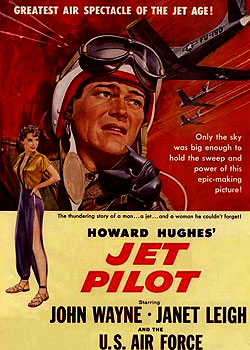
                        In the early 1950’s, the U.S. was deep into the Cold War.  Howard Hughes felt the patriotic thing to do was to make a film that would help us win that war.  He envisioned “Jet Pilot” as a jet version of his “Hell’s Angels”.  John Wayne was conned into making it after being told it would be a take-down of Communism.  The production took 18 months and was finished in 1953.  Officially, it was directed by Josef von Sternberg, but there were several uncredited directors, including Hughes.  Hughes kept tinkering with the film during the editing process which was part of the reason why the movie was not released until 1957.  By that time, most of the jets were either obsolete or obsolescent.  All those jets were provided by the U.S. Air Force which also gave access to two bases.  Chuck Yeager was provided as a stunt pilot.  He flies the X-1 and one of the F-86’s in the film.  He almost crashed when an acrobatic stunt went wrong.  The cinematographers were given a B-43 Tornado bomber as a camera aircraft.   The Air Force did not get much of a boost in enlistments because the movie was an expensive box office flop.  However, it was Hughes’ favorite movie and he watched it many times.

                        The movie opens with some nifty shots of F-86 Super Sabers (our main jet fighter in the Korean War).  You have just seen the best actors in this movie.  An F-86 forces a Soviet jet (actually an F-80 painted black) to land at a base in Alaska.  The pilot is a dame!  Lt. Anna Marladovna (Janet Leigh) is defecting and fetching.  Col. Jim Shannon (Wayne) is put in charge of this hot potato.  She may not be a potato, but she sure is hot.  She takes off her flight suit like she is doing a strip tease.  Shannon immediately decides he can overlook her being a communist.  He comments about her breasts (which must have interfered with her instrument panel):  “This may be some new form of propaganda.”  Their first date is a flirtatious jet ride.  And I’m not talking about him taking her up in his plane.  They are each flying F-86’s!  If you think the cockpit chatter in most air combat movies is lame, imagine what these two future love-birds are saying.  She’s a good pilot, but how is she in bed?  They go through the frenemies stage to marriage.  He shows her the materialism of America, but that doesn’t change her mind about being a spy.  Shannon is down with that.  I guess we know the answer to that question about her in bed.  They end up in the Soviet Union where the tables are turned.  If you are still watching at this point, keep drinking.

                        I was a big John Wayne fan growing up.  It was a legal requirement for Baby Boomer males.  And yet, I had never seen this movie until recently.  Now I know why.  It was not on any retrospectives when Wayne passed away.  Probably by his request since he did not like it.  He and Hughes had opposite views on its quality.  He was right and Hughes was wrong.   The movie is a crapfest.  The plot is ludicrous. The characters are ridiculous.  Wayne and Leigh are not bad and probably deserved awards for keeping a straight face.  Even the hard-core anti-communist Wayne found the script laughable.  There are many unintentional laughs in the film.  It is hard to understand why Hughes felt this was effective propaganda.  None of the developments are realistic.  The Air Force may have provided the hardware, but not a technical adviser.  How else to explain not vetting a script that has a Soviet defector allowed to pilot our most state of the art fighter.  Speaking of which, any movie with F-86’s is going to be partially watchable (like the superior “The Hunters”).  That jet was one sleek puppy and very photogenic.  So was Leigh in this film.  She may be forced to spout simplistic Marxist platitudes, but that figure is pure capitalism.   I guess her breasts are supposed to blind us to the fact that she is a traitor.  But she’s our traitor.

                        Wayne made worse films than “Jet Pilot”, but not many.  It is definitely in his bottom five.  Only watch it if you are committed to watching all his films or every aerial combat film.  If it’s the second reason, fast forward and only watch the aerial scenes.  And watch the Janet Leigh scenes, muted.

GRADE  =  F


Wednesday, August 4, 2021

1st REVIEW REVISITED: They Were Expendable (1945)


                This is 11th anniversary of this blog.  I wanted to do something special and I decided to return to my first review.  I often think back to movies I have reviewed and wonder if I was right about my grade.  This is because even though I have reviewed over 900 movies for this blog, I have seen many of them a second time since the review.  Rarely do I change my mind about the movie now that I am a reviewer.  This differs from my perceptions of some of my childhood favorites that I have reviewed and found to be less than I thought at the time.  But what about a movie I reviewed eleven years ago?  I’ve seen a lot of war movies since then and read a lot of books about war movies.  Part of that reading is because I am a history buff and like to include back-stories for the films.  “They Were Expendable” is a movie with a lot of back-story. 

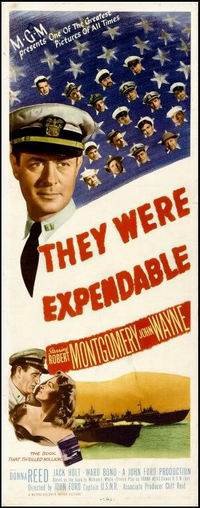
                In 1942, William L. White wrote They Were Expendable:  An American Torpedo Boat Squadron in the U.S. Retreat from the Philippines.  It was excerpted in “Reader’s Digest” and “Life” and then became a bestseller.  In 1945, MGM obtained the rights and wanted John Ford to direct it.  Ford was serving with the Navy Field Photographic Unit and had famously filmed the Japanese attack on Midway for a documentary.  He refused to leave the war to make the film.  However, he met John Bulkeley (the hero of the book) when he spent five days on his PT-boat during D-Day.  The experience convinced Ford to change his mind.  This was ironic because Bulkeley felt White had exaggerated his actions and he did not deserve the Medal of Honor.  Robert Montgomery’s casting as Bulkeley was brilliant.  He had entered the American Field Service in London before Pearl Harbor.  He was already a well-respected actor before that. He was President of the Screen Actors’ Guild and had been nominated for Best Actor.  After driving ambulances in France before the fall, he returned to his day job in Hollywood.  He was nominated for another Best Actor in 1941 and then enlisted in the Navy after Pearl Harbor.  He served in PT-boats in the Solomons and served on the USS Barton, a destroyer that was at D-Day.  He left the Navy as a Lt. Commander.  “Expendable” was his first movie after his war service.  

                John Wayne was second-billed as Bulkeley’s exec Robert Kelly.  Wayne’s WWII experience was almost the opposite of Montgomery’s.  He was 34 at the beginning and classified 3-A (family deferment), but could have enlisted.  He talked about it and wanted to join Ford’s unit, but Republic Pictures threatened to sue for breach of contract and Wayne kept postponing his defiance of Republic until after his next picture. That moment never came.  Ironically, the epitome of cinematic war heroes was considered by some to be war avoider.   Surprisingly, the problem on set was not with Montgomery.  Ford, partly to suck up to Montgomery, treated Wayne like dirt, calling him “clumsy bastard” and “big oaf”.  The snide comments continued until Montgomery intervened and told Ford to lay off.  Another significant cast member was Ward Bond.  Ford created the role of Mulcahey for his down on his luck player (he made 25 movies with Ford).  The screenplay was by Frank “Spig” Wead who Wayne had played in “The Wings of Eagles” (“I’m gonna move that toe.”)

                After wrapping, Ford returned to his unit in time to cross the Rhine with it.  He did not like the finished product.  He felt it was forced and claimed to not have watched it until an interviewer suggested it to him in 1950.  Upon viewing, Ford admitted it was good.  He may have avoided watching it because of bad memories.  He fell off a scaffolding and broke his leg during production.  He spent two weeks in traction.  Montgomery took over directing.  He was the logical choice since he had been treating the experience as an apprenticeship under Ford.  At one point, Montgomery had suggested a different way to shoot a scene.  Ford did it Montgomery’s way and then when it was finished, he asked Montgomery if he was satisfied.  When he said yes, Ford opened the camera and gave the film to Montgomery saying “Here, take it home with you”.  At the helm, Montgomery did a good job and went on to direct several films, including “The Gallant Hours”.

                The movie is considered a classic example of the WWII films made during the war.  Although the war was coming to an end, it still has a heavy whiff of patriotism and propaganda.  It is an homage film to PT-boats in the darkest days of the war, specifically “in the year of Our Lord nineteen hundred and 41”.  John Brickley (Montgomery) and his exec Rusty Ryan (Wayne) head a unit of PT-boats which they proudly show off for a visiting admiral.   The admiral parts by proclaiming he prefers “something more substantial”.  Rusty agrees and wants a transfer to a destroyer.  (Way to think big!)  Pearl what?  Screw this transfer, I’d rather die in a “high-powered canoe”.  The god of war is going to try to make that happen.  It is going to be a bleak month or so.  In between two attacks on Japanese cruisers, they are tasked with evacuating MacArthur from the Philippines.  Through the whittling down of the boats moreso than the men, a romance between Rusty and a nurse (Donna Reed) is thrown in.  There is some command dysfunction similar to a submarine movie. 

                Although made during the war, TWE is considered subgenre challenging.  It appears to be different than films like “Bataan” and “Wake Island”.  Both are grim depictions of the hopeless, yet hopeful, early days.  Wayne does not get the girl, which is the only thing about the romance that is not cliche.  There is a scene that perfectly contrasts with where war movies are today.  Nurse Davis is invited to a dinner with the officers and is serenaded by some of the sailors. Imagine that in a modern movie.  The two leaders accept abandoning their men.   The enemy does not even appear (except in the form of T-6 Texans disguised as Zeros and dropping bombs they aren’t carrying).  However, in most ways it is not groundbreaking.  It has two heroes who butt heads.  (By the way, although Wayne is second-billed, his role is more substantial than Montgomery’s.)  The unit is heterogeneous.  There is a redemption arc, for the boats. They have a mascot, the cat “Bad Luck”.  There is a funeral.  In some ways it is the combination of a small unit and a submarine movie.

                The biggest problem with the movie and the thing that keeps it from being a great movie is its targets for adulation do not hold up.  The central theme is that the PT-boats were an underestimated weapon and had a bright future after the Philippines fell.  The whole point of Bulkeley and Kelly being evacuated is for them to help build the force.  The movie has them sinking two Japanese cruisers and taking credit for an escort carrier, a tanker, and a freighter.  By 1945 when the movie came out, it would have been very apparent that the boats, while glamorous, were light on successes and the successes shown in the movie were not based on facts.  For instance, in the second cruiser attack the movie has most of the torpedoes hitting the Japanese warship with fireworks ensuing.  In actuality, only one of eight torpedoes hit and it was a dud.  (Clearly the movie was not interested in criticizing our abysmal early war torpedoes.)   Perhaps the historical license is why the names of Bulkeley and Kelly were changed.  More unpalatable is the movie’s treatment of the MacArthur evacuation.  The general is treated like the god that the press had built him up as, so the movie was giving the audience what they expected.  But to have the sailors fawn over him is laughable considering his reputation amongst the men he left behind. 

                It turns out that I have not changed my mind about the movie.  I thought it was overrated in 2010 and I still do.  It was a good movie for its time and is one of the best movies made during the war, but it feels stodgy today.  The overly patriotic score and poorly written romance drag it down.  It breaks some tropes, but overall it is pretty predictable.

GRADE  =  B-