Showing posts with label nuclear war. Show all posts

Saturday, February 3, 2024

Special Bulletin (1983)


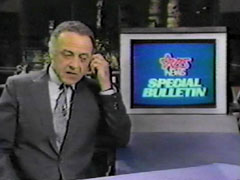
            Back when there were only three major tv networks (ABC, CBS, and NBC), there were television events that large audiences watched.  Some of them were sporting events and others were made-for-tv movies.  “Special Bulletin” appeared on March 20, 1983 on “NBC Night at the Movies”.  I saw it that night and did not see it again for four decades.  It did stick with me over the years.  It was a memorable experience that especially impacted my generation which grew up in th Cold War.  I used to teach a sub-unit on nuclear war in my American History classes to scare the crap out of my  students, but also to help them survive a nuclear war.  Survival involved following current events and recognizing when a crisis between the U.S. and the USSR began to escalate.  The type of scenario that I was referring to was covered in two outstanding television movies -  “The Day After” and “Threads”.  “Special Bulletin” fits in the nuclear war subgenre, but it deals with a scenario that no one could be prepared for.

            The movie was directed by  Edward Zwick (“Glory”, “Courage Under Fire”, “The Last Samurai”, “Defiance”).  The film reminds of Orson Welles’ radio broadcast of “War of the Worlds”.  NBC was determined to avoid the panic that the radio play caused.  Since it was structured as a live news broadcast, the network insisted on a disclaimer at the beginning and end.  Plus, periodically the word “dramatization” appeared on the screen.  Of course, you would assume that any intelligent viewer that tuned in after the opening would have flipped to another network to find that only NBC was reporting on a sensational event.  The key word being “intelligent”.  It ended up causing only a small amount of panic.  The movie created quite a stir, but not on the level of “The Day After”.  By “stir” I mean there were some conservatives that were upset that a movie would portray a nuclear bomb as being a bad thing.  And why scare people with reality?  It won four Emmy awards, including “Outstanding Drama Special”.

            The fictional RBS network interrupts its regular schedule for a special bulletin.  A reporter and her cameraman happen to be doing a story at Charleston harbor when they are taken captive by some terrorists who have control of a tugboat moored at a pier.  There are other hostages as well.  The terrorists are Americans who are upset with America’s policy of relying on nuclear weapons to win World War III.  The two leaders are scientists who are familiar with nuclear weaponry.  One has designed his own nuclear bomb, which is on board the ship.  They demand air time to explain their position.  They favor unilateral disarmament.   They threaten to explode the bomb if the military does not deliver all the triggers for all the nuclear warheads in the Charleston area.  They make it clear that their bomb has anti-tamper devices that will prevent anyone other than the maker from disarming it.   We are going to find out if he is bluffing.

            The movie has a tv news look to it.  What I would normally call a low-budget look.  While looking authentic, it actually is a low-budget affair.  The cast is less than stellar with Ed Flanders as the top-billed.  The acting matches the status of the actors, but that makes it seem more believable.  They flub their lines as though they are reporting live.  I think it is possible that a person could have tuned in midway through and gotten a sick feeling before they realized it was fictional.

            “Special Bulletin” fits in well with other movies that deal with nuclear war.  And it has a scenario that is possible.  The last twenty minutes are edge of your seat. However, it does not pack the wallop of “The Day After” and “Threads” because it does not cover the aftermath of a nuclear explosion like they do.  If you have seen either of those two, this one adds the element of “what if you have little warning?”  It is noteworthy that before the Oklahoma City bombing, this movie used domestic terrorists as the villains.  Well, they certainly don’t think they are villains.  They sincerely believe unilateral disarmament would make the world safer.  The teleplay does not give them a soapbox, probably to avoid complaints from the Reagan administration.  Looking back forty years later, liberals watching the movie today would have to admit that Mutually Assured Destruction actually worked.  Go figure.  That doesn’t mean that a homemade nuclear bomb is inconceivable.

GRADE  =  B


Thursday, October 12, 2023

100 BEST WAR MOVIES #91 (tie) Threads (1984)


                  “Threads” was a British/Australian production for the BBC.  It was directed by Mike Jackson (“Live from Baghdad”).  His research included consulting scientists, psychologists, doctors, and defense specialists.  For the nuclear winter scenes, he used a Science magazine article entitled “Nuclear Winter:  Global Consequences of Multiple Nuclear Explosions” by Carl Sagan and James Pollock.  The movie was filmed in 17 days in Sheffield.  The city  was chosen because it was a “nuclear free zone” which meant the city council would be amenable to the disruption of a movie production.  Unlike the similar “The War Game”, which did not air in 1966 because of pressure from the Wilson government, “Threads” was aired to a large audience.  It was nominated for 7 BAFTAs and won for Best Single Drama, Design, Film Cameraman, and Film Editor. It came up short for Costume Design, Film Sound, and Make-Up (the third degree burns were Rice Krispies and ketchup).

                The movie opens with a narrator proclaiming that society is made up of threads woven together.  This makes it strong, but vulnerable.  The film follows the families of Ruth Beckett (Karen Meagher) and Jimmy Kemp (Reece Dinsdale).  Ruth is pregnant so she and Jimmy are to be wed.  The Becketts are a working-class family and the Kemps are middle class.  The people of Sheffield are not concerned when the news reports that the Soviets have invaded Iran after a coup they blame on the U.S.  Three days later, an American sub gets sunk in the Persian Gulf.  The President claims the attack was unprovoked.  He sends American forces to Iran to protect the oil fields.  A week later, the U.S. accuses the Soviets of bringing tactical nuclear weapons into Iran.  Since Sheffield is near a NATO air base, the citizens of Sheffield should be fleeing the city.  It is an obvious target.  Most people are ignorant about the danger they are in.  Some leave when the U.S. issues an ultimatum that the USSR leave Iran.  Since governments are like people, they don’t like to back down, a red line has been crossed.

ACTING:                   B

ACTION:                   N/A

ACCURACY:           N/A

PLOT:                        A

REALISM:                A

CINEMATOGRAPHY:  B 

SCORE:                     average

BEST SCENE:  Ruth gives birth

BEST QUOTE:  Bob: [seeing mushroom cloud]  Jesus Christ! They've done it... They've done it!

                I used to do a game with my American History classes in conjunction with covering the Cuban Missile Crisis. I called it “Escalation” because it emphasized that a Cold War confrontation could spiral out of control.  I divided the class into leadership councils for two countries.  They had to make decisions based on what the other country’s leadership had done.  In order to “win” or save face, it was eye-opening how far a country would go in a nuclear scenario.  My scenario had some similarities to “Threads”. 

                Since I doubt many of you will watch the movie, I’m going to run through what happens to Sheffield in the movie.  This may save your life some day as it is a realistic portrayal of what might happen.  You should not be in a major city when the nukes start flying.  We left the movie situation with the U.S. ultimatum.  Great Britain moves troops to Europe.  This results in pro-NATO and anti-war protests in Sheffield.  B-52s bomb Soviet forces in Iran. The Soviets use nuclear anti-aircraft missiles to shoot down several of them.  The Americans use a nuclear bomb on a Soviet base in Iran.  There is a naval battle in which an American carrier is sunk.  Now there is a traffic jam to get out of the city.  It’s too late. A nuclear blast over the North Sea fries all communications in Great Britain.  Nukes take out targets like the nearby air base and the city itself.   Sheffield is devastated.  Huge fires break out. Over 80 megatons of explosives hit the country.  Fallout blankets most of the country.  Few residents are prepared for the two weeks they must spend indoors away from any windows.  Hospitals are swamped with burn victims and radiation casualties.  The movie goes on to show the effects nuclear winter.  Survivors have to cope with lack of food in the present and the killing of crops and livestock in the next few months.  Ten years later, Ruth and her daughter are barely eking out their existence.  Civilization has collapsed.

                Watching “Threads” is a sobering experience.  I also could have used adjectives like gut-wrenching, depressing, emotional, and powerful.  Don’t avoid it as I did, especially if you have little idea of what a nuclear war will be like.  The scenario the movie posits is a realistic one.  Once one nuclear explosion occurs, anywhere in the world will be in danger.  If you want to live, you will have enough warning to take steps to survive.  However, watching this movie, you might not want to survive.  It is an indictment of human reaction to threats.  There was a time after the Cold War when “Threads” could be seen as a curio.  Unfortunately, the threat of nuclear war has returned. 

The cast was mostly unknowns.  Director Jackson wanted fresh faces that the audience could identify with.  Karen Meagher stands out since her Ruth is the only character that is followed to the end.  Well, not quite the end.  Karen gives birth in a barn.  She cuts the umbilical cord with her teeth.  (That’s licorice, by the way.)  The acting is decent and kudos to make-up for showing how nuclear war will affect appearances. 

                For a low budget affair, “Threads” has high production values.  The special effects are gruesome, but they needed to be.  There are a lot of dead bodies, human and animal.  Don’t eat while viewing.  Just when you think it can’t be grimmer, there is a shot of a woman carrying her dead baby.  This movie is depressing.  Not one positive thing happens.  The film focuses on the emergency city council’s efforts to deal with a catastrophe that it is ill-prepared for.  There is no optimism even 13 years after war.  The final scenes depict the loss of humanity that will result from hundreds of nuclear explosions.

Tuesday, October 10, 2023

THE 100 BEST WAR MOVIES #91. The Day After (1983)


            As a baby boomer and an avid TV viewer, I grew up during the period of time when there were television events like “Roots”.  People tend to remember the miniseries that the 1970s and 1980s were noted for, but sometimes it was made-for-tv movies that became water cooler fodder.  I saw most of those, like “The Night Stalker” and “Tribes”.  The biggest TV movie of the Cold War era was a movie about the Cold War.  “The Day After” reached a massive audience.  More than 100 million Americans watched it when it appeared on Nov. 20, 1983.  62% of televisions were tuned to it.  The idea for the movie came from ABC’s Motion Picture Division President Brandon Stoddard.  Stoddard had seen the movie “The China Syndrome” which nailed the nuclear power industry.  He was inspired to develop a movie about nuclear war.  Specifically, the aftermath of a nuclear war, hence the title.  Edward Hume was tapped to write the screenplay.  He did a massive amount of research.  Nicholas Mayer was hired to direct.  He was coming off a big hit with “Star Trek 2:  The Wrath of Khan”.   He and producer Robert Papazian did a lot of research, too.  So much that Mayer suffered from depression.  They visited a FEMA facility and were told by an official that they were working on putting evacuation information in telephone books.  He estimated it would get done in 6 years!  Clearly a movie was needed to show Americans what could happen in a catastrophe.  In order to be realistic, the movie would end up being hard to watch.  ABC was naturally worried about a movie that would be shown to families in prime time.  Mayer had a lot of push back from the censors.  The movie was first intended to be a two-night event, but Mayer thought getting it to 4 hours would mean a lot of padding.  It was determined to be better as a two-hour movie.  This meant the editing would remove a lot of the grosser images and some scenes.  Mayer fought hard to retain some scenes that the network felt were too intense.  He ended up walking away from the editing, but the network begged him to come back and they compromised on the final product.  The TV version ended up being 122 minutes long.  One scene that was cut (thankfully) had the athletes at a college fighting the science students for food.  They should have that scene in a remake because it fits our society today. 

            ABC launched a large promotion campaign which included commercials months before the air date.  A half million viewer guides were distributed to highlight the fact that the movie would be informative about the effects of nuclear war.  A hot line was set up to handle calls from distraught viewers.  The showing was more sobering than depressing.  It did open up conversations about our policy of mutually assured destruction and debates about whether surviving a nuclear war was better than dying instantly.  It even had an impact within the American government.  The movie was screened for Pres. Reagan.  He commented that it was “powerfully done, very effective … and left me greatly depressed.”  It may have had an impact on the nuclear weapons reduction talks with the Soviets.  The Joint Chiefs of Staff were shown it and they were impressed with depiction of what could happen if they did not put peace ahead of war.  The showing was a big event that transcended the vast majority of TV programming.  And it was critically acclaimed.  It was nominated for 12 Emmys, including Hairstyling, Makeup (which it definitely should have won), Directing, Cinematography, Writing, and Supporting Actor (John Lithgow).  It won for Sound Editing and Special Visual Effects.

            The movie can be divided into two parts.  Although it was advertised as a movie about the aftermath of a nuclear war, it does spend time on the characters that will be impacted by the war.  The movie is set in Lawrence, Kansas because it is geographically in the middle of America and it is a typical Middle America city.  Some of the characters include a well-respected doctor (Jason Robards), a farm family (the Dahlbergs), an Air Force airman who was stationed at an ICBM base, and college student Stephen Klein (Steve Guttenberg).  The opening scene has a documentary feel as an Air Force general boards one of the aircraft that orbit America in case of a nuclear attack.  This is a reminder of the Cold War.  News reports in the background announce a buildup of Soviet forces along the West German border.  The residents of Kansas are not really paying attention.  The Dahlbergs are preparing for the wedding of their oldest daughter.  The news is just background noise for most Kansans.  However, those missile silos in their vicinity are foreboding.

            As people go about their everyday lives, events escalate.  Shots are fired in Germany.  Berlin is blockaded.  Moscow begins evacuating.  Some jumpy residents of Kansas City pack up and hit the road.  The Soviets invade West Germany.  NATO has to use tactical nukes to stop them.  The Soviet Union retaliates by sending a nuke to destroy NATO headquarters.  Now people are paying attention.  Hoarding begins.  A hurricane style evacuation fills the interstate.  The tension is reaching a boiling point.  And then the pot boils over.  The rest of the movie depicts the effects of nuclear exchange on the various characters.  Not all will survive.  And some will wish they didn’t.

ACTING:                   B

ACTION:                   N/A

ACCURACY:           N/A

PLOT:                        A

REALISM:                A

CINEMATOGRAPHY:  B  

SCORE:                     average

BEST SCENE: the explosions

BEST QUOTE:  Joe Huxley:  You know what Einstein said about World War III? He said he didn't know how they were gonna fight World War III, but he knew how they would fight World War IV: With sticks and stones.

            I saw this movie when it first was shown and have wanted to see it again since I started this blog.  It is not an easy movie to find if you are not willing to spend a lot on a DVD.  For such a huge movie, it is seldom shown on TV.  It is not on any streaming service and Netflix does not even have the DVD.  Thankfully, YouTube finally got it and it is the expanded `127 minute version.  I was skeptical whether it would hold up over all these decades.  It does and still packs a wallop.         

            Papazian told the casting director to avoid well-known actors because he wanted the story to stand on its own.  Mayer was on a plane flight with Robards and asked him on the spur of the moment to be in the film.  He is outstanding and the rest of the cast is good. Some went on to nice careers, like Gutenberg, Lithgow, and JoBeth Williams and Amy Madigan.  The movie used a lot of locals for the cast.  Many were given speaking roles.  Some were paid $50 to go bald and all were encouraged to stop bathing.  The cast is ably served by a great makeup team.  The effects of nuclear war on a person’s body are visceral.  And it could have been worse.  The censors cut the scenes in Kansas City when the bomb hit it.  The effects of radiation sickness were downplayed.  And the lawlessness.  Mayers had to be content with a statement at the end of the movie that told viewers what they had seen was probably not as bad as it will be.  If you know anything about nuclear weapons, that was a “no? duh!” comment.          

            The movies format works well.  We get to know these typical Americans with their typical American lives.  This allows us to wonder how we would do in their shoes.  The plot does not leave you confident that you and your family will be fine.  It does make you want to follow the war in Ukraine more closely and you might have more trouble sleeping.  It’s a good reminder of how tense the Cold War was.  I used to teach a sub-unit on the effects of nuclear war.  Even sleepy little New Iberia was not safe.  In a large-scale attack, no American would be safe.  I wanted my students to be able to read the signs and be prepared, but if they see this movie, I wonder if they would want to survive.  I believe most informed Americans were already aware that a nuclear war would be devastating, but this movie brings the possible into your home.  And I am sure even informed Americans were not aware that you could be evacuating a target area and have your car stop and never start again.  Do people even today know that?  We can be complacent now that the Cold War is over.  New Iberia is a much safer place.  But the use of tactical nukes in Ukraine could put us in Lawrence, Kansas.  In conclusion, let me end on a positive note.  The movie concludes with a Morse code spelling M-A-D.  This was a reference to the policy of “mutually assured destruction”.  Both the U.S. and USSR leadership kept their fingers off the button because they knew there would be no pulling back once the first nukes were fired.  As insane as the strategy sounds, it worked.  Maybe partly because of this movie.