Showing posts with label Alfred Hitchcock. Show all posts

Tuesday, November 29, 2022

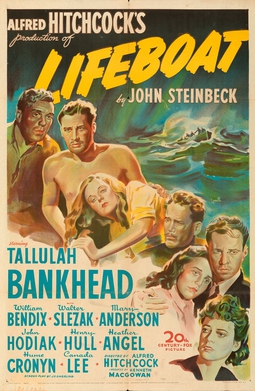
Lifeboat (1944)


                “Lifeboat” is an Alfred Hitchcock film.  It was one of his “limited-setting films”, like “Rear Window”.  The limited-setting is a lifeboat after a ship has been sunk by a u-boat.  It came from a novella by John Steinbeck.  He was paid $50,000.  Steinbeck was upset with the finished product.  He criticized “slurs against organized labor” and the “stock comedy Negro”.  His black character was dignified.  He wanted his name removed from the credits, but the studio refused.  As you can imagine, it was a difficult film for Hitchcock to do his famous brief appearance.  He thought about being a floating body.  He ended up appearing in a before/after ad  for a weight reduction drug in a newspaper one of the passengers looks at.  And this gave Alfred the chance to highlight his recent loss of 50 pounds.  The movie was nominated for Oscars for Best Director, Original Story (Steinbeck), and Black and White Cinematography.  Although most critics praised it and it is considered a classic today, the film was controversial for its supposedly sympathetic portrayal of a German.  It is the only Hitchcock movie without a score.  The movie was a difficult shoot even though it was inside in a tank.  The water and oil caused illnesses in the cast that held up production.  Tallulah Bankhead caught pneumonia, for instance.  Maybe she needed more clothing.  They had to climb a ladder to get to the boat in the tank.  Tallulah did not wear underwear, which caught the attention of the crew.  When informed, Hitchcock said:  “I don’t know whether to call for wardrobe, make-up, or hairdressing.”

                The movie opens by panning over wreckage from a ship, including a body.  There is one lifeboat.  A columnist (Bankhead) pulls a man aboard.  She is excited about the film she took of the sinking.  Others join the passengers.  A black steward (Canada Lee), a rich industrialist, a mentally unstable mother with her dead baby, several regular joes, another female, and a German survivor named Willi (Slezak).  Willi is hiding a secret identity.  There is some discussion on whether to throw the German overboard, the liberals win. There are other scenes that develop the scene that different personalities must work together to survive.  Hitchcock was personalizing the Allies here.  The boat starts with eight members, it won’t stay that way.  It goes through several leaders, including Willi.  They have to manage lack of water and getting on each other’s nerves.  And the fact that there is a Nazi on board.

                “Lifeboat” is an interesting movie because of the interaction between various types in a confined space.  And you have the rat in seaman’s clothing.  It is a lesser Hitchcock film and if you did not know it, you might not guess it’s Hitchcock.  Unless you look carefully at that newspaper ad.  The cast is good and the movie is well-acted.  It has some stars from the 1940s including Bankhead, Slezak, Jon Hodiak, William Bendix, and Hume Cronyn.  Bankhead gets the meatiest role.  She plays a stereotyped rich gal who is forced far from her element.  There is a running gag where she keeps losing her rich trappings, including the camera that got all those great shots of the sinking.  However, the film does not allow the actors to really cut loose because despite the scenario, they really don’t go through enough hardship considering the lack of food and water.  I don’t need to tell you Ms. Bankhead keeps her well-coifed hair throughout.  One weakness of the character development is some of the characters do not behave consistently.

                As far as the criticism by Steinbeck, I have to say that I did not see the German as a sympathetic character.  He is cunning (which would be a German stereotype), but he is clearly evil and he does get his comeuppance. Ironically, he does aim them to their rescue.  The film does not have the feel of anti-Nazi propaganda.  And it is not racist.  I did not find Joe to be a stereotyped black.

                “Lifeboat” is considered a classic, but I found it to be just an average war film.  I have seen most of Hitchcock’s films and would put this one somewhere in the middle.  In fact, I think all of Hitchcock’s WWII films (Foreign Correspondent, Saboteur, Notorious) are average   “Lifeboat” cannot be classified as a mystery because the audience is aware that Willi is the u-boat captain and vile.  I guess it is a mystery as to how the captain was the only survivor, but the movie does not deal with that. 

GRADE  = B-

Tuesday, October 15, 2019

CONSENSUS #57 - Notorious (1946)


SYNOPSIS: "Notorious" is a Hitchcock film set in Rio De Janiero after WWII. Alicia (Ingrid Bergman) is the daughter of an executed Nazi who is recruited by the FBI to infiltrate a gang of Nazi refugees that is plotting in Argentina. The plan is for her to renew her relationship with the gang leader (Claude Rains) and find out what they are planning. Things get compilicated as she develops a love/hate relationship with her FBI contact (Cary Grant).

BACK-STORY: “Notorious” is a classic Hitchcock film released in 1946. It was shot in crisp black and white and has many of the iconic Hitchcock touches. It was one of four movies where Hitchcock teamed with Cary Grant and his second picture in a row with Ingrid Bergman ( the first was “Spellbound” ). The film was a big hit and was nominated for two Academy Awards – Claude Rains for Best Supporting Actor and Ben Hecht for Best Original Screenplay. Leopoldine Konstantin ( Rains’ mother ) made her only appearance in an American movie. She was actually only four years older than Rains. Another problem that the magic of movies handled was Rains being several inches shorter than Bergman. This was overcome with ramps and elevator shoes so well that in the movie Grant and Rains appear to be the same height. The use of uranium for an atomic bomb as the Maguffin the plot needed supposedly was prescient by Hitchcock and Hecht and got Hitchcock tailed by the FBI for a while. The movie has a famous two and a half minute kissing scene where Hitchcock circumvented the Production Code rule of maximum of three seconds of lip-locking by having Grant and Bergman nuzzle between smooches. This actually works on film.
TRIVIA:  Wikipedia
1.  Hitchcock got around the Production Code’s restriction of kisses to three seconds by having Cary Grant and Ingrid Bergman disengage every three seconds to nuzzle and whisper sweet nothings for two and a half minutes. 
2.  The studio wanted Joseph Cotton to play Devlin (for contract reasons), but Hitchcock insisted on Grant. 
3.  Hitchcock wanted Clifton Webb to play Sebastian, but David Selznick talked him into Claude Rains for box office reasons.
4.  It was Leopoldine Konstantin’s only American movie.
 5.  Hitchcock makes his appearance drinking champagne at the party at Sebastian’s party.
 6.  Rains was three inches shorter than Bergman so ramps and boxes were used to fix it.  He also wore elevator shoes.
 7.  Grant kept the UNICA key and later gave it to Bergman.  She delighted Hitchcock by presenting it to him at a tribute dinner for him sponsored by AFI to present him with a lifetime achievement award.
 8.  Hitchcock claimed the FBI had him under surveillance for several months because of the use of uranium as a plot development.

Belle and Blade  =  no
Brassey’s              =  5.0
Video Hound       =  no
War Movies         =  no
Military History  =  #57
Channel 4             =  no
Film Site                =  yes
101 War Movies  =  no
Rotten Tomatoes  =   no

OPINION: I am a big Hitchcock fan, but I have to swim upstream and state that I do not think this is one of his best films. It is well written and well acted. It has its moments of standard suspense.  By far the best reason to watch the film is the dialogue and acting. The sparring between Alicia and Devlin is priceless. Grant and Bergman are at the top of their games, but Rains is outstanding as well. He portrays a sympathetic Nazi who ironically is more in love with Alicia than Devlin is. He also has those terrible mommy issues that we can sympathize with. You almost feel sorry for him. He is a cultured, urbane Nazi sap. As his mother, Konstantin is one of the great villains of filmdom.  This is the second Hitchcock film on the list and it is even less of a war movie than “Foreign Correspondent”.  Even the loosest definition of war movie would not include this movie.  

Tuesday, January 29, 2019

CONSENSUS #86 - Foreign Correspondent (1940)


SYNOPSIS: An American reporter (Joel McCrea) is sent to pre-WWII Europe to report on treaty negotiations to avoid war. He gets involved in the kidnapping of a diplomat.  He is ensnared in espionage and romance. This is a Hitchcock movie.

BACK-STORY: Foreign Correspondent was directed by Alfred Hitchcock and was only his second American production (after Rebecca). It was released in 1940. It was Hitchcock’s attempt to help the British war effort.  The film has an incredible 14 writers which can be explained by the desire to keep up with current events during the filming. It was a critical and box office success. It was nominated for 6 Academy Awards including Best Picture (ironically, it lost to Rebecca), but won none. The events and characters are fictitious, but obviously Hitchcock meant it as a commentary on the storm clouds rising in Europe. It was dedicated to those forthright ones [foreign correspondents] who early saw the clouds of war while many of us at home were seeing rainbows…”.

TRIVIA:  Wikipedia, imdb, TCM

1.  It was based on an autobiographical book called Personal History by Vincent Sheean. Producer William Wanger purchased the rights for $10,000.  Little of the book made it into the screenplay.
2.  Alternate titles were “Imposter” and “Personal History”.
3.  This was Alfred Hitchcock’s second Hollywood movie after coming to America from England.  The first was “Rebecca” which was also released in 1940.
4.  Originally the movie was going to be set in the Spanish Civil War, but it ended too soon for the movie to be topical.
5.  It received five Academy Award nominations, but won none. It lost Best Picture to “Rebecca”.  Albert Besserman was nominated for Best Supporting Actor.  It was also nominated for Original Screenplay, Art Direction, Cinematography, and Special Effects.
6.  Besserman was German and did not speak English.  He memorized his lines phonetically.
7.  Hitchcock wanted Gary Cooper to play Jones / Haverstock, but Cooper did not want to make a thriller.  He later admitted he made a mistake.  Clark Gable turned down the role and Cary Grant was not available because he was filming “Only Angels Have Wings”.  He wanted Joan Fontaine to play Carol, but her studio would not loan her. 
8.  Hitchcock makes his cameo around the thirteen-minute mark.  He is reading a newspaper when Haverstock sees Meer getting in a car.
9.  Ben Hecht was brought in after the movie was completed to write a new ending which involved Haverstock giving an inspirational speech at a radio station.  The scene was filmed on July 5 and bombs fell on London on July 10.  The original ending had Haverstock discussing the events of the film on a transatlantic flight.
10.  Josef Goebbels admired the film and felt it was a “masterpiece of propaganda”.  The film was not shown in Germany until several years after WWII and not shown uncut until 1995.
11.  Hitchcock may have gotten his persona for his TV show from working with humorist Peter Benchley on this film.  Benchley wrote his own lines.

Belle and Blade  =  N/A
Brassey’s              =  5.0
Video Hound       =  N/A
War Movies         =  5.0
Military History  =  #86
Channel 4             =  not on list
Film Site                =  yes
101 War Movies  =  no

OPINION:  Once again, we have movie that is not really a war movie.  “Foreign Correspondent” is clearly a Hitchcockian mystery/thriller.  It is not even a good Hitchcock movie.  I would not put it in his top five.  The plot and characters are not realistic or believable.  It should not be on this list.