Showing posts with label espionage. Show all posts

Sunday, February 10, 2019

The Catcher Was a Spy (2018)


                In 1994, Nicholas Dawidoff wrote a biography entitled The Catcher Was a Spy:  The Mysterious Life of Moe Berg.  Twenty-four years later, a movie studio decided Moe Berg’s story would be a profitable subject for a movie.  And yet, still no movie about his boss Wild Bill Donovan.  Less drugs, Hollywood green-lighters.  “The Catcher Was a Spy” was directed by Ben Lewin.  He was given a big enough budget to film on location in Boston and Prague.  He also got a nice cast, headed by Paul Rudd.

                In 1936, Moe Berg (Rudd) was a back-up catcher for the Boston Red Sox.  He was called “Professor” because he was an intellectual.  He is included on a baseball tour of Japan headlined by Babe Ruth.  Berg was included not for his mediocre playing ability, but because he spoke Japanese.  While in Japan, he used a home movie camera to film Tokyo harbor.  When war broke out, Berg visited Bill Donovan (Jeff Daniels) of the OSS to show the film.  An impressed Donovan hired Berg and gave him a desk job handling the Balkans.  When Donovan learns that the Nazis are developing a nuclear bomb, he sends Berg to Italy to investigate a scientist named Heisenberg (Mark Strong).  He is accompanied by an OSS agent (Guy Pearce) and a physicist (Paul Giamatti).  Berg’s mission is to assassinate Heisenberg.

                “The Catcher Was a Spy” has the feel of a “movie of the week”.  The cast gives me the impression the producers had bigger goals.  The stars are way out of this movie’s league.  Dawidoff manages to get them to give sincere performances to match the movie.  Rudd is solid in a movie that lacks any humor.  It’s not heavy lifting as Berg is a strange dude.  But not interesting strange.  More like nerd strange.  The movie throws in a gay subplot (I already mention no humor, so you can figure out what I mean here).  This sort of thing is required for a 21st Century biopic.  The subplot goes nowhere and adds no tension.  But then, there is little tension provided by the rest of the plot.  For a spy movie, there is little cloak and dagger or edge of your seat suspense.  His mission is easy and his life is never in danger.  Other than a nifty combat scene where the trio has to follow an American unit through an Italian city that is being taken house to house.  When you are making a lame spy movie, don’t throw in a good combat scene to contrast with.

                One positive thing I can say about the movie is it is fairly accurate.  As you will see below, it uses the basics of Berg’s life as the structure for the story.  Clearly it enhances the entertainment value like every biopic.  I seriously doubt he was in firefight.  As usual, the final act goes off the rails the most.  Berg is a fascinating historical figure and deserved a movie, but so do a lot of more deserving individuals.  I mentioned his boss William Donovan as an example.  This movie does not make a strong case for Berg receiving the Presidential Medal of Freedom.  (The biography below proves he deserved it.)  But my main beef with the movie is – who the hell green-lit this movie?  It made less than $1 million at the box office and that sounds about right.

GRADE  =  C-

HISTORICAL ACCURACY:  For the very few people who saw this movie (and the fewer who care), here is the low-down on Moe Berg.  He graduated from Princeton and Columbia Law School.  He spoke several languages and read ten newspapers a day.  He became a professional baseball player and played fifteen seasons as a back-up catcher.  He was described as the “brainiest guy in baseball”.  He did appear on a radio quiz show called “Information, Please” which was great publicity for major league baseball.  He quit when the moderator began to ask him personal questions.  Casey Stengel said he was “the strangest man ever to play baseball”.  Was this because he was a closet homosexual?  The movie assumes that with no proof.  Twenty years ago, a movie would have avoided besmirching a man’s reputation, but I guess we have arrived at the point where depicting an historical figure as gay is a compliment.  I am for gay rights, but I wonder what Berg would have felt about the movie.  Considering his love of privacy, I think he might have sued.  I doubt he had a girlfriend like in the movie.  I really doubt he called her long distance from Zurich in the middle of the war.  He did go on a baseball tour of Japan with Babe Ruth.  (This was actually before he joined the Red Sox.)  While in Japan, he did surreptitiously film Tokyo harbor.  In his five years with the Red Sox, he played in less than 30 per year.  When he retired in 1939, he coached for two years.  After Pearl Harbor, he went to work for Nelson Rockefeller’s Office of the Coordinator of Inter-American Affairs and showed them his film.  It may have been part of the preparation for the Doolittle Raid.  In August, 1943, he switched to the OSS where Donovan put him to work on the Balkans Desk.  He was paradropped into Yugoslavia to investigate the partisan groups to determine which the OSS should support.  He recommended Tito.  The movie covers Operation AZUSA.  Berg’s mission was to interview Italian scientists to find out how close the Germans were to an atomic bomb.   I would be shocked to find that he was told about the Manhattan Project by Donovan.  (The movie would have us believe Berg knew about the project while the Vice President didn’t.)  When it was learned that Heisenberg was scheduled to give a lecture in Zurich, the OSS sent Berg to attend and assess whether Heisenberg was close to developing a bomb.  If Berg determined Heisenberg was a threat, he was to assassinate him.  Berg decided the Germans were not close to a nuclear bomb and did not make an attempt on Heisenberg’s life.  I doubt there was a confrontation as shown in the movie.  Heisenberg was captured after the war and interrogated.  The Anglo-Americans determined that he was not attempting to create a superbomb.  He spent the rest of his life in scientific endeavors.  Berg left the OSS and worked part-time for the C.I.A., but by the mid-50s he was unemployed and stayed that way for the rest of his life.  He lived with siblings until his death in 1972.  His baseball card is on display at the C.I.A.   

Tuesday, January 29, 2019

CONSENSUS #86 - Foreign Correspondent (1940)


SYNOPSIS: An American reporter (Joel McCrea) is sent to pre-WWII Europe to report on treaty negotiations to avoid war. He gets involved in the kidnapping of a diplomat.  He is ensnared in espionage and romance. This is a Hitchcock movie.

BACK-STORY: “Foreign Correspondent” was directed by Alfred Hitchcock and was only his second American production (after “Rebecca”). It was released in 1940. It was Hitchcock’s attempt to help the British war effort.  The film has an incredible 14 writers which can be explained by the desire to keep up with current events during the filming. It was a critical and box office success. It was nominated for 6 Academy Awards including Best Picture (ironically, it lost to “Rebecca”), but won none. The events and characters are fictitious, but obviously Hitchcock meant it as a commentary on the storm clouds rising in Europe. It was dedicated to “those forthright ones [foreign correspondents] who early saw the clouds of war while many of us at home were seeing rainbows…”.

TRIVIA:  Wikipedia, imdb, TCM

1.  It was based on an autobiographical book called Personal History by Vincent Sheean. Producer William Wanger purchased the rights for $10,000.  Little of the book made it into the screenplay.
2.  Alternate titles were “Imposter” and “Personal History”.
3.  This was Alfred Hitchcock’s second Hollywood movie after coming to America from England.  The first was “Rebecca” which was also released in 1940.
4.  Originally the movie was going to be set in the Spanish Civil War, but it ended too soon for the movie to be topical.
5.  It received five Academy Award nominations, but won none. It lost Best Picture to “Rebecca”.  Albert Besserman was nominated for Best Supporting Actor.  It was also nominated for Original Screenplay, Art Direction, Cinematography, and Special Effects.
6.  Besserman was German and did not speak English.  He memorized his lines phonetically.
7.  Hitchcock wanted Gary Cooper to play Jones / Haverstock, but Cooper did not want to make a thriller.  He later admitted he made a mistake.  Clark Gable turned down the role and Cary Grant was not available because he was filming “Only Angels Have Wings”.  He wanted Joan Fontaine to play Carol, but her studio would not loan her. 
8.  Hitchcock makes his cameo around the thirteen-minute mark.  He is reading a newspaper when Haverstock sees Meer getting in a car.
9.  Ben Hecht was brought in after the movie was completed to write a new ending which involved Haverstock giving an inspirational speech at a radio station.  The scene was filmed on July 5 and bombs fell on London on July 10.  The original ending had Haverstock discussing the events of the film on a transatlantic flight.
10.  Josef Goebbels admired the film and felt it was a “masterpiece of propaganda”.  The film was not shown in Germany until several years after WWII and not shown uncut until 1995.
11.  Hitchcock may have gotten his persona for his TV show from working with humorist Peter Benchley on this film.  Benchley wrote his own lines.

Belle and Blade  =  N/A
Brassey’s              =  5.0
Video Hound       =  N/A
War Movies         =  5.0
Military History  =  #86
Channel 4             =  not on list
Film Site                =  yes
101 War Movies  =  no

OPINION:  Once again, we have movie that is not really a war movie.  “Foreign Correspondent” is clearly a Hitchcockian mystery/thriller.  It is not even a good Hitchcock movie.  I would not put it in his top five.  The plot and characters are not realistic or believable.  It should not be on this list.


Friday, November 9, 2018

THE CONSENSUS 100 GREATEST WAR MOVIES


This is my attempt at a statistical analysis of the greatest war movies.  Here is the methodology.  I found four 100 Greatest War Movies lists that I feel are knowledgeable on the subject.  Two of those lists (Military History magazine and Channel 4) rank the movies.  The others are Film Site and the book 101 War Movies You Must See Before You Die.   I also used three books that rate war movies:  Video Hound’s War Movies, Brassey’s Guide to War Films, and The Belle and Blade Guide to Classic War Videos.  (Since I did my research I received my copy of War Movies by Brock Garland.  I did not redo the data, but I have included its grade in the ratings list.)  The reason why the list is limited to only movies from the 20th Century is because not all of the sources include 21st Century movies. 

 I won’t bore with the details, but basically I used a combination of the average rating from the ratings books and a rating based on the ranking from the two ranked lists (on a scale of 1-5).   I grouped the movies based on how many lists they made so only movies that were in both Military History magazine and Channel 4 made the top 43. 

 I must emphasize that this list does not reflect my opinions.  In fact, I find some of the positions ridiculous.  I have seen and reviewed all of the movies on the list.  Some are not war movies, in my opinion.  Others are very overrated.  It is also apparent that foreign movies got short-changed.


#100 – THE MANCHURIAN CANDIDATE (1962)


SYNOPSIS: "The Manchurian Candidate" is a Cold War thriller. An American patrol is captured by the North Koreans and brainwashed. One of them (Laurence Harvey) is the step-son of a rabid anti-Communist Senator. He becomes an unwitting sleeper agent when he returns to America after the war.  His mother (Angela Lansbury) is part of a plot to use her "hero" son to assassinate the President so his step father can take over the Presidency. One of his brainwashed comrades (Frank Sinatra) is in a race against time to foil the plot.

BACK-STORY: “The Manchurian Candidate” is a political thriller released in 1962 during the Cuban Missile Crisis which is appropriate because it taps into the Red Scare hysteria of that time. It is based on a novel by Richard Condon and is faithful to the book. It was directed by John Frankenheimer and showcases his style of unusual camera angles and symbolism (notice all the images of Lincoln). The movie was supposedly taken out of circulation because of its proximity to the Kennedy assassination. There is also the possibility that Oswald saw the film and was inspired by it.  It was remade in 2004 starring Denzel Washington in the Sinatra role.

TRIVIA - mentalfloss, imdb, wikipedia

1.  United Artists did not want to make the film because of the political controversy.  Frank Sinatra went to Pres. Kennedy who was a big fan of the novel.  Kennedy contacted the studio head and got him to change his mind.
2.  Angela Lansbury was only three years older than her “son” Laurence Harvey.
3.  The movie came out in the midst of the Cuban Missile Crisis.
4.  When Marco visits Raymond in his hotel room towards the end of the film, Sinatra is filmed out of focus.  Critics lauded this cinematography for showing Raymond’s distorted perspective.  Actually, the assistant cameraman screwed up the shot and director Frankenheimer was upset and wanted to reshoot it, but he could not get Sinatra to duplicate the performance.
5.  Sinatra wanted Lucille Ball for the Angela Lansbury role.
6.  Sinatra broke a finger in the fight scene with Henry Silva.  Later, when he was up for “Dirty Harry”, he could not grip the pistol properly and had to drop out.
7.  When Laurence Harvey jumped in the lake in Central Park, it was so cold that ice had to be broken.
8.  The myth that the movie was pulled after the assassination of Kennedy was not true.  It was shown, but rarely because there was not a lot of interest in the film.
9.  In the novel, the relationship between Raymond and his mother is more incestuous and she even seduces him.  The movie could only go as far as a kiss on the lips.  (Surprisingly, the 2004 remake does not even have the kiss.)
10.  Mrs. Iselin is #21 on AFI’s list of 100 Heroes and Villains.
11.  It was nominated for two Academy Awards:  Editing and Supporting Actress (Lansbury).  She lost to Patty Duke in “The Miracle Worker”.

Belle and Blade  =  3 
Brassey’s              =  4 
Video Hound       =  5
War Movies         =  4.4 
Military History  =  85 
Channel 4             =  not on list
Film Site                =  yes
101 War Movies  =  no

OPINION: I am not sure if “The Manchurian Candidate” is really a war movie. It certainly fits more comfortably in the political thriller genre. As such, it has the usual unrealistic plot twists and unbelievably fortuitous occurrences (e.g., Joycelyn showing up in the queen of hearts costume). What would be faulted in a war movie is par for the course in a thriller. As a political thriller it is cracking entertainment full of suspense and great acting. As political satire, it is a devastating indictment of McCarthyism.


Wednesday, August 8, 2018

Eye of the Needle (1981)


                “Eye of the Needle” is a WWII espionage movie directed by Richard Marquard.  It was based on Ken Follett’s first best-seller.  Much of the movie was filmed on The Isle of Mull off the coast of Scotland.  The cottage and lighthouse were constructed for the film.  It marked the second time Donald Sutherland played a Nazi spy since he starred in “The Eagle Has Landed” five years earlier. 

                The movie opens during the Battle of Britain.  Henry Faber (Donald Sutherland) works at a railway station, but he is actually a German spy known as “the Needle” because of his use of a stiletto blade to dispatch anyone who suspects him.  He is a cool customer and has no compunction in murdering (I mean killing in the name of his country).  The other main character is Lucy (Kate Nelligan).  She is a society gal who is going to live happily ever after with her new RAF fighter pilot husband.  Unfortunately, David (Christopher Cazenove) can’t dodge trucks as well as he dodges Messerschmitts.  The trio’s fates will link up four years later on the aptly named Storm Island – population:  2,000 sheep + 4 humans.  The sheep are happier than Lucy and David.  If Lucy had seen any war movies she would have known married life would be rough with a crippled ex-fighter jock.  They tend to be morose.  In wades the master spy with his photos that will win the war for Germany.  All he needs to do is catch a ride on a u-boat.  Spoiler alert: the Allies still end up winning.

                “Eye of the Needle” is a competent thriller that is set in WWII.  It is more of a spy movie than a war movie.  It could easily have been set in the Cold War, but the plot depends on Faber getting the goods on Operation Fortitude.  Although that code name is not mentioned, the movie does make use of the deception effort that fooled the Germans into thinking Patton was building up an army in southeastern Britain to land at Calais.  Faber discovers that the bombers, etc. are fake. (It would have been awesome if he had taken pictures of men lifting up the blow-up tanks.)  How Faber gets together with Lucy requires the typical coincidences you get in any spy movie, but since it leads to Kate’s breasts I’m willing to overlook the dot connecting.  In fact, it’s best not to overthink the movie.  Like how Faber cannot figure out that Lucy is on to him when their love-making goes from him bedding a Frenchlike Lucy to her reverting back to being British.  In between we get a nifty fight between Faber and David, who manages to channel his bitterness into a moment where you wonder if the movie is going to be much shorter than you expected.  Not to worry, it’s just the preliminary bout before the epic Lucy/Faber showdown in the lighthouse.  The suspense builds well and the big payoff is fine and unpredictable since the movie eschews the  cavalry riding to the rescue trope.
 
                The movie is well acted as a showcase for Sutherland and Nelligan.  Sutherland is menacing as the unflappable Faber.  The movie jumps four years from Faber first murder so we have to wonder what spying he has been doing.  Considering the turn the war took during that stretch, he must not have been padding his resume.    It’s easier to figure out what Lucy has been doing.  She is married to a man who decided to drown his lost ace-hood with sheep raising.  He did take the time to father a cherubic, menace-worthy son.  (Although the movie naughtily suggests he was conceived pre-crash.) Her chilly marriage is supposed to explain why she is seduced by a sociopath.  Hey, when your options had been a drunken lighthouse keeper or a sheep…

                Director Marquard was tabbed by George Lucas to direct “Last of the Jedi” based on this movie.  That is hard to see.  The production is average.  There is no eye-popping cinematography, although the scenery is nice.  The music is meh and has the clicheish swelling romantic strings on queue.  However, the movie is entertaining.  It builds well to the rollicking conclusion, which is satisfactory unless you wanted Germany to win the war.  The twisty ending makes up for the very predictable deaths.  It is certainly not one of the 100 Best War Movies, but it is better than “Foreign Correspondent” and much better than recent attempts at WWII espionage like “Shining Through” and “Allied”.

GRADE  =  B-

Thursday, February 16, 2017

FORGOTTEN GEM? Carve Her Name with Pride (1958)


                “Carve Her With Pride” is a biopic about Violette Szabo.  Szabo was a British espionage agent in WWII.  The movie is based on the book by R.J. Minney.  It was directed by Lewis Gilbert (“Damn the Defiant” and “Sink the Bismarck”).  It is your typical British black and white 1950s war flick.  The movie stars Virginia McKenna, who is apparently well known in England and still a working actress.  She was very motivated for this movie.  She only took two days off during the 92 day shoot and that was for her wedding and brief honeymoon.  She insisted on doing her own stunts including parachuting from a parachute tower.  After going through all the hardships of the training scenes with aplomb, she freaked out over a cockroach in some vegetables. 

                Violette Bushell (McKenna) is working at a Woolworth's in London in 1940 when she brings home a French soldier named Etienne for supper.  A whirlwind romance results in their marriage and the birth of a daughter named Tania.  After Etienne is killed at El Alamein, Violette is recruited as a liaison to the French Resistance.  She goes through training with two other plucky British lasses.  Her mentor is a Capt. Frazer (Paul Scofield).  He is also her wooer.  They are parachuted into France to make connections with a Resistance cell.  On a train she meets a suave German officer who befriends her.  Later she is picked up by the Gestapo and guess who the interrogator is.  He is on to her but for some inexplicable reason he lets her go and she and Fraser return to England.  Although she had promised not to risk her life again, she is talked into going back into France with Fraser.  It’s vital to the war effort.   She is given a coded poem entitled “The Life That I Have”.  The poem does not keep her from being captured by a German patrol after a shootout.  It’s torture time.

                I had never heard of Szabo before viewing this movie, although she is famous in Great Britain.  A good thing about movies is they expose you to heroes from other countries.  She certainly was a heroine and deserved a film about her life.  Her portrayal by McKenna could not have been better.  She is outstanding and obviously put her heart and soul into it.  McKenna insisted on deglamorizing her.  However, this being an old school British war movie, her Szabo never loses her composure and all the British characters keep their upper lips stiff.  All the Nazis are sinister.  While the characters are unpredictable, the plot is not.  At least if you are not British.  However, the movie is predictably nongraphic in its handling of her torture and her concentration camp stint is completely skipped over.  It is, after all, a 1950s British war movie, so what do you expect?  You expect a romance between spies and a reunion between female spies.  And you expect to leave the theater inspired, but not conflicted.

                There is nothing to dislike about “Carve Her Name With Pride”.  It is competently made and has a bravura performance by the lead.  It does its job of lionizing Szabo and is educational for those who are not familiar with George Cross winner.  The problem is it is just an average biopic.  It is very much of its time and although I like Old School war movies, I prefer my Resistance movies with a little more pizzazz.  Give me “The Black Book” or “Flame and Citron”.

GRADE  =  C

HOW ACCURATE IS IT?

                
            For those of you who are not British and over 80 years old, here is the accuracy of the movie.  She was working at a Woolworth's when the war began, but she was actually working in an armaments factory when she met Etienne.  She picked him up at a Bastille Day parade.   The romance was quick and he was off to war.  He was killed leading an attack during the Second Battle of El Alamein.  At the time, she was serving in an anti-aircraft battery.  His death caused her to accept an invitation to join the Special Operations Executive.  She did go through intensive training (which she did not do particularly well at).  She badly sprained her ankle in a parachute drop.  This injury would come back to haunt her.  Her first mission was led by Capt. Phillippe Liewer.  He is the person that Fraser was based on.  There is no evidence that they were romantically involved.  The mission was to Rouen to assess the damage done to the exposure of a cell there.  It was before this mission that she was given the poem.  There was no contact with a German on a train, but the Germans were on to her and instead of arresting her they decided to tail her.  She managed to elude them and returned to England.  The second mission was in coordination with D-Day.  She and Liewer were dropped to aid the Resistance in sabotage efforts.  She was captured while traveling  in a car with a Maquis, even though travel by automobile was forbidden.  They encountered a road block and fled.  The movie accurately depicts the recurrence of her ankle injury and her use of a Sten to hold off the Germans as the Frenchman escaped.  She was tortured much worse than the movie implies.  She was transferred by train to Ravensbruck concentration camp.   The movie has her tritely reunited with her two female agent friends, but surprisingly this is fairly close to reality.  She did train with Lilian Rolfe and Denise Bloch.  Both were brave operatives.  Szabo was cuffed to Bloch.  Liewer was not on the train with them.  The incident involving the strafing (actually bombing) of the train is handled acceptably.  Szabo and Bloch did fetch water for the other prisoners, although it is doubtful this was at the expense of escaping.  The train journey was an excruciating 14 days.  She spent about 6 months in concentration camps where she endured hard labor and malnutrition.  Treatment got even worse after she led a mutiny against making munitions.  She continued to be inspirational until the three women were put in solitary confinement and physically abused.  This ended with their execution by way of bullets to the backs of their heads in February, 1945.   She was 23 at the time.  The movie closes with Tania receiving the George Cross from King George VI. 

Sunday, February 5, 2017

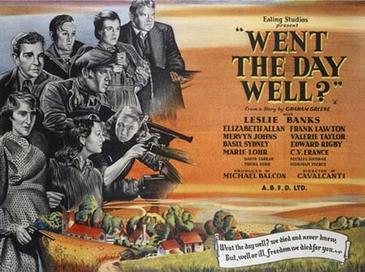
FORGOTTEN GEM? Went the Day Well? (1942)


                “Went the  Day Well?” is a propaganda curio from WWII Britain.  It was released in 1942 and although  the threat of Nazi invasion had dissipated, there was still a fear of a German raid and espionage activities.  People were also cognizant of Fifth Columnists living amongst the loyal British civilians.  The movie tapped into these fears and was a morale booster for a public which wanted confirmation that the British people would deal with these types of threats in their stiff upper lip style.  The film was based on a short story by Graham Greene entitled “The Lieutenant Died Last”.  It was directed by Alberto Cavalcanti.  The movie was a success with audiences and critics and has undergone a revival with the release of a restoration in 2010.

                The story is told in flashback form from a future where Great Britain has been victorious in the war.  A tourist in the village of Bramley is told the story behind the graves of German soldiers in the church cemetery.  On May 23, 1942, a lorrie full of British soldiers arrives in the village.  They are actually Germans who speak flawless English (as opposed to the American soldiers soon to arrive in England).  The village intellectual is suspicious, but makes the mistake of telling her suspicions to the local traitor who is able to explain away her concerns.  However, the Germans are eventually forced to lock the locals up in the church.  The people fight back and the village scamp goes for help.  With the cavalry on the way, the villagers attempt to take back their home.  This includes a spirited defense of the vicar’s house led by two feisty females from the Woman’s Land Army.  (The Land Girls were young ladies who volunteered to take the place of men in agriculture during the war.)

                “Went the Day Well?” is an underrated little gem.  It has a far-fetched plot which probably seemed near-fetched in 1942.  It was intended to be inspirational and educational.  The audience was taught to be wary and not to feel uncomfortable with killing Germans with axes (as one female character does).  There are some rousing heroes and heroines and some hissable villains.  The movie has some of the strongest female characters in any war movie.  Several women get in on the killing.  The villains are not caricatures.  The village and villagers appear stereotyped, but this is probably a realistic depiction of a rural British community from the 1940s.

                The movie is well-crafted.  The dialogue is good and acting is stellar from a classic British cast.  There is some excellent action and some gut-punching deaths.  In fact, the movie is refreshingly sober.  Although generally predictable (did you think the Germans would be successful?), how it gets to its feel-good ending is not obvious.  The suspense builds nicely.  And the traitor gets his.  It is a satisfying movie. 

                “Went the Day Well?” is from the “what if” subgenre and we will never know whether the British public would have reacted the way the fictional villagers do.  It seems likely that the movie is a “what would have been”.  Its depiction of how the various social classes come together to defeat the Nazis seems realistic.  The fact that the traitor is an upper class landowner also seems easy to believe.  Watching it made me wonder if the same thing would have happened in America during the war.  Certainly in New Iberia, but I have my doubts about the patriotism of many Northerners.  (That's a joke, my Yankee friends.)


GRADE  =  B

Sunday, November 27, 2016

NOW SHOWING: Allied (2016)


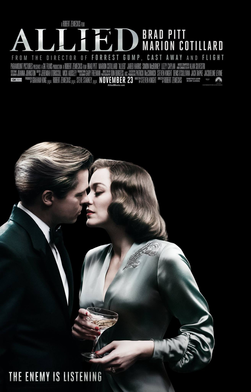
                The third in our series of war movies for this month is “Allied” starring Brad Pitt and Marion Cotillard.  They bring their star wattage to a WWII spy movie directed by Robert Zemeckis.  This is Zemeckis’ first war movie.  It was filmed mostly in London for $85 million.  The screenplay was by Steven Knight who claims it is based on a true story that he was told when he was 21.  Take that for what it’s worth.

                The movie opens with British spy Max Vatan (Pitt) parachuting into French Morocco in 1942.  A taxi delivers his genuine spy brief case which includes passports, weapons, and a wedding ring.  The taxi takes him to Casablanca where he meets a beautiful female spy named Marianne (Cotillard) who will masquerade as his wife.  Do you really want to remind people of a little old movie named “Casablanca”?  That’s some pretty big shoes to fill.  The script forces Max and Marianne to have a rocky start in their relationship.  Like in every romance ever filmed.  She is condescending and wears the pants in the partnership.  It is established early that she is a brilliant actress.  This will be a major plot point.  The mission is the assassination of the German ambassador at a party.  To get an invitation, Max has to get past a suave Nazi (August Diehl from the bar scene in “Inglourious Basterds”).  The movie actually does the old stunt hands shuffling cards routine.  Apparently Pitt was not willing to go to poker boot camp for his role.  Before the suicidal mission, Max and Marianne consummate their made in Hollywood romance in a car in a sand storm.  Points for originality with that setting.

                The assassination scene is surprisingly lacking in suspense and is not even close to suicidal.  In the post-coitaling of the Nazi glow, Max proposes and they return to Great Britain to an idyllic life with Blitz baby Anna.  Max is back to being an RAF wing commander, having apparently been on a spy lark in Morocco.  Time passes until the phone call comes.  It seems Marianne is suspected of being a Nazi agent.  Max must help ferret her out and then execute her if it turns out to be true.  They don’t plan on interrogating her or turning her into a double agent like every other German spy discovered in Britain during WWII.  According to the movie, killing his wife is routine procedure for an “intimate betrayal”.  It’s in the manual!

                “Allied” is not a bad movie, but it is forgettable.  It is too old fashioned.  And credit to the set designer and the costume designer for the period look.  You have to credit Zemeckis for not following the recent trend of defying all logic and physics.  That does not mean the movie does not have moments and plot developments that are fodder for “what was up with that?” or “why did the screenwriter throw that in?” discussions.  The answer to those question is invariably “because the plot needed it”.  I’ve already mentioned Max being put in a position where he may have to execute his wife.  Here’s another example.  In order for Max to be able to make a trip behind enemy lines for a crucial scene, the character has to be a spy / RAF pilot.  This is the kind of credulity straining you get in movies like this.  And then there are the plot developments that make no sense even if you factor in Hollywood.  Why is Max’s sister openly lesbian?  Is that cocaine someone is doing at a house party in 1940s London?

                Considering the stars, the movie is lacking in romantic spark.  The arc from disdain to impromptu proposal is too rushed.  Then we have a similar leap to marital bliss.  It just does not feel right.  The action does not take your mind off the flawed romance.  There are two underwhelming action set pieces.  In neither do you think Max and/or Marianne are in any real danger.  I will credit the movie with introducing enough red herrings to keep you wondering.  However, when the movie is over you will realize you were being manipulated the whole time.  It is a spy movie after all.  I just expected more than the usual. 

                I get psyched to go see war movies in a theater.  I get my clip board with my legal pad and I sit on the floor in the aisle so I can use the floor lights.  It’s not the most comfortable way to enjoy a movie, but I do it for my readers – both of them.  Since war movies are rare (except this month), I don’t get to do this very often.  For that reason I can’t be too harsh with a war movie I get to see in a theater.  It is disappointing when I see a war movie with the pedigree of “Allied” and realize a lot of talent was wasted on a tired story line.  There have been hundreds of war movies made, but there are still good stories to be told.  Including many true stories of actual events and people.  It angers me that the $85 million could have been spent on a movie about a real heroic spy like Vera Leigh, for instance.


GRADE  =  C

Friday, June 19, 2015

WTF? Firefox (1982)


                When “Firefox” was suggested as a possible participant in my dogfighting movies tournament, I had to consider watching it for the first time since it came out thirty two years ago.  I was only in my twenties when I first saw it and although normally a movie fan tends to be more tolerant in their earlier years of viewing, I clearly remembered being underwhelmed by the movie.  Since I have started this blog, I have sometimes found that I remembered movies too fondly, but I have rarely found that my first impression of duds was wrong.  Whenever I have not seen a war movie for decades, it was for good reason.  In this case, it would seem puzzling that I did not like it.  I am a big Clint Eastwood fan, I love air combat movies, and I enjoy James Bond.  “Firefox” is a combination of all three - so what’s not to like?

                Clint plays Vietnam veteran fighter pilot Mitchell Gant.  He is suffering from PTSD (like all other cinematic Vietnam vets in 1980s movies) and living isolated from society in a mountain cabin (like all other cinematic Vietnam vets who are not committing crimes in the cities).  The Cold War is going on and Gant must come out of retirement to save the free world from a super weapon called the MiG-31 Firefox.  It can go Mach 6, is stealthy, and its armaments are thought controlled.  It’s also a Transformer.  (Well, in the remake it will be.)  In the grand tradition of movies, since Gant is a fighter pilot, he can thus fly any fighter plane. Even a unique enemy plane that he has never seen the inside of.  In the grand tradition of the recent “Mission Impossible” movies, no spy mission is impossible.  All he has to do is infiltrate the Soviet Union with cursory espionage training, avoid the KGB which is on to him, sneak onto the super secure air base, replace the test pilot, and escape with the plane.  Piece of cake! 

I don't even speak Russian,
but this disguise will get me onto
the super secure base
                “Firefox” makes the most implausible James Bond movie look like a documentary.  This is possibly the most ludicrous espionage movie ever made.  But it is not camp ludicrous, it’s just terrible ludicrous.  I can’t think of another Clint Eastwood movie that is more embarrassing than this one and to make it worse, he directed it, too.  He does not even act well in it.  His attempt to portray PTSD symptoms is laughable.  This is not as readily noticeable since the rest of the cast is decidedly second rate.  In fact, a huge percent of the budget went to special effects.  This was not money well spent because as I was watching the effects seemed cheesy.  Apparently I was a fool because the cinematography used a new technique called “reverse blue screen photography” which I have been assured is awesome, not lame.  Fooled me! 
People are going to pay to see this crap and some are
going to thing it's good!  I love my job.
    
Much of the plot makes no sense and not in an overcomplicated Cold War tale sort of way.  It’s just moronic.  By the way, the plot is actually based on the defection of a Soviet fighter pilot to Japan in 1976.  Clint would have been much better playing disgruntled instead of shell-shocked.  And maybe something could have happened that could have happened.  At least Eastwood did not have the cheek to label the movie “based on a true story”.  He would have been truthful if he had put in a warning “based on a ridiculous screenplay”.


GRADE  =  F-


Sunday, May 24, 2015

FORGOTTEN GEM? Decision Before Dawn (1951)


                “Decision Before Dawn” is a black and white film directed by Anatole Litvak.  He filmed in post-war Germany for the ambiance provided by rubble. It was based on a novel by George Howe entitled Call It Treason which was inspired by the fact that the British and Americans used captured Germans as counterintelligence agents in the last months of the war.  These prisoners of war had various motives for helping.  The credits claimed that the movie was based on a true story with the names changed.  The movie was a surprise nominee for Best Picture.  Litvak thanked the U.S. Armed Forces and the French Army for cooperation.

                A narrator (Richard Basehart):  “Why does a spy risk his life – if he wins, he’s ignored.  If he loses, he’s shot.”  The quote is backed by a realistic firing squad execution.  The movie is set in Germany in December, 1944.  Col. Devlin (Gary Merrill) is recruiting German prisoners for spying behind enemy lines.  After a friend is “court-martialed” and killed by hard core Nazis for pessimism, a young soldier nicknamed “Happy” volunteers.  His motivation is the Germans have lost the war and his aid will shorten the war and free him sooner.  On the other end of the spectrum is “Tiger” who is a cynic who is in it for personal gain.  The duo are paired off with a skeptical Lt. Rennick (Basehart) for a crucial mission.  Rennick and Tiger will make contact with a German general who wants to defect.  Meanwhile, Happy will scout enemy troop dispositions on his own. 

                The movie concentrates on Happy’s odyssey (which is Homeric) and his interaction with a variety of Germans.  They range from defeatists to die-hards.  Some are sympathetically portrayed.  In his guise of a travelling German medic, Happy gets tabbed with serving a general.  The general is a good German common to Cold War depictions of German generals in cinema.  Instead of killing him, Happy saves his life when he has a heart attack.  This interlude provides him with the valuable intelligence that he sought and now it’s just a matter of returning.  He meets up with Rennick and Tiger in a safe house in Mannheim.  Only one will survive the return trip.

                “Decision Before Dawn” is a different take on the closing months of the war in Europe.  Enough time had passed to allow a more nuanced depiction of the German people in those chaotic days when some realized the war was hopeless and others wanted to continue the fight to the bitter end.  It was one of the first war movie to concentrate on the dissenters rather than the Nazis.  Coincidentally, "The Desert Fox" was released the same year.  Not only are the characters realistic, but the locales are amazing.  Six years after the war there were still areas of Germany that were war damaged.

                The acting is great.  Basehart is an underrated actor and he is matched by Blech (who so memorably played Pluskat in “The Longest Day”) and Werner.  Both were German veterans and ironically, the date that the Happy is captured (Dec. 8, 1944) was the exact date that Werner deserted.  The dialogue they are given is a cut above the usual WWII movie.  The screenplay is thought-provoking and unpredictable.  The hero is a traitor!  He is not “just another kraut” as a G.I. refers to him.

                I can’t recall how this movie showed up on my radar screen.  I had never heard of it and it is not well known (in spite of its Best Picture nomination).  I also had never given much thought to the use of German prisoners to spy on Nazi Germany.  The movie does an excellent job shedding light on that obscure program.  I like it when a war movie exposes the public to a little known aspect of history and does it in an entertaining and accurate way.  It reminded me of one of the first forgotten gems I posted on when I started my blog – "Time Limit".  That movie also starred Richard Basehart and dealt with collaboration.

                Forgotten gem?  Yes.  This movie deserves to be seen.


Grade =  B

Saturday, October 6, 2012

Enigma (2001)


               “Enigma” is a film by Michael Apted that was released in 2001.  It was partly meant to be an answer to “U-571”.   It is based the novel by Robert Harris.  The book and film are highly fictionalized accounts of the British code-breaking efforts at Bletchley Park in WWII.  Those efforts were based on captured Enigma machines.  Brilliant cryptanalysts worked to read German military messages.  In the movie, those messages involve routing u-boats to intercept a major convoy.

                The movie opens with Tom Jericho (Dougray Scott) reluctantly returning to Betchley Park after a nervous breakdown involving being jilted by beautiful fellow geek Claire (Saffron Burrows).   Jericho had earlier broken the “Shark” code when the Germans updated to a four rotor Enigma machine.  It doesn’t take long for Jericho to try to find Claire, but she is missing.  The movie becomes a mystery as Jericho attempts to find out what happened to Claire.  He finds evidence in her flat that she has been passing top secret information to someone and this may be connected to her disappearance.  His amateur sleuthing is aided by Claire’s friend Hester (Kate Winslet).  Will romance bloom?  Duh!

                Interwoven with the personal story is the bigger picture of saving the convoy by rebreaking the code.  The clock is ticking.  While Tom focuses with his comrades on doing their jobs, Hester uses an Enigma machine that she and Tom “borrowed” to read the intercepts they found in Claire’s room.  It turns out that Claire was in possession of a list of Polish officers executed by the Soviets in Katyn Forest.  The British government (represented by an agent named Wigram) wants to cover up the Katyn Massacre because it would damage their relationship with their allies, the Russians.  Claire passed the information on to another cryptanalyst nicknamed “Puck” (Nikolaj Waldau) who is Polish and had a brother whose name is on the list.  This humane gesture apparently backfired because the incensed Puck turns coat to rat out Betchley Park to the Germans to get revenge against Stalin.

                Jericho goes after Puck, but he’s not alone.  MI-5 agent Wigram (Jeremy Northam) is on to both of them.  It’s a cat and mouse game.  Puck escapes to Scotland where he hopes to hook up with a u-boat that will take him and his information to Germany.

                As far as historical accuracy, the movie is fine in depicting how Betchley Park operated and how the Enigma machine worked.  The cryptanalysts were probably not the heterogeneous characters as depicted in the film, but that is to be expected and makes the movie less bland.  In actuality, the Jericho character is based on a far from boring man named Alan Turing who was a big contributor to the code-breaking effort.  Turing was not your stereotypical geek because he was a homosexual who was later prosecuted for his sexual orientation and chemically castrated.  Not exactly the type to fall for Claire and Hester, but possibly the type to structure a more interesting movie around. 

                The movie is set in April, 1943 which is inappropriate for the secondary storyline of rebreaking the “Shark” code to save the convoy.  In reality, the German switch to a four rotor machine occurred in 1942 and had been solved for good by the time frame of the movie.  As far as the Katyn Massacre, it occurred in April and May of 1940 in the Katyn Forest in Poland.  The NKVD (the Soviet secret police) executed around 22,000 Polish officers.  The orders came from Stalin.  The movie’s Claire list is fictional, but it is true that the Churchill government knew who the villains were and yet supported the Soviet lies that the Nazis perpetrated the atrocity and he suppressed any contrary information.  The movie dramatizes a race against time to save a large convoy by solving the four rotor code, but that is not based on any actual situation.  The implication that a decision will have to be made whether to warn the convoy and thus jeopardize the code-breaking is intriguing although not really played out.  It is possibly based on the supposed decision by Churchill to allow the bombing of Coventry without warning the city.  This legend has been refuted, however.  The movie would have been more interesting if it focused on a fictional dilemma of “warn or not warn” instead of a romance/espionage plot.

                I mentioned that the movie was partly an answer to “U-571”.  If you are not familiar with that controversy, in this American movie the U.S. Navy is credited with acquiring the first Enigma machine.  In reality, the British deserve that credit.  The British were justifiably critical of that plot.  Ironically, “Enigma” can be similarly criticized.  Although briefly implied, the movie overlooks the fact that the Betchley Park operation got off the ground originally due to efforts by the Polish Cypher Bureau.  The Poles passed on their ground-breaking successes to the British.  That’s ironic, here’s what’s disgusting.  The movie (and book) incredibly makes the main villain a Pole!  At least “U-571” did not compound the offense by having a British member of the crew be a traitor.

                The movie is fairly entertaining.  The acting is satisfactory and the cast is appealing.  Special mention must be made of Kate Winslet who plays Hester as mousy.  She is not beautiful in this movie.  The chemistry with Scott is fine.  The suspense is tame, but thankfully the code-breaking is not headache inducing.  The movie just could have been a lot better and a lot more thought-provoking.  And by the way, this is not a war movie.

Rating – C+
 
the trailer
 
the full movie


TRAILER:  Pretty good.  Gives you an idea of the plot.  Overplays the action, of course.  The movie is not as fast-paced as implied.  B+
 
 
POSTER:  Nicely done.  Has the four main characters.  The convoy is a good touch.  A