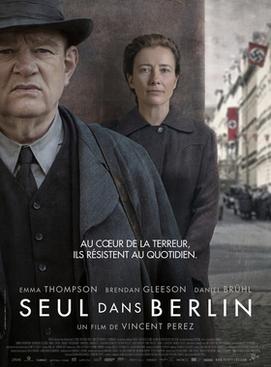
“Alone
in Berlin” is a movie about resistance to the Nazis. It was directed by Vincent Perez. The movie is based on the novel Every Man
Dies Alone by Hans Fallada. Fallada
was inspired by the story of Otto and Elise Hampel which he learned of through
their Gestapo file. The book was
published posthumously in 1947. It has
been made into a West German movie in 1962, an East German miniseries in 1970,
a movie in 1975, and a Czech miniseries in 2004.
Otto (Brendan Gleeson) and Anna Quangel (Emma
Thompson) are a working class couple living in Berlin. Their lives change when they receive word of
their son’s death fighting in France.
Otto takes it stoically and resumes his factory work seemingly
unaffected by the death. However, he
decides to channel his anguish into an act of civil disobedience against the
Nazis, who he blames for his son’s death.
He starts writing post cards with messages denouncing the war
effort. His first says “Hitler murdered
my son. He will murder your’s,
too.” He leaves the post cards around
town for strangers to pick up. Anna
joins in and their moribund marriage is rekindled. A police detective named Escherich (Daniel Bruhl)
takes on the case which he calls “Operation Hobgoblin”. He is a professional who appreciates the
challenge, but soon he comes under pressure from the Gestapo to catch the
traitors.
“Alone in Berlin” is based on a story that needed to
be told. We have so many Holocaust
movies, but so few movies covering the brave Germans who resisted against the
Nazi regime. The Quangels exemplify the
resisters. Their story is well told here
and is not as enhanced as you often see with most resistance films. Although this is commendable, the movie ends
up being a bit slight and predictable.
It follows the usual template for this type of cat and mouse plot. Unfortunately, there is a lack of suspense as
the mouse has no truly close calls. It
is not a movie that will have you on the edge of your seat.
The characters are stereotypical. Otto is the stoical average Joe who fights
the system. Anna is his partner in a
dull marriage, who insists on sharing his derring-do. A shared cause restores their love for each
other. The leads are what separates the
movie from a made for TV movie. Gleeson
and Thompson are perfect as the pair, but their unemotional characters leave
little opportunity for emoting. Gleeson,
in particular, never seems to change emotions.
This may be appropriate for a factory worker, but it reduces the
suspense of the movie. The movie comes
off as stolid as he is. It does not jerk tears as it clearly could have.
Escherich is the most fascinating character as he goes from pride in his
profession to disillusionment with law enforcement in the Third Reich. He is
not the villain, the movie adds a loathsome SS officer for us to hiss at. The movie also feels it is necessary to throw
in a Holocaust subplot involving an elderly Jewish neighbor of the Quangels. It seems the screenwriter felt it was not
enough that some Germans risked their lives against the Nazis because they
launched a war that killed thousands of young German men. However, the subplot is entertaining and the
movie would have been too short without it.
Then again, the movie could have been longer if it had covered the home
front. We really get no impression of
how the war is affecting other German common people. We also are unaware of the
effects of the post cards until the end.
“Alone in Berlin” is worth the watch and
informative. It is historically accurate,
in general. The liberties that are taken
with the original Gestapo file are acceptable to flesh out the story and bring
it to the screen.
GRADE = B-
HISTORICAL ACCURACY:
Otto Hampel was a factory
worker. His wife Elise was a domestic
servant who was a member of the National Socialist Women’s League. It was her brother who was killed in the war and
motivated them to leave the post cards.
The movie made a good decision to change the dead relative to their
son. This allowed for the marital
dynamic which is surely not accurate.
There were over 200 post cards from September, 1940 to the autumn of
1942. The statements on each card
covered ideas like don’t donate money to the Nazi regime, refuse military
service, avoid cooperation with the government, and overthrow Hitler. The Jewish subplot is probably fictional, but
certainly could have happened. In
reality, the Hampels were caught when they were turned in by a neighbor. The movie version is more entertaining. They were found guilty of treason and
beheaded.

