Showing posts with label Nazis. Show all posts

Friday, April 24, 2026

Nuremberg (2025)


            “Nuremberg” was written, directed, and co-produced by James Vanderbilt. He began research in 2013 after reading the book “The Nazi and the Psychiatrist: Hermann Goring, Dr. Douglas M. Kelley, and a Fateful Meeting of Minds at the End of WWII” by Jack El-Hai. He got Russell Crowe to star. Crowe was eight years older than the 53-year-old Goring. He reached 277 pounds for the role. Obviously the film was not filmed sequentially because Goering lost 65 pounds during his confinement. The film was nominated for several AARP Movies for Grownups awards: Best Supporting Actor (Michael Shannon), Best Screenplay, Best Ensemble, and Best Period Film. The movie was a box office success, making $73 million on a budget of $7-10 million.

            “What follows is based on the accounts of those who lived through it. And those who didn’t.” It is May 7, 1945, the day Germany surrenders. American soldiers watch a stream of refugees heading westward. One of the GIs pisses on a swastika. They stop a fancy car and Hermann Goring is captured. He is put in a prison with 23 other Nazi leaders. Supreme Court Justice Robert Jackson (Shannon) is appointed Chief Prosecutor at the Nuremberg Trials. In this position, he helps create an international code of laws governing war crimes. He insists the defendants deserve a fair trial. The fair trials includes having a psychiatrist interview the defendants to determine their mental capacity. Dr. Kelley (Rami Malek) is brought in for this job. He develops a relationship with Goring who he helps lose weight and kick his pervitin habit. (Pervitin was a methamphetamine that was given to German soldiers by the millions of pills.) Kelley enjoys verbal sparring with Goring, but he also has plans for writing a book about what made the Nazi leadership tick. Kelley acts a go-between for Goring and his wife and daughter, which was against the rules. Meanwhile, Jackson and his team are planning for the trial. They use footage of the death camps to show just how bad the “Final Solution” was. This builds to Goring’s time on the stand which is the moment he had been waiting for, confident that he will make fools of the prosecutors. He knows he will be found guilty, but loves the attention. The end is a foregone conclusion. However, the hangman is going to be disappointed.

            “Nuremberg” is a movie divided between two arcs that sometimes interconnect. The main core of the movie is the Kelley/Goring relationship. It is not quite the cat-and-mouse repartee that you would expect as the two men like each other and Goring is not trying to prove his innocence. He does insist he was not responsible for the death camps. Kelley is a strange bird as he violates orders, but sincerely cares about Goring’s wife and daughter and has some sympathy for Hermann. And yet, he becomes a spy for Jackson to help his prosecution efforts. There is some chemistry between Malek and Crowe. I don’t know how much Crowe fought for the role, but Goring is a fascinating person. Unfortunately, the film does not give him a lot of time on the stand. In fact, his confrontation with Jackson is something of a fizzle.

            The second arc is Jackson and his team preparing for the trial and then the trial itself. The movie glosses over the debate about whether Nazi leaders can be charged with crimes that did not exist before the war. There is no debate over the four charges that were arrived at. “Nuremberg” would seem to be a court room drama when it comes up short in that respect. Only Goring’s testimony is depicted and it is brief. By focusing on Jackson versus Goring, the film leaves the impression that Jackson wilted during the biggest moment in the trial. That may be true, but it is a disservice to his overall handling of the trial. There is no coverage of the defense offered for the defendants. The exoneration of two of the Nazis would have strengthened the theme of justice being served. And it would have been nice to know how their lawyers kept some off the gallows.

            The movie deserves credit for being mostly historically accurate. The transcripts from the trial were used for most of the dialogue in the trial scenes. The interactions between Kelley and Goring are accurate. And I assume his interactions with Streicher and Ley are probably true as well. I am confused that since there were 23 Nazis that Kelley interviewed, why were two of the least important ones focused on?

            I was disappointed in “Nuremberg”. It certainly is not in a league with “Judgment at Nuremberg”. The acting is excellent and is the main draw. As a behind the scenes look at the trial, it is interesting, but not fascinating. It provides Kelley with a traditional movie redemption that was not deserved, or true. It makes you wish that Goring versus Jackson had been given as much coverage as Goring versus Kelley.

GRADE  =  C+

HISTORICAL ACCURACY:  Goring’s arrest was actually arranged as far as the time and place. He was not trying to escape. Kelley had worked with thousands of PTSD (called combat fatigue) during the war. (He did dabble in magic.) His job was to determine the competence of the defendants to stand trial. He did use Rorschach tests. He did plan on using his findings to write a book. He worked with all the defendants, but spent more time with Goring than any of the others. Kelley did deliver letters between the Gorings. Emma did get arrested, but it was Bill Donovan of the OSS who got her released. Ley did commit suicide by hanging. Howie Triest was his translator and his back-story is accurate. He did emigrate to America in the 1930s and lost most of his family in the Holocaust. He only worked briefly with Kelley. The scene at the railway station where he opens up to Kelley was historical license. Dr. Gustave Gilbert (Colin Hanks) did work with Kelley. They had an adversarial relationship The fight did not occur, although Gilbert did have reason to be upset as Kelley broke their deal to publish a book together. Kelley did not work with Jackson on how to handle Goring. Kelley was not dismissed. He went home before the trial to be with his wife and write his book. Goring cried when he learned Kelley had left him. (Goring had wanted Kelley to raise his daughter if something happened to Emma as well as Hermann.) Having Kelley in the audience for the trial is necessary for plot purposes, but hard to justify historically. Kelley’s book “22 Cells in Nuremberg” was a flop. Americans were not interested in a theory that the Nazi leaders weren’t evil, he instead theorized they were opportunists motivated by ambition, immorality, and nationalism. It was Gilbert who had success with his books “Nuremberg Diary” and  “The Psychology of Dictatorship: Based on an Examination of the Leaders of Nazi Germany”. He believed leaders like Goring suffer from narcissistic psychopathy. 

              Jackson was torn a bit on accepting the job, especially since he was opposed to the death penalty. However, his belief in a fair trial convinced him to take on the daunting task of not only developing the law to cover the trials, but also prosecuting the Nazi leaders. (By the way, Elsie is his secretary, not his wife.) He believed in justice over vengeance. His dialogue in the trial scenes is almost verbatim from the transcripts. He gavegreat opening and closing statements, but Goring got the better of him as shown in the film. Sir David Maxwell Fyfe (Richard Grant) did save him. In reality, his questioning of Goring was not the overly simplified exchange of the movie. He broke Goring down by not responding to Goring’s baiting and he used persistent questioning to wear Goring down. It was not just Goring admitting he would still follow Hitler. The hanging of Streicher was accurate, as is Goring’s suicide. There is some belief that the hangman purposely put the Streicher’s noose so that he would not die immediately. Col. Burton Andrus (John Slattery) was a strict jailer, but the movie does not condemn him for gross negligence for not preventing the two suicides, especially Gorings since he clearly indicated he was not going to allow himself to be hanged.  

            The “adjustments” made to the facts are acceptable for a movie that is not meant to be a docudrama. The box office for a movie about Goring must have him smiling in Hell, but viewers do learn a good bit about the Nuremberg Trials. That is a good thing in today’s political landscape. Not that the movie is clearly commenting on that. It’s probably just a coincidence.      

Saturday, August 3, 2019

“Now Tarzan Go to War” – Tarzan Triumphs (1943)


          With the advent of World War II, M-G-M decided to dump the Tarzan franchise.  50% of the grosses had come from overseas markets which the studio had seen dry up.  Producer Sol Lesser and RKO were happy to pick up the rights.  M-G-M also traded Johnny Weismuller, Johhny Sheffield, and Cheetah, but not Maureen O’Sullivan.  The excuse was that O’Sullivan was a contract player, but the truth was that Mrs. O’Sullivan was sick of playing Jane and looked at the shift to RKO as a way out.  RKO cast Frances Gifford as the jungle babe.  She had caught eyes starring in a serial called “Jungle Girl”.   (Probably that credit on her resume was sufficient to get the role of “jungle girl”.)   M-G-M, in a dick move, refused to allow Lesser to use the iconic Tarzan yell.  The yell in the movie is abbreviated and weaker.  “Tarzan Triumphs” was the first RKO release after six made by M-G-M.  It was the first Tarzan movie that could be classified as a war movie.  The U.S. State Department encouraged Lesser to make a morale-booster.  This was something of a challenge considering previous films had made it clear Tarzan was a pacifist and previous outings had supported isolationism.  I’m sure director William Thiele, an Austrian, was up for the challenge.

                        For those in the audience concerned about the switch to RKO, the opening scene opens comfortingly with Boy (Sheffield) riding with Cheetah (sigh of relief!) on an elephant (Bully).  Boy says “ungawa”.  Jane may have taught Tarzan English, but Tarzan taught Boy Junglish.  Boy sees the lost city of Palandrya (it’s only a model) and then proceeds to fall off the cliff.  He is rescued by the Wonder Woman-looking Zandra (Gifford).   We learn that Jane is in London with her ailing mother.  She mentions the Blitz in a letter.  The war seems far away, but it intrudes via an “iron bird” carrying Nazi paratroopers.  A Captain Bausch had lived with the Palandryans and clued der Fuhrer in on their exploitable resources.  Their mission is to conquer the “haven of peace” (like they did to Austria).  This will be easier than Poland.  At first, Tarzan refuses to get involved.  “Jungle people only fight to live, civilized people live to fight.”  The only exception is if a jungle person’s son is captured by bad guys.  “Now Tarzan make war”.  So much for isolationism.

                        I had not seen a Weismuller Tarzan movie since my childhood.  I have fond memories, but as an adult I have learned that it’s usually not good to tamper with childhood movies.  They usually don’t hold up.  Plus, this Tarzan movie is a war movie, which means it was jumping genres.  I had no expectation that it would even be decent.  I watched it because my brother Jason is a huge Tarzan fan and he recommended it.  I was skeptical, but what the hell.  I have reviewed “The Incredible Mister Limpet”. 

                        If you are a Weismuller Tarzan fan and a war movie fan, this movie is right up your jungle trail.  The RKO features were lower budget.  The Palandrya set was recycled from “Gunga Din” (1939).  The movie makes up for the lower budget by upping the body count (a Tarzan record).  Fourteen Nazis are killed and they all deserve it.  The deaths are varied and range from being eaten by cannibal fish to being lured into a lion trap.  Most of the killings are done by Tarzan, but he doesn’t hog all the fun.  Boy kills one with a pistol and Cheetah uses a machine gun.  Because he’s Cheetah.  In fact, the movie would have been more accurately entitled “Cheetah Triumphs” or better yet, “Now Tarzan Go to War” (a line that drew applause from audiences). 

                        Thiele knows he is making a Tarzan movie, so he includes the swimming scene and the crocodiles and the vine-swinging.  It’s a war movie, but he doesn’t force in war footage.  Instead, we get the usual wildlife footage.  The swim scene involves some flirting with Zandra which would have enraged Jane, but did not impress the studio execs.  It was deemed that Gifford did not have enough chemistry with Weismuller so this was her last Tarzan film.  By the way, somehow she manages to change from her cleavagey Wonder Woman costume to more modest swimwear.  But then again, the Nazis packed pith helmets to replace their army helmets, so the movie is costume-fluid.  Thiele does not force some Tarzan tropes into a war movie.  Tarzan does not wrestle with a crocodile (or any other animal).  He does not enlist the animal kingdom.     However, he does rescue a damsel in distress and battles civilized villains.  It is a Tarzan movie, after all.

                        Weismuller was near the midway point of his Tarzan career and he is still virile and physical.  He is not at the O’Sullivan stage.  He doesn’t just go through the motions.  It helps that the cast is better than average.  The two main Nazi baddies are not buffoons and they don’t chew too much jungle.  More importantly, the sergeant is played by Sig Ruman (who played Schultz in “Stalag 17”).  He brings some comic relief, but comes out a distant second to the incomparable Cheetah.  That chimp was dynamite!  I recently watched several service comedies that had less laughs than were provided by that monkey.  Stick around for the end where Nazi officials mistake Cheetah for Hitler.

                        “Tarzan Triumphs” is the best Tarzan war movie.  I know it has little, or no, competition, but it is not a bad war movie.  It is a fun watch and it was able to make the leap to a different genre without embarrassing the series.  I would guess the State Department was pleased with it.

GRADE =  B-   


Wednesday, February 13, 2019

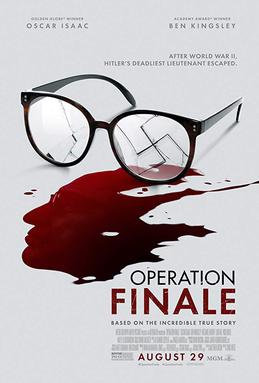
Operation Finale (2018)


                        Adolf Eichmann was the biggest Nazi fish that got away after WWII.  He infamously was in charge of transporting Jews to the concentration camps.  Unfortunately, his role was not well known until the Nuremberg Trials made him a most wanted man.  He managed to escape Europe and ended up in Argentina.  Eventually discovered, he was brought to Israel for a famous televised trial.  “Operation Finale” tells the story of the mission to abduct him and bring him to justice.  It is partly based on the nonfiction book Eichmann in My Hands by Peter Malkin.  Malkin is the main character in the movie, along with Eichmann.  The movie is directed by Chris Weitz whose father was a German Jew who escaped Germany in 1933.  He spent some years in Great Britain and then came to the U.S. where he served in the OSS during WWII.  He later wrote books including biographies of some Nazi leaders like Joachim von Ribbentrop.  Chris would proofread his father’s books.  He brought thirty-year Mossad veteran Avner Avraham in as technical adviser.  The movie was filmed in Argentina.  The movie theater where Sylvia first meets Klaus Eichmann was the actual theater where the real figures met.  In the movie, the film that is playing is “Imitation of Life” starring Weitz’ mother Susan Kohner.

                        The movie opens with the claim that with the suicides of Hitler, Goering, and Himmler, Eichmann was “the remaining mastermind of the Holocaust”.  Peter Malkin (Oscar Isaac) is introduced as a Nazi hunter in Austria in 1954.  Eichmann (Ben Kingsley) is living in Argentina under the name Peter Klement and is working at a Mercedes-Benz plant.  He lives outside Buenos Aires in an isolated farm house with his wife, young son, and adopted son Klaus (Joe Alwyn).   The Israelis have no inkling of his whereabouts until Klaus goes on a date with a girl named Sylvia.  On visiting Sylvia’s father (Peter Strauss), Klaus reveals the identity of his father.  Lotar Hermann is a concentration camp survivor and he contacts the authorities and the information is passed on to Mossad in Israel.  Rafi Eitan (Nick Kroll) is chosen to head up the project.  He chooses Malkin to head the team of abductors.  Malkin’s ex-girlfriend (Melanie Laurent) will go along to sedate Eichmann.  The plan is to positively identify Eichmann, kidnap him, bring him to a safe house, and then fly him to Israel on an El Al airliner.  It won’t be a spoiler to tell you that not everything goes according to plan.

                        “Operation Finale” is a well-crafted history lesson.  It combines the Holocaust and espionage subgenres.  The narrative is fairly straight forward and includes the usual cloak and dagger aspects of a spy movie.  The Holocaust references come through flashbacks.  Malkin’s character development involves flashbacks (really more nightmares) about the fate of his sister and her three children who died in the Holocaust.  He imagines various ways they may have died, including being placed in a poison gas van.  These scenes are effective in developing Malkin’s motivation.  How will he justify keeping this monster alive long enough to trial?  Isaac is excellent as Malkin.  He does not overplay the revenge motive.  Malkin is a professional and not even the team member who most questions the humane treatment of Eichmann.  The most indelible scenes are when Malkin and Eichmann talk as Malkin tries to convince the man responsible for the death of his sister to sign a document agreeing to go to Israel for trial.  These scenes are reminiscent of “Downfall” as they tend to humanize Eichman as that movie humanized Hitler.  To its credit, whenever “Operation Finale” has you thinking maybe he was “just following orders”, it follows with a flashback that proves he was more than just a clerk.  Kingsley is empathetic and menacing as Eichmann.  He carried a picture of Elie Wiesel to remind him what was at stake. The rest of the cast is very good.  Melanie Laurent is thrown in as Malkin’s love interest, but is not given much to do other than provide a female for the team.  It’s fun to watch Nick Kroll in a dramatic role and he is fine.

                        The movie does not really break new ground.  The plot is standard for this type of movie.  There is suspense, but it is dampened by the fact that you know they will succeed and you suspect it has been enhanced through artistic license (see below).  It has some clichés like redemption for the roguish Malkin.  There is some artificial dysfunction between Malkin and the orthodox interrogator and with the “let’s just kill him” agent.  The ex-girlfriend dynamic is mercifully rote.
 
                        The reason to watch this movie is for the history lesson which is done entertainingly.  Although it takes some artistic license for entertainment purposes, the movie is strong in historical accuracy.  It is not a docudrama.  The acting sets it apart from that type of movie.  Everyone knows about the Holocaust and the movie simply reminds us of the horror of it, but it is mainly focused on one of the great detective stories of the 20th Century.  The trial of Eichmann (which is just post-scripted in the movie) brought the Nuremberg Trials to a worldwide television audience.  By the way, Netflix streaming has a good movie on the trial called “The Eichmann Show”.  What “Operation Finale” does is bring Eichmann’s story to a 21st Century audience.

GRADE  =  B

HISTORICAL ACCURACY:   The movie does not make clear how Eichmann ended up in Argentina, although it is clear that it was Argentina because of its pro-Nazi government.  In reality, Eichmann was captured by U.S. forces at the end of WWII and put in a prison camp but he had a false identity that allowed him to blend in as a generic prisoner.  When he discovered that he was about to be discovered, he escaped from a work detail and assumed a new identity.  He bounced around Europe until he was able to get documents through Nazi sympathizers to get to Argentina.  He arrived in 1950 as Peter Klement.  His wife and sons came in 1952.  The movie accurately depicts his family.  After a series of low-paying jobs he did get a job at Mercedes-Benz.  In 1960, they moved to the house on Garibaldi street and he did ride a bus to work. 

                        Eichman was not really infamous until Rudolf Hoess, the commandant of Auschwitz, ratted him out at the Nuremberg Trials.  Famed Nazi hunter Simon Wiesenthal learned from a letter that he had been seen in Buenos Aires, but the trail was cold until in 1956.  Lotar Hermann (who had escaped Dachau after being severely beaten and losing sight in one eye) determined that Peter Klement was Eichmann through talking to his daughter Sylvia’s boyfriend Klaus.  Sylvia did go to Eichmann’s house to confirm this.  Hermann contacted the prosecutor general of Hesse, Germany with the information and Fritz Bauer passed the information to Mossad in 1957.  Prime Minister Ben-Gurion personally ordered the abduction project.  The team was headed by Rafi Eitan, although he was skeptical at first, unlike in the movie.  The team arrived in 1960 and put Eichmann under surveillance similar to the film.  The capture was very close to the cinematic reenactment with the not-surprising exception that the second bus was actually a half hour later.  They spent nine days at the safe house and the big stumbling block was getting Eichmann to sign the agreement to allow himself to be taken to Israel for trial.  Malkin did talk him into it after several one-on-one conversations. He later admitted that the conversations caused him to realize Eichmann was a human being, not a monster.  I doubt there was the dysfunction with the main interrogator Zvi Aharoni or a moment when one of the team almost killed Eichmann.  One of the team members was a doctor who sedated Eichmann, but he was male.  The Hanna character is fictional, but Malkin is fairly represented.  He did lose a sister and her children in the war.  They died at Auschwitz.  Malkin was one of Mossad’s greatest agents.  He was also a good artist, as shown.
 
                        Not surprisingly, the movie goes off the historical rails in its attempt at a rousing finish.  They did disguise Eichmann as an airline crew member and he was sedated to look drunk, but the egress was actually suspense-free.  They did not leave the safe house in the nick of time and there were no problems getting on the plane and taking off.  Klaus and the Argentinian Nazis were not in hot pursuit, but they did arrive at the air port a half hour too late.  Malkin was not involved in the take-off, he stayed at the safe house to clean things up.  He took a train to Chile and eventually flew to Israel.

Wednesday, October 3, 2018

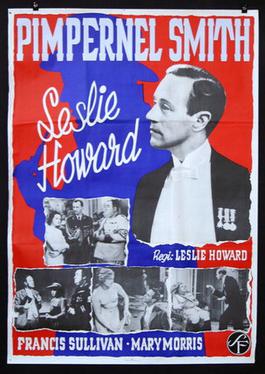
CLASSIC OR ANTIQUE? Pimpernel Smith (1941)


                In 1934, Leslie Howard made a classic movie called “The Scarlet Pimpernel”.  It was the tale of a British aristocrat who used his quick wits and disguises to rescue Frenchmen during the Reign of Terror of the French Revolution.  Seven years later, he revisited the premise and applied it to the situation in Europe right before the outbreak of WWII.  Howard was inspired by the story of the rescue of an anti-Nazi Hungarian leader.  He worked on the project for three years and ended up producing and directing.  The film was a big hit in Great Britain.  It was released in America as “Mister V” (I have no idea why they renamed it).  Churchill chose to show it to the officers of the HMS Prince of Wales on his way to meeting FDR for the conference that resulted in the Atlantic Charter.  When Raoul Wallenberg saw it in Sweden, it inspired him to rescue numerous Jews from the Holocaust.  The movie has some major street cred.  The movie claims to be a fantasy based on real people and events, but you should view it as preposterously entertaining propaganda.

                Howard plays Horatio Smith.  Smith is a professor of antiquities at Cambridge University.  He is absent-minded and anti-female.  No one would guess he is the daring “shadow” who has been sneaking Nazi targets out of Germany.  The mission portrayed in the movie is to rescue a German pianist who is anti-Nazi.  He plans to do this via a Nazi approved archeological dig that he tells them will prove the German civilization has Aryan beginnings.  So, if you’re wondering how a British professor has the opportunity to be rescuing right under Nazi noses, there you have it.  Don’t overthink.  The professor takes six of his students with him, including a brash American (I know that is redundant) named David (Hugh McDermott).   They will piece things together (the clue comes from a wound Smith gets while masquerading as a scarecrow!) and end up teaming up with their prof.  Smith’s nemesis is a Goering-like Gestapo chief named von Graum (Francis Sullivan).  He is pompous, but not buffoonish.  However, he does not get snark well.  He suspects Smith and their interplay is the highlight of the movie.  The movie has a running joke about von Graum’s claim that Shakespeare was German.  At the end of one of their exchanges, Smith says “Parting is such sweet sorrow.”  When Von Graum asks “what is that?”, Smith responds with “One of the most famous lines in German literature”.  To show the level of intelligence of the script, Smith refers to the theory that the Earl of Oxford wrote Shakespeare’s plays.  Von Graum sics  Ludmilla (Mary Morris) to flirt the truth out of the Professor and provide us with romance. 

                “Pimpernel Smith” is an entertaining propaganda piece from WWII Britain.  It is a showcase for the wonderful Leslie Howard.  He made it because he felt he needed to weigh in on the Nazi threat and show Brits what they were fighting for.  It was one of the first movies to reference the concentration camps, although the scene in one of them is ludicrous and far from showing the horrors of the Holocaust.  The movie’s theme is more of a fist in the face of the Nazis.  The movie closes with the obligatory speech by Smith which concludes with him promising Von Graum:  “I shall be back.  We should all be back.”  That is a bit trite, but most of the dialogue is crisp and there are some humorous lines.  Smith describing a skeleton uncovered at their dig:  Buried with all his weapons, you see, presumably, in the belief that there might be a rearmament program in the hereafter, eh, Mr. Spencer? An ancient Teuton.”  Howard dominates the movie.  He has a bravura scene where he goes to Gestapo headquarters in disguise and snarks the hell out of them.  (The scene reminds of “To Be or Not to Be”.)  The rest of the cast is average, except Sullivan who makes Von Graum a worthy adversary.  He is atypical for a comedy Nazi.  Otherwise the movie is predictable, but you expect that.

                “Pimpernel Smith” is available on You Tube and is well worth a watch.  Although not particularly well known, it is a classic and it stands the test of time well because the dialogue is intelligent.  The words balance the silliness and Howard moves it to a B.

GRADE  =  B

Thursday, May 10, 2018

CRACKER? Judgment at Nuremberg (1961)


                “Judgment at Nuremberg” is another of Stanley Kramer’s “message movies” like “Guess Who’s Coming to Dinner?” and “Inherit the Wind”.  This time he decided to be one of the first to take on the Nuremberg Trials and the Holocaust.  He was inspired by a teleplay that aired on Playhouse 90.  He got Abbie Mann to adapt the screenplay for the big screen.  He then convinced Spencer Tracy to lead the cast.  Tracy loved the script and liked working with Kramer.  He made the film in spite of a kidney ailment and ill health due to years of alcoholism.  The cachet of Tracy brought several other all-stars to the production.  Most agreed to take substantially less of their normal salaries because of the social importance of the movie.  The cast included three actors who were problematic:  Marlene Dietrich, Judy Garland, and Montgomery Clift.  Dietrich was difficult on set and insisted on special lighting and wanted her lines rewritten, which Kramer denied.  Garland had not made a movie in seven years and had a reputation for being difficult.  She was uncharacteristically fine for this production.  However, she had trouble getting into character.  Clift binge-drank through his participation, which actually enhanced his performance.  The movie was a minor hit (but did not do well in West Germany because most Germans did not want to reopen old wounds).  It was critically acclaimed although there were some that questioned Kramer’s directing.  It was nominated for eleven Academy Awards and won for Best Actor (Maximilian Schell) and Best Adapted Screenplay (Mann).  Kramer received the Irving Thalberg Memorial Award.

                Mann based the screenplay on the Judge’s Trial of 1947.  This was one of the twelve U.S. military tribunals (known as the Subsequent Nuremberg Trials) that followed the main trials.  16 jurists and lawyers were on trial.  Most were members of the Reich Ministry of Justice and the others were prosecutors and judges of the Special Courts or People’s Courts.  The main charge was furthering the “racial purity’ program including eugenics. Specifically, the defendants were accused of judicial acts of sterilization and persecution of people for religious, racial, political reasons or for disabilities.  This particular trial was held from March 5-December 4, 1947.  Ten of the sixteen defendants were found guilty and most were given life sentences (although all got out in a relatively short time).  Mann also incorporated the Katzenberger Trial which involved an elderly Jew who attempted to seduce a sixteen year-old Aryan girl in violation of the Nuremberg Laws.  He was sentenced to death.

                The movie opens with the iconic shot of the blowing up of the swastika at Nuremberg Stadium.  The movie takes place in Nuremberg in 1948.  The trial is of what seems to be small fry – four Nazi judges.  Tracy plays the presiding judge Dan Haywood.  He is modest about his abilities and is determined to understand as well as judge.  As part of his process, he befriends the widow  (Dietrich) of a German general who was executed for his role in the Malmedy Massacre.  Haywood is not locked into finding the defendants guilty.  The prosecuting attorney is Col. Ted Lawson (Richard Widmark) who, in an emotional opening statement, makes it clear that all Germans are to blame for the depredations of the Nazis. On the other side, defense counsel Hans Rolfe (Schell) argues that the men had no choice because they would have been considered traitors if they had refused to carry out the laws.  Clift plays an intellectually-challenged man who was forcibly sterilized.  Garland plays a woman who was a sixteen year-old girl who had relations with a Jewish man resulting in his execution.  They both have memorable stints on the witness stand.  Lawson uses their testimony to nail the four judges who handled cases like these.  Lawson himself makes a trip to the witness stand to narrate footage of the liberation of the death camps.  The footage includes piles of naked corpses and bulldozers being used to inter them.  

                The climactic moment in the film is the testimony of Ernst Janning (Burt Lancaster) who had been a famous and respected jurist and scholar before the war.  Janning is pleading guilty, but explains that good people went along with the Nazis because they thought the injustices would be temporary.  Rolfe uses his closing argument to reference how the Allies shit stank too.  He mentions Oliver Wendell Holmes defense of eugenics and Churchill’s early praise for Hitler.  And, of course, he can’t go without bringing up Hiroshima.  It’s up to Haywood and the other two judges to decide the fate of the accused.

                “Judgment at Nuremberg” is a thought-provoking film.  It explores several themes.  One is whether international law takes precedent over national law.  In other words, should the defendants refused to enforce laws they should have known were wrong.  Another is how can the Allies condemn actions that were not that much different than injustices they perpetrated.  Many American states had eugenics and/or miscegenation laws at the time.  The movie only hints at the hypocrisy of that situation.  After all, the movie was made during the Cold War and no studio would have financed an indictment of America.  In fact, the movie uses the breaking out of the Berlin Blockade to make the case that the trial was influenced by the desire to not offend West Germany too much during the crisis.

                The real strength of the movie is the acting.  Kramer makes great use of his outstanding cast.  This is definitely an actors’ movie.  The stunt casting of Dietrich, Garland, and Clift works, especially if you know their backstories.  Clift, in particular, is amazing given what he was going through in his personal life.  In fact, Kramer used his mental instability to get a great performance out of him.  It was a gamble.  Clift was drinking so heavily that he could not remember his lines.  Kramer allowed him to ad lib most of his testimony.  It worked.  Tracy glues it all together and gets to give a closing speech that was eleven minutes of one take.  But acting honors go to Schell.  He won the Best Actor Oscar even though he was fifth billed.  His nomination with Tracy was a rare double nomination and even rarer victory for one of them.  Speaking of great actors, Werner Klemperer recreated his role of the unrepentant judge from the Playhouse 90 production.  Klemperer was a Jew whose father’s family had fled Nazi Germany.  He insisted that if he played German roles they had to be negative characters or buffoons.  Col. Klink was the latter.

                The acting distracts from the length and preachiness of the movie.  It is typical Kramer.  Kramer was criticized by many for this aspect of his “message movies”.  I think this was unjust.  He took chances with his topics and those movies were significant.  They may seem tedious to some, but he was sincere.  He also took some grief for showy cinematography in this film.  Most famously for a shot where the camera makes a 360 degree circuit around Widmark during a monologue.  Kramer admitted later that it was a bit overblown.  I thought it was cool and I liked the frequent use of deep focus.  If you are not a critic whose job is to get upset about cinematography stunts, such shots can be interesting.

                Will “Judgment at Nuremberg” crack my 100 Best War Movies?  It could.  It is a must-see.  It is a rare war movie that makes you think and examine your conscience.  A key part of the script is that the audience wonders what Haywood’s final decision will be.  It could go either way.

GRADE  =  B+


Monday, March 12, 2018

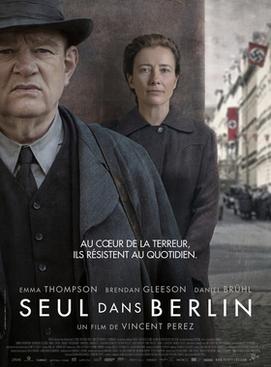
Alone in Berlin (2016)


         “Alone in Berlin” is a movie about resistance to the Nazis.  It was directed by Vincent Perez.  The movie is based on the novel Every Man Dies Alone by Hans Fallada.  Fallada was inspired by the story of Otto and Elise Hampel which he learned of through their Gestapo file.  The book was published posthumously in 1947.  It has been made into a West German movie in 1962, an East German miniseries in 1970, a movie in 1975, and a Czech miniseries in 2004.

                Otto (Brendan Gleeson) and Anna Quangel (Emma Thompson) are a working class couple living in Berlin.  Their lives change when they receive word of their son’s death fighting in France.  Otto takes it stoically and resumes his factory work seemingly unaffected by the death.  However, he decides to channel his anguish into an act of civil disobedience against the Nazis, who he blames for his son’s death.  He starts writing post cards with messages denouncing the war effort.  His first says “Hitler murdered my son.  He will murder your’s, too.”  He leaves the post cards around town for strangers to pick up.  Anna joins in and their moribund marriage is rekindled.  A police detective named Escherich (Daniel Bruhl) takes on the case which he calls “Operation Hobgoblin”.  He is a professional who appreciates the challenge, but soon he comes under pressure from the Gestapo to catch the traitors.
 
                “Alone in Berlin” is based on a story that needed to be told.  We have so many Holocaust movies, but so few movies covering the brave Germans who resisted against the Nazi regime.  The Quangels exemplify the resisters.  Their story is well told here and is not as enhanced as you often see with most resistance films.  Although this is commendable, the movie ends up being a bit slight and predictable.  It follows the usual template for this type of cat and mouse plot.  Unfortunately, there is a lack of suspense as the mouse has no truly close calls.  It is not a movie that will have you on the edge of your seat. 

                The characters are stereotypical.  Otto is the stoical average Joe who fights the system.  Anna is his partner in a dull marriage, who insists on sharing his derring-do.  A shared cause restores their love for each other.  The leads are what separates the movie from a made for TV movie.  Gleeson and Thompson are perfect as the pair, but their unemotional characters leave little opportunity for emoting.  Gleeson, in particular, never seems to change emotions.  This may be appropriate for a factory worker, but it reduces the suspense of the movie.  The movie comes off as stolid as he is. It does not jerk tears as it clearly could have. Escherich is the most fascinating character as he goes from pride in his profession to disillusionment with law enforcement in the Third Reich.   He is not the villain, the movie adds a loathsome SS officer for us to hiss at.  The movie also feels it is necessary to throw in a Holocaust subplot involving an elderly Jewish neighbor of the Quangels.  It seems the screenwriter felt it was not enough that some Germans risked their lives against the Nazis because they launched a war that killed thousands of young German men.  However, the subplot is entertaining and the movie would have been too short without it.  Then again, the movie could have been longer if it had covered the home front.  We really get no impression of how the war is affecting other German common people. We also are unaware of the effects of the post cards until the end.

                “Alone in Berlin” is worth the watch and informative.  It is historically accurate, in general.  The liberties that are taken with the original Gestapo file are acceptable to flesh out the story and bring it to the screen. 

GRADE  =  B-

HISTORICAL ACCURACY:   Otto Hampel was a factory worker.  His wife Elise was a domestic servant who was a member of the National Socialist Women’s League.  It was her brother who was killed in the war and motivated them to leave the post cards.  The movie made a good decision to change the dead relative to their son.  This allowed for the marital dynamic which is surely not accurate.  There were over 200 post cards from September, 1940 to the autumn of 1942.  The statements on each card covered ideas like don’t donate money to the Nazi regime, refuse military service, avoid cooperation with the government, and overthrow Hitler.  The Jewish subplot is probably fictional, but certainly could have happened.  In reality, the Hampels were caught when they were turned in by a neighbor.  The movie version is more entertaining.  They were found guilty of treason and beheaded.


Saturday, February 11, 2017

FORGOTTEN GEM? It Happened Here (1964)


                If you are an American and watch hundreds of war movies, you will eventually run across “It Happened Here”.  It is a unique film.  It was the brainchild of two teenagers.  Eighteen year old Kevin Brownlow got the idea when he saw some thuggish looking men wearing leather coats come screeching up in a car and go storming into a house.  He thought “what if?”.  An alternative title for this alternative history is “It Happened Here:  The Story of Hitler’s England”.  Brownlow asked a history buff named Andrew Mello to help him.  The sixteen year old soon became Brownlow’s collaborator.  They spent eight years on the project, making it one of the longest productions in cinema history.  Brownlow went on to become a famous film historian and recipient of an honorary Oscar for film preservation.  Mello is now a well-respected military historian.

                The movie is set in 1944 England.  A narrator informs us that England fell to the Nazis after the retreat from Dunkirk in 1940.  The resistance movement had been crushed, but the success of a Soviet offensive has led to the withdrawal of a large part of the occupation forces and a revival of the resistance.  American soldiers have recently arrived to aid the insurrection.  The country is being ruled by British Union of Fascists which is a political party of collaborators.  The counterinsurgency is comprised of police collaborators and German S.S.  Most of the public is acquiescent of the occupation.  At least the Nazis are better than the Bolsheviks.  The government’s counterinsurgency strategy is to remove civilians from zones where the resistance is powerful.  Massacre of civilians deemed disloyal is also part of the strategy.

                The main character is a nurse named Pauline (Pauline Murray) who is initially apolitical.  This changes when she barely survives an ambush by rebels which kills several of her friends.  She ends up in London and gets a job with the government’s paramilitary ambulance corps.  The training includes firearms.  Indoctrination encourages her evolution towards collaborating.  At one point she goes to a theater where a propaganda film uses the Christmas Truce of WWI as an example of the true love of the British and Germans!  Also, Waterloo is an example of Anglo-German cooperation.  And International Jewry has brought on WWII.  Later, there is a discussion of how the Jews are evil and inferior.  A character refers to them as “fleas on a dog” and argues for euthanasia to get rid of “useless” people.  Pauline does not succumb to these odious views, but she does take the realistic attitude that since England lost, they should be happy with law and order.  Her evolvement is sidetracked by an encounter with two respected friends who are harboring a rebel fugitive and her posting to a hospital that disposes of incurables through “cleansing operations”.

                “It Happened Here” is an amateur triumph.  The fact that it was made by two young men is astounding.  Brownlow and Mello used a shoe-string budget and unpaid actors to accomplish the eight year task.  The actors, including Pauline Murray, were amateurs but this added to the natural feel of the acting.  Some of the scenes look unrehearsed.  The duo used actual British fascists, some of whom were playing themselves.  They also made use of German veterans.  Although the movie is in black and white and was shot with 16mm film, the cinematography is noteworthy.  Peter Suschitzky was lensing only his second film and went on to a distinguished career.  His greatest feat in “It Happened Here” is the recreation of newsreels and fake archival footage.  Even the battle scenes have the look of real footage.  In this respect they resemble the assault on the air base in “Dr. Strangelove”.  (Coincidentally, Stanley Kubrick donated some film stock from that film.)
 
                The movie is thought-provoking.  The theme is that fascism can rise anywhere and a majority will accept it.  From that foundation the movie proceeds to chronicle the result of that.  It does not take sides between the collaborators and the rebels.  There is a feel of “a pox on both houses” to it.  This is clear in the bookending of the movie with dueling atrocities.  Murray’s character arc is a bit unrealistic as she stands in for the rare individual in those circumstances who starts out neutral and then moves from one side to the other.  She is not typical of the average Britain who accepted the status quo in exchange for security.  The movie was controversial because of its insinuation that it could have happened in England if it had not won the Battle of Britain.  This is also unrealistic, but doesn’t detract from the plot.  Surprisingly, the collaborators are not villainized.  The movie was decried by Jewish groups partly for its use of British fascists.  More problematic is the references to the Jews.  Some of the dialogue is repulsive and there is no rebuttal.  United Artists insisted on cutting some of the anti-Jewish rhetoric for its American release.  Needless to say, Brownlow and Mello did not have the clout to prevent this.

                “It Happened Here” is a must-see for hard core war movie lovers.  It is definitely a forgotten gem here in America and I had never heard of it until recently.  I certainly would never have seen it if I had not undertaken this blog.  Another perk of my hobby.  Not only did I see a unique film, but the researching of it informed me of some fascinating facts.  In the movie, we see on the walls of government offices portraits of Oswald Mosley (alongside Hitler).  I now know that Mosley was a British politician who founded the British Union of Fascists in 1932.  Mosley was a big fan of Mussolini and wanted Great Britain to go the route of Italy.  Unoriginally, his followers were called “blackshirts”.  The party was condemned in 1940 and he was interred for the rest of the war.  The movie imagines if things had gone in the opposite direction.  It is not unimaginable that had England fallen, he would have been released by the Germans and appointed puppet ruler.  It is unimaginable that the British people would have accepted this, but it sure makes for an interesting movie.


GRADE  =  B-  

Monday, September 5, 2016

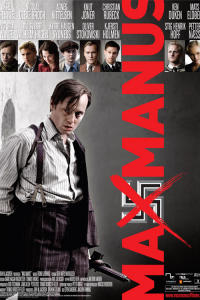
SHOULD I READ IT? Max Manus: Man of War (2008)


                “Max Manus:  Man of War” is a Norwegian film about a famous Norwegian hero.  It is a biographical war movie that is based on Manus’ biographies and other historical research.  The film was a major production and used 1,800 extras and 2,000 people behind the cameras.  Parts of Oslo were adapted to represent the 1940s including flying Nazi Germany flags above public buildings.  The movie was a big hit in Norway and won numerous awards.  It was Norway’s submission for Best Foreign Film for the Oscars.

                The movie opens with Manus (Aksel Hennie) fighting in the Winter War in Finland.  He is in the middle of a battle.  The movie then jumps to him in a hospital bed.  The plot is nonlinear and will return to the Winter War battle as a framing device.  When he returns to Norway, Manus joins the Resistance.  He and his buddies form a group and put out a propaganda paper.  They are like frat boys enjoying the adrenaline rush.  Many of those friends will not survive the war.  After being captured by the Gestapo, Max escapes to Great Britain.  In Scotland, he is trained in sabotage.  In particular, the new unit targets German shipping in Oslo harbor.  Operation Mardonius involves sneaking around the harbor after dark to lay Limpet mines.  The mines would be hand-placed below the waterlines.  Every superhero needs a supervillain.  Gestapo agent Fehmer plays this role.  He hounds Manus and his Oslo Gang.  The pressure wears on Max and he shows symptoms of PTSD.  He is still able to go for one last big score.  The target is a munitions ship called the Donau.  Even a Norwegian movie needs a huge explosion, right?

                Based on my research, the movie appears to be accurate.  Of course, much of this depends on the veracity of Manus’ recollections.  Some have called into question whether he actually fought in the Winter War, but the consensus is that he did.  This is fortunate because the scenes flashing back to the battle juice up the film and are a good framing device.  The rest of Manus’ acts are believable.  His superhero actions are balanced with some luck.  For instance, he is lucky that the Gestapo was incompetent.  At one point he is left virtually unguarded in a hospital and he is able to escape.  This in spite of his being one of the most wanted men in Norway.  The sabotage efforts in the harbor take advantage of laughable security.  These missions must have been accurate, otherwise the screenwriter would have added more suspense to the film.  His trips back and forth to England are not fraught with tension.  Most of the tension in the movie comes from Manus’ reaction to the loss of friends.  One theme of the movie is survivor’s guilt.  Hennie does a good job portraying this.  The acting overall is fine.
 
                “Max Manus” is a middle of the road Resistance movie.  It is certainly inferior to its closest relative “Flame and Citron”.  This does not make it a bad movie.  There is some interesting cinematography.  The dialogue is fine, if unmemorable.  As a history fanatic, the accuracy is a big plus, but is also a weakness since the movie lacks suspense.  To tell the truth, after watching the movie, I wondered why Manus is such a national hero. 


GRADE  =  B-

Wednesday, January 6, 2016

QUEUE CLEANSING: Man Hunt (1941)


                “Man Hunt” was one of the first anti-Nazi movies to come out of Hollywood before U.S. entry into WWII.  It was directed by Fritz Lang ("Ministry of Fear").  Lang was born in Austria and although raised Roman Catholic, he was classified by the Nuremberg Laws as a Jew.  He emigrated to America and resumed his movie-making career in Hollywood.  It was his choice to film the novel Rogue Male by Geoffrey Household.  The novel got positive reviews for its taut and exciting spy chases.  The movie also did well for the same reasons.  It is propagandistic, but Lang does not let his personal feelings ladle it on too thick.  By the way, Daniel Zanuck tried to keep Lang from having editorial control for fear the movie would be too harsh on the Nazis.  Lang secretly edited it anyhow which partly explains why the movie manages to violate the Hays Office rule of having some good Germans to balance the bad ones.

                Walter Pigeon plays renowned big game hunter Alan Thorndike.  The movie opens with him stalking Hitler at Berchtesgaden.  When der Fuhrer appears in his sights, Thorndike at first pulls the trigger on an empty chamber.  He then puts in a live round, but before he saves the world, he is captured.  After being tortured off screen because the Hays Office refused to allow the showing of Nazi brutality, Thorndike is interrogated by a monocled Nazi named Maj. Quive-Smith (George Sanders).  Thorndike insists he was just doing a “sporting stalk” (a better title for the movie) and had no intention of killing Hitler.  Monocle wants Thorndike to sign a confession that he intended to kill Hitler and he was working for the British government.  He, of course, refuses. Option two is to throw Thorndike off a cliff.  He survives the fall and a chase straight out of a Mississippi chain gang film.  Thorndike stows aboard a Danish ship where he is aided by a cabin boy named Vaner (Roddy McDowell in his first role – he had been evacuated to the States from Blitz-ravaged London).  Back in England, Thorndike is tailed by a sinister “walking corpse” named Jones (John Carradine acting by muscle memory).  Thorndike takes refuge with a cockney lass named Jerry (Joan Bennett).  She’s a prostitute except that the Hays Office insisted a sewing machine be placed in her flat so maybe she is a seamstress or something.  Jerry and Alan have their own theme music – “A Nightingale Sang in Berkeley Square”.  It’s both of their ring tones.  Jerry introduces him to fish and chips and eating with your fingers and he shows her how a gentleman pulls a chair out for a lady.  Thorndike uses the word “minions” to describe his pursuers who are so persistent that he ends up hiding in a cave.  This does not stop Monocle from finding him and coercing the confession out of him.  Thorndike is in the cross hairs like all the innocent animals he has slaughtered.  Unlike all his victims, he has the ability to fashion a weapon out of a bed slat, a belt, and poetically justified pin he had given to Jerry.


                “Man Hunt” was meant to be fun entertainment by a top-flight director, and it may have been for a 1940s audience.  However, I found it preposterous and too Old School to overcome its ridiculousness.  I recognize that the plot centering on a big game hunter stalking was not meant to be taken seriously, but reality seldom intrudes anywhere in the script.  Much of it makes no sense.  Why wouldn’t the Gestapo put him on trial?  Surely, this would have been more damaging to Great Britain than a confession.  Kudos for jumping right into the woods outside Hitler’s lair.  That at least spared us getting him to that locale. I am not looking forward to a prequel.  The movie also deserves credit for not subtitling the Germans so we are not clear on what their plans are.  Monocle talks in English, of course.  There are some interesting twists, including the death of a major character, but some of the twists are used to advance to the exciting conclusion in a way that could only happen in a movie where a big game hunter tries to kill Hitler, escapes back to England, and then is tracked down to his cave hiding place.  Speaking of which, the movie is full of stereotypes.  Besides the monocled villain, we also get the “seamstress” with a heart of gold, the cadaverous hit man, and the suave upper class Brit.  The actors are game and Bennett brings a lot of verve to her role.  There is a cute interlude between Jerry and an upper class woman.  The truth is that without her, the movie would be unmemorable (other than the absurd plot).  It is also a kick seeing Roddy McDowell.

                I am sure there are fans of “Man Hunt”.  You know who you are – Fritz Lang fan boys and girls.  I don’t mind fantasy in my war movies.  Give me a monster rhino in “300” any day. Stick around for the last ten minutes of the movie and tell me it is not more fantastical than “300”.  In those last ten minutes you will witness the silliest killing of a Nazi in any WWII movie.  And the post script – hilarious!  I would like to see the sequel.


 GRADE  =  D

Saturday, June 21, 2014

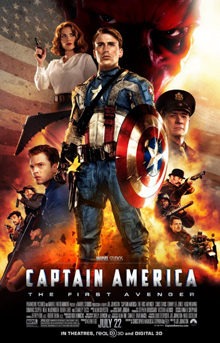
CRACKER? Captain America: The First Avenger (2011)


                I am not a big superhero fan, but I do love war movies so why not review a hybrid.  “Captain America” is a superhero who is a soldier and was involved in fighting Germany in WWII.  The character was created in 1941 and helped the good guys win the war.  He then went on to fight in the Cold War.  Lately, he has been tasked to join the Avengers to fight modern villains.  “Captain America:  The First Avenger” is a movie that goes back to the character’s origins. 

                The movie has your typical superhero opening with the discovery of something mysterious.  The setting is Norway in 1942.   An evil Nazi named Schmidt finds something Norse.  The object which has enormous potential power is called the Tesseract.  Schmidt (Hugo Weaving) is the leader of Hydra which is the German weapons development organization.  Meanwhile, in America, a wimpy looking Steve Rogers (Chris Evans) dreams of joining the military, but he can’t pass the physical.  His genuine desire to serve his country and the fact that he is from Brooklyn catches the attention of a scientist who recruits him for a super-soldier project.  Rogers volunteers for injection of a serum which will convert him into an awesome physical specimen (like if Rambo and the Terminator had a baby).  The new and improved Rogers is manned up by the gruff, grizzled, growly Col. Phillips (Tommy Lee Jones).  He is chaperoned by the sexy British agent Peggy Carter (Hayley Atwell).  At first, he is used for propaganda purposes and to sell war bonds (and pin-ups for WACS), but you can bet he has a date with Schmidt (aka the Red Skull).  In the honored tradition of superhero movies (and all recent action movies in general), the villain is hissably despicable.  And that’s before he lifts his mask to reveal a red skull.  Schmidt considers Hitler to be a pussy.

Can you guess who the bad guy is?
 
                Captain America arranges a meeting with the Red Skull and they negotiate an end to their differences.  Just kidding.  There is a big set piece where Cap infiltrates the Hydra factory to rescue a potential heterogeneous squad of he-men followers and his best friend (the world was smaller back then).  A raids montage follows which includes a fight with a German tank that apparently ate three Tiger tanks.  Cap goes medieval on the Nazis by using  a shield.  (Did they throw shields in the Middle Ages?)  We also get an Aston-Martin motorcycle ala James Bond.  There’s a Star Wars forest scene (without Ewoks, thankfully).  A train scene like you’ve never seen before.  Just kidding.  This all builds up to the climactic duel on a Hydra futuristic bomber (which was based on two actual Nazi designs – thank God the war ended early) complete with Japanese ohka-like suicide rockets.

                I have to say that “Captain America” is not as ridiculous as most superhero movies.  The acting is fine and the cast is appealing.  Tommy Lee Jones is perfectly cast as himself.  He admitted that his character has been seen in thousands of war movies.  Chris Evans is studly and sturdy as the Captain.  Kudos to him for losing a tremendous amount of weight and allowing his muscles to atrophy so he could shoot the pre-serum scenes and then eating, weight-training, and steroiding his way to his Captain America self.  Just kidding.  It was Hollywood magic.  His hero is pure, but not diabetes-inducing.  However, if you are looking for Batman-like personal strife, forget it.  The Red Skull is an acceptable villain although he was more interesting before he pulled his mask off.  There is no character development of the squad, but why bother when they were going to be left in the 1940s?  The dialogue is surprisingly kind to your brain cells. 

                The problem is not with the characters.  It’s with the plot.  It is predictable and even throws in the best-friend-has-to-die-to-make-it-personal trope.  Not to mention the sexy, girl-with-a-gun (but perfect hair) love interest.  The plot is extremely unrealistic and takes a big chance by setting itself in a real historical event, but the futuristic weapons shoved into the 1940s are cool.  It is like they had to make this movie to get Captain America into the present so he could join the Avengers, but they could not avoid sending weapons back in time to appear in the movie.  The action scenes are typically busy and explosive. And ridiculous.  All of these scenes have been cribbed from other action flicks, but the target audience for superhero movies doesn’t seem to care about originality.  As usual, the ratio of deaths to wounded is extremely high, but this is true for standard war movies.  Also the inability of the bad guys to hit the broad side of a barn makes it very frustrating if you are rooting for them (which probably hurt the movies box office with Skinheads and Jihadists).

                Overall, it is a fun variation of a war movie.  I can see it making my 100 Best War Movies list.  Just kidding.  Don’t get me wrong.  I am appreciative of what Captain America did to help the Allies win WWII, but I cannot condone drug abuse.


GRADE  =  C+