Showing posts with label C.S. Forester. Show all posts

Monday, August 26, 2024

100 BEST WAR MOVIES #42. Hornblower: The Duel (1998)


                “Hornblower:  The Duel” (entitled “The Even Chance” in Great Britain) is the first in a series of movies produced by ITV and A&E.  This movie introduces Midshipman Horatio Hornblower (Ion Groffudd) as he joins the crew of the HMS Justinian in 1793.  “Welcome to Purgatory”, he is told as soon as he boards.  It will be closer to Hell for the seventeen year old rich kid. The ship is commanded by an old and worn out captain and the midshipmen are dominated by a psychopath named Simpson (Dorian Healy).  He makes it his objective to make Hornblower’s life as miserable as possible.  It gets so bad that Hornblower challenges Simpson to a duel.  However, another midshipman named Clayton (Duncan Bell) takes Hornblower’s place, so the rivalry continues.  Hornblower gets transferred to the HMS Indefatigable, which is commanded by the no nonsense Captain Edward Pellew (Robert Lindsay).  He forbids Hornblower to fight any more duels.  Hornblower is given command of a gun crew.  It is motley.  He will have to earn the tars’ respect.  And get on the good side of the captain.  Luckily, he is a quick study and a born leader.  The movie is episodic after the build-up.  Hornblower has a time dealing with a French prize ship.  Hornblower leads a boarding party that cuts out a French warship.  Hornblower rescues the Indy from attack by three corvettes.  The movie culminates with the return match with the dastardly Simpson.  Hornblower gets killed and the series ends with just one episode.  Just kidding.

ACTING:                     A-

ACTION:                     B  (7/10)

ACCURACY:                N/A

PLOT:                            A

REALISM:                      A

CINEMATOGRAPHY:   B

SCORE:                          A

SCENE:  the capture of the French ship

QUOTE:  Capt. Pellew:  Damn your impudence, sir!

                “Hornblower:  The Duel” was a big budget production and it showed.  The Indefatigable is actually the Grand Turk (a replica of the HMS Blandford) which is a 22-gun corvette with twelve pound guns.  It is supposed to represent a 44-gun frigate with twenty-four pounders.  The film is lensed so the action appears to be on a larger ship.  The exteriors and interiors allow the movie to be nicely instructive on shipboard life.  The below deck set is authentic.  You can learn a lot about what is was like to serve on a British warship in the age of fighting sail.  The plot manages to hit on midshipmen training, burial at sea, firing sequence, boarding, women below decks in port, and of course, dueling.  But this is not a documentary.  The story is entertaining and the characters are intriguing.  The story revolves around two themes.  One is Hornblower’s growth as a leader.  The other is his conflict with Simpson.  The first follows a traditional arc, the second is what sets the movie apart.  Simpson is one of the greatest war movie villains.  The final duel closes the movie with a cherry on top.  The casting director deserved a bonus.  The actors are all perfect in their roles.  Hornblower dominates, but it is truly an ensemble movie. The movie launched Gruffudd to stardom and just like Bean as Sharpe, it is impossible to imagine anyone else playing the role.  Healy is not a cartoon villain and he makes his character’s death very fulfilling. Lindsay’s Pellew ranks among the great cinematic ship captains. And he gives life to one of the greatest Royal Navy heroes.  There is nothing TV about the production.  The dialogue is excellent.  The music fits nicely.  The sound effects make you feel you are on the ship.

                The story is fictional, but Edward Pellew is based on the famous English sea captain. Pellew took part in the American Revolutionary War and was with Burgoyne’s army when it surrendered at Saratoga. In the war with France, he took the first French warship.He led the boarding party.  In 1795, he was given command of the HMS Indefatigable. He had such success that he became famous. He rose to admiral and was made a noble. He was commander-in-chief of the Mediterranean fleet from 1811-1816. While fictional, the movie is very realistic about life aboard an English frigate.

                Here are things you will learn from the movie:

1.        dunnage – a sailor’s sea chest

2.        when a ship was in port, some captains allowed women on board (below deck)

3.        the sailors slept on hammocks

4.        the lowest rank of officer was midshipman

5.        vittles -  food

6.        cut a rill – dance

7.        time was kept by bells

8.        rigging -  the rope used with the sails

9.        press gang – the forceable enlisting of civilians into the Royal Navy

10.    prize money – when an enemy ship was captured, the officers and crew shared in the value of the ship; usually a portion of the crew (prize crew) were put on board to sail the ship to an English port

11.   rat baiting – a gambling game where the sailor tries to kill as many rats by biting them in a certain amount of time

12.    one type of punishment was to be tied to the rigging

Wednesday, November 15, 2023

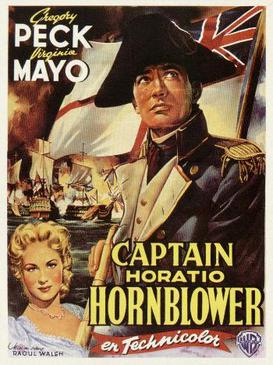
Captain Horatio Hornblower (1951)


            “Captain Horatio Hornblower” (known as “Captain Horatio Hornblower, R.N.” in the United Kingdom) was one of the last swashbuckler films.  It was natural that C.S. Forester’s Hornblower series would be made into a movie.  His first three were used for the screenplay.  Forester helped adapt his books.  Those titles were “The Happy Return”, “A Ship of the Line”, and “Flying Colours”.  Raoul Walsh (Objective Burma, Battle Cry, The Naked and the Dead) was chosen for his skill at making action movies.  And action was what he was interested in.  When dialogue scenes were shot, Walsh took a seat and read a newspaper.  The studio originally wanted Errol Flynn, but thankfully settled for Gregory Peck.  Flynn would have been wrong for the role.  Hornblower is a stoical leader who is more cerebral than any Flynn character.  The ship from Disney’s “Treasure Island” was used for some of the scenes.  The other ships were refurbished vessels.  The final scene was shot on the HMS Victory.  The movie’s profit more than doubled its budget.

            The movie is set in 1807.  A narrator tells us the HMS Lydia (a 38-gun frigate) is on a secret mission around Cape Horn into the Pacific.  Only Hornblower knows their mission.  It is so important that when the doctor urges they make land to deal with a scurvy outbreak, Hornblower turns him down.  The movie is filled with nautical details that are informative.  The ship routines are accurately portrayed.  When the ship is becalmed, it is towed by boats.  A sailor is flogged.  Hornblower is a sailor captain, meaning he believes a happy ship is a good ship.  But he backs up the officer who ordered the flogging and then in his cabin dresses the officer down.  The movie can be used as a study in command.  The mission is to support a rebellion in Central America against the French.  This means helping “El Supremo” who is an insane a-hole. 

            The first action scene is the boarding of the 60-gun Spanish ship Natividad which he then has to turn it over to the odious “El Supremo”.  Soon after, he takes aboard the sister of the Duke of Wellington.  Barbara (Virginia Mayo) gets off on the wrong foot with Horatio like in every similar situation in movie history.  Spoiler alert:  that will change.  The next action scene is the Lydia versus the Natividad.  The scene lasts ten minutes and has plenty of mayhem.  There’s lots of falling debris, but little blood even though the movie was made in brilliant technicolor.  This is followed by two montages:  repairs and romance.  Unfortunately, Horatio is married and Barbara is engaged. To Hornblower’s admiral.  Awkward!  The final set piece has Hornblower’s ship of the line attacking French ships in a port.  More falling debris.  It’s rousing with an unpredictable result. 

            “Captain Horatio Hornblower” is not as good as the Hornblower series of movies, but it is not bad as a swashbuckler.  The combat is not realistic.  No one is felled by a splinter.  It’s vivid and done with verve, which is what you would expect from Walsh.  The battles do not look like models because actual ships were used.  The cinematography and score match the action well.  The sets are excellent.   It is a educational on tactics.  However, it is very command-oriented with little coverage below decks.  The movie goes for romance over bromance.  Puzzlingly, the plot sets up some dysfunction among the officers, then doesn’t deliver.  The romance is from the black and white era, although the movie is in color.  Mayo and Peck have some chemistry, but the relationship is chaste.  Peck is his usual solid self (did he make any bad movies?) and was a good choice for Hornblower.  He clearly read some of the books because he has Hornblower’s mannerisms and personality down pat.  The rest of the cast is average.  Mayo was chosen for her beauty, but she was not a bad actress.  The first third of the movie is marred by the buffoonish El Supremo.  But then he gets his comeuppance in a crowd-pleasing way.  The movie’s top priority is entertainment and it succeeds in that.  If you learn a little about Napoleonic naval warfare, that’s a bonus.  The most important thing to me is the audience was introduced to the greatest character in Napoleonic naval fiction.

            We have plenty of pirate movies, but not that many naval combat movies from the age of sailing ships.  This movie and “Damn the Defiant!” are the best two from that era. “Master and Commander” tops them, but since it was not a big box office success, we probably won’t be seeing many more swashbucklers.   If you have seen all the “Pirates of the Caribbean” movies, try watching something a bit more realistic.

GRADE  =  B  

Sunday, September 13, 2020

BOOK/MOVIE: The African Queen (1935/1951)


                In 1935, C.S. Forester published his adventure novel The African Queen.  It is probably his most famous stand-alone novel.  He also wrote the Horatio Hornblower series.  The African Queen adds romance to adventure.  It is set in Africa during WWI and involves an odd couple who decide to try to sink a German warship that dominates a strategic lake.  The title refers to the small steamboat that they attempt the task with.  To get to their target, they must navigate a rapid-filled river and overcome numerous obstacles.  Their love develops as they conquer nature.  In 1951, John Huston made the classic film based on the novel.  It starred Humphrey Bogart and Katharine Hepburn.  The screenplay was written by Huston, James Agee, Peter Viertel, and John Collier.  The adapted screenplay was nominated for an Oscar.  The script was faithful to the novel until the end.  There were some significant changes made for the trek part of the story.  I am going to assume you have seen the movie, so be aware that the following comparison of the book to the movie will reveal details of the plot.  I will concentrate on the book and how the movie made changes.


                The book begins with Rose and her brother praying.  He is ill and dies that night.  The Germans have already come to their village and taken the villagers away.  They did not burn the village.  Rose blames the Germans for her brother’s death and this increases her hatred toward them.  She already had problems with their mistreatment of them and their villagers.  She dreams of revenge, but what can a woman do?  Then along comes Charlie.  In the book, Charlie is British and speaks with a heavy cockney accent.  (Since Bogart could not handle the accent, Charlie was changed to a Canadian.)  Rose is very patriotic and besides revenge, wants to strike a blow for the British Empire.  She convinces Charlie that the blow will be the sinking of the German warship Konigin Luise.  He gives in easy because he figures her first taste of rapids will douse her ardor.  Instead, Rose is transformed by the experience and is exhilarated by the action and adventure that is so different from her previous life as a proper woman.  This is made evident early on when she is not offended and does not evict him from her dry bed when Charlie crawls in during a rain storm.  When Charlie gets drunk and stands up to her, she does dump his liquor, but unlike the movie, she does it for revenge.  Similarly, the silent treatment is not to get him to reconsider, it just happens to work out that way. 


                As in the movie, they fall in love. However, although Forester does not go into detail, their love goes beyond chaste kissing.  She is more domineering than in the movie.  “He was a man made to be hen-pecked.”  The book covers in detail the running of the series of rapids, the repair of the shaft, passing by the fort.  It includes the mosquito attack and the leeches.   They get through the reeds mainly by rowing or pulling on the reed roots with a boat hook.  It takes weeks. They do not get stuck and get miraculously saved by rain raising the water level.   They contract malaria.  The preparation for the attack on the warship is basically replicated in the movie, but the aftermath is radically different.


                In the novel, Charlie is captured after the African Queen goes down in the storm.  He is accused of espionage for spying on the ship from the island and wanting to destroy the ship’s stores on shore.  He is going to be found guilty when Rose is brought in. She does not tell them anything about their plan.  She was found with the African Queen life buoy so they figure out who the couple is.  The Captain decides not to execute them because Rose is a remarkable woman and he admires what they accomplished.  He releases them to the British authorities.  Meanwhile, the British have moved two motor boats to the lake to confront the Konigin Luise.  These warships are fast and maneuverable and have three-inch guns.  They easily and anticlimactically sink the German ship.  The British commander makes arrangements to send Charlie and Rose to the coast where he expects Charlie to enlist and Rose to return to England.  Rose proposes marriage and they agree to get married as soon as they reach the British consul.


                Naturally, the book gives more details than the movie.  The running of the rapids is much more suspenseful.  Rose is an amazing steerswoman in the book.  The period in the reeds is more exhausting and has the malaria thrown in.  Fixing the shaft is more complicated and time consuming.  But other than more details, the journey to the lake is very similar to the book.  The characters are also very similar, other than Charlie being Canadian in the movie.  The book Charlie is meeker and less intelligent.  No surprise that character was given more testosterone.  Rose is a proto-feminist in the book.  She starts as a spinster and ends up an action hero.  She is much more interesting than Charlie and Forester has her dominating Charlie and the narrative.  She blooms as a result of the adventure.  She knows she is coming out of her cocoon.  For 1950s reasons the movie made her more traditional.  And obviously, she could not be having premarital sex, and enjoying it!


                The reason why the movie is better than the book is it keeps the basics and vastly improves the ending.  Forester flubbed the ending badly.  To have Charlie and Rose fail after all they went through may have been realistic, but it hardly was crowd-pleasing.  If Hollywood is anything, it is crowd-pleasing.  The scriptwriters deserve a lot of credit for improving the ending and it is genius.  The twist puts a cherry on top of a movie that was already perfect.


BOOK    =   B-

MOVIE  =   A