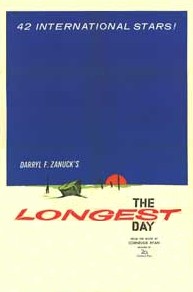
BACK-STORY: “The Longest Day” is the granddaddy of the war
movie epics. Its progeny include “A Bridge Too Far”, “The Battle of the Bulge”, “Battle of Britain”, etc. It was a labor of love for famed producer
Darryl Zanuck who purchased the rights to Cornelius Ryan’s bestseller. Zanuck got multinational cooperation and
brought in a international cast. At $10
million, it was the most expensive black and white film until “Schindler's List”. Zanuck used several directors and
was very hands-on. He insisted on
shooting at the actual locations whenever possible which included Ste. Mere
Eglise, Pointe du Hoc, and Pegasus Bridge.
The Omaha landings were filmed on Corsica. The movie was a box office success and was
the highest grossing black and white movie until “Schindler’s List”. It won Oscars for Cinematography and Special
Effects. It was nominated for Picture
(“Lawrence of Arabia” won), Art Direction, and Editing.
OPENING: A comely French Resistance operative named Janine
(Zanuck’s new mistress Irina Demick) uses her low cut blouse to distract German
soldiers while her fiance smuggles contraband past them. Several other characters are introduced in
mini-scenes. The sequence ends with
Rommel intoning that the first 24 hours of the invasion will be “the longest
day”.
 |
| "Look at these, not at that hay" |
SUMMARY: TLD is a difficult movie to
summarize because it is basically like the book – a series of vignettes
bouncing between the Allies and the Germans.
The first third of the film introduces the multitude of characters and
gives the audience perspective on the Allied plans and the German
cluelessness. Dialogue is used to inform
the audience about the military situation.
The role of the weather (its raining cats and chiens) is highlighted. Little details like the clickers used by
American paratroopers for identification and the Rupert decoy dummies are
introduced. It becomes apparent through
the introduction of characters that the movie will be balanced between the
brass and the boots.
Once the battle begins
the film can be divided between its set pieces.
Maj. Howard (Richard Todd who actually participated in the assault on
the bridge) leads a glider attack on the Orne River Bridge (Pegasus
Bridge). There is some good POV and the
scene is done with no soundtrack. The
first bullets fly at the 53 minute mark of the movie. It’s a “guns and grenades” scene with lots of
intensity, but no gore (typical of the whole film). The deaths are not silly, thankfully.
 |
| "This place seems familiar" (Richard Todd) |
Next come a variety of
paratrooper landings again sans music but avec frogs and crickets. The confusion authentically depicts the “fog
of war”. This leads to the famous Ste.
Mere Eglise landing. Here the star is
Pvt. Steele (Red Buttons) whose parachute gets caught on the church steeple. His comrades aren’t so lucky as they land in
the middle of the German garrison.
 |
| "Nobody touch my parachute on the steeple - it's iconic" |
The next big set piece
is the Omaha landing. Werner Pluskat
(Hans Blech) sees the armada coming right at him from a bunker in an iconic
scene. The view is not tainted by CGI. The naval bombardment is realistic. There is a nice tracking shot following the
first wave to the sea wall. (Director:
“every fourth man needs to die”.) No
bullet wounds or blood. It’s the
opposite of SPR, but if Zanuck had used that style, the 1962 audiences would
have needed paramedics. Its pretty large
scale with help from the U.S. fleet available off Corsica. The other beaches are appropriately given less
coverage, but each has its memorable moments.
Like when the Canadian correspondent accuses wayward carrier pigeons of
being “damned traitors” or when German uber-ace Josef Priller (Heinz Reincke)
and his wing man strafe Gold and Juno beaches.
 |
| "Every fourth man - die" - the director |
 |
| Paul Anka - action hero |
Shocking for an
American movie, the movie’s biggest set piece is the French assualt on the
Ouistreham casino. This features a
magnificent helicopter tracking shot of the French commandoes charging through
the streets. Most memorable here is the
gaggle of nuns which walks through the maelstrom to help with the wounded. Eventually a tank shows up to wreck the
German bunker.
 |
| "I don't care if there isn't supposed to be a casino there, blow it up." |
The movie returns to
Omaha so Gen. Cota (Robert Mitchum) can chew his cigar and kick some ass. “Only two kinds of people are going to stay
on this beach – those that are dead and those who are going to die.” He encourages Sgt. Fuller (Jeffrey Hunter) to
use bangalore torpedoes and TNT to blow a hole in the sea wall. Not exactly the way it happened, but neither
was SPR.
 |
| "Why do I have to be the last star to die?" - Jeffrey Hunter |
CLOSING: Pvt. Schultz (Richard Beymer) has his arc that
began with a crap game end with an intersection with downed RAF pilot Flying
Officer Campbell (Richard Burton). This
scene also closes the arc of the Nazi wrong-booted dude. Schultz represents the typical paratrooper
when he comments that he has not fired his gun all day. He sums up the fog of war when he says, “I
wonder who won.” Sadly, this question
could be asked by many of my students before we cover D-Day. If they were to watch this movie, they would
find out.
 |
| "Anytime I see a Jerry with his boots on the wrong feet, I shoot him." - Campbell (with Breymer) |
RATINGS:
Acting - A
Action - 8/10
Accuracy
- A
Realism - A-
Plot - A+
Cliches - A
Overall – A+
WOULD CHICKS DIG IT? Yes. Although there is only one
significant female character, there is one significant female character. That’s better than most war movies. Just don’t tell your girl friend how she got
the role. The violence is intense, but
lacks gore or bloodshed. Plus you can go
back in a time machine and see what hunks looked like in 1962. If she loves Justin Bieber – there are three
of them in this movie! (Paul Anka, Tommy Sands, and Fabian)
HISTORICAL ACCURACY: People who have not read Ryan’s book have faulted some of the obvious
Hollywoodisms in the movie. And
truthfully, there are vignettes and character developments that seem
invented. However, as you will see if
you go to my post on "History or Hollywood: The Longest Day", most of the dubious elements are actually true to Ryan’s
well-researched book. Some of the
supposedly hokey dialogue in the movie is straight from the book (which was
based on extensive interviews by Ryan).
As a tutorial, the movie does a
great job telling the story of D-Day.
Zanuck brought in ten technical advisers, but entertainment and
logistics trumped them in some cases.
For instance, Rupert was a lot less photogenic in real pseudo-life. There was no casino at Ouistreham at the time
of the assault. Most problematic is the
simplistic success at Omaha.
The movie is often labeled a
docudrama. This is a misnomer, but
buttresses its claims to accuracy. It is
easy to watch the way the movie covers most of the cogent facts about Operation
Overlord and the balanced approach to both sides and think you are watching a
documentary.
CRITIQUE: This is a big movie. Zanuck went all in and it shows. He literally commanded an army of actors and
crew. The equipment is sometimes
anachronistic (the ME-109s are actually ME-108s, for instance), but it was not
from lack of trying. He also spent a lot
of effort trying to get things right.
For example, he originally tried to reenact the drop on Ste. Mere Eglise
using actual paratoopers dropping from planes.
Uncooperative winds put an end to that noble attempt. He insisted all the dialogue be in the
correct language. Using subtitles was a
bold move and sends a strong message that entertainment was not the only goal.
Some critics find fault with the
cast and the acting. There is something
of a stunt feel to it, but the variety of characters was based on the book and
why not have the best professionals play the roles? Granted, it is hard not to see John Wayne as
playing Col. John Wayne (actually he is Lt. Col. Vandervoort). Can anyone seriously argue that Zanuck, who
is making the epic WWII movie, should pass up the chance to have the biggest
star on Earth and the man most associated with war movies in his film? By the way, when Wayne wanted in, Zanuck
agreed to pay him $250,000 instead of the standard $25,000 the other stars
made. (Wayne forced the fee due to a
grudge against a crack Zanuck made about the bombing of “The Alamo”.)
 |
| "What do you mean no one can walk on a compound fracture? Did you notice I'm John Wayne, you dumbass Pilgrim?!" |
The movie is uniformly
well-acted. There is little
scene-chewing by the stars in spite of their recognition that their screen time
would be very limited. It is interesting
to see how the big stars use little tricks of the trade to maximize their time
on camera. The best example is the
inflection Rod Steiger puts into his big line:
“You remember it. Remember every bit
of it, 'cause we are on the eve of a day that people are going to talk about
long after we are dead and gone.” The amazing aspect of the
casting is the most memorable performances are by the B-Listers. Richard Beymer ("Dutch" Schultz) and Hans Blech (Werner Pluskat) come to
mind. More importantly, some of the
performances made the actual people famous.
What American would have cared about the fascinating “Pips” Priller
(look him up on Wikipedia) if not for Heinz Reincke’s vibrant portrayal?
The cinematography is crisp
black and white. Most of it is standard,
but then you have the Ste. Mere Eglise drop and the casino tracking shot to
marvel at. The movie has a surprising
lack of score. This is so refreshing
compared to other Old School WWII movies!
No pomposity or mood manipulating.
The plot handles a complex topic
in a way that you do not need much knowledge of D-Day to follow it. Unlike many similar movies, TLD periodically
informs us when and where the action is taking place. The jumping between the Allies and the
Germans works well. The Germans are not
demonized and in fact there is not a single “heil Hitler” in the film. For a serious pseudo documentary, there are
brief, but effective interjections of humor.
CONCLUSION:
Considering it was
the first of its type (the big budget, all-star, battle epic) and has had many
challengers over the years, it is amazing that you can argue it is still the
best of them all. I doubt it could be
much better than it is given the state of war movie making in 1962. I think it is also true to say that even with
modern technology, a remake could not improve on it. Zanuck did not try to reinvent the genre, but
he did create a subgenre and using orthodox methods fashioned a
masterpiece. Although it is sometimes
unfairly compared to “Saving Private Ryan”, it is actually the perfect
companion to it. By watching both, one
gets a well-rounded view of D-Day. As
far as its placement at #16, I’m fairly sure it is superior to some of the
higher ranked movies and could have a shot at the top ten on my eventual 100 Best War Movies
list.
Once again I would like to thank the wonderful Internet Movie Firearms Database for the fantastic pictures.

