Showing posts with label Flying Leathernecks. Show all posts

Saturday, April 11, 2015

#1 BATTLE OF BRITAIN vs. #16 FLYING LEATHERNECKS


VS.


MATCH-UP:  “Battle of Britain” (1969) is an epic take on the famous air battle.  It is a British film with an all-star cast.  The movie takes the “Longest Day” approach of covering both sides.  The movie focuses on several British pilots, but also covers command decisions.  There is a romance thrown in for the ladies. 

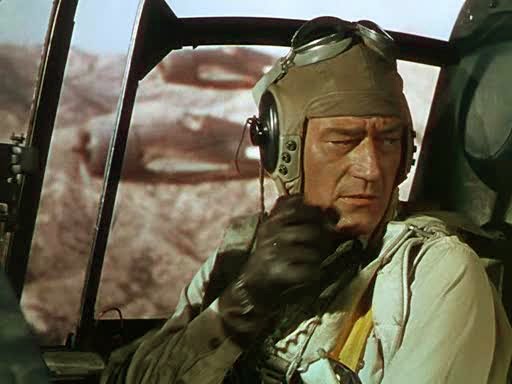
                “Flying Leathernecks” (1951) is a John Wayne WWII movie that also stars the ever dependable war movie stalwart Robert Ryan.  The movie has a submarine-type plot set in a Marine Corps squadron.  Wayne and Ryan disagree on command philosophy and as a corollary Wayne is attempting to implement a new tactic of ground air support on Guadalcanal and then on Okinawa.

FIRST QUARTER:  Dogfighting Quantity

                “Battle of Britain”  =  21 minutes
                “Flying Leathernecks”  =  8 minutes

FIRST QUARTER SCORE:
Battle of Britain                   10
Flying Leathernecks            6

SECOND QUARTER:  Plot

                BoB tries to hit all the big historical moments and add in personal stories.  The subplots involving the British pilots are fictional and seem a bit cursory.  The real characters are in the higher command sphere and those scenes are nicely instructional.  Although the movie intercuts between both sides, there are no Luftwaffe characters that are developed which is an odd mistake considering the movie seems to have used the “Longest Day” template for its basic plot.  B

                Leathernecks has a typically predictable plot.  The dysfunctional command structure is nothing new, but it is aided by the two leads.  The movie is too patriotic which is surprising because it was not made during the war.  It does cover an actual tactical concept (ground air support), but does it in a simplistic way.  The movie crashes and burns in its atrocious home front scenes.  D

HALF-TIME SCORE:
Battle of Britain                   18
Flying Leathernecks            12

THIRD QUARTER:  Realism and Accuracy     

                BoB is commendably accurate, but does take some liberties.  None of the pilots are actual people although Robert Shaw’s character resembles “Sailor” Malan and Falke is reminiscent of Adolf Galland.  The movie gives the textbook view of German strategic mistakes and although sadly lacking a time frame, hits some of the major German attacks like August 15 and September 15.  The “big wings” controversy is touched upon, but left hanging.  It does a good job covering the reason why the Germans shifted concentration to the British cities.  The movie had ten technical advisers, including Galland.  B

                Leathernecks is more fictional.  Kirby was based on Maj. John L. Smith who was awarded the Medal of Honor and shot down 19 Japanese planes while commanding the Cactus Air Force on Guadalcanal.  The debate over air combat versus close air support may have occurred so the movie might be a good summary of this, but it is handled very simplistically.  The movie uses a lot of footage of Hellcats when Wildcats were used on Guadalcanal.  D

THIRD QUARTER SCORE:
Battle of Britain                   26
Flying Leathernecks            18

FOURTH QUARTER:  Cliches

                BoB has few fighter squadron clichés partly because it is a battle movie rather than a small unit movie.  Many of the clichés depend on squadron dynamics and this movie does not feature that kind of plot.  We do get a mid-air collision.  An air field is bombed, but it is not by an opposing fighter squadron and is not in the form of throwing down the gauntlet.  There is a scene where a pilot breaks formation.  Actually, it is a flight of Polish pilots who leave their mother hen and is meant mainly for comic relief.  A

                Leathernecks has the gruff crew chief who also doubles as the clicheish scrounger.  Japanese fighters bomb their air field on Guadalcanal (with bombs they don’t carry, of course).  There are two separate incidents of pilots leaving formation to get a kill.  One of the main characters shows his readiness for command by sacrificing his best friend.  The movie throws in submarine clichés like the commander and the exec disagreeing about the commander’s tough love policy.  The exec comes over to the commander’s perspective. The commander is determined to fight the war differently and this causes dissension among the men.  D

FINAL SCORE:
Battle of Britain           36
Flying Leathernecks    24

POST-MATCH ANALYSIS:


                This was no contest which is as it should be in a match between a #1 seed and a movie that had to play its way into the tournament.  BoB is not only a highly regarded dogfighting movie, but one of the epic battle movies.  Although it is not in a league with its predecessor “The Longest Day”, it still had enough juice to handle an Old School John Wayne movie.   

Monday, August 4, 2014

FORGOTTEN GEM? Flying Leathernecks (1951)


                “Flying Leathernecks” is a John Wayne movie directed by Nicholas Ray (“Bitter Victory”).  The movie got a lot of cooperation from the Marine Corps, which was the branch that did the best job of cozying up to Hollywood after WWII.  Not only did it allow the movie to be filmed at Camp Pendleton, but it flew down fighters to provide aerial footage.   The Marines knew that in the post-WWII funding battles, public adulation would come in handy.  The movie opens with the credits backed by the “Marine Corps Hymn”.  The movie is dedicated to the USMC and Marine Corps aviation.

                Wayne plays Maj. Kirby who is the new commander of VMF 247.  He interrupts a party for the assumed promotion of the current exec Capt. Griffin (Robert Ryan).  Awkward!  (Same situation that Burt Lancaster was put in in “Run Silent, Run Deep”.)  You don’t have to be on a submarine to have command dysfunction.  Not only has Griffin reason to be pissed, but he disagrees with Kirby’s tough love philosophy with the boys.  (Similar situation to “Twelve O’Clock High”.) 

The squadron is posted to Guadalcanal during the darkest days of the campaign.  The “Cactus Air Force” is taking losses and morale is low.  Kirby has an idea of how to turn things around – close air support.  This new tactic is enacted without any training or even discussion.  The fighter pilots are not thrilled with strafing anddive bombing, but Kirby discourages them from engaging in dog fights.  When one disobeys orders and gets himself shot down, Kirby insists the ace-wannabes go look at the body.  Meanwhile the empathetic “’Griff” is seething over Kirby’s treatment of the boys.  This is brought to a head when a pilot incapacitated by malaria is forced to fly and is lost.  Kirby responds to Griffin’s criticism with an epic reaming for being too caring. 

"Extreme dysentery is no
excuse for not flying"
"Give the guy a break, we're out of
Charmins"
 
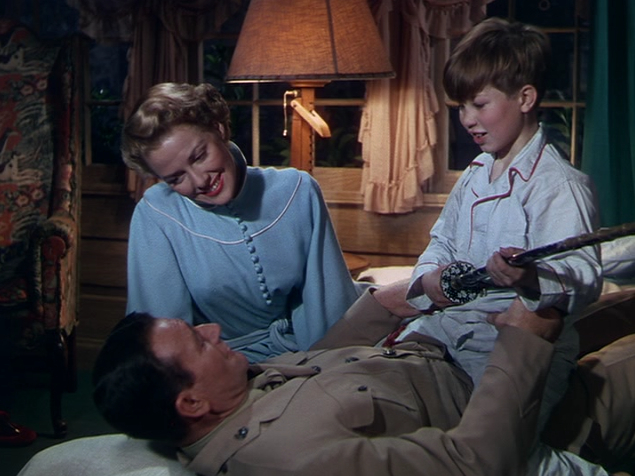
The new tactic is effective and Kirby is sent stateside to promote ground support.  Get ready to gag as he spends some time with his wife and child.  This registers higher on the vomit meter than the earlier record from home.  Kirby is assigned a new squadron to train in his tactic and guess who his exec is!  Griff has learned his lesson and is now just as much of an asshole as his mentor.  He proves this when they are sent to Okinawa and Griff declines to go to the aid of his brother-in-law who is having engine trouble.  He is finally ready to take command and carry on.

There is a little factual basis for the movie.  Kirby is based on Maj. John L. Smith who commanded VHF-223 on Guadalcanal.  He shot down 19 Japanese planes to become one of the leading aces in the Marine Corps in WWII.  You don’t shoot down that many while concentrating on ground support, so that part was apparently made up.  Possibly because when the movie was being made, Marine aviation was performing a mainly ground support role in Korea.  In actuality, Smith’s tactic was to pounce on Japanese bomber formations from high above, passing through the formation, then racing home if there were any Zero escorts.  That practical, yet unsporting, tactic probably did not go over well with the real flyboys either.


"I stole this from a future squadron.  It will convert
our Wildcats into Hellcats."
The movie is average Wayne.  He plays himself, of course.  Anyone expecting him to have a nervous breakdown like Gregory Peck in “Twelve O’clock High” does not know Wayne movies.  Ryan holds his own in a role different from his usual war movie characters.  He’s usually the Kirby.  The director wanted an actor that could take Wayne in a fight.  The supporting cast is familiar faces, but there is little character development.  This is not a small unit movie.  Comic relief is provided by the scrounging, crusty crew chief Sgt. Clancy (Jay Flippen).  There is no humor between Kirby and Griffin.

The plot is standard.  The maverick with new ideas comes in over the head of the traditional, more popular leader.  They butt heads until the traditionalist learns that the new ideas are war-winning and tough discipline is the key to success in battle.  The problem is the character arc of Griffin is shaky.  He starts off surprisingly accommodating even though humiliatingly jilted from his dream job.  When Kirby is transferred, their relationship has hit rock bottom, yet he is happy to become his exec again.  This makes no sense.  The lame romantic subplot of Kirby’s family was apparently geared toward getting a female onto the poster.  The dialogue is boring, but not laughable.  The music is typical for a movie of its ilk.


"Tell us the story of the time you made that guy with
bad malaria fly a mission that killed him"
The one big selling point for the movie is the aerial combat.  There is plenty of action.  This was the first movie to use color gun footage.  And they used a lot of it.  The footage fits the scenarios nicely, but if you have an eye for this sort of thing you’ll notice that there is too much variety in it.  At least they don’t shoot down any Stukas.  You also might notice that they are not flying F4F Wildcats over Guadalcanal, but the anachronistic F6F Hellcats amply available in 1951.  The movie more appropriately features the F4U Corsair for the Okinawa scenes.  There is thankfully little stupid cockpit banter.  However, we do get the common cinematographic trope of blending the actual footage with shots of the guns firing and the pilots grimacing in the cockpits.  Thankfully, the cockpit chatter is not lame.

Forgotten gem?  This is far down the list of Wayne war movies.  If you are not a Wayne fan, there is little reason to watch it and if you are a Wayne fan, you are probably going to be disappointed.

 
GRADE  =  C+
 
the trailer