Showing posts with label Frank Sinatra. Show all posts

Saturday, December 28, 2013

Christmas Day 4: Never So Few (1959)


On the fourth day of Christmas, my true love gave to me:  four guerrilla Kachin
 

                “Never So Few” is a WWII movie set in Burma in 1943.  It was directed by John Sturges (“The Great Escape”) and released in 1959, one year before his vastly superior “Magnificent Seven”.  It is loosely based on OSS Detachment 101 which operated behind enemy lines in Burma and made use of the anti-Japanese Kachin warriors.  The unit was tasked with ambushing patrols, rescuing downed pilots, and setting up landing strips.  The movie is highly fictionalized, however.

                The film has a recognizable cast led by Frank Sinatra as the unit leader, Capt. Reynolds.  The movie gets a head-scratching start as the men lounge around in a jungle camp even though they are warned that the Japanese are sneaking up on them.  Supposedly they are luring the enemy into a trap, but one character is still reading a comic book when the Japanese open fire.  They then proceed to dash into the foliage and then counterattack.  Wouldn’t they have been waiting in concealment?  WTF  The movie makes no attempt to recover from this perplexing opening.  One theme is established as Reynolds puts his caddy (the Kachin that is tasked with handing Reynolds an appropriate weapon in combat) out of his stomach-wound misery even though he is unconscious and not screaming in pain or begging to be killed.  We now know Reynolds is a bad-ass who doesn’t care what his wimpy subordinates want.

                Reynolds makes a trip back to civilization (well, India anyway) so we can get an exotic locale and some romance in the form of Clara (Gina Lollobrigida).  She waltzes in on the arm of a three-finger cigarette smoking rich snob and proceeds to stomp on Reynolds tongue which happens to be lying on the floor.  She is so brutally condescending to the Yank that you can be sure they will hook up by the end of the film.  Lucky for anyone hoping to see some acting in this movie, Reynolds meets Cpl. Ringa (Steve McQueen) and enlists him to bring some life into the film.

                From here the movie drunkenly sways from Old School combat action of the no blood, no enemy wounded variety to Old School romantic interludes between Reynolds and Clara.  These interludes are like speed bumps.  The feisty Clara is frosty until she suddenly isn’t.  She is always well-dressed and well-coiffed, but so is Sinatra.  There is a scene where Reynolds is wounded and is gleeful when it is suggested he return back to India (John Wayne, he ain’t).

                The big set piece is a raid on a Japanese base.  The action is ridiculous with drive-by shooting via trucks and Reynolds tossing jerry cans that explode on contact.  There are plenty of gasoline barrels to make for pretty explosions in the night.  Hollywood!  Reynold’s old Kachin liaison gets a good death scene (this comes on the heels of the Japanese killing Reynold’s monkey during a Christmas ambush – Jap bastards!).

                Reynolds defies orders by infiltrating China to track Chinese bandits who ambushed an Allied convoy.  They sneak up on the camp in broad daylight because all the enemy are sleeping.  When Reynold’s BFF Danny is treacherously gunned down, Reynolds orders the execution of all the prisoners.  When he returns he faces court-martial.  Guess who is waiting for him?  Hint:  well-coiffed.  She’s like a big-breasted bad penny.  Queue the swelling music.

                This is a typical Sinatra war movie.  It’s all about him.  He gets to spend half the movie romancing Lollobrigida because he could.  The movie has a low ratio of macho to smoochie.  The combat, when it sporadically arrives, is poorly staged and unrealistic.  The acting is average which allows McQueen to stand out.  Sinatra plays himself which means Reynolds is a jerk and a poor leader.  The theme of leaders having to make tough decisions is diluted a bit by Reynolds’ decision to commit a war crime.  But they’re just Chinese bandits.  Note the year of the movie’s release to figure out why the Chinese are bigger villains than the Japanese.  Another flaw is that for a movie dedicated to the Kachin, there is little lauding going on. 

                Good Christmas viewing?  Only if you would like to see a monkey get killed at a Christmas celebration – you sick bastard!
                P.S.  Look at the poster. "Kiss by kiss the time ran out and never so few were the moments left for love."  If that got you into the theater, I hope you were a female.

Grade =  D 

Thursday, August 1, 2013

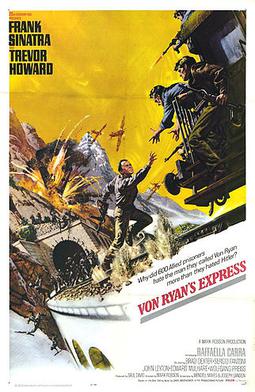
Von Ryan's Express (1965)


              “Von Ryan’s Express” is a prison escape / chase film hybrid.  It is a star vehicle for Frank Sinatra and he gives one of his most memorable performances.  His most memorable if you were a teenage boy when the movie came out in 1965.  It was ably directed by Mark Robson (“The Bridges at Toko-Ri”).  It is based on a novel by David Westheimer, but Sinatra insisted the ending be changed.  The movie was a big hit, but has been largely forgotten.

                Words tell us the movie is set in WWII Italy right before the Allied invasion.  Col. Ryan (Sinatra) is a hot-shot (is there any other type?) American P-38 (that is a real P-38!) pilot who gets shot down and captured by the Italians.  They treat him well as Hollywood was not interested in demonizing Italians at this point.  I don’t think Sinatra and his Mafia cronies would have appreciated that.  Ryan is taken to a POW camp run by a Blackshirt Major Battaglia (he’s Italian, but a Fascist).  The camp is predominantly British, but Ryan’s rank puts him in command.  He immediately butts heads with the ranking Brit Maj. Fincham (Trevor Howard) because the Brits are obsessed with escaping and Ryan thinks the war will be over soon so it’s ridiculous to risk lives.  To add fuel to the fire, Ryan forbids escape attempts and even tells Battaglia about an escape tunnel in exchange for better treatment for the men.  The Brits begin to put “Von” in front of Ryan’s name.  However, when the commandant reneges, Ryan has the men go nude and burn their ragged uniforms.  We get to see some cheeky cheeks.  Ha ha!  This earns Ryan a stay in the “sweat box”, but some grudging respect from the Brits.
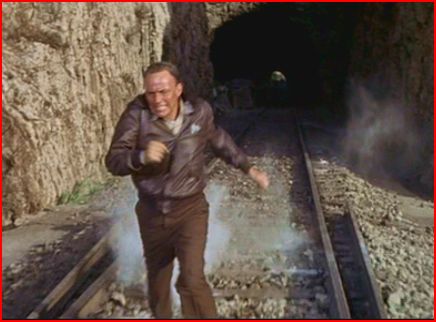
Sinatra and Howard - two teen idols
 
               News of the Italian government’s surrender causes all the guards to return to civilianhood.  The POWs want to execute Battaglia, but Ryan intervenes and gets him commuted to the sweat box.  How this is more humane escapes me.  The Italian second in command Capt. Oriani (Sergio Fantoni) joins up because he’s a good Italian.  The POWs escape into the countryside, but are soon recaptured by the Germans guided by a sneering Battaglia.  The wounded prisoners are killed and the survivors are loaded on a train. 

                Ryan organizes the take-over of the train in a good scene and they have an uneventful run to Switzerland.  Just kidding.  Complications arise.  First, there is a SS Major and his bimbo.  The Italian bombshell was possibly inserted for fourteen year old boys.  This subplot is very lame, but does lead to a nice twist.  After this sidetrack, the train is back on track and attempting to outrun a Nazi train.  There is a lot of “The Train” in this part of the film.  Much of their schemes are implausibly, but entertainingly successful in duping the clueless Germans.  At one point they run through a railyard while it is being bombarded (see “The Train”).  Look, there are the Alps!  Almost to Switzerland – piece of cake, right?  Just have to make it through these picturesque cliff-side tunnels while maintaining their lead over those pesky Germans.

                Oh, oh!  Are those ME-109s (actually their bastard obese brothers ME-108s)?  Their missiles make a mess of the track and it has to be repaired plus the German pursuers must be held off.  Here comes the big set piece combat scene and it is well worth the wait.  The setting in a tunnel is cool and there is lots of bloodshed.  This is done with no score - nice touch.  It is also nicely suspenseful although we never doubt the train will escape at the last second.  What is surprising is what happens to Ryan.  It’s right up there with Old Yeller and Sgt. Stryker for my generation.  Although it is closest to Jefferson in “The Dirty Dozen”.  Why couldn’t they both run faster, damn it?

                “Von Ryan’s Express” was a family favorite with myself and my brothers.  Although not in a league with “The Great Escape”, it is crackerjack entertainment.  The final scene was stuck in my mind although I had not seen the movie in decades.  I have to say that it held up pretty well.  It is well acted, especially by Sinatra.  His performance is reminiscent of Richard Burton in “Where Eagles Dare”.  Truthfully, without Sinatra, the movie would be forgettable.  The decision to film it in Italy was a good one.  The section in the mountains is particularly scenic and perfect for the situation.  The studio also went to the trouble of constructing the prison camp.  You have to admire the effort.  The film was nominated for Best Special Effects even though I did not find anything spectacular in it.  The sound track is by Jerry Goldsmith, but it is nothing special.  At least it is not pompous.  Kudos for the use of maps to explain where they are and that makes the changes in the plan more comprehensible.  Why don’t more war movies use maps effectively? 

bring on the nightmares, again
                For a movie that posits a totally impossible scenario, it does not come off as head-shakingly ridiculous.  It is average in implausibility for this subgenre that includes “The Guns of Navarone” and others.  It’s big problem is that for a mash-up of “The Train” and “The Great Escape”, it is vastly inferior to either of those films.  Still, nice try and it deserves more remembrance.  Cracker?  It has a chance.

GRADE  =  B


Friday, June 14, 2013

DUELING MOVIES: None But the Brave vs. Hell in the Pacific


VS.


                There are two war movies that posit Americans and Japanese being thrust together on islands in the Pacific in WWII.  “None But the Brave” (1965) brings together two platoons and “Hell in the Pacific” involves two men.  Both movies focus on the clash of cultures and the difficulties of peaceful coexistence between enemies that do not understand each other.  Which is stronger:  the urge for survival or the hatred and fear of someone different than you?
                “None But the Brave” was a vanity project of Frank Sinatra.  He produced the film and it was the only movie he directed.  Thankfully, he did not write it as well.  It is set on one of the Solomon Islands.  The movie is narrated by the Japanese commander of a cut-off unit.  Kuroki (Taysuya Yamihashi) is a warrior/pacifist who is humane, but has a martinet second in command (representing all the other Japanese officers in WWII films).  They are building a boat to get off the island when an American unit arrives via a shot down C-47 (in a painfully poor special effect).  The Americans are heterogeneously clichéd.  The Air Force Capt. Bourke (Clint Walker) takes command due to rank.  The Marine Lt. Blair (Tommy Sands) is green, but gung-ho.  There is a cigar-chomping, jerk of a sergeant (Brad Dexter).  Sinatra plays the boozing, wise-cracking Chief Pharmacist Mate. 
                The movie revolves around two sets of conflicts.  The conflict between the two forces and disagreements between the commanders and their subordinates.    The conflict within the units is basically because Bourke and Kuroki want to avoid bloodshed and their seconds want to carry on the war.  The hot heads win out so we can have some action.   The boat gets blown up, forcing them to realize they are all stuck.  There are mutual acts of humaneness like Sinatra amputating the leg of a wounded Japanese.  Later, Kuroki saves the LTs life.  A storm forces them to work together to save the well.  Hey, this just might work…  Unfortunately, when an American rescue ship looms on the horizon, the Japanese ambush the evacuating Americans even though they had promised not to reveal the presence of the Japanese on the island .  This leads to the climatic fire-fight which results in the film's “nobody ever wins” conclusion.
                “Hell in the Pacific” was directed by John Boorman and was released three years later.  Toshiro Mifune is stranded alone on an island (the movie was filmed on one of the Palau Islands) when Lee Marvin crash lands.  Their hatred and distrust are palpable from the beginning.  There are a series of back and forth incidents involving fresh water and fish.  They are not willing to share and would rather destroy what the other has.  Each has the opportunity to kill the other, but backs off.  Eventually, they agree to coexist, but still clearly hate each other.  They build a raft, but disagree over construction.  Language is a barrier.  They leave and manage to overcome the rough surf.  Even through a montage of laying around on the raft, they still have little affection for each other.  They arrive at a new island and find a deserted Japanese camp.  Finally some camaraderie develops over the food and sake, but it is short-lived as each is reminded of the cultural gulf between them.
                Besides the obvious similarities in themes, the movies share the emphasis on the language barrier.  Both eschew subtitles for the Japanese to give the audience a feel for the confusion and misunderstandings of the two sides.  This is effective, but especially in the case of “None”, it can be more confusing than effective.  “None” is more interested in examining the differences in command and warrior ethos, whereas “Hell” is more personal.  Mifune and Marvin do not so much represent their nation’s attitudes as they represent two nut cases thrust together.  Mifune could just as easily have been a cantankerous German.
                “None” may have a better template, but it is the inferior film.  It is poorly acted with absolutely horrendous dialogue.     At one point, Bourke tells Kuroki “Aw shove it, and don’t forget to duck”.  WTF  Does this make sense to anyone?  The soldier talk is laughable (at least we don’t have to understand what the Japanese are saying).  The narration is sappy with ridiculous emphasis on pronunciation of the Rs and Ls.  It is also riven with clichés.  For example, the green, gung-ho lieutenant who gets his battle, but regrets it.  Sinatra hams it up, but surprisingly lets Walker lead.  The movie does have a good action scene in the battle over the boat and the portrayal of the Japanese enlisted is sympathetic.
                “Hell” is better, but could have been a hell of a lot better.  It is thought-provoking and well-acted (of course with Mifune and Marvin), but unrealistic.  For example, two guys in such terrible shape could not have survived the raft adventure.  Some of the vignettes are silly.  Marvin throws bullets into Mifune’s fire and they go off like a machine gun.  Later, he pees on the Japanese.  Some of the interactions are a bit slap-stick.  The cinematography is good, but the score is bizarre.  It does avoid clichés as both of the men are dislikable and borderline insane.  You can’t root for either or both.  The ambiguous ending is off-putting, but appropriate.
                Both movies have the same pious anti-war message.  Each seduces us with the idea that enemies can coexist and learn to respect each other, but then pulls out the rug to hammer its “war is uncivilized” conclusion.  The duel is between the ridiculous and the unrealistic.  Go with the unrealistic because it has two great actors chewing the scenery instead of a bunch of bad actors playing army men.
None But the Brave = D-
Hell in the Pacific = C