Showing posts with label Lee Marvin. Show all posts

Saturday, October 19, 2019

CLASSIC or ANTIQUE: Eight Iron Men (1952)


                        “Eight Iron Men” is a movie directed by Edward Dmytryk (The Young Lions, Back to Bataan, Anzio, The Caine Mutiny) based on a screen play by Harry Brown (A Walk in the Sun- book and movie).  Brown adapted his play “A Sound of Hunting” which had a short run starring Burt Lancaster as Sgt. Mooney.  Lancaster was discovered and went to Hollywood to make his first film “The Killers”.  Lee Marvin was cast in the Mooney role because Lancaster was unavailable.  It was Marvin’s first big role.  He was a veteran of WWII.  As a Marine, he was wounded on Saipan.  In some ways, he was the unofficial technical adviser.  During production, when the German machine gun was malfunctioning, Marvin fixed it by breaking it down and putting it back together.    He taught the other cast members how to fall when wounded.  This alone sets it apart from most war movies.

                        “Eight Iron Men” is a classic small unit movie.  It takes place in a bombed out Italian town.  From the point of view of a German bunker, a machine gun opens fire on a G.I. patrol.  Small gets pinned down in a shell crater and the other two withdraw to the squad’s basement outpost.  Here we enter the play phase as the men flesh out their personalities.  Collucci (Bonar Colleand in his American debut) is the wisecracker/slacker/ladies’ man.  He daydreams about dames to the accompaniment of stripper music.  This lasts several minutes!  (The poster above is one of the most inaccurate posters I have ever seen.  It literally has nothing to do with the movie!)   Sgt. Mooney is a pansy.  Just kidding, he’s played by Lee Marvin and Marvin ain’t acting – he plays himself.  Coke (Richard Kiley) is tightly wound.  Sapiros (Nick Dennis) is Greek.  He and Collucci have a Rivera/Friedman type relationship (“A Walk in the Sun”).  Muller (Dickie Moore in the Richard Jaekel role) has received a fruit cake from home.  Presumably because his mother hates him.  He divides it into eight pieces – one for each.  Including Small.  Collucci volunteers to eat Small’s piece, but Mooney takes a “leave no man behind” position.  There is a discussion about whether the sad sack Small is worth the risk.  Coke argues that they have been lucky so far and if they lose Small, it could open the flood gates.  To complicate matters, the squad gets word that they are pulling out.  Mooney goes to Captain Trelawny (Barney Phillips) to get permission to rescue Small.  The captain believes one man’s life is not worth several men’s lives.  Apparently, Army philosophy underwent a change in Vietnam.  Will they disobey orders and go after Small?  If they don’t, we won’t have much of a movie.

                        “Eight Iron Men” has the same vibe as “A Walk in the Sun”, “Attack!”, and “Hell is for Heroes”.  In other words, it is dialogue driven and has the feel of a play.  The soldiers’ talk is authentic.  They gripe a lot.  When Mooney brings the dilemma to the captain, the captain says:  “Before the war, I used to be a car salesman.  I used to smile all the time.”  He adds:  “I came up here with a company and I’ll be lucky to leave with a platoon.”   Hence, the reluctance to risk more men.  You can see his point of view and the point of view of Mooney.  The movie is thought-provoking.  Trelawny is not Cooney (“Attack!”).  There are no villains in this movie and the Germans are faceless.  The movie is excellent in delving into the pressures of command.  It also daringly focuses on the reality of war being mostly boredom that is occasionally broken by stressful action.  This might explain the fact that the movie was not a hit.  Audiences don’t want reality. 

                        The movie is well-made.  Dmytryk likes deep focus, which works well in what is essentially a one set movie.  When the camera leaves the basement, the outdoors is appropriately rubbly. Although the cast is not all-star, the actors act like soldiers (except they are not grubby enough).  The characters are all stereotypes, but at least the movie is not full of clichés.  It is not predictable and has a neat twist ending.  Colleand gets star billing, but did not get a career boost.  He returned to Great Britain where he was more of a star and died in a car accident six years later.  His Collucci could have been obnoxious, like most war movie wolfs, but he is likeable and he gets to say this line which somehow got by the censors:  “Tonight I’ll be whistling at every dame in the country.  You can’t keep a healthy guy like me stuck away like this for too long – I go crazy – I get hair on the palms of my hands – the beast rises in me.” 

                        “Eight Iron Men” is not for the combat porn junkies.  There is a little action, but it is more cerebral than most 1950’s WWII movies.  It fits snuggly into the niche of small unit, play-like movies.  It’s entertaining and manages to overcome two ridiculous dream sequences.  Those scenes, which almost torpedo the movie, apparently were added so the poster artist could honestly add a female.  Do not expect what the poster implies.  What you will actually get is a minor classic that holds up well because it concentrates on an intriguing scenario and the soldiers in the scenario behave like G.I.s would have behaved.

GRADE  =  B           

Wednesday, September 10, 2014

CRACKER? Attack! (1956)


“Attack!” is a 1956 film from Robert Aldrich (“The Dirty Dozen”) based on the play “Fragile Fox”.  The movie was low budget and was shot on the back lot in just 35 days.  Because of the plot, the Pentagon refused any cooperation.  Shame!  Aldrich had to rent two decidedly inauthentic tanks.  This justs adds to the “charm” of the film.  (First use of the word charm in a review of this movie.) 

The film is set in WWII Belgium before the Battle of the Bulge.  A depleted American platoon led by Lt. Costa (Jack Palance) is assaulting a pill box and gets pinned down.  The company commander Capt. Cooney (Eddie Albert) is a coward who refuses to support the attack.  Costas survives and is in a bad mood, to say the least.  It turns out that Lt. Col. Bartlett (Lee Marvin) is propping up Cooney for future patronage from Cooney’s father who is an influential judge.  Costas is very cynical and the only thing that prevents him from fragging Cooney is his friend Lt. Woodruff (William Smithers).  Woodruff is the buffer between Costas and Cooney.  He wants Cooney gone, but doesn’t want his friend in Leavenworth.

Bartlett orders Cooney to capture the next town.  Cooney decides a full scale effort (which would involve him facing flying metal) is uncalled for and orders Costas to lead a squad into an Alamo on the outskirts of the town.  Before leaving, Costas tells Cooney that if he leaves him hanging again, “I’ll shove this grenade down your throat.”  He forgets to add “sir”.  It’s “last stand” time.  Costas is shocked, shocked to find that Cooney pulls a Cooney.

It’s Hitler’s last great counteroffensive time as the Battle of the Bulge hits the company.  Bartlett arrives and literally slaps Cooney into defending the town at all costs.  Cooney does not have the cowardice slapped out of him.  Instead, he snaps and is psychiatrist couch-bound.  Unless Costas has survived the Alamo.  Indeed, Costas arrives in a friggin’ fraggin’ mood, but is distracted by having to take out a German tanks with a bazooka.  He then suffers one of the best woundings in war movie history.  The final scene takes place in a basement with Germans rampaging above.  Things are said, things are done.  Issues are resolved.  Not a happy ending, but satisfying.
Eddie Albert channeling the opposite
of his WWII persona

Talk about getting bang for your buck.  The only thing low budget is the sets and the tanks.  This was Aldrich’s seventh movie and he is definitely showing his style and panache.  The film does have the stage vibe you often get when plays are transferred to film, but he uses cinematic touches to negate that.  His camera shoots through barriers and doorways.  There are shots from above and diagonal views and deep focuses.  It’s a bit showy, but adds to the appeal of the movie.  The score gets attention with sometimes discordant piano music.  The acting is outstanding with Palance successfully treading the line between scene-chewing and scene-stealing.  It is a remarkable performance with tremendous energy.  Costas is one of my favorite war movie characters.  The rest of the cast is perfect.  Marvin is loathsome and Smithers (in his first big role) is solid.  Kudos to Eddie Albert (a war hero, as were Palance and Marvin) for daringly playing against type.  John Wayne would have never accepted a role like that and he was not even a veteran.  The supporting cast includes Buddy Ebsen, Robert Strauss, and Richard F’in Jaeckel (of course).  If you are of my generation, you will feel very comfortable watching this movie.   The combat scenes are fairly good for a play, but you’ll remember the dialogue more than the action.  The movie blends violence and exposition well.  There are some good lines.  My favorite comes from Pvt. Bernstein (Strauss), who after he encounters Bartlett and Cooney, says: “When you salute them two, you have to apologize to your arm.”  There is some good comic relief in the film. 


after the war, he used his shooting skills to
uncover some buubling crude
If your heart goes out to the officers instead of the enlisted men, you might not enjoy this movie.  It is not so much anti-war as it is anti-brass.  It tends to be moralistic in its anti-authority theme.  Other themes include;  the military is like politics, the higher up you go the more corrupt the officers are, and following orders can really suck.  Released in 1956, it was a harbinger of the 60’s wave of modern war films.  The fact that it is relatively unknown and did not do well at the box office shows that Americans were not yet ready for this type of flag furler.  This is 2014 – see this movie!   It will definitely crack my 100 Best list. 
P.S.  Check out that awesome poster.  Jack Palance is one of the few human beings that actually could pull a grenade pin with his teeth.  And for once the tag line is accurate.  And that is one kick-ass trailer.  Old school style. 


Grade  =  A-
 

Wednesday, May 28, 2014

DUELING MOVIES: Shout at the Devil / Murphy’s War


vs.


                In the 1970s a pair of action movies came out that dealt with obsessions to destroy a German warship.  One is set in WWI Africa and the other is set in WWII South America.  Both are buddy films. 
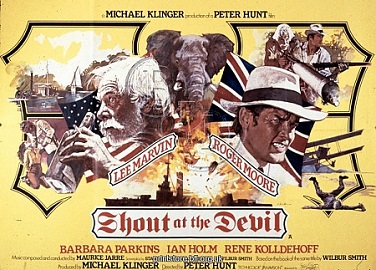
“Shout at the Devil” was released in 1976 and is a typical 1970s action/adventure with comedy infused to match the tastes of that decade.  It’s a British film directed by Peter R. Hunt.  It purports to be based on a remarkable true story.  It is set in Zanzibar in 1913.  It’s basically a buddy film starring Lee Marvin and Roger Moore.
                A British nobleman named Sebastian Oldsmith (Moore) meets up with a hard-drinking American named Flynn O’Flynn (Marvin) in tropical Africa.  Their relationship starts off rocky as O’Flynn steals all of Sebastian’s money.  O’Flynn is an ivory poacher who is on the outs with the local German forces led by a commander named Fleischer.  When O’Flynn is ambushed by the Germans, Sebastian rescues him from a crocodile.  Yes, it’s that kind of movie.  Later, O’Flynn’s boat is rammed by a German warship named the Blucher.  The two buddies wash ashore and eventually reach O’Flynn’s daughter’s home.  Rosa (Barbara Parkins) nurses the malaria-suffering Sebastian back to health and they fall in love.  Naturally, O’Flynn is opposed to the relationship and a comical fistfight ensues.  O’Flynn is often drunk in the movie and one has to wonder if Marvin was “acting” drunk.  He is unable to prevent the marriage and subsequently the Oldsmiths have a child.
 
Sebastian and Flynn discussing the
white man's burden
 
                After raiding Fleischer’s camp, the German retaliates by burning O’Flynn’s home while the men are away.  The Germans kill the baby, but strangely leave Rosa alive and vengeful.  The trio decide to aid the British Admiralty by sinking the Blucher.  They hatch a plan to blow up the ship, but complications arise.  The movie builds to a rousing finale.
                “Shout at the Devil” is all over the place.  It has action, violence, romance, humor, fistfights, explosions, villains, etc.  Unfortunately, none of these elements are special and the blend is uneven.  The movie does not know what it wants to be.  The first half is a farce, then the baby gets killed and it becomes a revenge flick.  Neither half is strong.  The whole movie has a large amount of silliness, mostly in the form of Marvin chewing the scenery (the movie does have some awesome scenery, by the way).  I am a big Lee Marvin fan, but he looks like he did not take the production seriously.  You will enjoy the movie more if you do like Marvin apparently did, drink heavily during it.
                As far as the claim that it is based on a true story, you better take that with a grain of salt.  There was a Battle of Rufiji Delta in which a German light cruiser the SMD Konigsberg was blockaded and then sunk by two British monitors.  This does not sound anything like what happens in the movie.
                “Murphy’s War” is a Peter Yates film (his only war movie) and was released in 1971.  It was set and filmed in Venezuela on the Orinoco River.  It stars Peter O’Toole  (three years after “The Lion in Winter”).  Murphy was a crewman on a British freighter that is sunk on the river by a German u-boat (actually an American sub sold to the Venezuelan Navy).  He was the sole survivor as the Germans machine-gunned the crew.  He recovers at a nearby missionary settlement where he makes the acquaintance of a female Quaker doctor named Hayden (Sien Phillips - O’Toole’s then wife).  The pilot of a floatplane that had been shot down by the sub washes ashore and is murdered by the u-boat captain when his men raid the settlement.  Murphy vows revenge with the help of a handy man named Louis (Phillippe Noiret).  They recover the plane and Murphy learns to fly it.  His plan is to drop some rather large Molotov cocktails on the sub.
                “Murphy’s War” is well made.  The cinematography is showy.  The opening scene of the sinking of the ship is very busy with quick cuts and some distorted POV from Murphy’s perspective (O’Toole did his own stunts amidst the burning oil, explosions, and machine gun bullets).  The scene is quite effective in establishing that the Nazis are evil and deserve vengeance.  Another bravura scene is the one where Murphy learns to fly the plane.  I doubt he did the stunt flying because it is pretty hairy.  It is an extended scene which is typical of a movie that takes its time getting where it’s going.  It is also typical of the implausible nature of much of what happens in the plot.  Cinematic baubles can only partly mask the lack of reality evidenced in the movie.  To advance the obsessive revenge angle (and to get the movie to feature length), the film has several plot developments that defy logic.  Starting with what the hell is a u-boat doing up a South American river in the last weeks of WWI?  So turn your logic off and enjoy.  There are some entertaining action sequences that will leave war movie fans smiling (and shaking their heads).  Accuracy is not a factor as it is obviously not based on a true story.  In order to add the irony that the war is nearing an end and yet both the u-boat captain and Murphy are pursuing hostilities with avengeance, the movie has a u-boat operating in Venezuela.  This would have been extremely unlikely since the u-boat fleet had been pulled back long before April, 1945. 
a shot from the O'Toole's wedding album

                O’Toole has a fun time and reminds of Marvin (partly because I would not be surprised if his performance was not alcohol-enhanced as well).  An interesting dimension to his character is there is an allusion to his having been a poor crewman so his motivation is a bit puzzling.  His wife is the rare strong female character in a war movie.  She is not in the movie to be a bimbo.  She represents sanity and refers to the charming Murphy as a “mindless bastard”.  Noiret is appealing as Murphy’s Sancho Panza.  The Germans are bland and the captain is straight out of central casting – handsome, blond, and malevolent.  (He reminded me of the u-boat captain from “The McKenzie Break”.)  The reason to see the movie is not for the acting, it's for the three attempts on the sub.  Each is as delirious as Murphy himself. 
                Which is the better movie?  Clearly “Murphy’s War”.   Sometimes one star is better than two.
Shout at the Devil  =  D+
Murphy’s War  =  B- 

Friday, June 14, 2013

DUELING MOVIES: None But the Brave vs. Hell in the Pacific


VS.


                There are two war movies that posit Americans and Japanese being thrust together on islands in the Pacific in WWII.  “None But the Brave” (1965) brings together two platoons and “Hell in the Pacific” involves two men.  Both movies focus on the clash of cultures and the difficulties of peaceful coexistence between enemies that do not understand each other.  Which is stronger:  the urge for survival or the hatred and fear of someone different than you?
                “None But the Brave” was a vanity project of Frank Sinatra.  He produced the film and it was the only movie he directed.  Thankfully, he did not write it as well.  It is set on one of the Solomon Islands.  The movie is narrated by the Japanese commander of a cut-off unit.  Kuroki (Taysuya Yamihashi) is a warrior/pacifist who is humane, but has a martinet second in command (representing all the other Japanese officers in WWII films).  They are building a boat to get off the island when an American unit arrives via a shot down C-47 (in a painfully poor special effect).  The Americans are heterogeneously clichéd.  The Air Force Capt. Bourke (Clint Walker) takes command due to rank.  The Marine Lt. Blair (Tommy Sands) is green, but gung-ho.  There is a cigar-chomping, jerk of a sergeant (Brad Dexter).  Sinatra plays the boozing, wise-cracking Chief Pharmacist Mate. 
                The movie revolves around two sets of conflicts.  The conflict between the two forces and disagreements between the commanders and their subordinates.    The conflict within the units is basically because Bourke and Kuroki want to avoid bloodshed and their seconds want to carry on the war.  The hot heads win out so we can have some action.   The boat gets blown up, forcing them to realize they are all stuck.  There are mutual acts of humaneness like Sinatra amputating the leg of a wounded Japanese.  Later, Kuroki saves the LTs life.  A storm forces them to work together to save the well.  Hey, this just might work…  Unfortunately, when an American rescue ship looms on the horizon, the Japanese ambush the evacuating Americans even though they had promised not to reveal the presence of the Japanese on the island .  This leads to the climatic fire-fight which results in the film's “nobody ever wins” conclusion.
                “Hell in the Pacific” was directed by John Boorman and was released three years later.  Toshiro Mifune is stranded alone on an island (the movie was filmed on one of the Palau Islands) when Lee Marvin crash lands.  Their hatred and distrust are palpable from the beginning.  There are a series of back and forth incidents involving fresh water and fish.  They are not willing to share and would rather destroy what the other has.  Each has the opportunity to kill the other, but backs off.  Eventually, they agree to coexist, but still clearly hate each other.  They build a raft, but disagree over construction.  Language is a barrier.  They leave and manage to overcome the rough surf.  Even through a montage of laying around on the raft, they still have little affection for each other.  They arrive at a new island and find a deserted Japanese camp.  Finally some camaraderie develops over the food and sake, but it is short-lived as each is reminded of the cultural gulf between them.
                Besides the obvious similarities in themes, the movies share the emphasis on the language barrier.  Both eschew subtitles for the Japanese to give the audience a feel for the confusion and misunderstandings of the two sides.  This is effective, but especially in the case of “None”, it can be more confusing than effective.  “None” is more interested in examining the differences in command and warrior ethos, whereas “Hell” is more personal.  Mifune and Marvin do not so much represent their nation’s attitudes as they represent two nut cases thrust together.  Mifune could just as easily have been a cantankerous German.
                “None” may have a better template, but it is the inferior film.  It is poorly acted with absolutely horrendous dialogue.     At one point, Bourke tells Kuroki “Aw shove it, and don’t forget to duck”.  WTF  Does this make sense to anyone?  The soldier talk is laughable (at least we don’t have to understand what the Japanese are saying).  The narration is sappy with ridiculous emphasis on pronunciation of the Rs and Ls.  It is also riven with clichés.  For example, the green, gung-ho lieutenant who gets his battle, but regrets it.  Sinatra hams it up, but surprisingly lets Walker lead.  The movie does have a good action scene in the battle over the boat and the portrayal of the Japanese enlisted is sympathetic.
                “Hell” is better, but could have been a hell of a lot better.  It is thought-provoking and well-acted (of course with Mifune and Marvin), but unrealistic.  For example, two guys in such terrible shape could not have survived the raft adventure.  Some of the vignettes are silly.  Marvin throws bullets into Mifune’s fire and they go off like a machine gun.  Later, he pees on the Japanese.  Some of the interactions are a bit slap-stick.  The cinematography is good, but the score is bizarre.  It does avoid clichés as both of the men are dislikable and borderline insane.  You can’t root for either or both.  The ambiguous ending is off-putting, but appropriate.
                Both movies have the same pious anti-war message.  Each seduces us with the idea that enemies can coexist and learn to respect each other, but then pulls out the rug to hammer its “war is uncivilized” conclusion.  The duel is between the ridiculous and the unrealistic.  Go with the unrealistic because it has two great actors chewing the scenery instead of a bunch of bad actors playing army men.
None But the Brave = D-
Hell in the Pacific = C


Tuesday, March 26, 2013

THE BIG RED ONE (3) vs. THE DESERT RATS (14)

 
VS.
 
 
THE BIG RED ONE (3) vs. THE DESERT RATS (14)
ACTING:


     “The Big Red One” is essentially a five actor movie. Lee Marvin plays a grizzled sergeant (he was 56 years old at the time) in charge of a squad that consists of four guys who can not be killed (or even wounded) and a series of cannon fodder replacements. Marvin is very good, as usual. He has the weary father-figure down pat. Unfortunately, he completely dominates the other four who range from barely registering (Kelly Ward as Johnson) to inconsistent (Robert Carradine as Zab ) to semi-charismatic (Bobby Di Cicco as Vinci) and earnestly bad (Mark Hammill as Griff).

     “The Desert Rats” is a Richard Burton movie. He plays British Capt. MacRoberts who given the task of cracking the whip on an undisciplined Australian unit. Burton is above this kind of material but he is game and takes the role seriously. The only other actor that makes an impression is Robert Newton as MacRoberts ex-scholmaster Bartlett. Newton plays a cowardly drunkard who refuses to run because it would be dishonorable. It is a poignantly effective performance. James Mason makes a welcome appearance as Rommel to (A) showcase an exchange between Mason and Burton (well done) and to (B) scuff up his portrayal from “The Desert Fox” (this Rommel is less likeable).

FIRST QUARTER SCORE:
The Big Red One     7
The Desert Rats       8


CLICHES:

     “The Big Red One” is a small unit (very small unit) movie. The squad (actually 1/3 of a squad) is heterogeneous. Johnson is a farm boy, Vinci is the wise-cracking Italian-American, Zab is the budding writer from Brooklyn, and Griff is the sharpshooter who can’t kill. The group is led by a hero (the Sarge), but they are not moving forward to accomplish a particular objective. There is a chronicler in the form of the narrator Zab (who represents Samuel Fuller). The movie does not alternate between opposites like action and rest, instead it is a series of vignettes. There is a redemption figure in Griff, but that subplot is surprisingly incomplete. There is no conflict within the group or over command. In conclusion, other than the stock characters the film avoids clichés.

     “The Desert Rats” has some familiar characters and situations. There are two redemption arcs: Carstairs who is almost court-martialed by MacRoberts and Bartlett. Both resolutions are predictable. MacNamara is the stock character who builds a unit using tough love which at first causes resentment but eventually results in respect. The unit is not clichely heterogeneous because few characters are developed. MacNamara is the hero and leader, but the role is not really forced upon him. The movie alternates combat with exposition.

HALF TIME SCORE:
The Big Red One       14
The Desert Rats         14


PLOT:

     The plot of BR1 can best be described as: a small squad led by an old sergeant go from Operation Torch to the end of the war while experiencing a series of incidents. The vignettes range from interesting (the liberation of the death camp) to bizarre (the insane asylum) to ridiculous (the ambush at the crucifix). It’s like Samuel Fuller kept a notebook of ideas for war movie scenes and then made a movie that included all of those ideas, good and bad. The scenes could have been put in any order. The movie is entertaining, but several of the mini-stories are painful for an intelligent war movie fan to watch. It’s one of those movies that tends to fall apart upon repeat viewing, but kudos for being different.

      The plot of TDR is much more standard. It flows from green, undisciplined unit being broken and trained by a tough leader to become confident, disciplined veterans led by a more understanding leader. Throw in combat sequences to prove the evolution and to add action. Nothing you haven’t seen before, but well done and not hackneyed. Very predictable, however.

THIRD QUARTER SCORE:
The Big Red One          20
The Desert Rats            21


COMBAT:

     BR1 has surprisingly little combat for such a long movie (I watched the extended version) and the scale is small because of budget constraints. You get the impression this squad is fighting the war by itself. Most of the scenes are the “guns and grenades” variety. When the movie moves into a combat sequence it is usually PG intense, but brief. Compare it to “Cross of Iron” that was made three years earlier and you can see that Fuller was still clinging to Old School combat. There is a fire-fight for the Torch landing, an extended attack on an African town that features a French cavalry charge (WTF) and the smallest tank in war movie history, the D-Day landing featuring a Bangalore Torpedo relay, the ambush at the crucifix, the insane asylum shoot-out, and the liberation of the death camp. Each is fairly intense, but most are too brief. The tactics and weaponry are fine.

      TDR has only two battle set pieces, but they are both excellent. The first is defense against a German Panzer attack during a sand-storm. The artillery barrage is realistic (the movie has great sound and explosion effects). The deaths are reasonable. There is a cool duel between a German tank and an anti-tank gun. The other action sequence involves a commando raid on a German munitions dump. A “guns and grenades” at night spectacle. Both scenes are better than anything in BR1, but BR1 puts the unit in combat more frequently.

SCORE AT THE END OF REGULATION:
The Big Red One        27
The Desert Rats          27


OVERTIME: Director

      BR1 was directed by Samuel Fuller. It is semi-autobiographical as Fuller served in the 1st Division and participated in Operations Torch, Husky, and Overlord. His unit fought through France, Belgium, and Czechoslovakia. He was involved in the liberation of the Falkenau concentration camp. He was awarded the Bronze Star, Silver Star, and Purple Heart. He went on to a legendary career as a filmmaker. He was noted for gritty B-movies which he made with low budgets. These included “Steel Helmet”, “Fixed Bayonets!”, and “Merrill’s Marauders”. “The Big Red One” has many of the attributes of a B-movie even though it was by far his biggest film.

       TDR was directed by Robert Wise. Wise was a much more mainstream director than Fuller. He was also much more highly acclaimed. He won two Best Director Oscars. His other war movies were “Run Silent, Run Deep” and “The Sand Pebbles” (for which he was nominated for Best Director).

FINAL SCORE:
The Big Red One       36
The Desert Rats         33

COLOR ANALYSIS:

      This was a shocker. BR1 has a strong reputation among critics and war movie fans and TDR has been largely forgotten. But the tournament is all about the match-ups. Plot and combat did not play to BR1’s strengths and TDR had just enough talent to take the match to overtime. In the end, Samuel Fuller pulls his movie through to the second round.

Sunday, February 27, 2011

#71 - The Big Red One


BACK-STORY: “The Big Red One” is a war movie set in WWII – Europe. It follows a sergeant and his squad from North Africa to Sicily to D-Day and beyond. At the end they liberate a concentration camp. The movie is loosely based on the writer/director Samuel Fuller’s experiences with the 1st Division in WWII. The character Zab represents Fuller. The movie was released in 1980 with a substantial amount left on the cutting room floor. In 2004, the director’s cut was released almost doubling the length of the film.  It was entitled "The Big Red One:  The Reconstruction".  This is the version that I am reviewing. The movie stars Lee Marvin in arguably his best role. Marvin was a veteran of WWII.  He served in the Marines and was wounded at Saipan.


OPENING SCENE: In stark black and white, the movie opens on the last day of WWI. A black horse attacks the Sergeant (Marvin) and soon after a German soldier approaches trying to surrender, but he stabs him to death under a wooden crucifix. When he returns to an accurately depicted dugout, his commander informs him the war has been over for four hours. Oops! Maybe that’s why the German was not threatening me in any way. Oh, well, "c'est la guerre" (or that was la guerre five hours ago).

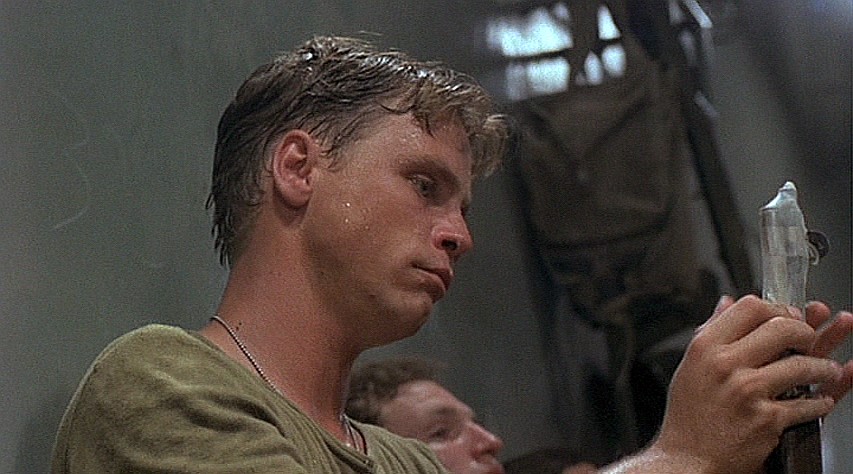
Griff prepares his gun for safe sex
SUMMARY: The movie jumps 24 years to a troop transport involved in Operation Torch. Narration is provided by Private Zab (Robert Carradine) who is a member of your typically heterogeneous rifle squad led by the Sergeant. They are sweating! They talk like soldiers do before they are going to risk their lives. Lots of ribbing and bravado. They authentically place condoms over their rifle barrels to keep the sand and seawater out.

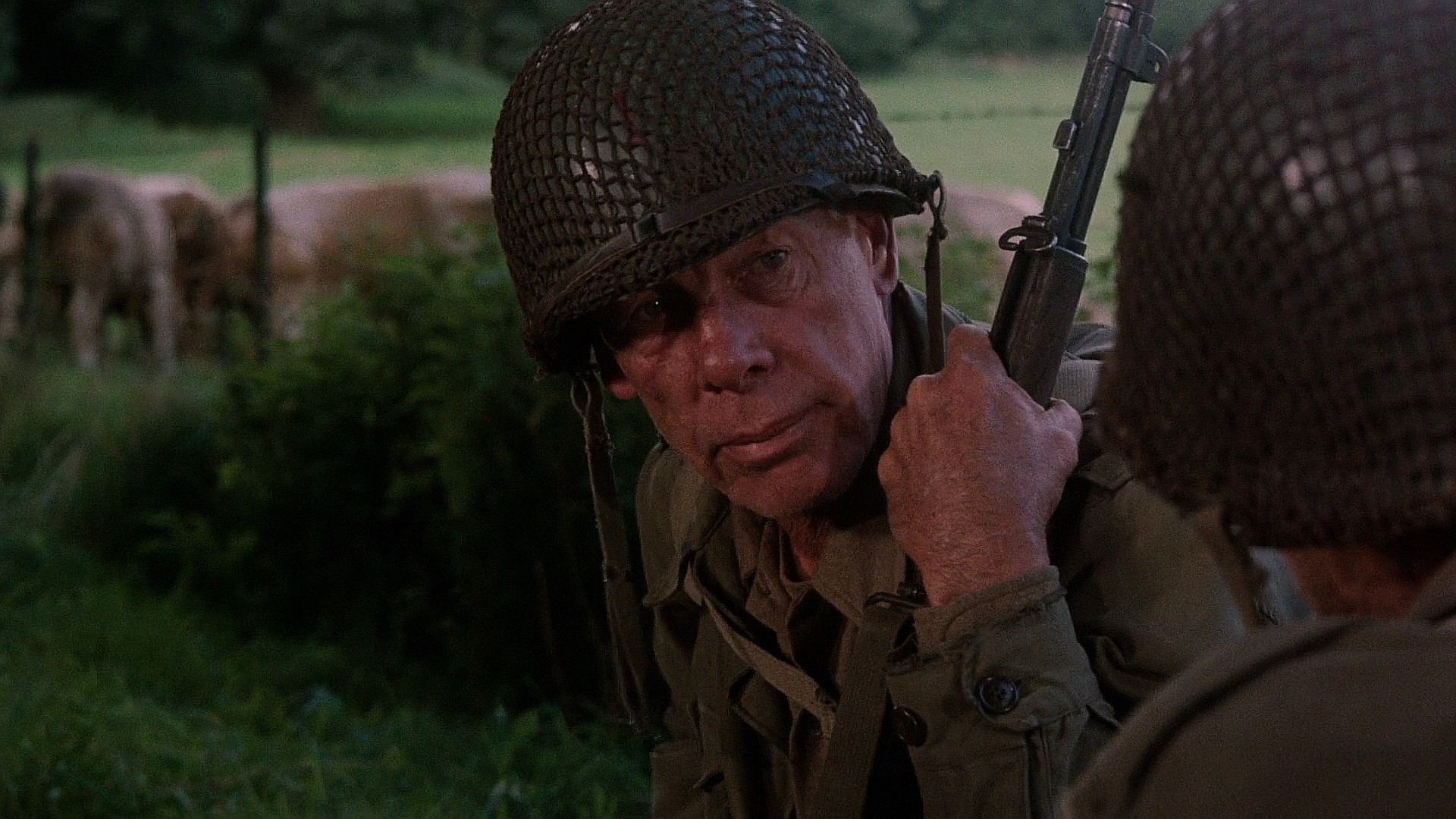
the gruff, but lovable, Sergeant
     The movie follows the exploits of the Sergeant and his “Four Horsemen”. Besides the aspiring novelist Zab and the sharpshooter who refuses to shoot humans Griff (Mark Hammill), there is Vinci (Bobby DiCicco) playing the obligatory Italian-American and the farm-boy Johnson (Kelly Ward). Our heroes need a villain so their paths will cross those of a fanatical Nazi named Schroeder. We know he is a bad-ass when we meet him he has a potato-masher in his boot and he murders another soldier for criticizing the war effort.

     Since the film was low budget, the Torch landing is a little cheesy and unrealistic. This is compounded by a silly exchange between the Americans and the Vichy French via megaphones. From here the film settles into its episodic nature. Scenes of the squad chilling and soldier-bantering are interspersed with action scenes. One of the themes is revealed to be the inability of Griff (Mark Hammill) to kill. The Sergeant opines that “We don’t murder, we kill. You don’t murder animals, you kill ‘em.”
     Some of the episodes are surrealistic. At one point the squad is rescued by a French cavalry charge in a town! They battle the smallest tank in war movie history which despite its miniature size blows up like the Fourth of July when Zab tosses in a grenade.

     At the Battle of Kasserine Pass, our boys bury themselves to survive the overrunning Panzers (actually Israeli Sherman tanks, but the other equipment and uniforms appear authentic). Griff panics and runs precipitating a rout in which the Sarge is wounded by Schroeder. When he returns from the hospital, there is a touching reunion with his four charges and we are introduced to the theme that these five are inseparable and unkillable. The same cannot be said for the replacements who periodically grace the screen for brief life spans. They should have come with “dead meat” stamped on their foreheads.

the squad stalking Schroeder
     In a typically bizarre scene, the five hide in a cave during a German counterattack and when a naval bombardment causes Germans to take refuge in the cave (one at a time), they kill each as they enter like in an old Three Stooges flick. In another, a boy with his dead mother’s body takes them to a German gun position in exchange for a decent burial for his mom.

     From Sicily, they move on to Normandy. The low budget makes the invasion look like it was done by one squad, but this fits the squad-level view of the movie. You won’t mistake this scene for “Saving Private Ryan”. In a scene similar to one in “The Longest Day”, they use a Bangalore torpedo relay to open up the beach. No covering fire, the rest just watch as each relayer gets shot. Griff is #8 and goes chicken again so the Sarge has to shoot at him. Tough love, but it works because when the explosion occurs the battle is won and we can move on to the next scene.  The movie conveniently ignores that the busting of the barbed wire was followed by the scaling of the bluff and the taking out of bunkers, etc. to actually open up the beach.

     In probably one of the most famous scenes, Schroeder sets up an ambush at the very same crucifix from the opening! The Germans lay around a tank playing dead while Schroeder hides behind Christ. Somehow Schroeder has figured out this is the one unit in the American army that will not plunder dead German bodies for souvenirs and important papers. The Sarge is not fooled and uses the tank’s machine gun to wipe out the krauts. Schroeder escapes, of course. A Frenchman on a motorcycle arrives with his pregnant wife and the GIs assist the birth inside the tank using ammo belts for stirrups.  In a move to get giggles from 12 year old boys, the guys encourage the woman to push the baby out by chanting “poo-say” (hee! hee! get it?).

"I am one of you, I am sane"
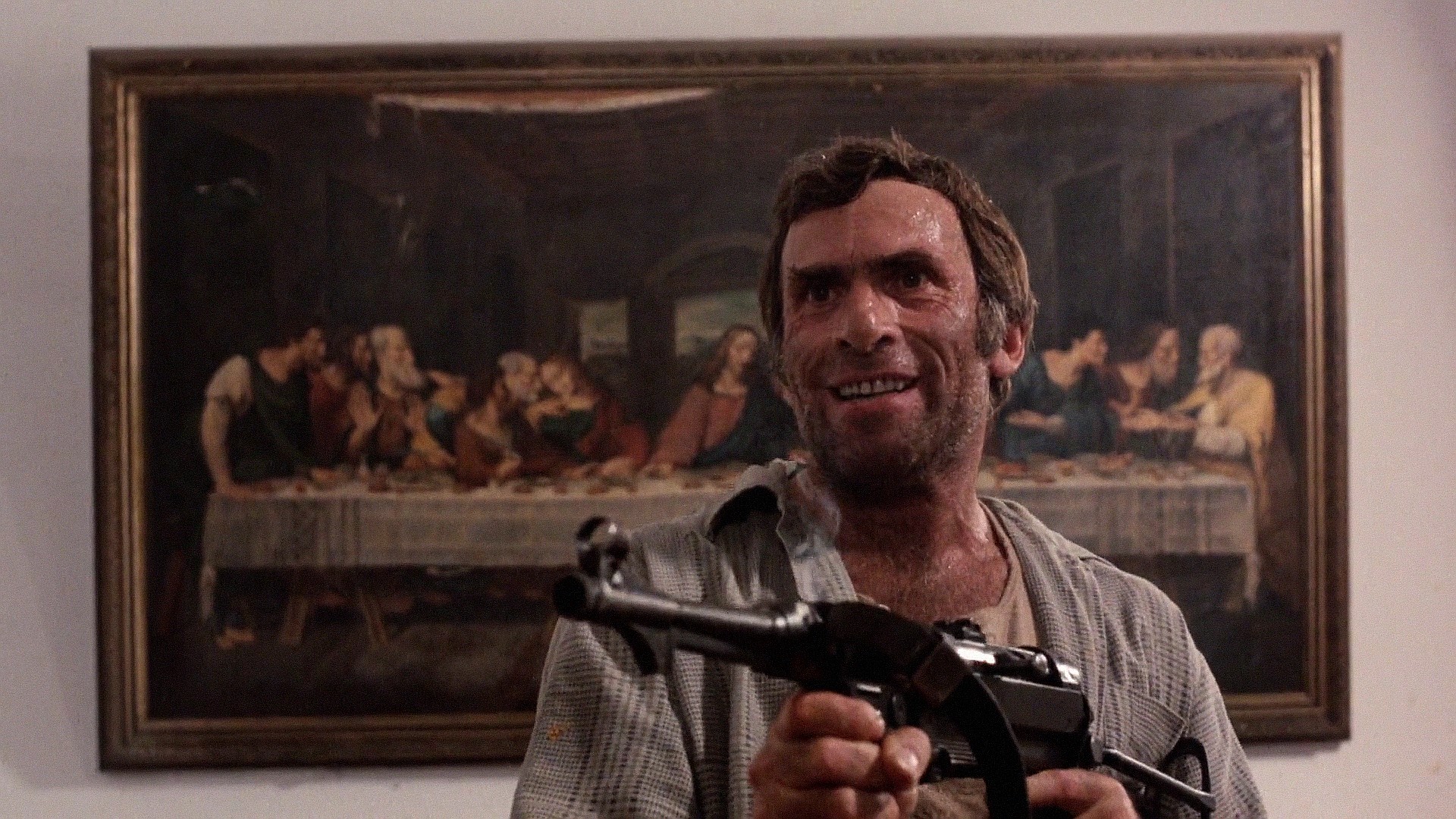
     Next, our heroes go after some Germans using an insane asylum as a forward artillery observing post. A fire-fight breaks out during which one inmate grabs a machine gun and opens random fire proclaiming “I am one of you, I am sane”. Heavy-handed, much?

     In the Heurtgen Forest, they undergo tree bursts, but do not deign to dig in. The theme of a crass attitude toward the dead is explored. They take out one small artillery piece with a bazooka and suddenly the bombardment ends. The longest lasting replacement (Keiser) is killed in a foggy forest by a sniper who presumably passed up chances to kill the other five.

FINAL SCENE: The guys help liberate Falkenau concentration camp in Czechoslovakia. They have to assault the camp and kill the guards. Griff corners a Nazi hiding in one of the ovens and empties a clip into the German's face. Griff finally can kill! It’s a powerful scene partly abated by the fact that Mark Hammill cannot act.
    
     Meanwhile, the Sergeant befriends a little Jewish boy who he walks around on his shoulders until he dies. Very poignant. It’s full circle time as Schroeder appears (small world, eh?) ready to surrender. This is the same fanatical Nazi who had murdered a German woman he had just slept with for criticizing Hitler. He is clearly unarmed and has his hands up, but the Sarge knifes him anyway. Would you believe the Sarge is immediately informed that the war is over? This has to be the least surprising case of déjà vu in war movie history. This time the Sarge makes amends for his senseless murder in WWI by working feverishly to preserve the life of the despicable Schroeder. Go figure. In a line straight from Moe Howard, the Sergeant proclaims that “you’re going to live if I have to blow your brains out!” Zab (Fuller) adds the postscript: “I’m going to dedicate my book to the survivors. Surviving is the only glory in war, if you know what I mean.”

RATINGS:

Action – 7


Acting – 7


Accuracy – 6


Realism – 7


Plot – 7


Overall – 7

WOULD CHICKS DIG IT? Possibly. The cast is attractive. Lee Marvin is a commanding presence. The violence is not graphic. There are a few female characters including a French Resistance fighter in the insane asylum. The movie has a light touch at times and has emotional moments involving children.

ACCURACY: “The Big Red One” is a personal story and a small unit tale, so historical accuracy is not really a factor.  Much of the historical incidents are handled in a simplistic manner.  For example, the Torch invasion where the French open fire, but once their commander is killed, it's all hugs and kisses between the new allies. One could argue that the landing at Omaha Beach was much busier and complex than the movie implies, but the low budget of the film and the emphasis on following just five soldiers makes that a moot point. The 1st Division did fight in the different locales shown in the film. It did liberate the concentration camp.  The arms and equipment (with the exception of the German tanks) are authentic.

CRITIQUE: “The Big Red One” plays as a series of weird vignettes. They are all interesting and move the narrative along and although each of them may have been based on an actual incident, it is highly unlikely than any squad would have had all these incidents happen to them. In fact, some of the scenes (e.g., the tank birth and the insane asylum) seem unlikely to have happened to anyone. The movie gets cred because supposedly it is autobiographical, but it is telling that the companion book by Fuller is a novel. Two minor incidents are based on Fuller’s experiences: when Zab discovers Keiser reading a novel written by Zab and when Zab acts as a runner to inform their colonel that they have broken through on Omaha Beach. That’s pretty puny to back up the claim that the movie is based on fact.

     The film is strongest in its depiction of soldier life. The dialogue rings true. The relationships are realistic, including the paternal attitude of the sergeant and the refusal to bond with replacements. Fuller throws in little details that make the movie feel authentic. Things like the condoms on the rifle barrels, salt peter in the food to lower libido, and an “appearance” by “Axis Sally”.

     Fuller has a sparse style. Some scenes end abruptly. It gives the movie something of an episodic feel. One begins to wonder what mess the squad will get into next. The battles are small-scale and end quickly. The battles are meant to be gritty, but the movie is firmly in the old school style, pre-“Saving Private Ryan”. Deaths are usually bloodless and of the “hands throw in the air” variety. In the D-Day landing scene, we get a shot of a soldier whose intestines are exposed, but zero other graphic shots.

     The use of the Schroeder character to have a foil for the five is misguided, but typical of a B movie (which the movie has been described as). It reminds me of the main German character in “Saving Private Ryan”, but Speilberg did not go overboard like Fuller does. Meeting up with this one Nazi several times really strains credulity. Another problem is the important theme of Griff’s cowardice is never resolved. Another theme, war is brutal and arbitrary in dealing out death, is undercut by the survival of all five. In fact, only the sergeant even gets wounded. The movie would have much more powerful if one of the five had been killed. The deaths of most replacements is exaggerated, the invulnerability of the five is unrealistic.

CONCLUSION: “The Big Red One” is an entertaining and in many ways amusing war movie. Marvin is marvelous and the young actors are competent. It does a good job of informing the viewer about what it was like to be in a rifle squad in the 1st Division in WWII. However, on close examination, the movie does not hold up well. Much of it is implausible. Some of the incidents seem unlikely to have happened to any squad, much less to the same squad. This would be less of an issue if the movie was not touted as based on Fuller’s experiences.  It's a fun movie, but undoubtedly overrated by many critics.


Next up:  #70 -  Hail the Conquering Hero