Showing posts with label French Resistance. Show all posts

Monday, June 17, 2024

100 BEST WAR MOVIES: #54. The Train (1964)


                  “The Train” is a war movie directed by John Frankenheimer that was released in 1964. It is based on a non-fiction book entitled Le Front de l’Art by Rose Valland. The film was originally helmed by Arthur Penn, but co-producer and star Burt Lancaster axed him because Penn wanted to make more of a character study and Lancaster insisted the action be revved up. The film was shot on location in France. No models were used. Those are all real trains crashing and getting blown up. The air bombardment of the marshalling yard was symbiotic because the French government wanted the area cleared anyway. (That less than one minute scene required fifty men wiring TNT for six weeks.) Lancaster (51) did all of his stunts. This included sliding down a hillside. When he injured his knee stepping in a hole while golfing, it was written into the script that he would be wounded while fleeing under fire. One scene where the train races into a tunnel to avoid a strafing Spitfire was added to have an additional action sequence. Frankenheimer was almost killed when the helicopter he was filming from came within ten feet of being hit by the Spitfire.

                  The movie opens in Paris on August 2, 1941 (the 1511st day of occupation), just days away from Allied liberation. A German officer Col. Von Waldheim (Paul Scofield) visits an art gallery where the Nazis have concentrated much of the French masterpieces they have stolen. The curator Mlle. Villard (Suzanne Flon; based on the author Valland) thanks him for being a non-typical Nazi in that he admires art. He says “I’ve often wondered at the curious conceit that would attempt to determine taste and ideas by decree.” She is stunned when he suddenly orders the paintings to be crated up to be removed to a “safe place” in Germany.  It is unclear whether he is an art lover or simply a thief. Von Waldheim becomes obsessed with getting the train loaded with the art out of Paris. He considers it more important than military trains. We first meet his adversary Labiche (Lancaster) on a long tracking shot as he tries to flag down a train, slides down a ladder, runs along the tracks, and jumps aboard the moving train. Labiche runs the rail yard, but is also a leader in the Resistance. He is visited by Villard who makes a passionate case for delaying the art train because the art is part of the glory of France. Labiche is unimpressed and points out that his cell started with eighteen men and is now down to three. “I won’t waste lives for paintings.” Besides, their top priority is delaying a military train so it is still in the yard when a scheduled bombing raid takes place. However, as you can guess, Labiche eventually comes around and becomes heavily involved in making sure the train with the art does not leave France.


ACTING:                      A

ACTION:                      N/A

ACCURACY:                N/A

PLOT:                            A

REALISM:                      C

CINEMATOGRAPHY:   A 

SCORE:                           C  sparse


QUOTE:  Labiche:  There were over a hundred involved in stopping that train. Switchmen, brakemen, yard gangs, stationmasters. God knows how many will be shot, like Jacques. You know what's on that train? Paintings. That's right, paintings. Art. The national heritage. The pride of France. Crazy, isn't it?

BEST SCENE:  the bombing of the station with the train rushing through

ACCURACY: The movie is surprisingly based on a true story. The book is supposedly a real nail-biter, but in reality the Resistance used paper work and red tape to delay the departure of the train and then put it on a loop around Paris until the Allies arrived. The Spitfire attack was also based on an actual incident, but not involving the art train. The activities of a train station and marshalling yard are authentically depicted.  Other than Villard, all the main characters are fictional.

CRITIQUE: This is a remarkable movie. Frankenheimer described it as the last great action movie made in black and white. It is hard to imagine it in color and colorizing it would be a sacrilege on a par with “Casablanca”. The cinematography is crisp and the railway yard comes off as appropriately gritty and busy. The long tracking shots are awesome and you see a lot of the Frankenheimer style (interesting angles and close-ups) in the way the movie is filmed. There’s lots of deep focus and sweaty faces.

               The acting is great. Lancaster is in top form. He portrays the complexity of Labiche. Labiche is cynical, yet patriotic. He becomes just as obsessed as Von Waldheim. Scofield is an effective foil. He is not your typical Nazi. He is cultural, yet ruthless. He disobeys orders and schemes. The rest of the cast is memorable, especially Michael Simon as Papa Boule and Jacques Marin as the stationmaster. The trains do a great acting job as well. The musical score by Maurice Jarre is fine, but it is overshadowed by the sounds of a working railway and the trains themselves.

The movie starts as a resistance film, but the cloak and dagger has some action in it.  In a terrific scene, an air bombardment catches the train in the yard. A crusty old engineer named Poppa Boule races the art train through the explosions to save the precious cargo. (This iconic scene used 140 explosions involving 3,000 pounds of TNT and 2,000 gallons of gasoline.)  Later, we get an awesome train crash that solidifies the movie’s place as the number one war movie involving trains. Several cameras were destroyed in the shoot.

              The one flaw in the movie is it is pretty preposterous at times. The Germans have to be clueless to be fooled by the changing of the station names. The idea that bombers could avoid hitting some box cars because they are painted white gives too much credit to bombing accuracy. Although the French Resistance was probably not as efficient (or lucky), the movie gives a good look at the dedication of its members and the incredible risks they took. It is an homage to those brave men.

               The theme of the movie is thought provoking. Is a nation’s cultural heritage worth men’s lives? This is the question Labiche has to answer. It is unclear, even at the end, what his answer is. Considering he is the only good guy left alive at the end, the viewer could come to the conclusion that the art was not worth it.


Sunday, February 14, 2016

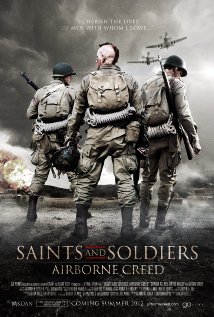
QUEUE CLEANSING: Saints and Soldiers: Airborne Creed (2012)


             “Saints and Soldiers: Airborne Creed” is a Mollywood movie that is the sequel to “Saints and Soldiers”.  Mollywood movies are movies made for Mormon audiences and/or by Mormon directors.  In this case, both apply.  The director is Ryan Little who directed all three in the “Saints and Soldiers” trilogy.  His war  movies are noted for not being overly religious and having a theme of not all religious soldiers are saints and not all Nazis are sinners.  This second installment in the series is not a sequel to the first.  It is set during Operation Dragoon, which was the Anglo-American invasion of Southern France in WWII.

                The movie opens by introducing us to a German officer named Neumann (Lincoln Hoppe).  He goes from writing a heart-felt letter home to his wife and kids to ordering the execution of two French Resistance fighters.  Meanwhile, members of the 517th Regimental Combat Team land behind enemy lines in Provence.  (Little is incapable of showing men parachuting.)  Corporal Curtis (Jason Wade) gets captured by Germans using a German shepherd, naturally.  Curtis is rescued by T5 Rossi (Corbin Allred from the first “Saints and Soldiers”).  He proceeds to kill all the Germans by himself.  As usual in a war movie, there are no wounded because that complicates matters.  War movies have a much higher mortality rate than real war.  The duo becomes a trio when they hook up with Sgt. Jones.  They recite the Airborne Creed (even though it was not created until 1946).  They sit around chatting for a long time even though they are supposed to be attempting to link up with their unit eight miles away.  No rush, there’s just a war on.  It’s time for back-stories via flashbacks.  Rossi is torn by the death of his best friend.  Curtis remembers his girl-friend.  Jones is the religious one and flashes back to telling his minister-father about his decision to join the Army, but not as a chaplain.
Saints and Soldiers:  Walking and Talking
 
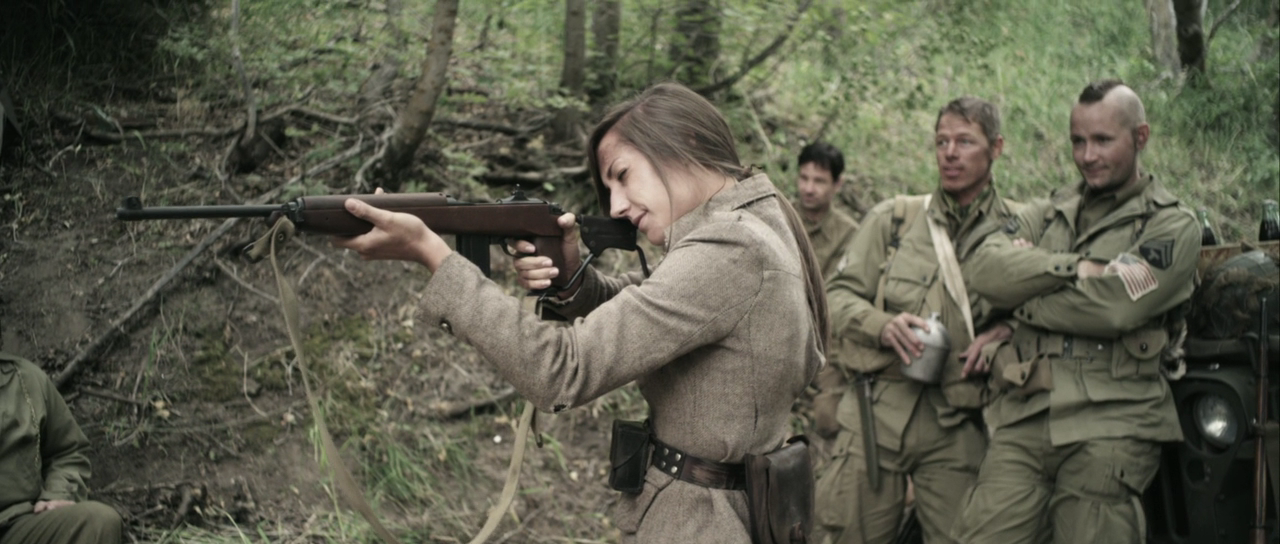
                They encounter Neumann and the almost-chaplain Jones apparently executes him. They next run into a comely French sniper-lass named Emilie (Virginie Fourtina Anderson) who recruits them to help rescue some Resistance captives.  More walking and talking.  They encounter two Americans in a jeep.  One of them uses the phrase “short man on the totem pole”.  What an odd thing for an American to say!  While that faux slang is hanging in the air, Emilie and Rossi have a shooting contest.  I kid you not.  This builds to a tussle with a German tank and half-track and the resurrection of a bad German.  There is a bonding scene involving a wounded paratrooper and a certain war criminal.  “I’m supposed to hate you”, but as a Mormon I can see the good in you.   There is also a reunion between a marksman and a markswoman.
There's always time for a shooting match

                The curse of the sequel.  “Saints and Soldiers” was a major surprise and did very well on the film festival circuit.  It has been the most successful Mollywood crossover.  Most of those films have had an appeal limited only to Mormon audiences and have been savaged by critics.  I was prepared for “Airborne Creed” to be a lesser movie than its predecessor, but I was not prepared for it to suck.  It is, in fact, a major misfire by Little.  The main problem is that it is boring.  There is way too much walking and talking.  There is no sense of urgency for these dudes.  You would think that reuniting with the main force would be a higher priority for three paratroopers trapped behind enemy lines.  Throwing in the Resistance subplot should have juiced the narrative, but once Emilie is introduced the movie slumps back into its leisurely pace.  The acting is what you would expect from a low budget film – sincere, but pedestrian.  The dialogue is blah, but at least there is little sermonizing.  Like “Saints and Soldiers”, the movie is not overtly religious.  You would not know it was produced by Mormons unless you read about this (or had me tell you this).  The flashbacks are thankfully brief and do their character development efficiently, but the actions and motivations of the three paratroopers have little relation to their prior experiences.  Jones, in particular, seems to be having no second thoughts about abandoning his religious upbringing.  However, his supposed execution of Neumann is hardly believable and the off camera gun shot is not going to fool anyone.  (Sorry, spoiler alert!)  The movie is full of clichés and is very predictable.  There is little action and there is a lack of suspense. 
Mormons commit atrocities too

                “Saints and Soldiers: Airborne Creed” is hard to fault.  I have to give it credit for attempting to bring some recognition to the paratroopers who participated in the overlooked Operation Dragoon.   A better movie would have informed the audience that members of the 517th Regimental Combat Team and the other airborne units did a great job in the operation.  Although most landed far from their designated landing zones, they achieved all their objectives in the first 48 hours.  This included ambushing German convoys, cutting enemy communications, and preventing reinforcement from reaching the beachhead.  You get no impression of this from the movie.  Actually, the unintended laughable moments do a disservice to the men who served.  So fault I must.  This is a bad movie and unpardonably boring.  Sincerity does not trump tediousness.


GRADE  =  F

Friday, September 30, 2011

SHOULD I READ IT? The Army of Crime


     “The Army of Crime” is a war movie that fits firmly into the French Resistance sub-genre. It is a French movie directed by Robert Guediguian. He intended it to be an homage to the FTP-MOI branch of the French Resistance. This group consisted mainly of Communist immigrants who conducted missions to kill Nazis in Paris in 1943.


     The movie opens with a preview of the end. Members of the group are on their way to torture and execution by the Gestapo. This probably worked well with a French audience which I assume knows the sad result of the Affiche Rouge affair, but for me it ended the suspense of who would survive. The rest of the movie is a flashback to how they got to that police van.

Marcel takes out another Nazi
     The movie follows several characters who eventually link up to work together. The leading character is an intellectual Armenian poet named Missak Manouchian (Simon Abkarian) who has a dedicated wife Melinee (Virginie Ledoyen). We first meet him as he is released from Gestapo captivity after he signs a document recanting his communism. Thomas (Gregoire Leprince-Ringuet) is a Jewish student who joins the movement and brings a bomb to a party (in a hollowed out copy of Das Kapital, naturally) full of Nazi officers. Marcel (Robinson Stevenin) is a Jew whose father has been deported. He takes vengeance by offering German soldiers cigarettes and then shooting them. He is a loose cannon, but does not dispute this. They hook up when Manouchian forms a group to carry out terrorist activities.

     At first, Missak refuses to kill, but it does not take long for him to get his hands dirty. In a cool scene, he throws a grenade in the midst of some marching German soldiers and then Marcel finishes them off. Later, the group attacks a bus in an orgy of quick and efficient violence.

     The movie is consistently somber, but there is some levity in a scene where the crew plans to use a grenade to blow up a brothel frequented by Germans. The first guy returns after refusing to kill teenage prostitutes, then shockingly Marcel wimps out as well. To make matters comical, they lose the grenade pin and have to go home to Melinee to get a sewing needle to disarm the bomb.

     Their run of luck ends when Marcel’s girlfriend is bribed by the evil French policeman into ratting out the gang. The various members are rounded up with Missak unrealistically going down without a fight even though he must know he will be tortured and killed. Only Melinee survives. The Nazis put out a poster (Affiche Rouge) to discredit them as communist troublemakers. The title of the film comes from an accusation from the poster.

      “Army of Crime” is fairly accurate. The three main characters are actual historical figures and are realistically portrayed. Most of the violent episodes are based on actual events., but I found no evidence for the brothel grenade scene. It also appears that the traitorous girlfriend and her police paramour subplot was fictionalized. More disturbing, it seems that Manouchian was actually the one who turned in the others under torture. The executions and poster are based on fact. One controversial aspect of the film is the accusation that Guediguian makes that the French authorities considered the Communist Resistance to be a bigger threat than the Nazis and thus collaborated with the Germans. The French police are bigger villains in the movie than the Gestapo. The French public is depicted as apathetic about German occupation and even upset with the boat-rocking FTO-MOI. There is also the implication that the ethnicity of the group played a role in their lack of support from average French people. Ironically, these “foreigners” were more interested in dying for “liberte, egalite, fraternite” than the French were. It may be exaggerated, but it feels authentic.

     I liked this movie much more than the similarly themed “Army of Shadows”. It does not drag and the action sequences are well-paced. The cinematography is crisp in color. The acting is very good, especially Abkarian and Stevinin. The production design and costumes take us back to wartime Paris.

OVERALL - 9/10


Wednesday, September 21, 2011

SHOULD I READ IT? Army of Shadows


     “Army of Shadows” (“L’Armee des Ombres”) is a French movie by acclaimed director Jean-Pierre Melville. It is based on the 1943 novel of the same name by French Resistance member Joseph Kessel. Originally released in 1969, it was hammered by the French critics for its supposed pro-De Gaulle slant. The backlash ended its chances for U.S. distribution until its reissue in 2006. It became a critical darling and made many critics’ Top Ten lists. Some had it as the best movie of 2006.


     The movie opens with a German band marching through the Arc de Triomphe in a long shot toward the stationary camera. (This scene was originally placed at the end of the film.) Nice start. It is October, 1942 and we meet the main character Gerbier (Lino Ventura) who is under arrest for Resistance activities. He is one cool customer. When he is transferred to Gestapo headquarters, he stabs the only guard and escapes. (This will not be the last implausible thing to happen in this movie.) Gerbier is part of a Resistance cell. Their lives are in constant danger, but they patriotically take it in stride. They live by a code and of course the worst violation of the code is to rat on one’s comrades. In one scene, they strangle a traitor because they cannot use a gun. Powerful.

     Gerbier recruits a young hot shot pilot named Jardie (Jean-Pierre Cassel). He joins the group that includes agents with cool nicknames like Le Masque and Le Bison. Unfortunately, Gerbier’s best friend Lepercq (Paul Crauchet) gets arrested while Gerbier is in England consulting with the British. He returns, parachuting from one of the most fake airplanes in cinema history. Mathilde (a matronly Simone Signoret) has a plan to rescue Lepercq from deep in Gestapo headquarters. Piece of cake, right? Meanwhile, Jardie takes it upon himself to get arrested hoping that the Germans will suspend logic and put him in the same cell as Lepercq. Mission accomplished! Mathilde’s rescue squad arrives disguised as an ambulance crew, but Lepercq has been tortured to the point of death and he can’t be taken so all this is for nothing. WTF? (And by the way, Jardie’s arrest plays no role in the success or failure of the plan.)

Gerbier (Lino Ventura) trying to stay awake

     Later, Gerbier is picked up in a routine raid. He and others are to be executed, but not by firing squad and before he can be tortured like Lepercq (wait, what?) It is not a simple execution thankfully. The victims are told to run down a corridor while a machine gun fires at them from behind. Luckily, Gerbier decides to be a coward and run instead of taking it like a man. I say lucky because Mathilde has somehow learned of the exact time of this bizarre event and is stationed on the roof of the corridor which conveniently has an opening for her to toss some smoke bombs to blind the machine gun and a rope to hoist Gerbier to safety. I am not making this up. Critics undoubtedly fawned over the lighting in this scene.

     Gerbier is whisked to a safe house where he must lay low for an incredibly long and boring time. Go use the bathroom and take a nap during this part of the film which feels like it is taking place in real time. While watching the paint dry in the house, Gerbier is visited by Le Grande Fromage who tells him Mathilde has turned her coat to protect her daughter. The code deems her death-worthy and so they do a drive-by on her. A post script tells us she is not the only one of our less-than-merry band to not collect their French Resistance pensions. This is not a feel good movie.

     I sometimes disagree with critics, but seldom as vociferously as with this movie. This movie is boring! It drags and is way too long. Some scenes seem to move at a snail’s pace. It is pretentious (which may explain some of the critical acclaim). It also has some ridiculous scenes which I have to assume were the author’s attempt to jazz up a novel that was supposedly about true events. I will admit the acting is good and the cinematography is well done, but that does not overcome the plot (or in this case, the plod). The incredible thing is I am way out on a limb on this one. Virtually no critic had anything bad to say about it. Normally I would admit I need to watch it again, but I’d rather take my chances trying to outrace a machine gun down a long corridor.

4/10