Showing posts with label Lawrence of Arabia. Show all posts

Friday, November 27, 2020

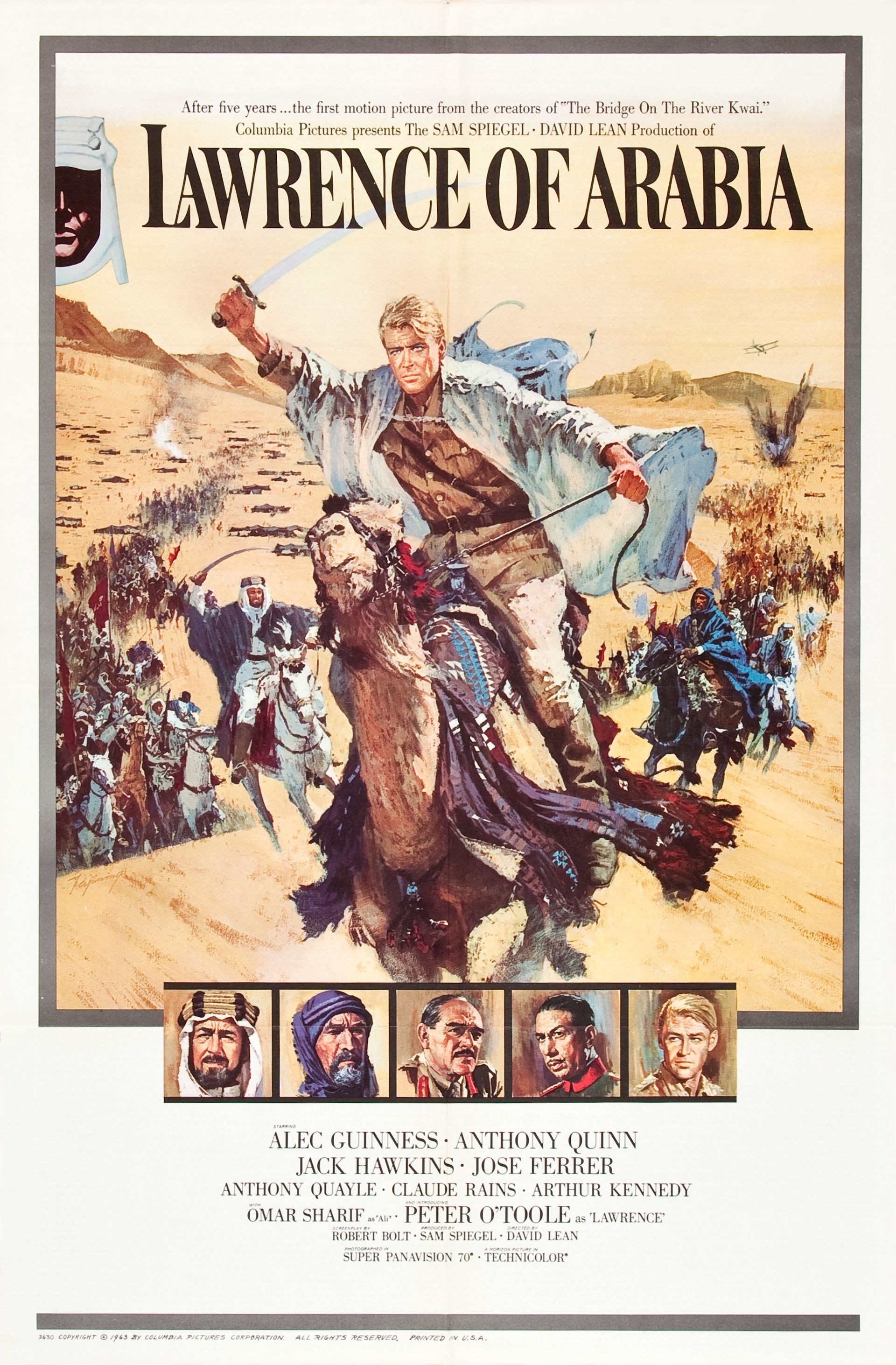
CONSENSUS #3. Lawrence of Arabia (1962)


SYNOPSIS:  This is the biopic about the famed T.E. Lawrence (Peter O’Toole).  Lawrence was a British officer in the Middle East during WWI.  He took it upon himself to try to enlist the Bedouins into the British war effort against the Turks.  He goes native and becomes determined to unify the Arabs and prevent the British from doing their usual colonial thing.

BACK-STORY:  “Lawrence of Arabia” is considered one of the great classic movies.  It is #7 on AFI’s latest list of the greatest movies.  It is #1 on the Epics list.  The film is considered to be the best of director David Lean’s awesome resume (which includes “Bridge on the River Kwai”).  It is loosely based on T.E. Lawrence’s “The Seven Pillars of Wisdom”.  The screenplay was first written by Michael Wilson, then Robert Bolt was brought in and changed virtually all the dialogue and characterizations.  Wilson was uncredited partly because he was blacklisted for communist sympathies.  His contribution was not credited until 1995.  The movie’s desert scenes were filmed in Jordan and Morocco.  King Hussein of Jordan provided a brigade of the Arab Legion as extras.   The film was universally acclaimed.  It won Academy Awards for Best Picture, Director, Art Direction, Cinematography (Freddie Young), Score (Maurice Jarre), Editing, and Sound.  It was nominated for Adapted Screenplay, Actor (O’Toole lost to Gregory Peck for “To Kill a Mockingbird”), and Supporting Actor (Sharif).

TRIVIA: 

 1.  The screenplay was first written by Michael Wilson, then Robert Bolt was brought in.  Wilson had focused on the political and historical issues of the Arab Revolt.  The characters and scenes were mainly Wilson’s.  Bolt made the movie into more of a character study.  He changed virtually all the dialogue and characterizations.      Wilson was uncredited partly because he was blacklisted for communist sympathies.  His contribution was not credited until 1995.

2.  The movie’s desert scenes were filmed in Jordan and Morocco.  King Hussein of Jordan provided a brigade of the Arab Legion as extras.  The famous train scene was shot in Spain.  Two and a half miles of track had to be laid down.

3.  ”.    Peter O’Toole was not the first choice for Lawrence.  Marlon Brando turned the role down.  Anthony Perkins and Montgomery Clift were considered.  Albert Finney went through extensive and costly screentests before he turned down the role because he did not want to sign a seven-year contract.  O’Toole got an “introducing” screen credit even though it was not his first role.

4.  Jose Ferrer agreed to appear in it only after being guaranteed pay that ended up being more than what was paid to O’Toole and Sharif combined!  He received $25,000 and a new Porsche.

5.  ”.    The movie took over two years from start to finish.  In one scene the O’Toole that finishes at the bottom of a staircase is two years older than he was at the top of the staircase.

6.  The desert shoots were difficult.  There was the 130 degree temperatures and the sandstorms and the critters.  O’Toole lost 28 pounds during the filming.  Unlike Lawrence, he hated the desert.  He was often drunk and obnoxious during his spare time.

7.  At one point, O’Toole was thrown from his camel and only was saved from being trampled by the camel standing protectively over him.  He was drunk and lashed to his camel for the big Aqaba charge.  By the way, O’Toole had to sit on a sponge pad to survive all the riding (the Arab extras called him “Lord of the Sponge”).

8.  Because his first attempts at sitting on a camel resulted in a bloody ass, O’Toole had to sit on a sponge pad to survive all the riding (the Arab extras called him “Lord of the Sponge”).

9.  Sharif was given his iconic mustache to contrast to O’Toole’s clean-shaven look.  Previous to this movie he had never worn facial hair.

10.  Edmond O’Brien was playing Bentley until he suffered a heart attack early on.  Kirk Douglas had been originally approached, but he insisted on second-billing and a large salary.

11.  To simulate a journey, Lean made sure almost all movement was left to right.

12.  No woman speaks in the movie.  It is probably the longest movie to achieve that.

Belle and Blade  =  N/A

Brassey’s              =  5.0

Video Hound       =  5.0

War Movies         =  5.0

Military History  =  #6

Channel 4             =  #40

Film Site                =  yes

101 War Movies  =  yes

        Rotten Tomatoes  =  #9 

HISTORICAL ACCURACY:  This section is going to be a chore.  I read “Setting the Desert on Fire” and the appropriate chapters of the new biography “Hero”, watched the PBS documentary “The Battle for the Arab World”, and visited several web sites, but there is a lot of contradictory information out there.  Part of the problem is that the movie is based on Lawrence’s memoirs, which have been called into question by historians.  It is understandable that Wilson used the book as the outline for the screenplay since Lawrence’s account of his adventures is compelling, but one has to wonder how much embellishment went into “Seven Pillars of Wisdom”. 

                First, the characters.  The main characters are all based on real people or composites of real people.  The composites are Ali (who is based on the actual Sharif Ali, but represents several Arab comrades of Lawrence’s), Brighton (who stands in for all the British military advisers), and Dryden (who is typical of British politicians of the Arab Bureau).  Feisal and Allenby are close to real.  Murray is maligned a bit too much.  Although a reluctant supporter of the Arab Revolt, he later became a strong believer in Lawrence.  Auda gets a raw deal in the film.  Depicted as mainly motivated by money, he in fact was a patriot.  His depiction as a great warrior is accurate.  Farraj and Daud had roles in Lawrence’s life similar to the movie, but Daud actually died from freezing to death.  Farraj was put out of his misery by Lawrence, but it was after he was shot by a Turk.  Gasim was a real person and he was saved from the desert by Lawrence, but he went back for him due to the Bedouin tradition that one was responsible for his servants.  The shooting incident was another person.  Bentley was based on the American journalist Lowell Thomas who spent about a week with Lawrence and then wrote glowing tales after the war.  He was not the cynic that Bentley is and did not witness any of the train attacks.  Also, by the time he met Lawrence, the U.S. was already in the war.

                The portrayal of Lawrence has come under criticism.  Some carp about Lawrence being much shorter than O’Toole, but this can not be a serious argument against O’Toole getting the role.  No actor on Earth would have been a better choice.  Other than height, he resembles Lawrence, including the blue eyes.  The movie implies that Lawrence wanted the job of meeting Feisal because he wanted to experience the desert.  In reality, Lawrence had been in the Middle East for some time at this point as an archeologist and had been coopted by the British Army to conduct a survey of the Negev Desert.  The famous match-dousing scene alludes to Lawrence’s masochistic tendencies which included going without food and sleep when he was growing up.  The question of Lawrence’s sexuality is merely hinted at in the film which is appropriate not just because the film was made in 1962, but because even today it is unclear.  Lawrence’s brother, who had sold producer Sam Speigel the rights to “Seven Pillars”, disowned the film and refused the use of the book title for the film title. 

                Most of the events depicted in the film are based on actual incidents, but there are some accuracy issues.  Lawrence’s death is well done.  Lawrence was an intelligence officer with the Arab Bureau when the opportunity to encourage the Arab Revolt presented itself.  He did not get along with his superiors. The incident at the well was pure Hollywood as no one was killed.  When Lawrence arrives at Feisal’s camp the air attack had already happened, but Feisal’s force was disintegrating.  Lawrence brought the gold, guns, and glory to revive it.  Lawrence did establish a strong relationship with the prince, but the decision to attack Aqaba was more of a group decision including Auda (who met Lawrence at Feisal’s camp).  Auda was with Lawrence for the crossing of the Negev. 

                The assault on Aqaba was not as much of a surprise as the movie depicts.  In actuality, several Turkish outposts had already been captured and the surrender of the port had been negotiated.  The filmed charge was true to form, but it occurred after Arab reinforcements arrived and insisted on it.  Lawrence did cross the Sinai to report to Cairo, but he was accompanied by seven others and no one died.  When Lawrence met with Allenby, the two got along fine and continued to do so through the rest of Lawrence’s stay in the Middle East.  The relationship with Lowel Thomas (Bentley in the film) was very inaccurate.  He was an unabashed worshiper.  It was Thomas who coined the term “Lawrence of Arabia”.

                The train attacks actually began before the attack on Aqaba and were initiated by other British officers.  Lawrence was never wounded in any of the incidents and no Arab was wounded by an explosive.  As far as the arrest in Daraa, historians are divided on this one.  Some do not believe he ever was in Daraa.  It seems likely that he was taken prisoner and physically and sexually abused.  This traumatic event apparently led to the flagellation disorder that Lawrence evidenced later in life.  

              The atrocity at Tafas is pretty accurate.  The town had been massacred by a Turkish force which was then caught retreating by Lawrence’s men.  There is some question about whether Lawrence ordered “no prisoners”.  Some historians argue that he took responsibility for something he could not stop.  He did participate.  It is ridiculous to make a big deal of this since it is hard to imagine it playing out differently than what happened.

                 The closing events in Damascus are acceptable.  Lawrence did enter the city ahead of the British with the Arab army and he did have high hopes that the city and the whole of Syria would have its independence.  By this time Lawrence knew about British/French plans, but had kept his knowledge of them from Feisal.  The Arab Council did have trouble administering the city and one of the problems was lack of electricity.  However, the movie implies that the British were forced to take control fairly soon when actually Feisal was not deposed until 1920.  The last straw incident at the hospital did occur.

OPINION:   “Lawrence of Arabia” is a guy epic.  All the elements you associate with a movie of massive scope are there except the mushy romance.  The scenery is awesome.  Lean was influenced by John Ford’s use of Monuments Valley and one-ups him here.  I’m not much into scenery, but the desert vistas are incredible.  If ever a movie was made to be watched on as big a screen as possible, this is it.  The cinematography is equal to the locales.  Lean contrasts the sere desert scenes with the cool marble of the British interiors.  The outdoor shots could best be described as sweeping.  The movie includes one of the iconic cinematographic scenes in which Ali appears mirage-like at the watering hole.  Add to this the score which matches the scenes perfectly.  No one has ever deserved the Oscar more than Jarre. 

The perfection carries over to the casting.  It is hard to imagine any major role that could have been played better by another actor.  Has any actor ever had a more auspicious start than O’Toole?  You have to give the man credit for preparation as he read “Seven Pillars” almost to the point of memorization and interviewed as many people who knew Lawrence as he could find.  He also learned to ride a camel (Guinness and Quinn only ride horses in the film.)  And keep in mind that this was Sharif’s first English speaking role.  All of the actors acquit themselves well.  There is not an average performance.  Anthony Quinn is great as Auda and went to great lengthes to look like him.  Guinness delivers Feisal’s political bon mots with aplomb.  Quayle does a fine job as the officer who evolves into an admirer of Lawrence and a person who takes umbrage at the scheming that daggers the Arabs in the end.

                The movie’s themes are efficiently developed.  Lawrence is worn down from naïve optimism to disillusionment.  His character arc is fascinating and something of a roller coaster ride, but with the inevitable realization that one man can not change the Middle East.  Early in the film, Lawrence proclaims to Ali that “nothing is written”, but by the end of the movie it is apparent to him and the viewer that European domination of the region was written (literally in the Sykes-Picot agreement).  The movie controversially implies that the Arabs were incapable of governing themselves.  Although one theme is clearly that the Arabs were shafted by the British, the movie also gives the impression that the Arabs were too factional and incompetent to rule themselves.  This is reinforced by Lawrence going from believing that the Arabs can rise above being a “little people” to being frustrated with having to deal with them.  It is interesting to note that Ali and Lawrence go on opposite arcs as Ali ends up the more optimistic and empathetic individual.

                The movie does have some weaknesses.  It is a bit long with two lengthy desert passages.  In fact, “Lawrence of Arabia” clocked in as the longest Best Picture winner (one minute longer than “Gone with the Wind”).  In spite of the length, the combat scenes are too brief.  The movie could have used a few maps and the time frame is hard to follow.  This vagueness was a product of the decision to concentrate on Lawrence as opposed to the Arab Revolt.  Still, the cinematography, acting, plot, and music stomp out any quibbles.

In conclusion,  “Lawrence of Arabia” is one of the truly great motion pictures.  Everything about it is grandiose.  It is a film that holds up to multiple viewings and it stands up well when compared to the more modern war films.  It is interesting to compare it to a film like “Patton” and see that it is in the same league.  I would have to say that “Patton” is the better war movie, but the lesser movie.  The same could be said when comparing it to Lean’s other war epic – “Bridge on the River Kwai”.  Thus the conundrum of the list of the Greatest 100.  “Lawrence of Arabia” is firmly ensconced as one of the Top Ten movies of all time, but is definitely not one of the ten greatest war movies of all time.  My opinion is partially based on my belief that it is not primarily in the war movie genre.  I would place it first in the biography genre and then in the epic adventure category. 

Friday, July 1, 2016

THE 100 GREATEST WAR MOVIES (STATISTICALLY)


This is my attempt at a statistical analysis of the greatest war movies.  Here is the methodology.  I found four 100 Greatest War Movies lists that I feel are knowledgeable on the subject.  Two of those lists (Military History magazine and Channel 4) rank the movies.  The others are Film Site and the book 101 War Movies You Must See Before You Die.   I also used three books that rate war movies:  Video Hound’s War Movies, Brassey’s Guide to War Films, and The Belle and Blade Guide to Classic War Videos.  The reason why the list is limited to only movies from the 20th Century is because the sources do not include 21st Century movies. 

 I won’t bore with the details, but basically the first number is a combination of the average rating from the ratings books and a rating based on the ranking from the two ranked lists (on a scale of 1-5).   I grouped the movies based on how many lists they made so only movies that were in both Military History magazine and Channel 4 made the top 43. 

 I must emphasize that this list does not reflect my opinions.  In fact, I find some of the positions ridiculous.  I have seen and reviewed all of the movies on the list.  Some are not war movies, in my opinion.  Others are very overrated.  It is also apparent that foreign movies got short-changed.

Sorry about the columns.  I was not drunk when I made them. 

Either MH (Military History magazine) or C4 (Channel 4) plus one more list
100.  The Manchurian Candidate  (1962)                3.85        85MH 
99.    Bridge at Toko-Ri                                        3.85        73MH
98.    Mrs. Miniver                                               3.93        79C4   
97.    To Hell and Back                                          3.94        77MH
96.    Run Silent, Run Deep                                   3.95        79MH
95.    The Alamo  (1960)                                       4.02        61MH
94.    Sands of Iwo Jima                                        4.03        76C4
93.    Land and Freedom                                        4.05        80MH
92.    Ulzana’s Raid                                              4.05        54MH
91.    The Sea Hawk                                              4.05        48MH
90.    The Man Who Would Be King                      4.08        74MH
89.    Hail the Conquering Hero!                            4.08        70MH
88.    The Cruel Sea                                             4.08        41C4
87.    They Died with Their Boots On                    4.09        68MH
86.    Foreign Correspondent                                  4.1          86MH
85.    Ride with the Devil                                       4.1          73C4
84.    Casualties of War                                        4.12        55C4
83.    The Train                                                    4.16        62MH
82.    Empire of the Sun                                        4.16        43C4
81.    Life is Beautiful                                          4.19        56C4
80.    Twelve O’Clock High                                    4.2          72MH
79.    The Story of G.I. Joe                                    4.26        45MH
78.    She Wore a Yellow Ribbon                            4.28        55MH
77.    Catch-22                                                     4.28        42C4
76.    Oh!  What a Lovely War                              4.28        40C4
75.    The Tin Drum                                              4.3          60MH
74.    Scipio Africanus                                           4.3          56MH
73.    Ministry of Fear                                           4.3          53MH
72.    Colonel Redl                                                4.3          50MH
71.    The Third Man                                            4.33        80MH
70.    Battleground                                               4.34        36MH
69.    Beau Geste                                                 4.35        52MH
68.    Three Kings                                                 4.4          50C4
67.    Hell’s Angels                                               4.4          43MH
66.    Hope and Glory                                           4.43        52MH
65.    Pork Chop Hill                                            4.43        39MH
64.    Good Morning, Vietnam                               4.44        31C4
63.    Gettysburg                                                  4.46        46MH
62.    Battleship Potemkin                                     4.47        47MH
61.    Tora! Tora! Tora!                                        4.51        39C4
60.    Kagemashu                                                 4.53        34MH
59.    The African Queen                                      4.53        32MH
58.    Duck Soup                                                  4.53        27MH
57.    Notorious                                                   4.55        57MH
56.    The Searchers                                             4.55        49MH
55.    The Dawn Patrol  (1938)                             4.58        38MH
54.    Best Years of Our Lives                              4.61        40MH
53.    The Dam Busters                                        4.69        11C4
52.    The Killing Fields                                       4.75        15C4
Either MH or C4 plus two more lists                       
51.    Birth of a Nation                                          3.8          92C4
50.    Ballad of a Soldier                                        3.9          81MH
49.    The Big Parade                                            4.1          58MH
48.    In Which We Serve                                     4.12        57C4
47.    Gallipoli                                                     4.19        48C4
46.    Stalag 17                                                    4.19        18MH
45.    Sergeant York                                              4.4          19MH
44.    Wings                                                        4.7          11MH
Both MH and C4  (the highlighted movies appear on all four lists)
43.    The Last of the Mohicans  (1992)             3.75        65  (avg. of MH and C4)
42.    Battle of Britain                                         3.75        59.5
41.    Guns of Navarone                                      3.94        53.5
40.    The Deer Hunter                                        3.95        20.5
39.    A Bridge Too Far                                     4.02        50.5
38.    El Cid                                                      4.05        74.5
37.    Breaker Morant                                         4.07        84.5
36.    The Thin Red Line  (1998)                       4.12        58
35.    Cross of Iron                                            4.12        50.5
34.    Braveheart                                                 4.13        40
33.    Charge of the Light Brigade  (1936)          4.15        51.5
32.    The Dirty Dozen                                       4.19        24
31.    Rome, Open City                                      4.2          56
30.    From Here to Eternity                              4.29        56.5
29.    The Longest Day                                      4.3          17.5
28.    Spartacus                                                  4.35        33
27.    Alexander Nevsky                                     4.38        39.5
26.    The Big Red One                                       4.4          84.5
25.    The General                                             4.45        53.5
24.    Stalingrad  (1992)                                      4.45        40.5
23.    Platoon                                                    4.65        7.5
22.    Battle of Algiers                                        4.5          44
21.    MASH                                                     4.52        26.5
20.    The Great Escape                                    4.52        23.5
19.    The Life and Death of Col. Blimp               4.55        79.5
18.    Ran                                                          4.55        70
17.    Napoleon                                                 4.55        52
16.    Full Metal Jacket                                    4.55        10.5
15.    All Quiet on the Western Front  (1930)    4.65        17   *  #1 in MH
14.    Apocalypse Now                                      4.67        8
13.    Glory                                                      4.69        39
12.    Dr. Strangelove                                         4.7          51
11.    Casablanca                                               4.7          47.5
10.    Paths of Glory                                         4.74        12.5
9.      Bridge on the River Kwai                        4.75        11
8.      Das Boot                                                 4.84        10
7.       Saving Private Ryan                               4.84        4.5      *  #1 in C4
6.       Henry V  (1944)                                       4.85        55.5
5.       Grand Illusion                                        4.85        34
4.       Patton                                                    4.85        30.5
3.       Lawrence of Arabia                                4.85        23
2.       Schindler’s List                                       5.0          17.5
1.       Zulu                                                        5.0          15  *  #22 MH  /  #8  C4

A few thoughts:
1.  The two ranked lists (MH and C4) differ greatly in placement of the movies.  Only 43 movies made both lists.  The movie that was highest on both lists was “Saving Private Ryan”. 

2.  Because I could find only three appropriate rating sources, this meant that if one reviewer disliked a movie, it could skew the average rating.  For instance, “The Longest Day” got a 2.0 in Belle and Blade, which is ludicrous.  However, I had to stick with the system.

3.  “Patton” and “Dr. Strangelove” were the only movies to get a perfect rating in all three sources.  Several movies had 5s on two sources, but were not reviewed by the third source.  These were “Lawrence of Arabia”, “Zulu”, “Schindler’s List”, “Casablanca”, “Henry V”, “Ran”, and “Grand Illusion”.

4.  Only three movies made the top ten in both MH and C4:  “Das Boot” (3 & 10), “Saving Private Ryan” (8 & 1), and “Platoon” (9 & 6).  “Platoon” ended up at #23 because of lukewarm ratings.

5.  Movies that met the criteria, but did not make the top 100 included:  “Guadalcanal Diary”, “Castle Keep”, “The Desert Fox”, “A Walk in the Sun”, “Sahara”, “The Desert Rats”, “Dunkirk”, “Midway”,  “Ben Hur”, “Come and See”, “Regeneration”, and “Europa, Europa” .

Sunday, July 12, 2015

HISTORY or HOLLYWOOD: Lawrence of Arabia

In honor of the great Omar Sharif, here is my "History or Hollywood" analysis of his best movie - "Lawrence of Arabia".


1.        Lawrence was killed when his speeding motorcycle ran off the road.  

2.       Lawrence was working as an intelligence officer for the Arab Bureau in Cairo before being tapped for his role in the Arab Revolt.  

3.       The British authorities wanted Lawrence to meet Prince Faisal and encourage him to unite the Bedouin tribes against the Turks.  

4.       Gen. Murray was anti-Lawrence.  

5.       Lawrence’s guide is killed by Ali because he was drinking from Ali’s water well.  

6.       Faisal’s camp was bombed by the Turkish air force.  

7.       Lawrence proposed the attack on Aqaba.  

8.       Lawrence and Ali led a force across the Negev Desert and Lawrence rescued Gasim.  

9.       Lawrence was rewarded with white Arabic clothing.  

10.    Lawrence met Auda and convinced him to join the cause.  

11.    Lawrence executed Gasim to preserve Bedouin unity.  

12.    Lawrence and Auda captured Aqaba in a surprise cavalry charge.  

13.    Lawrence crossed the Sinai to bring the news of Aqaba to Cairo.  

14.    An American newspaperman named Bentley publicized Lawrence’s adventures.  

15.    Lawrence led guerrilla attacks on the Turkish railway.  

16.    Lawrence was arrested and tortured by a Turkish commander in Daraa.  

17.     Lawrence reacted to the sacking of Tafas by ordering a “no prisoners” vengeance.  


18.    Lawrence tried to circumvent British plans by having the Arab Council take control of Damascus, but the Arabs proved incapable of governing themselves.  

ANSWERS

1.        Lawrence was killed when his speeding motorcycle ran off the road.  History

2.       Lawrence was working as an intelligence officer for the Arab Bureau in Cairo before being tapped for his role in the Arab Revolt.  History

3.       The British authorities wanted Lawrence to meet Prince Faisal and encourage him to unite the Bedouin tribes against the Turks.  History

4.       Gen. Murray was anti-Lawrence.  Histywood  Murray was at first skeptical of Lawrence, but soon became a fan (although Lawrence never warmed to him).

5.       Lawrence’s guide is killed by Ali because he was drinking from Ali’s water well.  Hollywood  The guide is based on a real person and Lawrence did meet Sherif Ali at a well, but there was no violence.

6.       Faisal’s camp was bombed by the Turkish air force.  History  Lawrence was not there to witness the event.  Faisal told him about it when they met.  The Arabs were having trouble coping with the Turks’ modern weaponry.

7.       Lawrence proposed the attack on Aqaba.  Histywood  The plan was a group effort by several British officers including Lawrence.

8.       Lawrence and Ali led a force across the Negev Desert and Lawrence rescued Gasim.  Histywood  Auda was with them at this point.  Lawrence did rescue Gasim, but it was because it was his responsibility to take care of his servant.  Lawrence did not like Gasim because he was a bad character.

9.       Lawrence was rewarded with white Arabic clothing.  History  However, Lawrence was already wearing Arabic clothing before the movie shows this.

10.    Lawrence met Auda and convinced him to join the cause.  Hollywood  Auda was already on board when he first met Lawrence at Faisal’s camp.  Auda was a ruthless warrior, but was not motivated by greed.  He was a sincere patriot.

11.    Lawrence executed Gasim to preserve Bedouin unity.  Histywood  Lawrence did have to execute a murderer, but it was not Gasim.  It did take him several shots.

12.    Lawrence and Auda captured Aqaba in a surprise cavalry charge.  History  The attack was not as much of a surprise as the movie shows.  The Turks had already lost some outposts and a surrender had been negotiated when Arab reinforcements arrived and insisted on a charge.  The charge is accurately depicted as brief and almost unopposed.  Auda was not upset at the lack of treasure and in fact turned down Turkish bribes to switch sides.

13.    Lawrence crossed the Sinai to bring the news of Aqaba to Cairo.  Histywood  Lawrence was accompanied by seven others (including Daud and Farraj).  Daud did not die in quick sand.  He died a tear later of typhus and Lawrence was not with him.

14.    An American newspaperman named Bentley publicized Lawrence’s adventures.  Hollywood  Bentley was based on Lowell Thomas.  Thomas met Lawrence after the U.S. entered the war.  He was only with Lawrence for a short time and did not witness any train attacks.  He was not cynical or critical of Lawrence.  In fact, he made Lawrence famous after the war.

15.    Lawrence led guerrilla attacks on the Turkish railway.  Histywood  The train attacks started before Aqaba and it was other British officers that originated them.  Lawrence was never wounded in any attack.  Farraj was not injured by an explosive.  He was actually wounded in a raid on the Turks.  Lawrence did put him out of his misery and the dialogue was authentic.

16.    Lawrence was arrested and tortured by a Turkish commander in Daraa.  History  The incident in the movie is accurate as far as it goes, if you take “Seven Pillars” at face value.  The movie implies that there was a rape.  This seems likely, although there are historians who believe the entire story was made up by Lawrence.

17.     Lawrence reacted to the sacking of Tafas by ordering a “no prisoners” vengeance.  History  The initial charge was initiated solo by Talal as shown in the film.  Lawrence did participate in the killing.  His supporters insist he took responsibility for the killings because that is what a leader does.


18.    Lawrence tried to circumvent British plans by having the Arab Council take control of Damascus, but the Arabs proved incapable of governing themselves.  Histywood  Lawrence was aware of the Sykes-Picot agreement to create British and French spheres of influence in the region, but he hoped to preempt the plan.  There were electricity and other public services problems, but the Arab administration was not deposed until 1920.

RATING  =  .64