Showing posts with label Henry V. Show all posts

Friday, November 15, 2019

NOW STREAMING: The King (2019)


                        I had looked forward to seeing Netflix’s “The King” since I first heard about it.  I love British history.  King Henry V is my second favorite king (behind Henry II).  My favorite British battle is Agincourt.  My favorite Shakespeare play is “Henry V”.  A movie about Henry V and the Battle of Agincourt was something to get excited about.  There was reason to believe it would be good because the most recent foray into British military history, “Outlaw King”, had been decently entertaining.  There was reason to be worried because we already have two excellent movies based on Shakespeare’s “Henry V”, so what could a new take offer.  It was sold as more of a biopic of Henry, which he certainly deserves.  The movie was the brainchild of director David Michod (“War Machine”) and his co-writer actor Joel Edgerton.  There screenplay was loosely based on Shakespeare’s “Henriad” – Richard II, Henry IV parts 1 & 2, and Henry V.  But mostly Henry V. 

                        The movie starts with Henry walking through the detritus of a battlefield and finishing off a wounded enemy.  That’s the Henry I know.  Except it is not Henry V, it’s Henry Percy (Tom Glynn-Carney).  At a meeting with King Henry IV (Ben Mendelsohn), Percy has the temerity to mouth off to him.  Again, like the Henry I know.  Our first view of the titular Henry (Timothee Chalamet) is as a wastrel living above a tavern and partying with Falstaff (Joel Edgerton).  This is the Henry we all know from the “Henry IV” plays.  He hates his dad like a teenager who has been grounded and had his cell phone taken away.  And behaves like it.  He wants nothing to do with the throne and his father has turned to his younger brother Thomas as successor and commander of an expedition against the rebellious Percy.  Hal, as his buds call him, is a pacifist, but he shows up to help little bro and offers to duel Percy to settle the dispute.  Not one single member of the British army is willing to put money on the Robert Smithesque  Hal.  The duel is a realistically sloppy armored fist fight.  This rite of manhood does not change Henry.  He still has those daddy issues and is down-right rude at Henry IV’s deathbedside.  His ascension promises changes of policies and détente with all enemies.  However, war mongers influence Henry into declare war on France.  It’s off to France to lay siege to Harfleur and get his butt whipped by a huge French army of armor-clad knights at a place called Agincourt.  Well, that’s what should have happened, but according to this movie Henry’s appointment of his drunken puke bucket holder Falstaff as commander is the key to victory. 

                        Sir Laurence Olivier and Kenneth Branagh both took on “Henry V”.  They were faithful to the play which was faithful to the life of Henry.  Shakespeare was no historian, but he consulted them for his historical plays.  Michod decided to neither read “Henry V” nor about Henry V, apparently.  I fear that viewers will think they are learning a little about the famous king.  It’s one thing to fictionalize a biopic for entertainment purposes, it’s another to fabricate a large portion of that biography and often depict the opposite of what actually happened.  This movie is both an historical atrocity and a Shakespearean atrocity.  I’ll go into more detail in the accuracy section below, but right now let’s focus on Falstaff, a beloved figure in the Shakespearean universe.  He is a main character in the “Henry IV” plays and the pre-coronation Falstaff is as portrayed by Edgerton.  But Edgerton co-wrote the movie and clearly wanted to have a major part in the second half of the movie.  What to do about the fact that Falstaff does not appear in “Henry V” and is referenced to have died in bed before the invasion fleet sailed?  Disregarding the death, Edgerton decides to enhance his role by having Henry appoint Falstaff his commander (which I must admit had Henry’s advisers rolling their eyes in sync with me).  This allows Falstaff to go on the expedition where he laconically spouts platitudes whenever Henry asks for advice.  Just when you think Henry will finally come to his senses and kick the buffoon out of the tent, Edgerton, I mean Falstaff, comes up with a brilliant strategy that Henry implements because Falstaff’s knee can predict rain.  Don’t ask.  Edgerton then leads the assault.

                        I suspect Michod/Edgerton calculated that there are few people like me who are both Shakespeare and history purists.  The screenplay is proud of thumbing its nose at the source material.  And frankly, it has no interest in even being faithful to reality.  Much of what happens is laughable in a movie that lacks a sense of humor.  This in spite of having Falstaff in it!  Not only is Falstaff’s transformation from drunkard to tactician ludicrous, but Henry’s character development is problematic.  Others have referred to him as “Emo Hal”.  He goes from peacenik to reluctant warrior to ruthless royal in a short time.  The real Henry went from toper (which may have been exaggerated by Shakespeare) to take-no-prisoners ruler.  He is dragged into a war with France.  His personality as king was almost the opposite of what is portrayed in the movie.  Chalamet’s performance will be shocking for anyone expecting Olivier’s or Branagh’s Henry.  Of course, if Michod had asked Chalamet to match those actors, it would have been a disaster.  Note that Henry’s speech before the battle is not even close to the superfamous “Band of Brothers” speech.  Chalamet would have sounded silly trying to pull that off.  Instead he histrionically yells something about uniting England and fighting for your small piece of England.  Speaking of disasters, the Dauphin (the son of the French king) is played by Robert Pattison, who apparently read his history so cursorily that he confused the insane king with his son.  The performance could best be described as campy.  While Chalamet is channeling Robert Smith, Pattison is Pauly Shore.  Batman fans need to be very worried.

                        The movie looks fine.  Although clearly low budget in scale, they did have access to British castles for interiors.  The battle was filmed in Hungary and used 300 men and 80 horses.  The armor appears appropriate for the Late Middle Ages.  There’s a lot of clanking.  While wildly inaccurate on tactics, the climactic melee is realistically brutal.  Michod restages the “Battle of the Bastards” from Game of Thrones with Falstaff playing Jon Snow!  Michod solves the denouement problem of the play and both movies by twisting the closing scenes that boringly involve Henry’s wooing Princess Catherine (Lily-Rose Depp).  For you “Twilight” fans, don’t look for any fireworks here.  But you might like the anachronistic feminism of Catherine.

                        I have seen a lot of bad war movies, but my reviews of them are my opinion and I seldom flat-out tell my readers not to watch a movie.  I have to make an exception here.  As a fan of Henry V and Agincourt, I can not recommend this trashing of Shakespeare and history.  If you have not seen Olivier’s or Branagh’s movies, please do.  They are great and you will learn a lot about Henry V and Agincourt.  If you insist of watching this movie, please treat it as total fiction.  Decide for yourself if it is bad fiction.

GRADE  =  F

FAITHFULNESS:  Normally, I call these sections Historical Accuracy, but here I will discuss how close the movie is to the plays and the real Henry V.  Henry Percy did rebel against Henry IV.  He did not demand that Henry ransom Mortimer from the Welch and accuse him of being a bad king.   Instead the rebellion was due to money issues involving the Percy family.  He was killed at the Battle of Shrewsbury, but not in a duel with Hal.  He was killed by an arrow.  Hal was at the battle with his father and fought bravely.  He was wounded by an arrow to his face.  In a puzzling adherence to history, Chalamet sports a scar on his cheek.  Take that, history nerds.  And he really did have that bowl cut hairdo.  

                        If you believe Shakespeare, Hal was on the outs with his father over policies.  For instance, Henry IV was reluctant to go to war with France, but Hal was for it.  He was hardly a peacenik.  Shakespeare has probably exaggerated his wastrel ways.  Falstaff is the only fictional main character in the movie. Hal was banished from the court due to disagreements with his father.  However, he had reconciled with his father at the time of his death and his father did want him to succeed.  Thomas was never seriously considered.  Thomas did not die before Henry IV.  In fact, he went to France with his brother and died in battle there.  Falstaff was banished from Henry V’s court as depicted in the film, but he was not reinstated.  He died miserably before Henry left for France.

                        The leadup to the war is a bit more grounded in history and Shakespeare.  According to Shakespeare (Willie may have invented the story), Henry gets a gift of tennis balls from the Dauphin insultingly suggesting he chose play over war.  Why Michod went with one tennis ball instead of several must have been a budget issue.  The Archbishop of Canterbury did argue that French Salic Law supported Henry’s claim to the French throne, but this was not to convince him, but to give him justification for the invasion.  Henry was set on the French kingship from day one.  The executions of Cambridge and Grey are the most accurate historical incident in the movie.  This was the Southampton Plot.  There were actually three nobles who were beheaded.  The movie is unclear as to Cambridge’s motivation, historians feel he was bribable and wanted Henry overthrown.

                        William Gascoigne (Sean Harris) was Henry’s main adviser, but he did not go on the expedition and died peacefully in bed.  The siege of Harfleur is poorly handled.  The movie gets credit for depicting trebuchets in action, but they probably fired rocks against the walls, not fireballs.  (Henry also had cannons, not shown in the movie.)  Who wants to capture a burned-out city?  For character arc purposes, Henry refuses to launch a bloody assault on the city.  Probably because Pattison was not capable of that “Once more into the breech” moment.  The movie makes no reference to the terrible dysentery that hit Henry’s camp. The city falls as if by miracle when actually it was a long and bitter siege. The city surrendered when no relief came.

                        After Harfleur, with his exhausted army dwindling and still suffering from dysentery, Henry made the very questionable decision to march to a different port to return to England.  The movie greatly downplays that horrible march through enemy territory.  Finally, the march ended in what should have been disaster with a powerful French army blocking the path to the port.  Henry certainly did not go to see the Dauphin to propose a duel!  The Dauphin was not even with the French army (although Shakespeare had him there).  The Dauphin was likely similar to the way Olivier/Branagh portray him – a snobby, overconfident prince, but not a loony.  As far as Henry’s plan, he was open to a deal, but when nothing acceptable was offered, he was determined to fight.  The plan (which was probably the result of Henry’s discussion with his commanders) was to play defense and lure the French knights to attack him on a muddy field.  He gave his “Band of Brothers” speech before the battle because he was virtually the only Englishman that thought they could win.  Unlike Chalamet’s speech, Shakespeare has Henry basically promising his men that their victory will bring glory to them all.  Henry did not send out a phalanx of foot-bound knights to provoke the French.  In the actual battle, when the French refused to attack, Henry moved his army closer and started pelting them with arrows.  This resulted in a charge by knights on horseback who were hit by a blizzard of arrows.  Subsequently, French attacks were by dismounted knights wading through the mud to get to the British.  This did result in a melee similar to the movie.  Although the movie battle is chaotic (how did they know who to kill?), it appears that the archers got involved, which would be accurate.  Overall, the movie barely suggests the key role the longbowmen played in the victory.  They fire only two volleys in the movie.  Henry did fight in the battle, but he would have been wearing more than just a breastplate.  (Branagh’ version is the closest cinema has come to the actual battle.)  The duel with the Dauphin is ludicrous, but does provide us with possibly the worst death in war movie history.  Robert Pattison did his own stunt!  After the battle, the now hardened Henry orders the execution of the prisoners because they were not secured and they might rejoin their comrades if the French attacked again.  In reality, Henry did order this, but the battle was still going on and he was concerned by a report that the baggage train had been raided. 

                The movie implies Henry meets the French king soon after the battle and the king surrenders.  This meeting actually occurred four years later, after Henry returned to England and then launched his second expedition.  Part of the deal was the hand of Catherine.  Michod junks the charming scene where Catherine learns English from her hand maid for one where she goes unmedieval on his ass, saying “I will not submit to you, you must earn my respect.”  She then tells him there was no French assassin and questions the tennis ball message.  Henry then has an “aha!” moment that results in a major headache for William Gascoigne.  The only thing true here is Henry married Catherine (and then proceeded to ignore her for most of the marriage).      

Friday, July 1, 2016

THE 100 GREATEST WAR MOVIES (STATISTICALLY)


This is my attempt at a statistical analysis of the greatest war movies.  Here is the methodology.  I found four 100 Greatest War Movies lists that I feel are knowledgeable on the subject.  Two of those lists (Military History magazine and Channel 4) rank the movies.  The others are Film Site and the book 101 War Movies You Must See Before You Die.   I also used three books that rate war movies:  Video Hound’s War Movies, Brassey’s Guide to War Films, and The Belle and Blade Guide to Classic War Videos.  The reason why the list is limited to only movies from the 20th Century is because the sources do not include 21st Century movies. 

 I won’t bore with the details, but basically the first number is a combination of the average rating from the ratings books and a rating based on the ranking from the two ranked lists (on a scale of 1-5).   I grouped the movies based on how many lists they made so only movies that were in both Military History magazine and Channel 4 made the top 43. 

 I must emphasize that this list does not reflect my opinions.  In fact, I find some of the positions ridiculous.  I have seen and reviewed all of the movies on the list.  Some are not war movies, in my opinion.  Others are very overrated.  It is also apparent that foreign movies got short-changed.

Sorry about the columns.  I was not drunk when I made them. 

Either MH (Military History magazine) or C4 (Channel 4) plus one more list
100.  The Manchurian Candidate  (1962)                3.85        85MH 
99.    Bridge at Toko-Ri                                        3.85        73MH
98.    Mrs. Miniver                                               3.93        79C4   
97.    To Hell and Back                                          3.94        77MH
96.    Run Silent, Run Deep                                   3.95        79MH
95.    The Alamo  (1960)                                       4.02        61MH
94.    Sands of Iwo Jima                                        4.03        76C4
93.    Land and Freedom                                        4.05        80MH
92.    Ulzana’s Raid                                              4.05        54MH
91.    The Sea Hawk                                              4.05        48MH
90.    The Man Who Would Be King                      4.08        74MH
89.    Hail the Conquering Hero!                            4.08        70MH
88.    The Cruel Sea                                             4.08        41C4
87.    They Died with Their Boots On                    4.09        68MH
86.    Foreign Correspondent                                  4.1          86MH
85.    Ride with the Devil                                       4.1          73C4
84.    Casualties of War                                        4.12        55C4
83.    The Train                                                    4.16        62MH
82.    Empire of the Sun                                        4.16        43C4
81.    Life is Beautiful                                          4.19        56C4
80.    Twelve O’Clock High                                    4.2          72MH
79.    The Story of G.I. Joe                                    4.26        45MH
78.    She Wore a Yellow Ribbon                            4.28        55MH
77.    Catch-22                                                     4.28        42C4
76.    Oh!  What a Lovely War                              4.28        40C4
75.    The Tin Drum                                              4.3          60MH
74.    Scipio Africanus                                           4.3          56MH
73.    Ministry of Fear                                           4.3          53MH
72.    Colonel Redl                                                4.3          50MH
71.    The Third Man                                            4.33        80MH
70.    Battleground                                               4.34        36MH
69.    Beau Geste                                                 4.35        52MH
68.    Three Kings                                                 4.4          50C4
67.    Hell’s Angels                                               4.4          43MH
66.    Hope and Glory                                           4.43        52MH
65.    Pork Chop Hill                                            4.43        39MH
64.    Good Morning, Vietnam                               4.44        31C4
63.    Gettysburg                                                  4.46        46MH
62.    Battleship Potemkin                                     4.47        47MH
61.    Tora! Tora! Tora!                                        4.51        39C4
60.    Kagemashu                                                 4.53        34MH
59.    The African Queen                                      4.53        32MH
58.    Duck Soup                                                  4.53        27MH
57.    Notorious                                                   4.55        57MH
56.    The Searchers                                             4.55        49MH
55.    The Dawn Patrol  (1938)                             4.58        38MH
54.    Best Years of Our Lives                              4.61        40MH
53.    The Dam Busters                                        4.69        11C4
52.    The Killing Fields                                       4.75        15C4
Either MH or C4 plus two more lists                       
51.    Birth of a Nation                                          3.8          92C4
50.    Ballad of a Soldier                                        3.9          81MH
49.    The Big Parade                                            4.1          58MH
48.    In Which We Serve                                     4.12        57C4
47.    Gallipoli                                                     4.19        48C4
46.    Stalag 17                                                    4.19        18MH
45.    Sergeant York                                              4.4          19MH
44.    Wings                                                        4.7          11MH
Both MH and C4  (the highlighted movies appear on all four lists)
43.    The Last of the Mohicans  (1992)             3.75        65  (avg. of MH and C4)
42.    Battle of Britain                                         3.75        59.5
41.    Guns of Navarone                                      3.94        53.5
40.    The Deer Hunter                                        3.95        20.5
39.    A Bridge Too Far                                     4.02        50.5
38.    El Cid                                                      4.05        74.5
37.    Breaker Morant                                         4.07        84.5
36.    The Thin Red Line  (1998)                       4.12        58
35.    Cross of Iron                                            4.12        50.5
34.    Braveheart                                                 4.13        40
33.    Charge of the Light Brigade  (1936)          4.15        51.5
32.    The Dirty Dozen                                       4.19        24
31.    Rome, Open City                                      4.2          56
30.    From Here to Eternity                              4.29        56.5
29.    The Longest Day                                      4.3          17.5
28.    Spartacus                                                  4.35        33
27.    Alexander Nevsky                                     4.38        39.5
26.    The Big Red One                                       4.4          84.5
25.    The General                                             4.45        53.5
24.    Stalingrad  (1992)                                      4.45        40.5
23.    Platoon                                                    4.65        7.5
22.    Battle of Algiers                                        4.5          44
21.    MASH                                                     4.52        26.5
20.    The Great Escape                                    4.52        23.5
19.    The Life and Death of Col. Blimp               4.55        79.5
18.    Ran                                                          4.55        70
17.    Napoleon                                                 4.55        52
16.    Full Metal Jacket                                    4.55        10.5
15.    All Quiet on the Western Front  (1930)    4.65        17   *  #1 in MH
14.    Apocalypse Now                                      4.67        8
13.    Glory                                                      4.69        39
12.    Dr. Strangelove                                         4.7          51
11.    Casablanca                                               4.7          47.5
10.    Paths of Glory                                         4.74        12.5
9.      Bridge on the River Kwai                        4.75        11
8.      Das Boot                                                 4.84        10
7.       Saving Private Ryan                               4.84        4.5      *  #1 in C4
6.       Henry V  (1944)                                       4.85        55.5
5.       Grand Illusion                                        4.85        34
4.       Patton                                                    4.85        30.5
3.       Lawrence of Arabia                                4.85        23
2.       Schindler’s List                                       5.0          17.5
1.       Zulu                                                        5.0          15  *  #22 MH  /  #8  C4

A few thoughts:
1.  The two ranked lists (MH and C4) differ greatly in placement of the movies.  Only 43 movies made both lists.  The movie that was highest on both lists was “Saving Private Ryan”. 

2.  Because I could find only three appropriate rating sources, this meant that if one reviewer disliked a movie, it could skew the average rating.  For instance, “The Longest Day” got a 2.0 in Belle and Blade, which is ludicrous.  However, I had to stick with the system.

3.  “Patton” and “Dr. Strangelove” were the only movies to get a perfect rating in all three sources.  Several movies had 5s on two sources, but were not reviewed by the third source.  These were “Lawrence of Arabia”, “Zulu”, “Schindler’s List”, “Casablanca”, “Henry V”, “Ran”, and “Grand Illusion”.

4.  Only three movies made the top ten in both MH and C4:  “Das Boot” (3 & 10), “Saving Private Ryan” (8 & 1), and “Platoon” (9 & 6).  “Platoon” ended up at #23 because of lukewarm ratings.

5.  Movies that met the criteria, but did not make the top 100 included:  “Guadalcanal Diary”, “Castle Keep”, “The Desert Fox”, “A Walk in the Sun”, “Sahara”, “The Desert Rats”, “Dunkirk”, “Midway”,  “Ben Hur”, “Come and See”, “Regeneration”, and “Europa, Europa” .

Monday, January 31, 2011

DUELING MOVIES: "Henry V" vs. "Henry V"


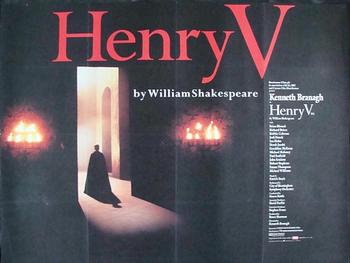
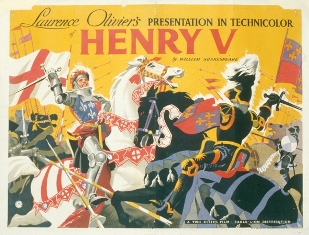
       Recently I reviewed Laurence Olivier’s "Henry V" (#75) and I got to wondering if Military History magazine chose the best Henry V movie. So here is my review of Kenneth Branagh’s version and comparison of the two versions.


Branagh released his version in 1989. He wisely chose not to try to duplicate Olivier’s wonderful vision of the play within a movie. His movie opens with the Chorus (Derek Jacobi) on a deserted sound stage. He throws open doors to launch the story in movie form (not as a play). The Archbishop’ discussion of Salic Law in front of Henry and his council is treated seriously unlike in Olivier’s. The arrival of the French ambassador with his mocking tennis balls is answered with brewing, but restrained anger by Henry.

Branagh not only has the scenes following Bardolph, Pistol, and Nim, but throws in some flashbacks to the “wastrel” Harry’s nights with Falstaff. These scenes are taken from Shakespeare’s Henry IV. They make it easier to understand Henry’s transition from immature prince to mature king. Branagh also adds a scene from the play that does not appear in Olivier’s version. The scene depicts Henry uncovering treachery by three of his nobles. He sets them up by getting them to argue for strict punishment for a soldier who spoke against the king. We see the keen intelligence of Henry in this great scene.

The siege of Harfleur is filmed at night and has a ghastly tinge to it. Henry gives his “Once more into the breach…” speech which more clearly results in another failed assault than in Olivier’s. Also, Branagh includes Henry threatening rape and killing if the city does not give up. Branagh was obviously not restrained by the need to make Henry a saintly hero for the British people to rally around during the dark days of WWII, like Olivier was.

The scene with Princess Katherine and her maid are similarly done without subtitles and are equally playful and light. Emma Thompson is a better actress than Renee Asherson, but not decisively so in this role.

The march to Calais is more realistic with its rain and mud. Branagh decided to include the hanging of Bardolph for violating his no looting policy. The scene did not fit Olivier’s goal for the film, but it is apparent Branagh was determined to expose every aspect of Henry’s complex personality. He even goes so far as reenacting a hanging that is just mentioned in the play.

The night before the battle focuses on the arrogance and hubris of the French knights and the gloom of the British foot soldiers. Branagh’s Henry roams the campfires more realistically incognito. His reaction to criticism of the king by common soldiers is more appropriately seething.

Branagh’s “Band of Brothers” speech is similarly staged, but better orated with a beautiful pairing of words with music. The reaction of the soldiers is also more integral to the scene than in Olivier’s. Branagh actually spits as he declaims. No second take for him.

In the battle, we see the fear in the British soldiers’ eyes. There is no cavalry charge and we jump straight into the melee. It is realistically muddy. Branagh makes the questionable decision to have the archers firing volleys into the melee, thus subjecting the British knights (including Henry) to friendly fire. This is not only tactically unsound, but inaccurate historically as the archers had ceased fire when the knights closed. By this time in the battle, the archers were wading in with their daggers and mallets. Branagh gets to this, adding the nice touch of some archers looting the bodies. Branagh does a good job of depicting the chaotic nature of a medieval battle with its “fog of war”. Some of the action is in slow motion, naturally. York dies a graphically violent death here where in Olivier’s version we only see the corpse. The French Constable is rescued and soon after dies. There is no duel with Henry. Some French knights break through to attack the baggage train and kill the boys (including Christian Bale). This is similarly inaccurate to Olivier’s, but Branagh does not imply the villains were from the French leadership group. At this point the Herald arrives to tell Henry the day is his. Henry does not return to the battle to get vengeance for the dead boys because the battle is over. Instead Henry carries the Boy’s dead body as a hymn swells in the background. The movie should have ended here! There are 17 minutes of denouement left, unfortunately.

The wooing of Kate is not remarkably different than in Olivier’s version, but Branagh and Thompson give the dialogue a more genuine feel. This is a weak part of the play and the movie does its best to reduce the embarrassing aspects of the whirlwind courtship.

It may seem at this point that I find Branagh’s version to be superior, but not so fast. Let me specifically comment on various elements.

1. the opening – Olivier wins with his brilliant decision to start the play in the Globe Theater

2. humor – Olivier wins with his Archbishop explaining Salic Law and several characters (especially Pistol) hamming it up; there is little humor in Branagh’s more serious version

3. the French king – Olivier’s king is more accurately addled

4. Harfleur – Branagh’s siege is more accurate and has better action

5. Kate’s English lesson – Thompson over Asherton; Geraldine McEwan over Ivy St. Helier

6. the night among the campfires – Branagh

7. Band of Brothers Speech – Branagh is more rousing

8. the battle – Branagh, although both include some inexcusable inaccuracies; Branagh’s volleys into the melee are trumped by Olivier’s ridiculous duel between Henry and the Constable; Olivier’s cavalry charge is wonderful, but the ambush by tree-jumping archers cancels some of it; Branagh by a nose because you have to have a lot of mud if you are doing Agincourt

9. the wooing – Branagh is less cringe-inducing

10. sets – Olivier wins with his imaginative transitions from the Globe to sets based on “The Book of Hours” to the great outdoors and back again

I also have to mention that one of my favorite characters in Shakespeare is Fluellen and Ian Holm’s portrayal of him is outstanding. In fact, truth be told, the acting in Branagh’s version is uniformly better than in Olivier’s version. I know Olivier was partially trying to replicate the acting style of Elizabethan theater, but the hamminess of some of the performers is too over the top. And at the risk of blasphemy, I feel Branagh makes a better Henry than Sir Laurence Olivier.

In conclusion, both versions are masterpieces and stand on their own as tours de force for their actor / directors. Each put his own stamp on the play. It is remarkable that two movies with virtually the same dialogue could be so different and yet faithful to the play. Olivier deserves tremendous credit for his unorthodox approach to the Bard, but Branagh’s decision to not try to top Olivier is commendable. Branagh’s approach is much more orthodox, but the execution could not be better. Each movie is reflective of its times. Olivier emphasizes the aspects that would inspire Englishmen to defeat the Nazis. Branagh is aiming at a modern audience and his nuanced portrayal of the king is appropriate for 1989 and actually closer to Shakespeare’s Harry. His inclusion of scenes that Olivier purposely left out makes his film more complete.

My recommendation is to watch both. It would be foolish to pick one over the other. However, if you insist on one – Branagh’s is slightly superior.


Branagh's BOB

Olivier's BOB


Branagh at the breach