It's the anniversary of D-Day in Canada, too. “Storming
Juno” is a Canadian war movie about the Canadian army storming Juno beach on
D-Day. It was directed by Tim
Wolochatiuk on a shoe string. It follows
three soldiers: a paratrooper, an
infantryman, and a tanker. The movie has
a docudrama feel to it, but there are no talking heads. It is “based on real characters and events.”
The
movie leads with the paratrooper.He is
part of the 1st Canadian Paratrooper Battalion.The film uses archival footage to coincide
with his background information.His
unit’s mission is to take out an artillery battery.The infantryman is in the first wave of the amphibious
landing.“Juno was one of the most
heavily fortified sectors of Hitler’s Atlantic Wall.”You won’t be able to tell that from this
movie, however.He is not concerned with
that since “given the naval bombardment, chances are nothing will be left.”That’s an accurate feeling of
over-optimism.Juno is going to be a
tough nut to crack considering that theirs is the only landing craft.The landing is far from “Saving Private
Ryan”, but there is some slo-mo and hand-held.The deaths are random. One of the soldiers fires a mortar by holding it
against a tree and firing it like a bazooka!Now, here comes the tank.The
effects are decidedly cheesy.It duels
with a bunker.The tank is alone and
without infantry support. The tactics in
the movie are shaky.There are several
head-scratching moments in the movie.Twice
characters enter enemy positions alone, for instance.
The
movie’s makers had a legitimate reason for wanting to recognize the Canadian
effort on D-Day.How many people outside
Canada even know that they were part of the invasion?And Canadians deserved a movie highlighting
their heroism. After all, what else do they have? The movie accomplishes its mission in a low
budget way.It is not overly
patriotic.As a teacher, I can vouch for
the fact that its intended audience prefers reenactments to historians talking
about the historical event.The problem
is the cheesiness of the production.Although the CGI is acceptable, the story it backs is low rent.The decision to follow three character arcs
was a good one, but there is little character development.Their voices sound similar so the narration
can be confusing.When they are speaking
in character, the banter is lame.There
is no cursing.But maybe that’s because
Canadians don’t curse.The actors are
amateurish, but not embarrassing.They
get lots of closeups.The movie is very
micro.You may learn about Juno Beach,
but you will not get the impression that it was arduous.It was a beautiful day and so quiet.The movie does do a decent job on
deaths.They are not too theatrical and
although not graphic, the wounds are realistic.That is very unusual for a movie like this, so kudos.
“Storming
Juno” is a sincere effort and should be seen by Canadians.It has a following and I have to assume they
are all Canadians because the movie is nothing special.Actually, the documentary after the film
entitled “Remembering Juno” is better than the movie.It makes me wonder why they didn’t reenact
the real stories?One of the veterans
talks about killing prisoners and another describes targeting a church steeple
where a sniper was.This latter would
have been an improvement over the clicheish sniper incident depicted in the
movie.
I
recommend “Storming Juno”, but only if you stick around for the
documentary. Or if you are a Canadian.
You can go here if you want to see my list of other D-Day movies.
It will come as no surprise to anyone who visits this
site that I love war movies and I watch a ton of them.Over fifty a year and that is a conservative
estimate. I am not easily impressed, but I also have a high tolerance for bad
war movies.I usually know ahead of time
what the buzz is on a movie, so I am seldom terribly disappointed.I usually reserve extreme umbrage for films
that abuse history in a callous way.Movies like “Braveheart” piss me off to no end.And the more critical acclaim they receive,
the more angry I get.That is one
category of bad war movies – the ones that should have been much better and ruined
a good topic.The other type is the
movies that are just plain bad because of a combination of poor production
values, plot, acting, etc.Sometimes
this can be excused because of a low budget.Hopefully at least the persons responsible were sincere and tried their
best, although their best was crap.“Pathfinders: In the Company of Strangers” is in the second category of
bad war movies, but it is so bad that there is no way the participants could
have been sincere.As far as doing their
best, if they maxed out on this movie, they should never work on another movie
again.No amount of experience and
improvement will ever make them competent.To make this situation even worse, I had heard positive buzz about the
film and had hopes it would be another “Saints and Soldiers”.Nope.
Since I sincerely hope no one reading this will be
tempted to watch this movie, I will not bother to conceal any plot
developments.The film begins on June 5,
1944.We are pompously informed that it
is about a top secret mission.“This
story has remained hidden for 60 years.”(By the end of the movie you will wish the story had remained hidden for
another 60 years.)Naturally, the
mission is crucial to the Allied war effort.We meet the main characters nose hairs (this movie takes extreme
close-ups to a new level) at a camp in England.The director had the avant-garde idea of hiding the microphone in a duffel
bag in the corner of the tent.You might
want to put the English subtitles feature on.(On second thought, don’t do that!)If you are watching this movie to scope out 1940s military hair styles,
you will be disappointed by all the shots that cut off the tops of the actor’s
heads.
Since they are Pathfinders, their mission is to
parachute behind enemy lines and set up a beacon to pinpoint the landing zones
for the paratroopers.If they don’t
succeed, their mates will land all over the place.Historical spoiler alert: mission not
accomplished!Would you believe their
already hazardous mission is complicated by factors beyond their control?It seems they will be dropping on top of the
crack German 91st Division which is hilariously described as “anti-parachute
maneuver specialists”.Before they
leave, one of our heroes parachutes into his British girl friend’s front yard
for supper.The rest stay in the tent
and regale us with stories that are more painful to hear than the English meal
their Casanova buddy is forced to stomach.
The drop features a brief bit of “Band of Brothers”
cinematography, as if we needed to be reminded of the other end of the
spectrum.They are immediately involved
in a fire-fight, I guess because those anti-parachute maneuver specialists were
waiting for them.Of course, the total
lack of noise discipline does not help.There
is a ridiculous scene where one of them plays dead to kill a German, but not
the German’s comrade who is two feet away.We are treated ( I use this word very loosely) to a series of
increasingly nonsensical vignettes.There is lots of aimless wandering around since they have no maps or
compasses -drat!When they do encounter Germans, the combat is
boring.An unacceptable development for
a movie that has nothing else going for it.Perhaps the big set piece will save this sinking ship.
A German vehicle stops near where they are hiding and
then backs up as though the director had yelled that they had missed their
mark.One of the Americans comes running
out screaming and shoots two of the enemy and then runs away.At this seemingly provocative act, the
Germans calmly drive off as though nothing had happened.(I had to do the unthinkable and rewind the
movie to see if I had seen what I had seen.)With that close call inexplicably out of the way, they put up the beacon
in (you guessed it) the nick of time.
Have you ever seen a movie that is terrible in every
single aspect?This film has it
all.Horrible acting.Atrocious dialogue.Terrible cinematography sprinkled with some
film school 101 stunts.Music that is
not only anachronistic, but it often does not fit the scene.Sound that is best described as garbled.Did I mention it took two directors to
accomplish this?(I would mention their
names but they are in witness protection now.)The combat has been better done by tweeners playing army in the woods
with one of them filming on his cell phone.Except their tactics would be more realistic than in this movie.But by far the worst aspect of the movie is
it was made to honor the Pathfinders who bravely played an important role in
D-Day.Talk about a backfire!(By the way, the movie falsely claims that
the role of the Pathfinders was unknown before this movie rectified that.While the Pathfinders may have been given
short shrift by history, they were not overlooked.)Those heroes did not deserve this
atrocity.Thankfully, unlike the
Windtalkers, this little known cinematic gem will not prevent a future attempt
to do justice to the Pathfinders.Soon
please, I’d hate to go to my grave with this being the only movie I had seen on
the Pathfinders!
BACK-STORY:“Saving
Private Ryan” originated from writer Robert Rodat seeing a monument to eight
siblings killed in the Civil War. He
brought the idea to producer Mark Gordon.The movie was a huge critical and box office success.Made for around $70 million, it made over
$480 million and was the highest grossing film of the year.The Omaha Beach set and reenactment cost $12
million and used 1,500 extras (including amputees) and 40 gallons of fake
blood.The Ramelle set was built from
scratch, including the bridge and the river.It was nominated for 11 Academy Awards and won 5 (Cinematography, Sound,
Sound Editing, Film Editing, and Director).Incredibly it lost Best Picture to “Shakespeare in Love” in the most
egregious miscarriage in Oscar history.Almost as perplexing was Hanks’ loss to Roberto Bergnini.The movie is currently #71 on AFI’s list of
greatest movies of all time.
OPENING:An old man visits a cemetery with his family in
tow.There are American and French flags
on display and rows and rows of crosses and Stars of David.The camera zooms in on the old veteran’s
face.Flashback time.
SUMMARY:Members of Charlie Company, 2nd Rangers
head for Omaha Beach on D-Day.They are
on board a Higgins Boat.When the ramp
goes down, all hell breaks loose.Thus
begins the most amazing combat scene in war movie history.The variety of viscerality is
overwhelming.Men getting hit by bullets
below the water.Others drowning due to
the weight of their equipment.A
flamethrower crew is incinerated.A
soldier picks up his severed arm.Someone pulls a torso.Deaths are
random.Blood turns the water red.Bullets ping off beach obstacles.Tracers whiz by. A medic blocks a wounded soldier with
corpses.
this ain't your granddads war movie
The sea wall is an only slightly safer refuge.A doctor performs triage on the wounded.A chaplain gives last rites.A soldier prays.Bangalore torpedoes open up a lane through
the barbed wire.Capt. Miller (Hanks)
leads his men against a machine gun nest and then up to the bluff where they
take out a bunker and battle Germans in a trench system.Potential prisoners are killed.With a lull in the violence, the camera pans
over the beach debris.One of the bodies
is a “Ryan, S.”
I see the place where Sgt. Fuller blew a hole in the concrete barrier
Back in the Pentagon, a typist notices three
death letters to a Ryan family.When
Gen. Marshall is informed that the last surviving Ryan boy is alive in
Normandy, he reads a letter written by Lincoln to a Mrs. Bixby who had lost
five sons in the Civil War.Marshall:
“If the boy is alive we are going to send somebody to find him and we’re gonna
get him the Hell out of there.”
It’s
D-Day plus 3 when Miller and his men are given the “public relations mission”
of finding PFC James Ryan.The
paratrooper is somewhere behind enemy lines.Miller takes six of his veterans and adds a nerdy cartographer who
speaks German named Upham (Jeremy Davies).The eight leave on their wild paratrooper chase in a foul mood.Why are they risking their lives for one
guy?They pass through the town of
Neuville so the countdown of who will survive can begin.There is a myth-busting moment involving an
enemy sniper and a Mexican stand-off with a German squad.And a Ryan who is not James F. Ryan.
A
night in a church allows for some exposition.This being an American movie there is a shot at Montgomery for tardiness
at Caen.We learn a little about the men.
Miller is the mystery man of the unit with the men debating what he was before
the war. The others are your standard heterogeneous small unit.Horvath (Tom Sizemore) is the gruff sergeant,
Mellish (Adam Goldberg) is the Jew,Wade
(Giovanni Ribisi) is the humane medic, Jackson (Barry Pepper) is the religious-hick
sniper, and Rieben (Ed Burns) is the carping Brooklynite.
The
next day answers the question of why Miller has seen the deaths of 94 of his
men as he makes an extremely poor decision to assault a well-defended radar
site.This in spite of being on a
special mission from Eisenhower’s
boss.To compound the irrationality of
the decision, Miller brings along the noncombatant medic and his brilliant
tactic is to rush the site, thus ensuring at least one death.On a positive note, the survivors find out
what Miller was before the war.This
revelation suspends a moment of unit dysfunctionality brought on by Miller’s
Geneva Conventionish freeing of a German prisoner.“Steamboat Willie” is on the honors system to
report to the nearest Allied unit.
Finally
the real Ryan (Matt Damon) is located in a concurrent assault on a German
half-track.Ryan’s unit is in the town
of Ramelle where it is defending a bridge.When informed of his good news/bad news situation, Ryan refuses to leave
his nonfamilial band of brothers.At
least not before the final set piece.If
this was a hockey match, we are now between the second and third periods.More exposition and in an homage to earlier
WWII films, a song.They, and the
audience, are resting up and preparing for the storm to come.The eerie tank-like sounds herald the arrival
of a Panzer unit.It’s go time!
CLOSING:Sticky bombs, Molotov cocktails, and thrown mortar
rounds versus Tiger tanks.It’s the
Alamo with WWII weapons.Or Fort
Zinderneuf.Or Rorke’s Drift.Or Pork Chop Hill.There is a reappearance of “Steamboat
Willie”, but not as a prisoner of war.There are some gut-wrenching deaths (and I’m not talking about Nazis)
and one Hell of a twist ending that puts us back in the Normandy American Cemetery
and Memorial.
WOULD CHICKS DIG IT?Apparently, from the box
office receipts.Excellence and Tom
Hanks trumps graphic violence and no significant female character.
where's a P-51 tank buster when you need one?
HISTORICAL ACCURACY:SPR does not claim to be based
on a true story, it does not even claim to be inspired by a true story.This is a bit surprising because it could
legitimately claim that inspiration by way of two sources.The 5 Sullivan Brothers all perished when the
U.S.S. Juneau went down off Guadalcanal. This led to the adoption of the Sole
Survivor Rule in which the Pentagon attempted to avoid the loss of entire
sibling sets.A stronger connection to
the film is to the Niland family.Frederick Niland was a paratrooper in Normandy who was pulled out of
combat and returned home after two brothers were lost in D-Day and a third was
shot down over Burma (and survived Japanese imprisonment).In spite of the similarity to the Niland
story, it is obvious that Spielberg’s film is meant to be fictional.For that reason, it is more appropriate to
discuss how realistic it is rather than how accurate it is.
The Omaha Beach scene has been justifiably lauded for
its realism (including by veterans of the assault) and still remains the most
realistic reenactment of any combat in war movie history.However, it is not perfect.The Americans landing on Dog Green sector
were actually transported on British landing craft, not Higgins Boats.The carnage rings true, but the time
compression makes the conquest of the bluff seem much too quick and easy.And by the way, bullets lose too much
momentum when they enter water to be able to kill men, as depicted in the film.
As to the mission, it seems unlikely that a crack
squad of Rangers would have been sent on this type of mission to find one man.In reality, a chaplain located Fritz
Niland.The sniper duel is reminiscent
of a confrontation involving Marine sniper Carlos Hatchcock in the Vietnam War.He put a bullet through the enemy’s scope at
about 100 yards.In the film, Jackson
estimates his shot at 450 yards which puts it out of the range of possibility
given gravity’s effect on a bullet’s trajectory.I’ve already dealt with the unrealistic
tactics in the radar site assault.As far
as allowing the prisoner to go, Miller certainly would not have faced charges
for the common sense alternative.
As far as the last battle is concerned, there are
several problems.Although there were
such things as “Sticky Bombs”, they were a British experiment and were not
make-shift.I found no evidence that
they were described in the U.S. Army Field Manual.It is also highly unlikely that mortar shells
could be armed by hitting them on the base plate and then thrown to explode on
a target.As far as the tanks are
concerned, there were no Tiger tanks in that part of Normandy at that stage of
the war.Also, tactically the Germans
would probably have sent the infantry in first.By the way, the tanks used in the film were Soviet T-34s mocked up to
look like Tigers.I have no problem with
that.What I do have a problem with is
why the tanks did not use their machine guns.I suppose that game changer would have messed with the plot.Speaking of tanks, Miller would not have been
able to fire a machine gun into the tank’s viewer.One last thing:the P-51 that arrives to save the day had no
ability to fire a rocket or drop a bomb.(Joining all the other fighter planes in war movie history that dropped
ordinance they did not have.)
CRITIQUE:
Thank God that tank forgot it's machine gun ammo
The acting in “Saving Private Ryan”
is very good. Tom Hanks is his usual outstanding self, but the supporting cast
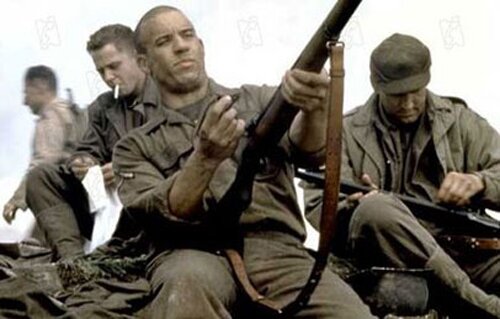
is strong and there are no weak performances. Even Vin Diesel (thankfully not
in the film long enough to do damage) ups his game and dies well. Speaking of
which, SPR has the highest quality of death scenes that I have seen in a war
movie.SPR is famous for the ten day
boot camp the actors were put through by Dale Dye in preparation for their
roles. Matt Damon (Ryan) was purposely left out so he would be treated
subconsciously as an outsider. For a movie that attempts to be as close to
reality as possible, the actors do not come off as like they are playing army
men. They gripe a lot and question the mission. They do not want to accept the
new guy (Upham) and never really bond with him. They respect Capt. Miller, but
only grudgingly follow him when he issues questionable orders.This is realistic considering some of the
stupid decisions he makes.
Dale Dye taught me how to do this
“Saving Private Ryan” is not
remembered for its dialogue. In fact, in one of the most powerful scenes (when
Mrs. Ryan is notified about her sons’ deaths), there is not a spoken word. The
movie does have some nice dialogue. Much of it is aimed at non-war movie buffs so some of it (the running FUBAR routine, for instance) can be aggravating. Robert Rodat’s script was nominated for
Best Original Screenplay. Much of the dialogue is terse and the most famous
line is simply: “Earn this.” The monologues are well done, especially when Wade
describes pretending to be asleep when his mother would come home and when
Miller finally reveals his previous life. Best line: “This Ryan better be worth
it. He'd better go home and cure some disease or invent a longer-lasting
lightbulb or something. 'Cause the truth is, I wouldn't trade 10 Ryans for one
Vecchio or one Caparzo.” (Miller)
SPR was lauded for creating a new
style war movie when it came out and many of the masses swallowed this analysis.
In reality, it merely puts a different spin on the classic war movie template.
It is after all a hero leading a
small unit on a mission. The hero is forced to assume
command. The unit is heterogeneous.There
is a conflict within the group between Reiben and Horvath that is resolved by
external pressure. There is a ritual recalling the peaceful past (listening to
the song on the gramophone). The movie clearly alternates from combat to
rest/exposition. The movie does lack a redemption character. See my post on WWII war movie cliches
SPR combines two standard war movie
plot tropes. The first half is the patrol
on a mission and the second half is the last stand. Both segments incorporate the “who will survive?”
angle. Although not groundbreaking as far as those tried and true elements, the
way the screenwriter handles them is quite good. The objective is certainly
outside the box- a mission to rescue one soldier. The plot is very manipulative
of the audience and takes advantage the non-war movie lovers who would find
much of it fresh. It pulls all the emotional strings reaching a crescendo at
the end. It throws in a German character to link key scenes and contrive the
ending. As ridiculously implausible as this arc is, it is not embarrassing like
in “The Big Red One”.
Although incorrectly credited with
modernizing the war movie plot, SPR can be credited with taking war movie
combat to a new level of realism. It is popular these days to downplay the
greatness of the movie, but the opening scene is still the most amazing combat
scene ever filmed and has not been topped after fifteen years and many
challengers. That one scene will be remembered as a seminal moment in war movie
history. I also would like to remind everyone that Dale Dye was the technical
advisor so it was well vetted.
The cinematography of Janusz Kaminski richly
deserved the Oscar.He managed to get a
newsreel feel by desaturating the colors.Equally impressive are the sound effects.The sounds of battle have seldom been better. The highlight is when Miller loses his hearing
due to explosions and combat stress. The monstrous roar of the Tiger tanks in
the final battle is straight out of a horror movie. It could be argued that SPR
has the best sound and visual effects of any war movie. The score by John Williams is fine and not bombastic.
CONCLUSION:It is popular lately to take shots at “Saving
Private Ryan” and I have to admit that upon watching it for the tenth time and
reading about some of the mistakes, it is not perfect.However, it is clearly a masterpiece as
entertainment for the masses.People
like me have to remind ourselves that not everyone has seen a lot of war
movies.Tropes are not as obvious to
average viewers.More specifically, most
people are not concerned with the use of a Higgins Boat in place of British
LCAs.You can accuse Spielberg of
manipulating the emotions of the audience, but he is a master at this and he is
at the top of his game here.When you
watch some of his more recent efforts like “War Horse”, you can appreciate the
relative sublety of this film and be thankful it’s earlier Spielberg.In my opinion, its position in the top ten is
appropriate.