Showing posts with label Sebastian Junger. Show all posts

Monday, September 5, 2022

Korengal (2014)


                “Korengal” is the sequel to the highly acclaimed “Restrepo”.  “Restrepo” was a war documentary about an Army unit at an outpost in the Korengal Valley in Afghanistan in 2007-2008  Both movies were directed by Sebastian Junger.  He and his photographer Tim Hetherington (who was killed doing his job during the Libyan Civil War in 2011) were embedded with the platoon for a year.  They developed a relationship with the men.  This allows the audience to be a fly on the wall in the outpost and on patrol. 

                The movie opens by informing us that the U.S. pulled out of the “valley of death” in 2010 after losing 42 men. One of them was PFC Juan Sebastian Restrepo.  Where “Restrepo” dealt mainly with the type of combat the soldiers encountered, “Korengal” deals more with the impact of that combat and soldier life off the line.  There are patrols and expenditure of ammo at unseen targets, but the movie is mainly interviews with the men.  These interviews give a clear picture of how modern war affects modern American soldiers.  The video game generation goes to war.  Now the adrenalin rush is not technology induced, it’s the real deal.  One main theme of the movie is that combat is addictive.  When one of the men is asked if he will miss anything, he says:  “Shooting people”.  Another theme is the bonding that takes place between comrades.  One describes the relationships by promising that he would “walk across the country to help change a tire” for any of his mates.  Another perspective of the war is that the intense moments of contact with the Taliban are balanced by long periods of boredom.  For example, they spend six hours arguing over who would win a fight between George Clooney and Fabio.  Similar to the Vietnam War, “Korengal” makes it clear that the civilian population in Afghanistan is caught between the two foes.

                Most of “Korengal” is up-close interviews.  Some of them were done in the studio after the men returned.  Several of the men are charismatic and what they say can be powerful.  One thing you can say about the platoon, there was no dysfunction and none of them has a negative personality.  I don’t know how realistic this is, but it appears the all-volunteer army is working effectively.  And in the field, they are good soldiers, although one has to wonder how they would handle previous generations’ wars like WWII.  Let’s hope we don’t find out.

                If you have seen “Restrepo”, you should see “Korengal”.  Just be aware that like most sequels, it is not as good as the original.  It just doesn’t pack the punch and it does have the feel of leftovers.  But even though the footage was left over from the first film, Junger wisely takes a different approach on this one and it fills in gaps more than replicates.


GRADE  =  B 


Sunday, December 19, 2010

MODERN CLASSIC? "Restrepo"

    
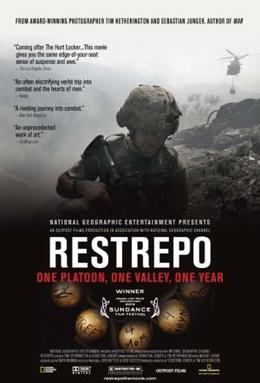
     “Restrepo” is the movie companion to the acclaimed best seller “War” by Sebastian Junger. Junger was a reporter who embedded with an infantry platoon in Afghanistan in 2007-8 to get an eyewitness look at the fighting. What came out of his experience is a grunts-eye view of the war that takes the viewer into a very foreign world where American boys are fighting a forgotten war. If you feel guilty about having forgotten about their sacrifices or if you want to know what is going on over there, you should watch this outstanding documentary.


     The movie is seen through the eyes of the cameramen (Junger and Tim Hetherington) who lived with the soldiers interspersed with frequent interviews with the troops after they got back. The men belong to the Second Platoon, Battle Company, 2nd Battalion, 503rd Infantry Regiment which was sent to the most dangerous place in Afghanistan – the Korengal Valley. They were deployed for 15 months and three of them did not come back including Juan “Doc” Restrepo. Their mission was to provide security for a road-building project that would benefit the obviously ungrateful residents. But based on the book and film, it is apparent their mission was to deprive the Taliban of control of the valley and kill as many of them in the process as possible.

     The movie is intense and personal. You have to admire the cameraman who was right there with the soldiers when they were taking fire. In fact, early in the movie we get an inside the Humvee view of what it is like to be blown up by an IED. Most of the action takes place at an outpost named after their beloved medic Restrepo. The commander named Kearny comes off as an intelligent officer who is trying to rectify mistakes made by the previous leadership which now make it harder to win “hearts and minds”. His decision to establish Outpost Restrepo turns the tide in the valley. (In a postscript, it is revealed that after all the effort in the area, the Army abandoned the valley. See “Hamburger Hill”.)

     Here are some of the things you will learn: 1. Afghanistan is a beautiful country with some truly ugly men. 2. The volunteer army concept is working. These boys are much more motivated than Vietnam War soldiers filmed under similar circumstances in 1969 would have been. 3. One of our main tactics is to make contact by drawing enemy fire. Sucks to be the guy who draws the fire. 4. If you want Americans to expend one thousand rounds, fire a few shots into their compound. 5. Life in an outpost can be so boring that you look forward to fire-fights. One soldier described fire-fights as like crack. 6. We are spending billions of dollars in Afghanistan, but we won’t pay for a farmer’s cow that “wandered into the barbed wire” and became steak. 7. Soldiers in Afghanistan do not curse as much as I thought. 8. This country and our army are not prepared mentally for losses comparable to Vietnam, much less WWII. The platoon lost “only” three men in 15 months, but because of the bonding, the deaths were gut-wrenching. 9. Being reasonable with Afghani elders is probably not going to work. 10. It is possible to make a realistic, informative movie about the war in Afghanistan without taking a political stand.

GRADE  =  A