Showing posts with label The Big Parade. Show all posts

Sunday, February 16, 2020

CONSENSUS #49. The Big Parade (1925)


SYNOPSIS: A spoiled rich boy (John Gilbert) is peer-pressured into volunteering for the Western Front in WWI. He befriends two common Joes (Karl Dane and Tom O’Brien) and hooks up with a feisty French femme (Renee Adoree). Before they can consummate the affair, the trio of doughboys are off to fight the Battle of Belleau Wood.

BACK-STORY: The Big Parade is a very influential war movie released in 1925. It was directed by King Vidor (“Northwest Passage”) and was a huge hit. The film cost $245,000 and made over $22 million. It is the highest grossing silent movie in history. The screenplay is based on a play by Joseph Farnham and the autobiographical novel Plumes by Marine veteran Laurence Stallings. It made a superstar of its lead John Gilbert (previously known for romantic roles opposite Marlene Dietrich) and boosted the career of Renee Adoree, who sadly died a few years later from tuberculosis. Vidor had the cooperation of the War Department, specifically the 2nd Division and the Signal Corps. Vidor watched hours of Signal Corps film to get the rhythm of battle and used some of the footage in the movie.

TRIVIA:  wikipedia, imdb, TCM

1.  It was based on the autobiographical novel by Laurence Stallings.  Stallings had been a Marine captain in WWI and was wounded in the leg in the Battle of Belleau Wood.  He was awarded the Croix de Guerre and Silver Star.

2.  It was MGMs highest grossing film until “Gone With the Wind”.

3.  The movie made a major star of Renee Adoree.  Unfortunately, she died a few years later at age 35 from tuberculosis.  Her co-star John Gilbert died at age 38.

4.  The gum chewing scene was improvised after director King Vidor saw a crew member chewing some.  He and Gilbert were not expecting Adoree to swallow it at the end of the scene.

5.  Vidor had a contract that called for 20% of the profits.  The studio’s lawyers conned him into believing the movie had been overly costly and would underperform.  He sold out for a small sum, thus avoiding becoming a millionaire.

6.  After a successful screen testing, it was decided to expand the film.  Vidor reshot the column scene with 3,000 extras, 200 trucks, and 100 planes (all provided by the War Department).  Uncredited director George W. Hill added some more combat.

7.  First film to use the word “damn” (on a title card).  Gilbert’s Apperson says:  “GOD DAMN THEIR SOULS!”

8.  Vidor used a bass drum when the soldiers are marching through the woods to get the men to keep a relentless pace into death.

9.  It was the second most profitable silent movie after “Birth of a Nation”.

Belle and Blade  =  N/A
Brassey’s              =  4.0
Video Hound       =  3.8
War Movies         =  N/A
Military History  =  #58
Channel 4             =  no
Film Site                =  yes
101 War Movies  =  yes
Rotten Tomatoes  =   no

OPINION: If you define greatest as most important, The Big Parade belongs in the top 100 and probably should be higher than #49. It is one of the great WWI movies. It will be interesting to see how it stacks up against Wings and Hells Angels. As far as the most obvious comparison, it is definitely inferior to All Quiet which came out five years later. However, if you define greatest as best quality, The Big Parade" naturally comes up short due to its simplistic plot and the drawbacks of the silent era. I would not hesitate to call it a classic, but it is not one of the best war movies ever made.
The battle section of the movie is very good. It may lack a bit of accuracy and realism, but it is excitingly done. The deaths are unexpected. The fog of war is emphasized. Audiences got a taste of what it must have been like to be trapped in no mans land.

The movie is important because it showed the human dimensions of war. Previous movies about war had not concentrated on the grunts (or in this case, doughboys). You had not seen realistic deaths like Slims and Bulls. The main character would not have been crippled. Previous movies were either anti-German or propagandistic, or both. This movie is neither. It is anti-war, but not as strongly as some critics have claimed. It does have a happy ending which dilutes the anti-war message.

Friday, May 27, 2016

THE BIG PARADE (3) vs. THE LOST BATTALION (11)

Well, we are now through the first round and there were some upsets. We have a #12 seed moving on - All Quiet (1979). Here are the second round match-ups.

#1 - All Quiet (1931)
#9 - Oh! What a Lovely War

#12 - All Quiet (1979)
#4 - Sergeant York

#11 - Lost Battalion
#3 - The Big Parade

#7 - Westfront, 1918
#2 - Paths of Glory


VS.


REALISM:   “The Big Parade” is weak on realism.  The soldiers go through little hardship, other than stale cake from home.  The first part of the combat payoff has the Americans advancing in lines through a forest.  This is actually a true depiction of the naivete of the American army in its early battles.  We had learned little from the experiences of the British and French.  And the filmmakers had learned little of the effects of machine gun fire on lines of men.  The night attack is also shown in lines which would have been appropriate even in crossing no man’s land, but it is staged at night.  This would have been uncommon.  The artillery fire is the most realistic thing about the combat.  GRADE:  Big Parade  -  C

“The Lost Battalion” is above average in realism.  The weak moments can be attributed to its made-for-TV nature.  The trench and no man’s land are authentic, but some of the fighting defies logic.  For instance, in some of the fighting, the Americans leave cover to confront the superior German forces in the open.  During artillery bombardments, they do not hunker down.  There is more hand-to-hand fighting than would have occurred.  On the other hand, the hardships the men went through are accurately depicted.  The film includes the lack of food and ammunition and the suffering of the wounded. GRADE  -  B

FIRST QUARTER SCORE:  Battalion  -  8    Parade  -  6

DIALOGUE:  Being a silent movie, the dialogue that makes the title cards is sparse.  Most of the dialogue spoken by the actors must be inferred.  This is a good thing because I can guess that if we had to listen to all of it, it would not be an improvement.  At least it is not flowery.  It just is not special.  The attempts at jokes are uniformly lame.  GRADE  -  C

“The Lost Battalion” throws in a lot of faux soldier banter.  The screenwriter picked up a copy of “Early 20th Century Brooklyn Slang” and sprinkled his research throughout the film.  The interchanges between Gaedecke and Rosen smack a lot of those between Rivera and Friedman in “A Walk in the Sun”.  The combat may be R-rated, but the dialogue is decidedly PG-13.  Much of it is pious.  The words put in the German officer’s mouth are what Hollywood can imagine a sympathetic German saying about the amazing Americans.  GRADE  -  B-

HALFTIME SCORE:   Battalion  -  14    Parade  -  13

SOLDIER BEHAVIOR:  “The Big Parade” skips over training and plunks the trio on the Western Front.  Their billeting at a French farm is all fun and games.  Like living in a frat house, there are pranks and ribbing in a lame sort of way. Their naivete is not far from the cluelessness of the newcomers from across the Atlantic.  The movie gets the camaraderie right and the way the war brought men of different backgrounds together. However, the film is not really interested in giving the audience an accurate picture of what the soldiers went through.  Go to France, make some friends, fall in love!  GRADE  -  C

“The Lost Battalion” does attempt to show how the soldier’s lived.  The movie splits time between command decisions and soldier interaction before going full combat mode.  The comradeship is apparent.  The movie makes a point of having the veterans instruct the newbies.  Much of this is patronizing to anybody familiar with the AEF, but for the average viewer it is instructive.  The screenwriter gets the brash attitude of the Yanks down.  But some of the characters are not gung-ho.  GRADE  -  B

THIRD QUARTER SCORE:  Battalion  -  22     Parade  -  19

ENTERTAINMENT:  “The Big Parade” is mainly a romance set in war with a buddy picture aspect thrown in.  It is not aimed at the macho combat groupies.  It is pretty good entertainment for a silent movie that wants to please both males and females.  If the men can sit through the character and relationships development, they get a fairly kick-ass combat payoff.  It holds up well over the years, but it is not something you could show students with any success whatsoever.  You must like classic films to like “The Big Parade”.  GRADE  -  B

“The Lost Battalion” is almost the exact opposite movie from “The Big Parade”.  For instance, there is not a single female in the movie. It is definitely a movie aimed at a male audience.  Unless you are a female who is hot for Rick Schroder.  Some of the movie comes close to combat porn.  It is amazingly intense and graphic.  If you enjoyed the opening to “Saving Private Ryan”, you will enjoy much of “The Lost Battalion”.  The fact that it is a true story accurately rendered makes it more entertaining than it otherwise might be.  GRADE  -  A

FINAL SCORE:  Lost Battalion  -  31
                           Big Parade  -  27

MATCH ANALYSIS:  I am a big fan of all war movies, no matter the era.  “The Big Parade” is one of the best silent movies set in WWI.  I was impressed with it the first time I saw it, but it does not improve with repeat viewings.  It is Old School which can be a good thing.  However, since the plot is dusty, it has a hard time going up against a modern war movie with a competent plot.  A movie like “The Lost Battalion” (even one with a made-for-TV budget and the constraints of that medium) has huge advantages in cinematography and effects.  When you look at the quantity and quality of the combat and the surprisingly good acting, it is not surprising that it won comfortably.

Tuesday, May 24, 2016

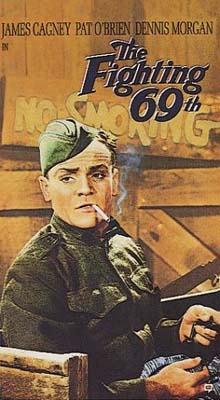
THE BIG PARADE (3) vs. FIGHTING 69th (14)


VS.


PLOT:  “The Big Parade” is a home front to war front romance.  It is also a buddy film.  The main character Jim is a rich boy who leaves his fiancĂ© to go to war.  He meets “Bull”, the bartender, and “Slim”, the construction worker.  The trios’ unit is billeted in a French barn.  Jim makes a love connection with a feisty mademoiselle named Melisande, but then it’s off to the front for a battle that consumes the last part of the movie.  Many of the scenes go on too long.  The plot is decidedly silent movieiesh.  There are some lame stabs at humor.  The plot builds slowly to the climactic battle which is the highlight of the movie.  GRADE  -  C

“The Fighting 69th” is a fictional story involving the famous American 69th Infantry Regiment.  The story centers around the attempts of Father Duffy to reform a street tough named Plunkitt (Jimmy Cagney).  The plot takes the unit from boot camp to battle with Plunkitt’s antics keeping Duffy busy and giving him grey hairs.  It is all very predictable.  It is also blatantly religious and patriotic.  It features an unlikeable central character who doesn’t deserve, but gets, redemption.  A movie like this could not be made today.  That’s a good thing.  The only positive is the portrayal of some real heroes like Duffy, William Donovan, and Joyce Kilmer.    GRADE  -  D

FIRST QUARTER SCORE:  Parade  -  6    Fighting 69th  -  5

ACTING:  “The Big Parade” stars John Gilbert who was a major silent movie star and was a rival of Valentino as a sex symbol.  He is fine for a silent movie role.  You have to expect a lot of mugging.  There is some chemistry with Renee Adoree.  The rest of the cast was not noteworthy at the time although Adoree made a big splash in the film.  She is adorable.  I know the mugging was considered acceptable back then, but today the performances seem very dated.  Plus, the actor who plays “Slim” is difficult to watch.  He is a bizarre looking dude and his biggest talent is spitting tobacco juice.  His look is as disgusting as Plunkitt’s personality.  GRADE  -  B-

“The Fighting 69th” stars Cagney and Pat O’Brian so it is strong in its leads.  Cagney could be great, but the character and script let him down.  He chews the scenery like he hasn’t had a decent meal in years.  O’Brian is overly pious, of course.  The rest of the cast is wooden.  GRADE  -  C

HALFTIME SCORE:  Parade  -  13    Fighting 69th  -  11

COMBAT:  “The Big Parade” has 17 minutes of combat.  There is a lot of trite before you get to it, but it is worth the wait if you don’t expect ‘’Saving Private Ryan”.  The big combat scene starts with the Americans marching in lines through a forest where they encounter snipers and machine gun nests.  The machine guns do not mow them down but instead pick off individuals!  Then the action transitions to an assault across no man’s land.  There are plenty of explosions and after darkness, the renewal of the attack is nightmarish.  In between, the trio takes refuge in a shell crater and have their own little adventure.  It’s all very micro and does not stand out as one of the outstanding combat scenes.  I do not show it in class.  GRADE  -  B

“The Fighting 69th” has about 9 minutes of combat and it’s mostly of the bombardment of troops in no man’s land.  It is also micro and concentrates mostly on the actions of Plunkitt.  It is also laughably unrealistic.  It tells you a lot when a WWI movie stages its combat  mostly at night.  GRADE  -  D

THIRD QUARTER SCORE:  Parade  -  21    Fighting 69th  -  16

ANTI-WAR:  “The Big Parade” is average when it comes to condemning the war.  It tries to earn its badge by inflicting hardship on its main characters.  Two of the three soldiers are killed and one is maimed.  Melisande becomes a refugee.  However, this is diluted by a happy ending.  There is no criticism of command or the war in general.  Jim’s decision to go to war is not questioned.  GRADE  -  C

“The Fighting 69th” is one of the few WWI movies that is pro-war.  The main character is the only one who questions the war and that is because he is a coward.  All the other soldiers are enthusiastic.  One theme is that war brings the country together.  I guess you can’t laud a unit and criticize its war at the same time.  GRADE  -  F

FINAL SCORE:  Big Parade  -  27
                           Fighting 69th  -  20


MATCH ANALYSIS:   I liked “The Big Parade” better the first time I watched it. This time I found it quite the antique.  The scenes linger way past their expiration date.  It is more of a romance than a war movie.  Thank God for the big combat scene which saves the movie in the end.  It also has a great ending, although its schmaltzy.  I do believe it is overrated and was seeded too high.  But that is because IMDB judged it as a movie, not as a war movie and it got the ”classic” bump.  It had an easy first round opponent in the mediocre “Fighting 69th”.  It may be a talkie, but it is even more of a dinosaur than “Parade”.  I like Cagney, but he embarrasses himself in this movie.  Instead of concentrating on Donovan and Kilmer, we get Plunkitt.  And Duffy does not come off well as he continues to support an a-hole. 

Tuesday, July 19, 2011

#58 - The Big Parade


BACK-STORY: “The Big Parade” is a very influential war movie released in 1925. It was directed by King Vidor and was a huge hit. The film cost $245,000 and made over $22 million. It is the highest grossing silent movie in history. The screenplay is based on a play by Joseph Farnham and the autobiographical novel Plumes by Marine veteran Laurence Stallings. It made a superstar of its lead John Gilbert (previously known for romantic roles opposite Marlene Dietrich) and boosted the career of Renee Adoree, who sadly died a few years later from tuberculosis. Vidor had the cooperation of the War Department, specifically the 2nd Division and the Signal Corps. Vidor watched hours of Signal Corps film to get the rhythm of battle and used some of the footage in the movie.


OPENING: The movie opens in 1917 before U.S. entry. The main character is Jim Apperson (Gilbert) who is a spoiled rich boy who has no intention of either working for his father or fighting for his country. However, he succumbs to peer pressure during a parade celebrating America’s entry and enlists. (A scene similar to the schoolboys marching off in “All Quiet”.) This thrills his fiancĂ© Justyn who coos “You’ll look gorgeous in an officer’s uniform. I’ll love you more than ever.” On the other hand, his mother is upset as mothers are wont to be. His previously disappointed father is now proud of him. (Again similar family dynamics to “All Quiet”)

SUMMARY: Jim ends up in the Rainbow Division. There is a disappointingly short training scene and then the unit marches off to war (apparently marching across the Atlantic). It is disappointing because we do not get to see the rich boy at boot camp. How does he become a soldier?

     They are billeted at a farm in the village of Champillon in France. Jim bonds with two men from the other side of the tracks. Slim (Karl Dane) was a worker on skyscrapers and Bull (Tom O’Brien) was a Bowery bartender. They share a very stale cake sent by Justyn and then want to share the cute farm girl Melisande (Adoree), but she chooses Jim. They conduct a chaste romance which is hampered by Jim’s inability to speak French (it’s Greek to him), but he tells her “I don’t understand a word you say, but I know what you mean.” Remember, she’s a French girl (contrast to “All Quiet”’s French mademoiselles). Some of the dialogue is done without subtitles which is cool. Being an American, he teaches this backwards European how to chew gum in a cute scene. Shockingly for a film made in 1925, Jim is carrying on behind the back of his American sweetheart which proves this movie is not your typical flag-waver.

     Guess what? There’s a war going on and soldiers have to fight. The trio is shipped off to the front. In a scene often copied (recently I saw a similar version in “The Cranes are Flying”), Melisande works her way through the chaos of embarking to finally locate Jim. They embrace and then she grabs his leg (foreshadowing) as the truck pulls away. She is dragged (I’m sorry to admit I laughed at this) and then he throws her a shoe? ( apparently he foresees that he will not be needing it in the future).

     In an amazing shot, we see a long line of trucks heading for the front (200 to be exact) while planes fly over (300). They take their first casualties when “Flying Fritzie” strafes them. The battle is set in Belleau Wood and the Americans naively advance in long lines shoulder to shoulder (at first). They march relentlessly forward disregarding the casualties taken from snipers. There is a plinking noise every time a sniper scores. After dealing with the snipers they encounter machine gun nests and use grenades (they pull the pins with their teeth) against them. The pace quickens as does the music. Next, they are hit by artillery. The nice disciplined lines are no more. They exit the woods and head into no man’s land. They need their gas masks.

     The trio ends up in a shell crater. The Germans are firing a trench mortar at them. (When they hit, someone off screen throws shovels of dirt on them.) They get an order for one of them to take out the mortar. Slim wins a spitting contest (no surprise since he’s been practicing spitting the whole movie) for the honor of committing suicide. Jim does not insist on a contest a rich guy could actually compete in.

      Slim manages to eliminate the mortar crew, but is wounded in the process. Jim loses it and he and Bull go after Slim. They find Slim dead and Jim goes Audie Murphy on the Germans followed by the more reluctant Bull. Bull gets mortally wounded and dies in Jim’s arms. Bull: “I’ll see you in Berlin.” Jim is hit in the leg and crawls after a German he had wounded, but he can’t bring himself to finish the German off and instead gives him a cigarette before he expires. (Contrast to the famous scene in “All Quiet”) The attack is renewed in the dark. The scene turns hellish with numerous explosions from frantically firing artillery. The Americans march in lines toward the enemy line.

CLOSING: A long line of trucks comes at the camera (a mirror of the earlier shot) indicating the close of the offensive. Jim is in the hospital having had his leg amputated. He sneaks out to return to the farm, but finds it deserted. Melisande is now a refugee. Jim returns home embittered. He does not know that his fiancĂ© is now in love with his brother! His mother does, however, and when Jim tells her about Melisande, she encourages him to go find her. Jim returns to France. Melisande is plowing a field when she sees a figure on the horizon. Could it be? She goes running, he comes hobbling like Chester from “Gunsmoke”. The music swells, they kiss.

RATINGS:

Action – 7


Acting - 8


Accuracy – 7


Realism – 7


Plot – 7


Overall – 7

WOULD CHICKS DIG IT? Yes. The love story is well done and engaging. The two leads are attractive and have good chemistry. The violence is not graphic and although intense at times, not especially macho.

ACCURACY: Although it is not specifically mentioned in the film, the battle is obviously Belleau Wood. Stallings lost a leg fighting in the battle. The depiction of the battle is very simplistic. In reality, the battle was in an artillery- ravaged forest and although the Marines (it was the Marines, not the Army as shown in the film) marched in lines into the forest, this did not last long. The problem in the woods was the numerous machine gun nests. The movie does not do a realistic job showing the slaughter inflicted by these machine guns. The battle took three weeks of consistently brutal fighting. Many of the Marines did not bathe or change clothes for the duration. The men did not robotically march forward to clear the woods. The tactics reenacted are consistent with an attack across no man’s land, however. By the way, soldiers do not pull pins out of grenades with their teeth, Hollywood.

     For a black and white movie made in 1925, the combat is pretty realistic in its hellishness. Veterans commented positively on this. No man’s land is accurately depicted and the grim reality of death is apparent. The soldierly bonding is well done. The effects of war on civilians is also touchingly rendered. Jim’s encounter with the wounded German soldier rings true, although it could have realistically gone the other way as well.

CRITIQUE: I was pleasantly surprised at how good this movie was. It holds up well and deserves its reputation as a classic. The cinematography is very good and the score fits the film well. The acting is top notch for the most part. Since it’s a silent movie, expect a lot of arm waving. Gilbert is outstanding. It would have been interesting to see him negotiate the transformation of a reluctant rich boy to a soldier in boot camp, but the movie inexplicably jumps over this phase. Yet, Vidor includes an extended segment of the unit shoveling manure! Go figure. Adoree is adorable (sorry). The chemistry between the two is palpable. The gum chewing scene is noteworthy in this respect. O’Brien as Bull is effective, although he plays him as a noncom leader at first when they arrive at the farm, but suddenly he turns into a typical stay-one-step-ahead-of-the-MPs soldier. This allows for comic relief with Slim. Speaking of Slim, Dane is the weak link in the quartet. He is so bizarre looking you can’t take your eyes off him, but not in a good way. It would be like putting Marty Feldman (for those who say “who?’, substitute Flavor Flav) in a serious war film. He would be good for the lighter moments, but what about when you get to combat?

     The romance feels a bit rushed. They fall in love quickly which is due to the time constraints of the plot. “All Quiet” does a more realistic job depicting wartime “romance”. The iconic departure scene is powerful and influential, but is definitely dated and I can’t imagine my high school students not laughing at Melisande being dragged behind the truck. The tidy resolution of Jim’s engagement by having her already jilt him in favor of his brother drained the potential of him choosing Melisande over his fiancĂ©.

      The battle section of the movie is very good. It may lack a bit of accuracy and realism, but it is excitingly done. The deaths are unexpected. The “fog of war” is emphasized. Audiences got a taste of what it must have been like to be trapped in no man’s land.

      The movie is important because it showed the human dimensions of war. Previous movies about war had not concentrated on the grunts (or in this case, doughboys). You had not seen realistic deaths like Slim’s and Bull’s. The main character would not have been maimed. Previous movies were either anti-German or propagandistic, or both. This movie is neither. It is anti-war, but not as strongly as some critics have claimed. It does have a happy ending which dilutes the anti-war message.

CONCLUSION: If you define “greatest” as most important, “The Big Parade” belongs in the top 100 and probably should be higher than #58. It is one of the great WWI movies and follows “All Quiet” (#1), “Paths of Glory” (2), “Wings” (11), Sergeant York (19), “The Dawn Patrol” (38), and “Hell’s Angels” (43). It will be interesting to see how it stacks up against “Wings” and “Hell’s Angels”. As far as the most obvious comparison, it is definitely inferior to “All Quiet” which came out five years later. However, if you define “greatest” as best quality, “The Big Parade’ naturally comes up short due to its simplistic plot and the drawbacks of the silent era. I would not hesitate to call it a classic, but it is not one of the best war movies ever made.