Showing posts with label Wings. Show all posts

Saturday, March 28, 2015

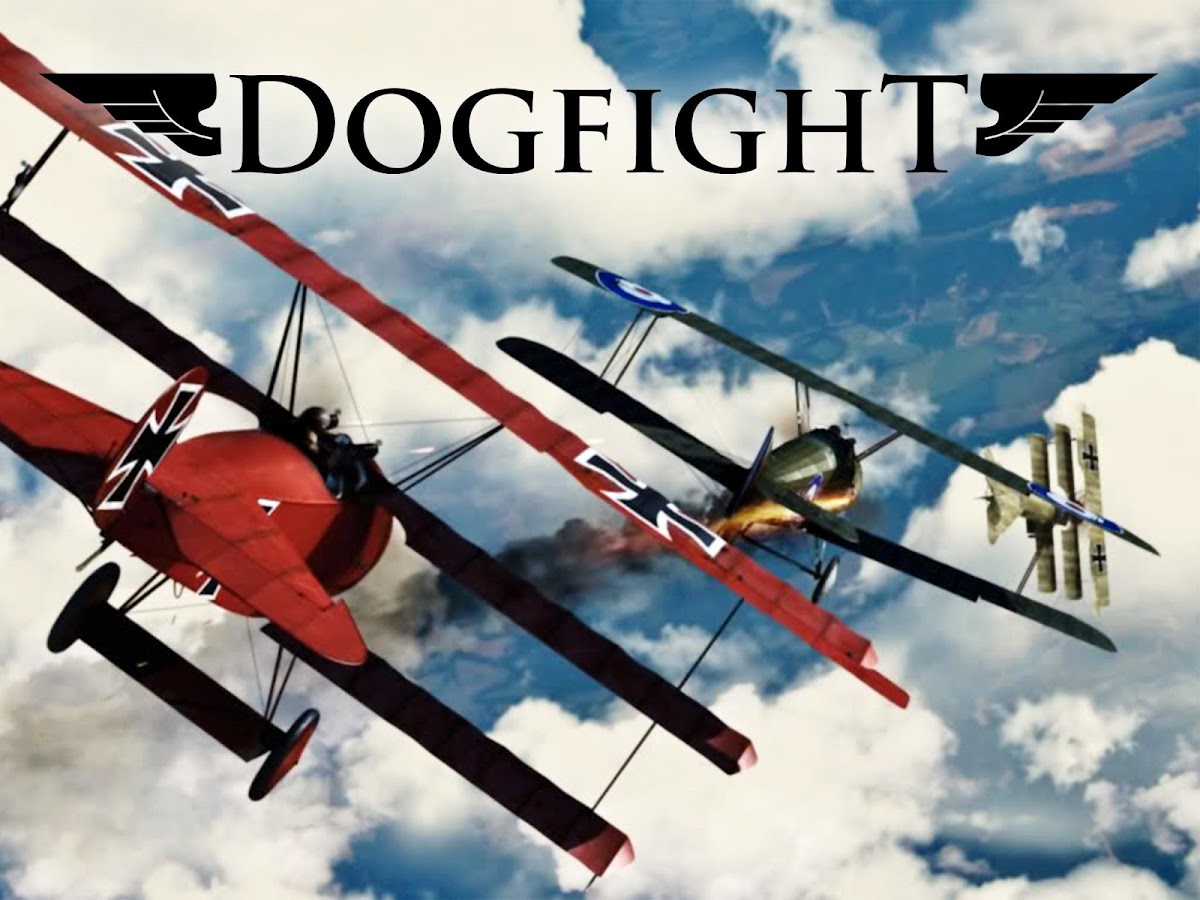
2015 WAR MOVIE SUBGENRE TOURNAMENT: Best Dogfighting Film


                I have decided to change the name of my annual tournament to “War Movie Subgenre Tournament” instead of “March Madness”.   That’s not because I was contacted by a lawyer from the NCAA.  I just have decided it is unoriginal and I do not want to be limited to getting it in during March. 

                This year’s tournament will determine the best war movie that includes dogfight scenes.  My father was a fighter pilot so this tournament is personal for me.  He flew F-105s in Vietnam.  I dreamed of being a pilot myself, but faulty genes gave me bad eyesight.  I ended up following in my father’s  post pilot shoes by becoming a teacher/coach.  When I was growing up, I devoured everything I could read on WWII air combat.  Unfortunately, the books I read and still read are vastly superior to most movies on the subject of air combat.  The great dogfighting movie is yet  to be made and unless CGI becomes much better in this area, may never be made.  However, I have assembled an interesting field that spans several wars going back to WWI.  I have seeded the movies based on Rotten Tomatoes and my own gut feelings about the movies. 

                As usual, the format will be that the movies compete in four different categories each round.  I have chosen categories appropriate for a dogfighting film.  One of those categories will be clichés.  Having seen eighteen dogfighting films in the last two weeks, I have compiled a list of the most common.

                Here they are:
1.       A boy sees a plane and dreams of becoming a pilot. 
2.       There is a gruff crew chief.
3.       A pilot breaks formation to go after the enemy.
4.       The main character loses his best friend.
5.       Fighter pilots party hard.
6.       There is an evil foe.
7.       A pilot is obsessed with glory.
8.       One pilot is a ladies’ man.
9.       There is a mid-air collision.
10.    An airfield is attacked by the opposing squadron.  (Often followed by a retaliatory raid.)
11.    One pilot courts a local girl.
12.    A fighter jock drives a motorcycle.

THE PLAY-IN GAME: 
Flying Tigers (1943) vs. Flying Leathernecks (1951)

                 When I proposed the tournament to my compadres on Armchair General Forums, I had several mention these two movies as potential participants.  I decided to have them compete for a spot in the tournament.  I found this intriguing because they are similar movies and both starred John Wayne.

                “Flying Tigers” was John Wayne’s first war film.  As is well known, Wayne did not serve in the military in WWII.  This movie is part of the argument that he better served his country by making “flagwaving” films like this one.  Since it is unlikely that the uniformed Wayne would have killed as many Japanese in reality as compared to the celluloid hero, let’s concede the argument.  The fact that the movie was made in 1943 means that there were technical constraints on the effects.  The movie is meant to be a tribute to the American Volunteer Group (popularly known as the “Flying Tigers”) and leads off with a testimonial by Chiang Kai-shek  and blathering narration.  The plot is basically the story of the leader of the unit (Wayne as Jim Gordon) and a hot shot jerk named Woody (John Carroll).  Gordon is the empathetic head pilot who takes in black sheep pilots to shoot down Japanese planes for the saintly (but hickish) Chinese people.  Woody is a wolf who makes no secret that he is in it just for the bounty money given for each kill.  He says “get out your checkbook, General” when he shoots down a Zero.  There is a love triangle involving a nurse named Brooke (Anna Lee).  Woody wears out his charming roguishness when he contributes to the downing and subsequent strafing while parachuting death of the beloved exec “Hap” (Phil Kelly).  He does get a chance to redeem himself at the end and the love triangle conundrum is solved via subtraction.

                “Flying Tigers” was a big hit in a country that was craving Japanese ass-kicking.  People had heard of the famous unit already, but if they were hoping for a history lesson they were disappointed.  None of the characters were based on real people.  The only thing the movie gets right is the fact that the pilots were paid a bounty for each kill.  The biggest boner is having the unit earning those bounties before Pearl Harbor.  In reality, the AVG did not go into action until after Pearl Harbor.  The other departure from reality is in the air combat depicted in the movie.  That can partly be blamed on the available technology.  The effects make heavy use of models (P-40 Warhawks) and footage (including Japanese newsreels to show the effects of bombings).  Although the movie was nominated for an Academy Award for Best Effects, it looks decidedly quaint.  There are three ways to go in dogfight movies:  the use of models, the use of actual planes to reenact, and the use of CGI.  The use of models can be pulled off if you are making “Star Wars”, but in this case it just looks like models.  Plus models pre-Star Wars often defy the realities of physics and look foolish doing so.  “Flying Tigers” also falls into the Old School of showing dogfights via cockpit shots and machine guns blazing.  Any plane shot at goes down and usually with the bullet ridden body of the pilot on board (unless you want to reenact the dastardly strafing of an American pilot early in the war).

                “Flying Tigers” is patriotic bull shit, but it is not painful to watch.  The acting is good.  Wayne is Wayne, as usual.  We get to see the unique sight of Wayne acting peevish because his girl jilted him.  Carroll gets the meaty role and digs his teeth into it.  The character is not two-dimensional and although quite a cad, he has some redeeming qualities.  Anna Lee is lovely and can actually act a bit (usually not a requirement in movies like this).  The plot is very predictable, but what do you expect from a 1943 movie?  I could say the same for the dogfighting scenes, but they were done much better by movies pre-1940s.

                “Flying Leathernecks” was made eight years later which means the air combat cinematography is better, but time does not necessarily improve plot.  It was directed by Nicholas Ray (his only war film).  It got substantial cooperation from the USMC.  The Marines gave a lot of cooperation including providing several F6Fs (unfortunately they had not kept some F4Fs for Guadalcanal movies).  The Marines provided gun camera footage for the first time for a war film.

                The plot is straight out of a submarine movie.  Wayne plays Maj. Kirby who has arrived as the new CO for a squadron scheduled for Guadalcanal.  He is promoted over the head of the popular exec Capt. Griffin (Robert Ryan) and there is dysfunction written all over their relationship.  Kirby is the hard-ass who forces men to fly missions while they may be unhealthy and Griff is the empathetic peer who thinks Kirby is driving the men too hard.  The men also think Kirby is unreasonable.  They are fighter jocks who signed up to shoot down Japs and he has this radical idea that the unit should provide close air support to the “mud Marines” on Guadalcanal.  Kirby is strict with anyone who strays from this mission.  He and Griff disagree on his treatment of the men and they are due for a reconciliation by the end of the film.  It is just a matter of time before Griff  realizes that command makes you a horse's ass who sheds tears in private.  He has to get tougher and if it takes the death of his brother-in-law, so be it.   Thankfully there is no love triangle.  The movie takes us through a series of dogfights, strafing enemy positions, and an attack on a convoy.  Mixed in are the confrontations between the two leads and a trip back to the home front for the ladies (in the audience).  The home front scenes separate the Guadalcanal and Okinawa segments of the film.

                “Flying Leathernecks” is well-acted.  Wayne is basically playing Sgt. Stryker as squadron leader.  Ryan has a thankless role, but he is solid.  He was cast for his ability to stand toe to toe with Wayne.  Interestingly, the two actors’ political philosophies are reflected in their characters, but did not cause trouble on the set.  The supporting cast is fine with Jay Flippen providing unsubtle comic relief as the scrounger/crew chief and Don Taylor as the aw-shucks fighter jock named “Cowboy” (of course).  Mrs. Griffin (Janis Carter) is okay as an actress, but has no hubba-hubba factor.    

                The problem with the film is the lame plot.  The command clash is a hybrid of the earlier “Twelve O’Clock High” and the upcoming “Run Silent, Run Deep”.  It is very predictable.  I wonder if the Marines liked the idea of a film showing their aviators supporting their ground troops.  Hey Congress, keep that funding coming!  The dialogue is terrible, but it could have been worse as the film has a puzzling dearth of cockpit chatter.  I guess the Marines were Spartan when it came to that.  (We do get the laughable use of “pancake” to refer to having to land due to lack of fuel instead of for a crash landing without wheels.)  The score is also cringe-inducing.  It matches the hokey dialogue.  There are parts of the movie that are hard to watch, especially the home front stuff.  There is a letters home montage early in the movie that manages to empty your stomach.  You’ll just have to dry heave when Kirby returns home to his wife and son.

                As far as the combat, one big plus is the use of the F6Fs and F4Us supplied by the Marines.  I won’t quibble too much about the fact that F4Fs were used on Guadalcanal.  The movie is more historically accurate than “Flying Tigers”.  Kirby was based on Maj. John L. Smith who was awarded the Medal of Honor and shot down 19 Japanese planes while commanding the Cactus Air Force on Guadalcanal.  The debate over air combat versus close air support is summarized here in a simplistic way.  Hellcats and Corsairs did perform close air support.  It is a dangerous and unglamorous task that fighter jocks would have been less than thrilled with.  The movie uses a lot of footage (mostly gun camera film) which means no one ever misses.  There are no swirling dog fights like you see in some WWI movies.  It is similar to “Flying Tigers” in that we see a lot of pilot faces and machine guns firing.  The blending of the footage is pretty seamless.  It certainly works better cinematically than the use of models.  Some of the footage is from the Korean War where Marine aviation did a lot more close air support percentage-wise.

                Which one make it into the tournament?  This is a tough call.  Tigers has a less silly plot, but the dogfighting is primitively depicted.  Leathernecks has good dogfighting, but a laughable plot.  Since this tournament is mainly about dogfighting, I’m going to move “Flying Leathernecks” on.  But I have a feeling it will pancake early.

Here is the field:

1 – Battle of Britain
16 -  Flying Leathernecks

8 -  Dark Blue World
9 -  Red Tails

5 -  The Blue Max
12 -  The Red Baron

4 -  Hell’s Angels
13 -  Top Gun

6 -  Tuskegee Airmen
11-  Aces High

3 -  Dawn Patrol
14 – Von Richthofen and Brown

7 -  The Hunters
10 -  Flyboys

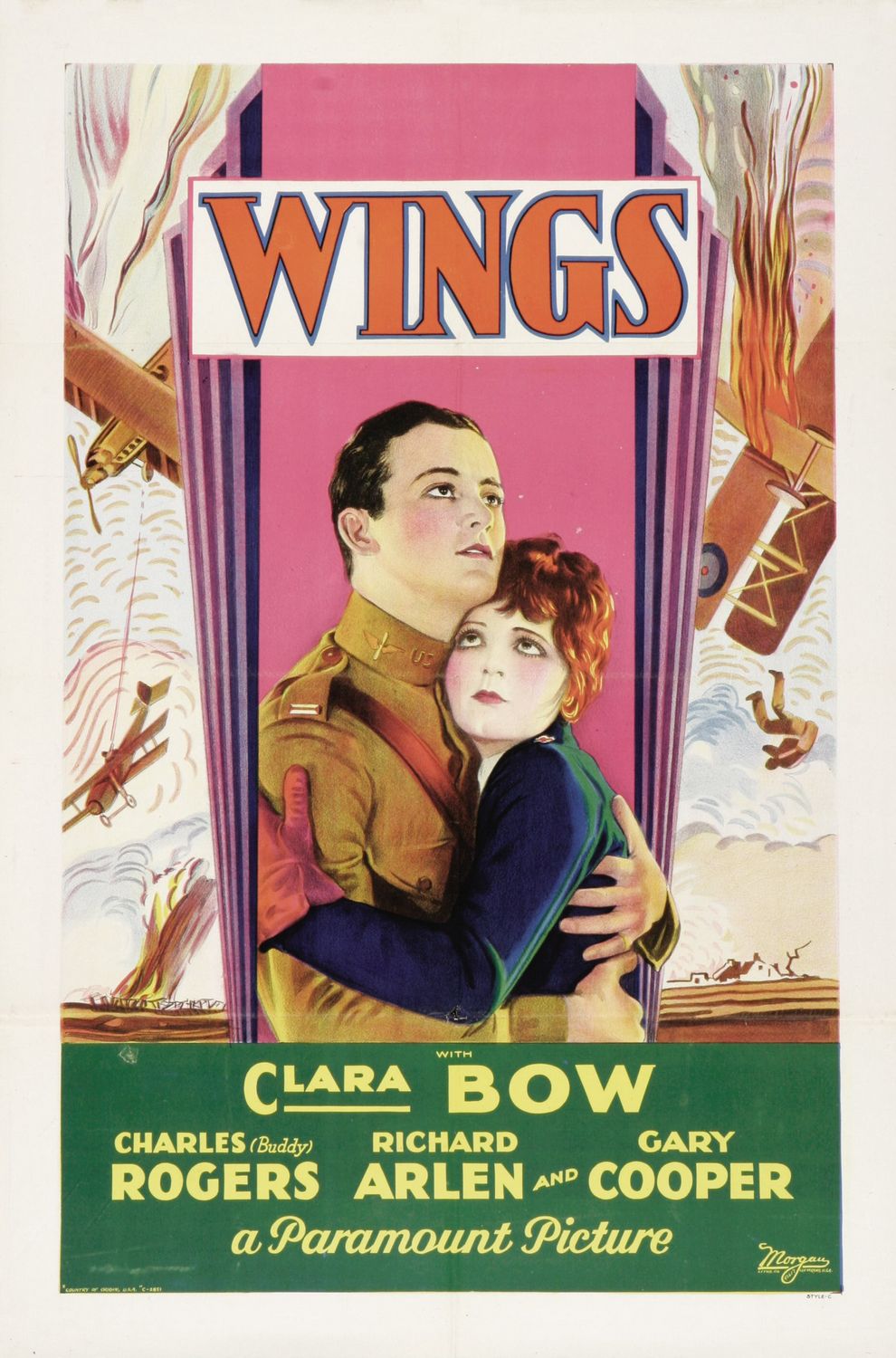
2 -  Wings
15 -  Angel’s Wing

Wednesday, September 25, 2013

#11 - Wings (1927)


BACK-STORY:  “Wings” was a movie that was loaded with firsts.  First aerial combat movie.  First male kiss.  First Best Picture (and the only silent movie until “The Artist”).  It set the template for future air combat movies.  The director was William “Wild Bill” Wellman (“Beau Geste”, “The Story of G.I. Joe”, “Battleground”) who had been a pilot with the Lafayette Escadrille in WWI.  He had three confirmed kills, survived a crash landing that left him with a limp, and was awarded the Croix de Guerre.  Sadly, he is one of the few directors who were not even nominated for his Best Picture efforts (tell that to Ben Affleck).  The movie was filmed at Kelly Field in San Antonio with full cooperation of the U.S. military.  The planes provided were mainly Thomas-Morse MB-3s and Curtiss PW-8s.  The German fighters were played by Curtiss P-1 Hawks.  One stunt flier broke his neck in a crash and another was a fatality.

OPENING:  The movie is dedicated to the air warriors of WWI.  Jack Powell (Charles Rogers) dreams of flying.  The girl next door, Mary (Clara Bow), dreams of kissing him.  They rebuild a car together and she suggests he name it “Shooting Star” and hints that when you see a shooting star you should kiss the one you love.  She puckers up but he is lusting after the new girl in town, Sylvia (Jobyna Ralston – Rogers’ future wife).  Unfortunately (or fortunately for the plot), she is in love with David Armstrong (Richard Arlen).  War comes and the two men enlist.  Sylvia gives Jack the impression she is in love with him by allowing him to mistakenly take a picture locket intended for David.   Mary goes off to France as a truck driver.

the girl next door
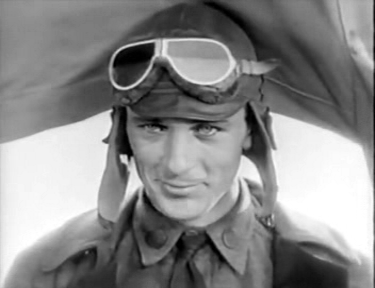
SUMMARY:  There is a brief training montage that leads up to a frenetic boxing match between Jack and David.  They throw more punches in two minutes than a normal fifteen round bout.  The result of the match is respect and friendship, naturally.  It’s off to their first billet where they are bunked with a veteran named White (Gary Cooper in his very brief, but star-making turn. Added bonus – he started an affair with Clara Bow).  White goes off to do his quota of figure eights and does not return.  It’s a dangerous game.

                A nifty split screen reminds us there’s a war going on in Europe and suddenly Jack and David are in the thick of it at an air base.  It’s time for their first dawn patrol and thus their first dog fight.  The audience gets the iconic front cowling view of the pilots.  Their death throes are creepy and unforgetable.  The other thing that stands out is the colorized flames.  One of the themes that emerges is that the air war is clean and chivalrous (a German ace named Kellerman lets Jack live when he sees that the American’s guns have jammed) and the ground war is dirty and gruesome.  Jack crash lands in no man’s land in the middle of a battle.  It seems that it is better to be in the air than on the ground.

Jack, Mary, and David
                The next scene is a Gotha (large German bomber) raid on a French village.  David and Jack scramble.  The bombing raid is well done with cool aerial views of the bombing, including shots through the bomb bay doors.  The explosions are realistic.  Mary gets caught in the raid and hides under her truck.  She does not realize it is Jack who is shooting down the bomber.

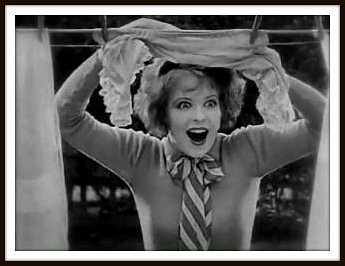
                Jack and David get leave in Paris.  They go to the Folies Bergere and get drunk.  Jack is so sousled that he is seeing imaginary bubbles.  (Check out these special effects, 1920s audiences!)  At first this is a cute effect, but it becomes interminable as the scene drags.  Mary arrives (it’s a small world … war) and finds Jack with a floozy.  Jack does not recognize Mary because he is only seeing bubbles.  She manages to get him into bed, but he passes out and she gets caught by MPs while changing clothes (use the pause button if you want to see the “It Girl’s” its) and they ship her back to America for being sexual.

the "it" girl
                Back at the front, Jack and David have a falling out over the locket picture.  David is so flummoxed that he forgets his lucky stuffed bear when they are scrambled to attack some observation balloons.  David takes on four German fighters to protect his wing man Jack.  Jack shoots down two balloons in an excellent scene.  David is hit and crashes in a stream.  German infantry opens fire on him and presume they have killed him.  Kellerman delivers a note to Jack’s base to let him know that David is dead.  Jack vows revenge, not knowing David is actually on the lam.

                The “big push” comes and Jack takes off intending to take on the enemy all by himself.  The movie blends the ground attack by American infantry with Jack’s one man air war.  There are realistic aerial views of the trench systems.  Doughboys assault the Germans across no man’s land with the help of tanks.  The deaths are tepid, but accurately random.  There is a really keen shot of a tank crushing a German machine gun bunker.  Jack is on a strafing rampage which includes an incredibly accurate swoop on a German machine gun nest that has American soldiers yards away.  A dying Yank (played by Wellman himself) yells skyward:  “Atta boy.  Them buzzards are some good after all.”

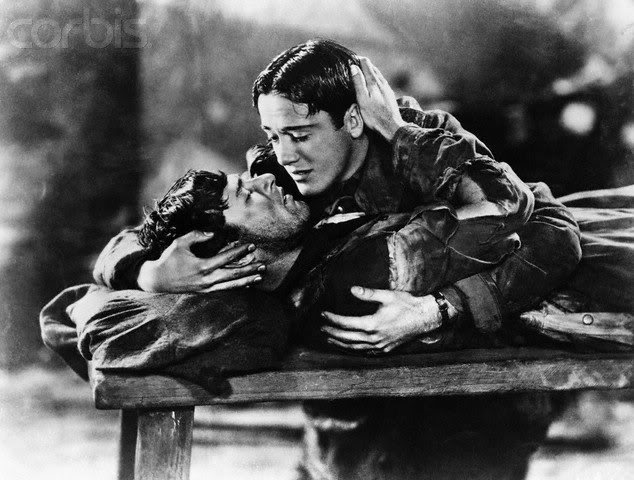
                Meanwhile David is sneaking through the swamps until he reaches a German air base where he incredibly steals a plane and shoots down a German fighter attempting to take off.  The German airman’s death is laugh out loud funny.    On the battlefield, the Germans are literally running away from the Amis while fighters strafe them.  Jack takes time off from strafing to stalk a lone German plane.  Guess who is flying that German plane?  No, it’s not Mary!  Arlen finally gets into the flow of the silent movie emoting as his David tries to identify himself.  He even yells “Fuck the Kaiser!”  (I think I read his lips correctly.)  Actually, one subtitle is “Jack – don’t you know me?!”  Jack stitches David’s plane which means bullets in the back are next.  David crashs into a house (owned by French played by Wellman’s wife and kid).  Jack lands to back-slapping in the yard.  Hey, Yank, come be chivalrous and say good bye to the guy you killed.  There is a tearful reunion and reconciliation where the actors are so intimately close you swear they are about to kiss.  Holy crap, that’s exactly what they do!  Cut to a propeller coming to a stop.

you don't think they're going to...do you?
CLOSING:  In packing up David’s kit, Jack learns that Sylvia was actually in love with David.  His bad.  Jack returns home as a “conquering hero”.  He goes to David’s parent’s home to bookend the painfully melodramatic scene of David going to war.  Even the family dog is pissed at him, but Mother Armstrong forgives him because it was the war that was to blame.  Unlike the earlier scene, this one is effectively tearjerking.  That stuffed bear is powerful.  Jack passes Mary on the street and does not even recognize her.  Just kidding.  He has finally come to his senses and decides he will hook up with the sexiest woman in America.  The movie comes full circle with a kiss as a shooting star sweeps across the sky.  Awwwww.

WOULD CHICKS DIG IT?  Certainly.  It has a heavy dose of romance.  Bow plays the girl next door so her sexuality is not intimidating.  She is very likeable.  Surprisingly, the Sylvia character is not a vamp.  The romance subplot almost did not come off because Bow was not happy with her role.  She felt the character was shoe-horned in to create a romance.  Wow, imagine that. 

HISTORICAL ACCURACY:  Obviously the movie is fictional so accuracy is not an issue.  The “big push” is supposedly the St. Mihiel Offensive although it is not identified by name.  The movie clearly indicates that the attack finishes off the Germans (which would more accurately have been the Meuse-Argonne Offensive.)  The combat is as realistic as could be expected for a 1927 film.  Not on the level of “All Quiet on the Western Front” mind you, but the overhead shots are actually quite extraordinary.  The use of tanks stands out.   Amazingly, the movie depicts the use of Bangalore Torpedoes to blast holes through barbed wire.  I am pretty sure this is the only WWI movie to show their use.

                The aerial combat is accurate, which is to be expected from a Wellman film.  The balloon attack is particularly well done.  The balloons are on cables.  The observers are in a basket with a telephone link-up.  The balloons are protected by anti-aircraft guns (but no fighters).  The observers parachute out.  The balloons go up in flames.  The strafing is a bit too perfect, but that is de rigeuer for war movies.  Jack even gets to kill a German general in his car.

CRITIQUE:  “Wings” probably deserved the Best Picture award, although I don’t have the foggiest notion of the other contenders.  It is epic in scale and execution.  Wellman had access to 60 planes and 3,500 extras.  He also had a bevy of intrepid stunt men who were willing to risk life and limb to depict the thrills of air combat.  The acrobatics of the doomed planes are particularly impressive.  In this film even the planes ham it up.  The restored 2012 version has a crisp look to it and one can see why audiences would have found it rousing.  The use of the Handsghiegel Color Process to add flames adds some pizazz to the black and white.  The cinematography is classic with some bells and whistles in the form of the split screen scene and the neverending bubbles.  POV enhances some of the cockpit scenes.  Speaking of which, the air combat shots seem to be either close-ups or far range.


                The acting is problematical.  Clara Bow dominates when she is on screen.  I know our perceptions of what is hot has changed greatly from the 1920s, but she has “it” even in today’s climate.  I can’t think of too many other actresses from that era that I stare at when they are on screen.  Unfortunately, she is off screen for much of the film.  The movie is more of a bromance than a romance.  Charles Rogers does the typical emoting expected of a silent movie star.  His drunken Folies Bergere scene is not cringeworthy, just tedious.  It’s probably best that we can’t hear his cockpit rantings (or read most of them).  The biggest problem in this area is with Arlen.  He is a stiff.  Plus he is way too old looking for the part.   The supporting cast is adequate.  The movie throws in a German-American mechanic with an American flag tattoo for some hammy comic relief.  Armstrong’s mother and father look like they belonged in the Addam’s family, but the stuffed bear requits itself admirably.

make this man a star!
                The plot eschews a love triangle for the rarer love quartet.  More unusually, all four characters are likeable.  It is obvious that Jack and Mary will end up together, but the rest of the arc is not so predictable.  It’s a nice touch that Mary is sent all the way to France and then does not really hook up with Jack.  The whole locket thing was a classic contrivance, but you see that sort of thing all the time in old movies (like “Beau Geste”).  Not to mention the shooting down of David by Jack.  Ridiculous, but inevitable.

                The movie is melodramatic and patriotic, especially in the title cards, but not overly propagandistic.  It does not demonize the enemy.  Kellerman is not a villain.  The enemy is faceless as are the squadron mates.  Cooper gets his fifteen seconds, but no one else makes a dent.  The plot is rife with contrivances to push it to the happy ending, but the contrivances are mostly endearing.  The buttons are pushed effectively.  I did not throw up in my mouth even once.  I can not say the same for the similar “Pearl Harbor”.

                The movie is justifiably famous for its aerial sequences.  They are among the best from that era.  Better than most, but not superior to “Hell’s Angels” (which was greatly influenced by it).  Amazingly, the trench sequences are actually stronger than the air combat and they get much more coverage than in similar films.

CONCLUSION:   I wasn’t sure going into this movie and the first half tended to confirm my suspicions that it would be too Old School to hold up.  If it weren’t for Bow, the romance would be a loser.  The movie is slow paced and the Folies Bergere scene brings the movie to a thudding halt.  Surprisingly, the movie takes off (get it) when Mary goes home and the boys have their falling out.  The balloon scene foreshadows the kick-ass St. Mihiel third.  The pace picks up considerably and the blend of air combat and trench warfare is deft.  The resolution of the quartet is pleasing, if predictable.  It’s one third of a very good movie.  Overall, I would have to say it may belong at #11 if you are basing the ranking on importance of the film.  However, if you are basing rankings simply on how good the film is, it is far from being the 11th best war movie ever made.  I can see it making my 100 Best, but not in the top fifty.  It’s definitely a must see and I must admit embarrassment at having seen it for the first time for this project.  
 
RATINGS:
Action                    8/10
Acting                     C
Accuracy                C
Realism                  C
Plot                         B-
OVERALL  =  C+