Showing posts with label Red Baron. Show all posts

Wednesday, June 24, 2015

Von Richthofen and Brown (1971)


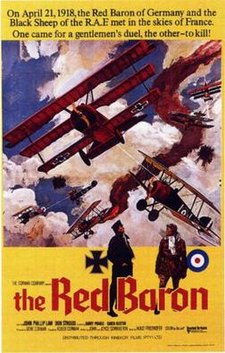
                “Von Richthofen and Brown” was another recent participant in my Best Dogfighting Movie tournament.  It did surprisingly well for a movie that is not very well known.  It was Roger Corman’s  attempt to go beyond his B-movie / cult movie reputation.  He had a much bigger budget than for films like “Bloody Mama” and Gas-s-s-s”.  It was his second war movie after the classic “The Secret Invasion”.  Unfortunately, his experience in the filming of “Von Richthofen and Brown” resulted in his directing only two more films in the next 37 years.

                The recently arrived Von Richthofen (John Phillip Law) arrives at his squadron and has a rough landing.  He then proceeds to show his mindset by rushing to take a souvenir from his first kill.  He has trophies made for each subsequent victory.  Pilot obsessed with glory – check!  Von Richthofen meets the famous Oswald Boelcke who advises him to come from out of the sun, get in close, don’t waste ammunition, and only fight if you have an advantage.  Soon the Red Baron has ten kills and is fast becoming a celebrity.  Meanwhile, Roy Brown (Don Stroud) has arrived at his RAF squadron where he makes an immediate impression by refusing to join in a toast to Von Richthofen.  He does not believe in that chivalric bull shit.  He is a modern warrior.  “I’m just a technician, I change things.  Put a plane in front of me with a man in it – I change him into a wreck and a corpse.”  He is also a cynic.  When asked “who’s next?”, he responds “we’re all next”.  Somehow Brown bullies his way to leadership and has his squadron hunt in packs with a plane as bait.  These two main characters are bound to duel.  The Knight of the Air versus the Hunter of the Sky.

                The movie is a roller coaster ride of scenes that are either entertaining or farcical.  The entertaining ones include Von Richthofen’s  encounter with the British ace Hawker and the climactic duel with Brown.  In between we get the Red Baron crashing in no man’s land so we can get a small-scale fire fight and not one but two attacks on air fields.  This being a Roger Corman film, there is a truly ludicrous moment when Fokker shows off his new plane while a hottie caresses it and he speaks in sexual innuendo!  This is a fun movie if you are in the right mood.

                Corman made no claims to historical accuracy and it’s a good thing he didn’t.  In spite of that, there is a smidgen of accuracy to be found here.  The Red Baron did replace Boelcke, but did not contribute to his death.  He did shoot down Hawker, but not in spite of the Brit motioning that he was out of ammo.   He did collect silver cups and his combat tactics are pretty close to his philosophy.  The script inserts Herman Goring as the villainous counterpoint to Von Richthofen when actually he did not join the Flying Circus until after the Baron’s death.  At one point, Goring actually argues that it is okay to strafe nurses and even “gas them”!  On the other hand, the Brown character is almost totally fictional.  He was not in the RAF.  He was in the Royal Canadian Air Force.  Instead of being a jerk, he was a well-respected squadron commander who insisted his charges be well-trained before seeing combat.   As far as the final duel, the movie basically sticks to the official version that credits Brown with the death of the Red Baron.  Most authorities feel Von Richthofen was actually killed by a bullet from an Australian anti-aircraft gun.  It is not surprising that the movie does not show that version.
                It is hard to get a hold on this movie.  “Directed by Roger Corman” sends a signal that the movie should be inferior to most war movies.  However, VR&B is definitely not your typical Corman movie.  It was a labor of love for him and he went all out on it with a much larger budget than he had ever had before.  This started with the purchasing of most of the aircraft used in “The Blue Max”.  VR&B used twelve planes including replica Pfalz DIIIs,  S.E. 5s, Fokker D.VIIs, and Fokker Dr.Is.  It’s a very nice line-up for a glorified B-movie like this.  The planes do not just sit at the airfield.  The movie has a large amount of dogfighting in it – 24 minutes.  That quantity is the most of any of the sixteen movies in the dogfighting tournament.  The quality is fairly high.  There are fine acrobatics by the stunt pilots, one of whom was killed.  Stroud and Law learned the rudiments of flying and they were filmed in the back seats as though flying.  Unfortunately, although the cinematography is well done, it is repetitive.  We get a lot of pilot’s faces, guns firing, and the use of smoke trails to indicate a plane has lost the battle.

                While the film deserves an A for effort and a B for dogfighting, it is inferior in all other areas.  The acting is wooden from the B-list cast.  Law was a poor choice for Von Richthofen, but Stroud does bring charisma to his role.  Still, we are talking about Don Stroud here.  The actors are not helped by the dialogue which is stilted and pious.  They are also placed in some ridiculous scenarios like the German attack on the British airfield while they are celebrating their attack on the German air field.  It does result in numerous cool explosions (from fighter planes bereft of bombs). 

                Does it crack the 100 Best War Movies of all time?  No way, but it is a nice time waster if you don’t invest any brain cells in it.  Make sure you do not watch it to get the true story of the death of the Red Baron.


GRADE =  C+


Saturday, March 28, 2015

2015 WAR MOVIE SUBGENRE TOURNAMENT: Best Dogfighting Film


                I have decided to change the name of my annual tournament to “War Movie Subgenre Tournament” instead of “March Madness”.   That’s not because I was contacted by a lawyer from the NCAA.  I just have decided it is unoriginal and I do not want to be limited to getting it in during March. 

                This year’s tournament will determine the best war movie that includes dogfight scenes.  My father was a fighter pilot so this tournament is personal for me.  He flew F-105s in Vietnam.  I dreamed of being a pilot myself, but faulty genes gave me bad eyesight.  I ended up following in my father’s  post pilot shoes by becoming a teacher/coach.  When I was growing up, I devoured everything I could read on WWII air combat.  Unfortunately, the books I read and still read are vastly superior to most movies on the subject of air combat.  The great dogfighting movie is yet  to be made and unless CGI becomes much better in this area, may never be made.  However, I have assembled an interesting field that spans several wars going back to WWI.  I have seeded the movies based on Rotten Tomatoes and my own gut feelings about the movies. 

                As usual, the format will be that the movies compete in four different categories each round.  I have chosen categories appropriate for a dogfighting film.  One of those categories will be clichés.  Having seen eighteen dogfighting films in the last two weeks, I have compiled a list of the most common.

                Here they are:
1.       A boy sees a plane and dreams of becoming a pilot. 
2.       There is a gruff crew chief.
3.       A pilot breaks formation to go after the enemy.
4.       The main character loses his best friend.
5.       Fighter pilots party hard.
6.       There is an evil foe.
7.       A pilot is obsessed with glory.
8.       One pilot is a ladies’ man.
9.       There is a mid-air collision.
10.    An airfield is attacked by the opposing squadron.  (Often followed by a retaliatory raid.)
11.    One pilot courts a local girl.
12.    A fighter jock drives a motorcycle.

THE PLAY-IN GAME: 
Flying Tigers (1943) vs. Flying Leathernecks (1951)

                 When I proposed the tournament to my compadres on Armchair General Forums, I had several mention these two movies as potential participants.  I decided to have them compete for a spot in the tournament.  I found this intriguing because they are similar movies and both starred John Wayne.

                “Flying Tigers” was John Wayne’s first war film.  As is well known, Wayne did not serve in the military in WWII.  This movie is part of the argument that he better served his country by making “flagwaving” films like this one.  Since it is unlikely that the uniformed Wayne would have killed as many Japanese in reality as compared to the celluloid hero, let’s concede the argument.  The fact that the movie was made in 1943 means that there were technical constraints on the effects.  The movie is meant to be a tribute to the American Volunteer Group (popularly known as the “Flying Tigers”) and leads off with a testimonial by Chiang Kai-shek  and blathering narration.  The plot is basically the story of the leader of the unit (Wayne as Jim Gordon) and a hot shot jerk named Woody (John Carroll).  Gordon is the empathetic head pilot who takes in black sheep pilots to shoot down Japanese planes for the saintly (but hickish) Chinese people.  Woody is a wolf who makes no secret that he is in it just for the bounty money given for each kill.  He says “get out your checkbook, General” when he shoots down a Zero.  There is a love triangle involving a nurse named Brooke (Anna Lee).  Woody wears out his charming roguishness when he contributes to the downing and subsequent strafing while parachuting death of the beloved exec “Hap” (Phil Kelly).  He does get a chance to redeem himself at the end and the love triangle conundrum is solved via subtraction.

                “Flying Tigers” was a big hit in a country that was craving Japanese ass-kicking.  People had heard of the famous unit already, but if they were hoping for a history lesson they were disappointed.  None of the characters were based on real people.  The only thing the movie gets right is the fact that the pilots were paid a bounty for each kill.  The biggest boner is having the unit earning those bounties before Pearl Harbor.  In reality, the AVG did not go into action until after Pearl Harbor.  The other departure from reality is in the air combat depicted in the movie.  That can partly be blamed on the available technology.  The effects make heavy use of models (P-40 Warhawks) and footage (including Japanese newsreels to show the effects of bombings).  Although the movie was nominated for an Academy Award for Best Effects, it looks decidedly quaint.  There are three ways to go in dogfight movies:  the use of models, the use of actual planes to reenact, and the use of CGI.  The use of models can be pulled off if you are making “Star Wars”, but in this case it just looks like models.  Plus models pre-Star Wars often defy the realities of physics and look foolish doing so.  “Flying Tigers” also falls into the Old School of showing dogfights via cockpit shots and machine guns blazing.  Any plane shot at goes down and usually with the bullet ridden body of the pilot on board (unless you want to reenact the dastardly strafing of an American pilot early in the war).

                “Flying Tigers” is patriotic bull shit, but it is not painful to watch.  The acting is good.  Wayne is Wayne, as usual.  We get to see the unique sight of Wayne acting peevish because his girl jilted him.  Carroll gets the meaty role and digs his teeth into it.  The character is not two-dimensional and although quite a cad, he has some redeeming qualities.  Anna Lee is lovely and can actually act a bit (usually not a requirement in movies like this).  The plot is very predictable, but what do you expect from a 1943 movie?  I could say the same for the dogfighting scenes, but they were done much better by movies pre-1940s.

                “Flying Leathernecks” was made eight years later which means the air combat cinematography is better, but time does not necessarily improve plot.  It was directed by Nicholas Ray (his only war film).  It got substantial cooperation from the USMC.  The Marines gave a lot of cooperation including providing several F6Fs (unfortunately they had not kept some F4Fs for Guadalcanal movies).  The Marines provided gun camera footage for the first time for a war film.

                The plot is straight out of a submarine movie.  Wayne plays Maj. Kirby who has arrived as the new CO for a squadron scheduled for Guadalcanal.  He is promoted over the head of the popular exec Capt. Griffin (Robert Ryan) and there is dysfunction written all over their relationship.  Kirby is the hard-ass who forces men to fly missions while they may be unhealthy and Griff is the empathetic peer who thinks Kirby is driving the men too hard.  The men also think Kirby is unreasonable.  They are fighter jocks who signed up to shoot down Japs and he has this radical idea that the unit should provide close air support to the “mud Marines” on Guadalcanal.  Kirby is strict with anyone who strays from this mission.  He and Griff disagree on his treatment of the men and they are due for a reconciliation by the end of the film.  It is just a matter of time before Griff  realizes that command makes you a horse's ass who sheds tears in private.  He has to get tougher and if it takes the death of his brother-in-law, so be it.   Thankfully there is no love triangle.  The movie takes us through a series of dogfights, strafing enemy positions, and an attack on a convoy.  Mixed in are the confrontations between the two leads and a trip back to the home front for the ladies (in the audience).  The home front scenes separate the Guadalcanal and Okinawa segments of the film.

                “Flying Leathernecks” is well-acted.  Wayne is basically playing Sgt. Stryker as squadron leader.  Ryan has a thankless role, but he is solid.  He was cast for his ability to stand toe to toe with Wayne.  Interestingly, the two actors’ political philosophies are reflected in their characters, but did not cause trouble on the set.  The supporting cast is fine with Jay Flippen providing unsubtle comic relief as the scrounger/crew chief and Don Taylor as the aw-shucks fighter jock named “Cowboy” (of course).  Mrs. Griffin (Janis Carter) is okay as an actress, but has no hubba-hubba factor.    

                The problem with the film is the lame plot.  The command clash is a hybrid of the earlier “Twelve O’Clock High” and the upcoming “Run Silent, Run Deep”.  It is very predictable.  I wonder if the Marines liked the idea of a film showing their aviators supporting their ground troops.  Hey Congress, keep that funding coming!  The dialogue is terrible, but it could have been worse as the film has a puzzling dearth of cockpit chatter.  I guess the Marines were Spartan when it came to that.  (We do get the laughable use of “pancake” to refer to having to land due to lack of fuel instead of for a crash landing without wheels.)  The score is also cringe-inducing.  It matches the hokey dialogue.  There are parts of the movie that are hard to watch, especially the home front stuff.  There is a letters home montage early in the movie that manages to empty your stomach.  You’ll just have to dry heave when Kirby returns home to his wife and son.

                As far as the combat, one big plus is the use of the F6Fs and F4Us supplied by the Marines.  I won’t quibble too much about the fact that F4Fs were used on Guadalcanal.  The movie is more historically accurate than “Flying Tigers”.  Kirby was based on Maj. John L. Smith who was awarded the Medal of Honor and shot down 19 Japanese planes while commanding the Cactus Air Force on Guadalcanal.  The debate over air combat versus close air support is summarized here in a simplistic way.  Hellcats and Corsairs did perform close air support.  It is a dangerous and unglamorous task that fighter jocks would have been less than thrilled with.  The movie uses a lot of footage (mostly gun camera film) which means no one ever misses.  There are no swirling dog fights like you see in some WWI movies.  It is similar to “Flying Tigers” in that we see a lot of pilot faces and machine guns firing.  The blending of the footage is pretty seamless.  It certainly works better cinematically than the use of models.  Some of the footage is from the Korean War where Marine aviation did a lot more close air support percentage-wise.

                Which one make it into the tournament?  This is a tough call.  Tigers has a less silly plot, but the dogfighting is primitively depicted.  Leathernecks has good dogfighting, but a laughable plot.  Since this tournament is mainly about dogfighting, I’m going to move “Flying Leathernecks” on.  But I have a feeling it will pancake early.

Here is the field:

1 – Battle of Britain
16 -  Flying Leathernecks

8 -  Dark Blue World
9 -  Red Tails

5 -  The Blue Max
12 -  The Red Baron

4 -  Hell’s Angels
13 -  Top Gun

6 -  Tuskegee Airmen
11-  Aces High

3 -  Dawn Patrol
14 – Von Richthofen and Brown

7 -  The Hunters
10 -  Flyboys

2 -  Wings
15 -  Angel’s Wing