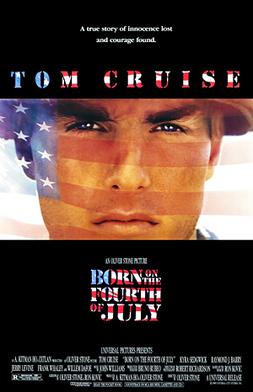
“Born
on the 4th of July” is the second in Oliver Stone’s Vietnam
trilogy. It was released in 1989. It is sandwiched between “Platoon” and
“Heaven and Earth”. The film shares
eleven actors with “Platoon”. It is
based on the memoir by Ron Kovic who wrote the script with Stone. Interestingly, the two veterans both won
Bronze Stars and Purple Hearts. Stone
also produced and directed the film. It
was a huge success at the box office and with critics. It was nominated for eight Oscars and won for
Director and Film Editing.
The
movie opens symbolically with a young Kovic playing war – an American rite of
passage. This flows into a 4th
of July parade featuring crippled veterans (including the real Kovic). The crowd is very appreciative of the WWII veterans. Next, we hear JFK urge young Americans to
“Ask not…” This trio of images establishes
the template of pre-disillussioned America. (Interestingly, the Kennedy of this film is urging young American boys to go to Vietnam whereas the Kennedy of Stone's "JFK" is killed for wanting us out!)
Kovic
is recruited by the Marines and seduced by the desire to “find out if you got
what it takes.” He doesn’t want to miss
the chance to go toe to toe with Communism.
In a twist, his veteran father (Raymond Barry) is not thrilled, but his
mother (Caroline Kava) is supportive.
The
movie jumps forward to Kovic’s second tour in Vietnam. His unit is attacking a village and find a
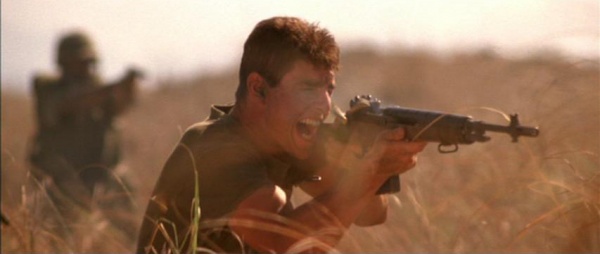
whole family slaughtered. The combat is
visceral and graphic. In the chaotic
retreat, Kovic accidentally kills one of his men named Wilson. When he tries to accept responsibility, his
CO brushes the incident under the rug.
This adds to Kovic’s anguish and creates an ominous vibe. Sure enough, in the next combat set piece,
Kovic is badly wounded in the assault on another ville. The action is intense and frenetic. Both scenes evidence the “fog of war”. Tragically, the military hospital is more
hellish. He is given last rites, but
survives to end up in the Bronx Veterans’ Hospital.
The
hospital is like Purgatory. Viewers eyes
are opened to how our warriors were treated by the system they fought for. Rats, filth, uncaring staff, drug abuse,
faulty equipment. (This makes it even
more damning that some similar examples of mistreatment greeted veterans of
Iraq!) In spite of this, Kovic remains a
hawk and rails against anti-war protestors.
“Love it or leave it!” Kovic also
retains his misplaced confidence that he will walk again. A broken leg ends his optimism and begins his
descent into depression.
His
return home does not slow the descent.
The family is dysfunctional with an anti-war brother to quarrel with and
a mother who cannot deal with the broken copy of her golden boy. The movie comes full circle with another 4th
of July parade. Although predictable
with its hippies causing trouble, the scene is a great bookend. Even the requisite PTSD flinching at the
fireworks and the failed speech with flashbacks do not feel clicheish.
The
worm turns when Kovic is caught up in a protest at Syracuse University. During a speech by Abbie Hoffman, the police
wade into the crowd with tear gas and billy clubs. This leads to a drunken rant
against his mother and the heart-rending “who’s gonna love me, dad?” He has to leave home now.
The
third stage of his life takes him to a seedy town in Mexico inhabited by
other mentally and physically damaged
veterans. It’s a life of frustrated
whoring and binge drinking. Kovic
poignantly falls in love with a “whore with a heart of gold” only to discover it’s just a job to her. He leaves this “home” with his friend Charlie
(Willem Dafoe) only to end up at rock bottom in a wheel chair fight on a
deserted highway. It’s more powerful
than pathetic.
 |
| "Well, I believe after Americans see our movie, wounded veterans will be treated with respect!" |
The
fourth stage begins with a soul-cleansing visit to Wilson’s family to tell them
the truth about their son’s death. Their
reaction is genuine and sincere and very Middle American. The weight has been lifted and Kovic begins his
career as fixture in the anti-war
movement. The climax of this evolution
from naïve patriot to patriotic dissenter comes at the 1972 Republican
Convention where Kovic and others disrupt Nixon’s speech and get violently
throw out of the hall.
Here’s
a cliché for you; “I’m not a big Tom
Cruise (Oliver Stone) fan, but…” How
often do you hear that? This is one of
those movies where both men are at their best.
I had not seen it in years and did not look forward to reviewing it with
relish. I was wrong. It is a very impressive movie. There are few weaknesses. Stone controls himself (you know how he can
be) and deserved the Oscar as Best Director. It is astounding that the movie lost
to “Driving Miss Daisy”. You can
definitely argue this was more egregious than the infamous “Shakespeare in
Love” win over “Saving Private Ryan”.
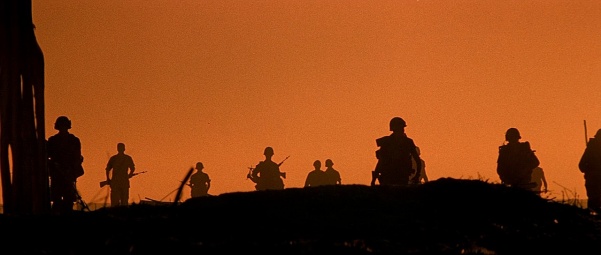
The cinematography of Robert Richardson mixes chromes to match the
moods. For instance, the combat scenes
have reddish tinge. (It lost to
“Glory”.) The two combat scenes stand
out for me, of course. Richardson uses a
hand-held and gets the you-are-there feel that has become common in modern war
films. The soundtrack by John Williams
was also nominated (losing to “The Little Mermaid”!)
 |
| War |
The
acting is outstanding. Cruise is amazing
and must have finished second to Daniel Day-Lewis. He is fully into a role that took great
physical commitment. Leave your feelings
about him at the door and admire his performance. The other standout is Defoe. Their scenes together are highlights.
 |
| "Give me that Oscar!" |
. In less capable hands, the movie could have been
maudlin and heavy-handed. Stone is
obviously sending a message, but he does not bludgeon us with it. The theme is simple: the evolution of a
patriotic warrior to a disillusioned pacifist.
The arc is realistic mainly because it’s a true story. Kovic’s role in the production gives it
cred. It makes it difficult to doubt the
accuracy. However, the two protest
scenes (Syracuse and the Convention) are
up-violenced for understandable
reasons. These are not major flaws.
Although Stone struck out with “Heaven and
Earth”, the first two in his trilogy are important films. “Platoon” has lost luster for many war movie
fans (not me), but the fact is that it opened the Vietnam combat experience to
many Americans. It is not the only
Vietnam film that has done a credible job in this area. On the other hand, “Born” opened people’s
eyes to the plight of wounded veterans.
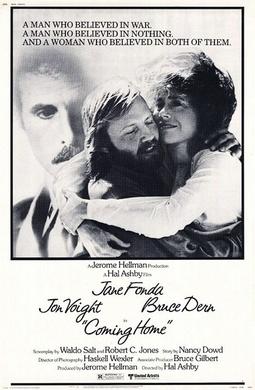
This depiction is rarer with the inferior “Coming Home” the obvious
competitor. The sad thing is the limited
impact it had on treatment of future veterans.
It also should be mentioned that the movie did the service of bringing
Ron Kovic to public recognition. For the
Vietnam War, it is appropriate that we get a crippled, but resilient hero to
replace Col. Kirby of “The Green Berets” (a movie that is the polar opposite of
this movie).
HISTORY or HOLLYWOOD
1.
Kovic was on the high school wrestling
team and lost in a championship match.
2.
He decided to enter the Marines after
Marine recruiters came to talk to him and his classmates.
3.
His unit opened fire on a vollage
without just cause. Many civilaians were
casualties in one particular hut. They
had to pull back when the enemy counterattacked. In the confusion, Kovic shot and killed an
American named Wilson who came running toward him.
4.
When he tried to report the friendly
fire incident, his commanding officer did not want to hear about it.
5.
Kovic was wounded during an assault on
a village. He was first hit in the foot
and then in the shoulder while returning fire.
6.
He spent several months In a Bronx
Veterans hospital that was noted for rats, faulty equipment, uncaring
personnel, and unsanitary conditions.
7.
Kovic was told he would never walk
again but he worked hard at it until he broke his leg.
8.
He returns home in a wheelchair. He is offered a job as a cashier by his
friend who had refused to join the military.
9.
He rides in the 4th of July
parade and has a flashback while giving a speech.
10.
Kovic goes to Syracuse University to
see Donna (his unrequited love) and gets roughed up when he attends an anti-war
rally that is broken up by the police.
11.
He starts drinking heavily and has a
falling out with his mother. He goes to
join other crippled veterans in Mexico.
There he meets Charlie and has an affair with a whore who he erroneously
feels is in love with him.
12.
He visits Wilson’s family and they
accept his apology.
13.
Kovic joins the Vietnam Veterans
Against the War and goes to the Republican Convention in Miami. He speaks to the press in the hall during
Nixon’s acceptance speech. He is thrown
out and arrested, but is rescued by other vets and leads a counterattack.
14.
He is invited to the Democratic
Convention in 1976 and gives a speech.
Okay, so what are the correct
answers? Keep in mind that Kovic
co-wrote the script and may have added some things that actually happened, but
did not appear in the book. But also
keep in mind the other script writer was Stone.
1.
Kovic was on the high school wrestling
team and lost in a championship match. Histywood Kovic was on the wrestling team,
but the memoir does not mention the match portrayed in the movie.
2.
He decided to enter the Marines after
Marine recruiters came to talk to him and his classmates. History
3.
His unit opened fire on a village without
just cause. Many civilians were
casualties in one particular hut. They
had to pull back when the enemy counterattacked. In the confusion, Kovic shot and killed an
American named Wilson who came running toward him. History Both
incidents occurred pretty much as depicted in the film, but they were two separate
incidents. The attack that resulted in the civilian casualties did not end with
an enemy counterattack. The wounded
civilians were medevaced, not abandoned as in the film. The killing of Wilson occurred on a patrol and it was at night.
4.
When he tried to report the friendly
fire incident, his commanding officer did not want to hear about it. History
5.
Kovic was wounded during an assault on
a village. He was first hit in the foot
and then in the shoulder while returning fire.
History
6.
He spent several months In a Bronx
Veterans hospital that was noted for rats, faulty equipment, uncaring
personnel, and unsanitary conditions.
History
7.
Kovic was told he would never walk
again but he worked hard at it until he broke his leg. Histywood
He did attempt to walk again, but the broken leg occurred after he left
the hospital and was in college.
8.
He returns home in a wheelchair. He is offered a job as a cashier by his
friend who had refused to join the military.
Histywood Kovic does return home
similar to the movie, but the book does not mention the friend (Steve Boyer in
the movie) who was a pacifist/capitalist.
9.
He rides in the 4th of July
parade and has a flashback while giving a speech. Histywood
Kovic did ride in the parade, but he was with another disabled vet. He was on the grandstand, but did not give a
speech. Tommy Law did come up and take
him away afterwards.
10.
Kovic goes to Syracuse University to
see Donna (his unrequited love) and gets roughed up when he attends an anti-war
rally that is broken up by the police.
Hollywood He does not mention
Donna in the book. He was attending
college when he went to a peace rally, but he listened from his car. Later he went to a demonstration in
Washington, DC with a friend named Skip.
They ended at the Reflecting Pool where the police waded into the
waders. The violence was similar to that
of the film with Skip wheeling him away to the Lincoln Memorial. He was not himself attacked. In the book, this is the incident that made
him a militant.
11.
He starts drinking heavily and has a
falling out with his mother. He goes to
join other crippled veterans in Mexico.
There he meets Charlie and has an affair with a whore who he erroneously
feels is in love with him.
Histywood The book does not dwell
on his relationship with his mother, the movie probably exaggerated this
dynamic. He did go to Mexico and live
with a community of veterans in a town known as the Village of the Sun. One of his friends was named Charlie and the
incident with the taxi was true. After
this he went back to the States and then broke his leg and spent six months in
a hospital. Although he slept around
with a lot of prostitutes in Mexico, there was no relationship like depicted in
the film.
12.
He visits Wilson’s family and they
accept his apology. Hollywood
13.
Kovic joins the Vietnam Veterans
Against the War and goes to the Republican Convention in Miami. He speaks to the press in the hall during
Nixon’s acceptance speech. He is thrown
out and arrested, but is rescued by other vets and leads a counterattack. Histywood
Kovic had moved to California and was living with a friend named Kenny
when he attended a meeting of the VVAW.
He started giving speeches and appearing on TV. The arresting by an undercover cop
masquerading as a veteran occurred at a different protest and he did end up in
jail. At the Convention, he was
interviewed on the floor by Roger Mudd, but it was before the Nixon speech. He was removed during the Nixon speech for
yelling anti-war slogans.
14.
He is invited to the Democratic
Convention in 1976 and gives a speech.
History
Accuracy Rating = .64
All things considered, "Born on the Fourth of July" is admirably accurate. Some of the
inaccuracies are designed to advance the themes and since Kovic had a hand in the production, we can assume he was okay with the liberties Stone took. Of course, this does not excuse inventing a character like Donna. It is more acceptable to combine some incidents for time and plot purposes. The biggest strength of the movie accuracy-wise is Cruise's portrayal of Kovic. The Kovic of the movie is the Kovic of the film. Cruise channels Kovic and the extreme emotions Kovic writes about in his book are apparent in the film.
BOOK vs. MOVIE
I should remind my readers that I am a strong believer that a movie should be better than the book it is based upon. The screenwriter has the luxury of taking the best elements of the book and then making whatever improvements to enhance the entertainment value of the story. Unless the book is such that the director can not replicate it due to technical, budgetary, or time constraints, the movie should be better than the book. In this case, I am going to call it a tie because although the movie is an outstanding rendering of the book, the book is more personal and passionate than the movie. The book is more likely to get under your skin. Also, the book is surprisingly more formalistic than the movie. The book is nonlinear. It skips between first and third person (sometimes within the same chapter). There are parts where Kovic speaks in stream of consciousness - something movies have a hard time depicting. The book has the luxury of developing the theme of a broken and unfulfilled life without being too maudlin. You can digest the emotions Kovic went through without being distracted with what a great acting job Cruise was doing.
 |
| This image from "Born" looks like the flag in "Saving Private Ryan". The GIs and Grunts fought and died for the same flag. Why were they treated so differently afterwards? the trailer |