Showing posts with label Jane Fonda. Show all posts

Wednesday, August 24, 2022

VIETNAM WAR DOCUMENTARY: F.T.A. (1972)


                By 1972, the anti-war movement was in full swing in America.  The college kids and hippies got most of the news coverage and the mention in high school textbooks, but there was also the GI Movement which consisted of soldiers and Marines who opposed the war.  This movement is the subject of the documentary “Sir! No Sir!”.  That movie acts as a companion to “F.T.A.”.  This doc was directed by Francine Parker who was one of the first females in the Director’s Guild of America.  “F.T.A.” was her most significant film.  Part of that was due to the controversy it stirred up.  It was yanked from theaters soon after its release.  Some accused the Nixon Administration of pulling strings.  Coincidentally, the premiere was the same week Jane Fonda made her infamous visit to Hanoi.  Ms. Fonda was a co-producer with Parker and Donald Sutherland.  Most people don’t associate Sutherland with the anti-war movement, but before Fonda’s trip made her the most despised dove in America, he was something of a partner, as the movie makes clear.

                F.T.A. Shows were a direct reaction to Bob Hope’s USO shows.  We now remember Hope as a great American who selflessly traveled to combat zones, starting in WWII, to entertain the troops.  An entire generation associates him specifically with the Vietnam War because those specials were televised.  What many don’t know is by the 1970’s the soldiers were beginning to sour on his pro-war vibe.  The jokes were ringing hollow.  There was an opening for an anti-Hope show.  The F.T.A. got its name as a play on the Army’s recruiting slogan: “Fun, Travel, Adventure”.  The slogan by this time was unintentionally cringe-inducing and ripe for satire.  Technically, F.T.A. stood for “Free the Army”.  But there was a song in the show called “The Lifer’s Song” (or the “F.T.A. Song”) that G.I.s were encouraged to substitute an obscenity for the word “free”. 

                The film begins with an introduction from Jane Fonda.  I’m guessing this will be as far as most vets will get.  There is some background information on the G.I. Movement.  The bridge between that and the F.T.A. Shows were the coffeehouses off bases where soldiers would get together to commiserate, gripe, and entertain themselves.  And protest.  Howard Leavy, one of the more famous figures in the movement (he refused to continue to train Green Berets), had the idea of getting Jane Fonda to tour the coffeehouses and then the tour was expanded to include the bases of the Pacific Rim.  The film follows the tour and includes several of the skits and songs.  One of the songs is “My Ass is Mine”.  There is a definite anti-officer theme to the shows.  Other songs are “Soldier, We Love You”, “We Will Not Back Down”, “Move on Over”, and “Save Our Soldiers”.  You get the drift from the titles.  The skits are what Fonda described as “political vaudeville”.  They pointedly avoided the sexism and pro-Americanism of the Hope shows and tapped into women’s lib and the anti-racism of the 70’s.  There is a long segment on black grunts protesting against discrimination and having to fight against other non-whites.   Along with the shows, there are interviews with soldiers in the G.I. Movement and footage of Vietnamese civilians disputing that the American army was there for their benefit.  It’s very one-sided, as you would expect from a propaganda film.  The only pro-war views are yelled out by some soldiers at one of the shows and they are quickly escorted out.  The movie concludes with Sutherland reading from “Johnny Got His Gun”.  If you are not familiar with one of the most anti-war novels ever written, the wounded doughboy has been left with no arms or legs, or ability to speak.  He wants to be put on display as a cautionary tale about war.  If you are still watching, you’ll have to agree it is a fitting end to the doc.

                If you are interested in learning about the F.T.A., this is the film for you.  And if you are interested, I assume you were against the war.  In which case, the film will cause you to put those old love beads on for nostalgia.  However, most of the people in this group will not be in that group.  I still recommend the movie because it is informative about the opposing side.  Plus, you’ll be able to prove your open-minded.  Or that you can still foam at the mouth.  All kidding aside, can’t we all agree that the truth was somewhere between LBJ and Jane Fonda?

                The movie had been thought lost, but it has been recovered by David Zeiger (the director of “Sir, No Sir”) in 2009.  It is now playing on Netflix (as is “Sir! No Sir!”).  Oops, did I just cost Netflix some subscribers?

GRADE  =  C   

Saturday, January 23, 2016

CRACKER? Hanoi Hilton (1987)


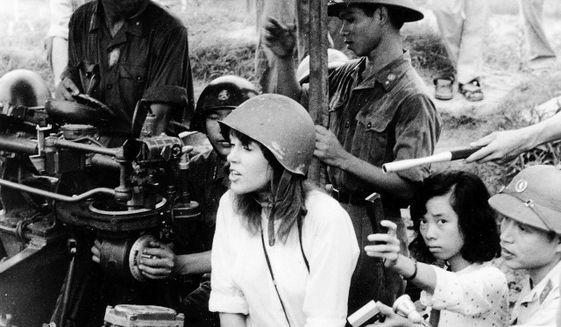
                     A recent post on Face Book reminded me that I still had not posted my review of "Hanoi Hilton".  The post was about Jane Fonda and her horrible treatment of prisoners of war when she visited Hanoi during the Vietnam War.  I am no fan of Jane Fonda.  My father flew an F-105 fighter-bomber in the war.  I lived in Japan for three years while he was doing this.  My father harbored a hatred for Hanoi Jane because of her support for the people he fought against.  He partially passed this on to me, but I never went to the extent of never watching a movie with her in it.  Still, seeing her sitting in the seat of an anti-aircraft gun whose purpose was to shoot down my dad is hard to forgive.  With that said, my extensive reading on the war tempers my view of her because the war was a mistake and I am not a blind patriot.  She certainly can be taken to task for her method of voicing her opinions.  The fact is that the post accused her of heinous actions that she did not commit.  There is a character in this movie that reenacts some of the calumnies.
   

                “Hanoi Hilton” is a prisoner of war movie about the infamous North Vietnamese prison.  It was directed by Lionel Chetwynd.  It came out the same year as “Full Metal Jacket”, “Good Morning, Vietnam”, and “Hamburger Hill” and got lost in the wake of those other films.  It was an example of the backlash against the cynical, anti-grunt films like “Platoon” and “Full Metal Jacket”.  All of the characters are fictional, but the movie purports to enlighten the audience about the mistreatment of American prisoners.  It covers the entire history of American internment at the Hoa Lo Prison.

                 The movie’s main character is a Lt. Williamson (Michael Moriarty) who gets shot down early in the war.  Before that, he is interviewed and proclaims that we are in Vietnam to help the South Vietnamese get their freedom.  The movie says nothing to contradict this belief.  When Williamson is captured, his co-pilot is shot in the head.  This movie is not going to show empathy for the North Vietnamese.  Williamson is taken to the Hanoi Hilton where he finds out that because there was no declaration of war, the Geneva Conventions do not apply.  He is a war criminal.  The first torture is a dry shave.  A variety is yet to come.  These include shock treatment, beatings, and sitting on a pile of bricks.  At one point a group of prisoners is marched through the streets of Hanoi and it becomes a gauntlet with civilians assaulting the Americans. 

                Williamson interacts with other prisoners who are all dealing with the dilemma of when and whether to answer the questions.  How much torture is enough to justify telling the torturers what they want to hear?  Unfortunately, some of the torture is to break the prisoners.  A guy is whipped for yelling when a rat crawls on him.  Another is killed because of an escape attempt.
Don't worry, Jane Fonda is coming to get us out
 

                The movie has two themes.  The captors are evil and manipulating the prisoners for propaganda purposes.  The commandant tells the prisoners that the media coverage of their confessions will help win the war.  The guards are hissable with the volume turned up to 11 with a Cuban interrogator who kills a Puerto Rican who refuses to betray the USA.  Equally loathsome are the liberal media.  A Jane Fonda type wants the men to apologize and ignores tales of mistreatment.  And don’t forget the home front stabbing the men in the back as they do their duty to their country.  At one point the guards pipe in coverage of hippies protesting.  A new prisoner tells the men that most Americans consider them to be fascists.

                “Hanoi Hilton” is the counterpoint to all those Vietnam War movies that cast aspersions on the American war effort and the men carrying it out.  Although from a different subgenre (POW film), it’s most close kindred soul is “Hamburger Hill”.  Hmmm, both have double H’s.  They both portray the Americans as simply doing their duty under difficult circumstances and being betrayed by the home front.  Having read extensively on the war, I can see both the hawkish viewpoint and the dove perspective.  There is a place for both among Vietnam War movies.  There is room for “Hamburger Hill” and “Platoon”.  Needless to say with Hollywood being what it is on the political spectrum, there are quite a few more movies that are cynical toward the war.  It is a shame when a movie like “Hanoi Hilton” botches the attempt to balance the scale.  It takes a worthy subject and bludgeons it.

                It is no wonder the movie got lost in the 1987 box office duel.  It looks second tier.  The cast is B-list and is not memorable.  Moriarty was not a good choice for the lead.  He is too tepid in a role that could have used some emoting.  In fact, one surprise of the movie is the lack of scene-chewing, but sometimes the opposite can be almost as bad.  For a movie about mistreatment of prisoners, the movie is curiously flat.  This may be because most of the torture is implied.  The movie is not graphic.  Weirdly, Williamson does not seem to be terribly mistreated in his eight years in the camp.  In other words, Moriarty was given no chance for an Oscar campaign.

                The biggest flaw is the ham-handed steamrolling of its themes.  The movie is too anti-anti-war.  Jane Fonda is a cheap target and pushes buttons with the intended audience, but why not be factual in her depiction.  In fact, the decision to have all fictional characters was a perplexing and poor one.  Throwing in the hippies and a detestable Cuban was overreaching.  A documentary style film about the prison would have been better.  As it is, one is left to question how accurate the movie is in depicting the treatment.  A neutral viewer could easily watch this poorly made movie and blow it off as conservative propaganda.

                How historically accurate is it?  The Williamson character was probably based on Lt. Edward Alvarez, Jr.  He was the first American taken prisoner and spent almost the entire war in the Hoa Lo Prison.  The North Vietnamese did not honor the Geneva Conventions with the excuse that the Americans were war criminals fighting an illegal war of aggression.  The torture included rope bindings, iron foot stocks, beatings, and solitary confinement.  The movie does show a variety of methods, but is not graphic enough.  The gauntlet scene was based on the infamous “Hanoi March” in which prisoners were paraded down a Hanoi street for newsreels, but the crowd got out of hand and attacked not only the Americans but the guards.  The goal of the jailers was not so much to get military information as to get the men to make statements that could be used for propaganda purposes.  The men developed a code of honor that basically said that you should take as much pain as you could before you were justified in talking.  Almost every prisoner eventually broke and signed statements.  Most of which wer e fabrications.  Executions, torture, injury, and diseases took the lives of 65 prisoners.  Most of the deaths came in the period before 1969.  It was in that year that the Nixon Administration reversed policy and began to condemn the mistreatment of prisoners.  After this, treatment improved.  As far as the Jane Fonda character, Jane did interview some prisoners, but did not encourage them to apologize.  (P.S. to those who have read and swallowed the post about her actions in Hanoi, she did not turn over to the guards notes passed to her by prisoners.)

                "Hanoi Hilton" is not in the upper tier of Vietnam War movies.  If you want some knowledge about the treatment of American POWs, it is not without merit.  However, it could have been a lot better.  It is too simplistically pro-America.


GRADE =  C

Tuesday, July 2, 2013

Coming Home (1978)


                 1978 was an interesting year for major motion pictures about the Vietnam War.  It was the first year that Hollywood felt that enough time had passed since the end of the war to make a commercially viable movie about it.  Holly wood jumped in feet first with “Coming Home” and “The Deer Hunter”.  Not only was a barrier broken, but a fierce competition ensued as the two vied for awards.  They also vied for the hearts of the public and critics.
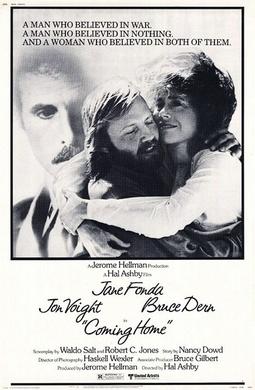
                “Coming Home” was loosely based on the book by George Davis and was influenced by Jane Fonda’s friendship with Ron Kovic (Born on the Fourth of July).  It was a difficult production as director Hal Ashby was something of a nutcase.  It also took several writers to pen the screenplay (which surprisingly won the Oscar for Best Original Screenplay). 
                The movie opens in the spring of 1968 at a Veteran’s Hospital.  Actual vets improvise dialogue as Jon Voight (playing paraplegic Luke Martin) wisely sits and listens.  The war movie trope of a love triangle develops early as we are introduced to the typical military couple.  Capt. Bob Hyde (Bruce Dern) is a careerist who is headed for Vietnam so he can earn a promotion and to “see the elephant”.  Sally (Fonda) is the dutiful wife who according to Bob “doesn’t understand it all, but she accepts it”.  They seem to be happily married and Bob promises to be faithful.
before and after
                Sally feels liberated once Bob is gone and rooms with a hippie type named Vi (Penelope Milford) whose brother Billy (Robert Carradine) is in the Vet Hospital due to PTSD after only two weeks in Nam.  It only took two weeks to ruin this American youth’s life.  War sucks!  Sally visits the hospital and literally bumps into Luke.  It turns out they went to the same high school and yet hardly remember each other.  This in spite of him being the star quarterback and her having been the head cheerleader!  Credit given for cliché-busting (and reality-defying).  They get off to a rocky start as he is abusively belligerent about the shoddy treatment at the hospital and sees her as naively clueless.  I wondered if they would hook up because this was the first movie I ever watched.  Just kidding.
                Sally gets a job at the hospital.  All of the veterans are saintly as a contrast to the evil government that sent them off to fight a misbegotten war and then treated them shabbily upon their return.  Sally becomes an advocate for them and warms up to Luke.  Bob deserves a cinematic chance so Sally meets him in Hong Kong.  Things are chilly.  He is upset that she is working.  He is disillusioned with the war.  “TV shows what it’s like, but not what it is.”  The movie green lights the affair with Luke.
thank goodness VA hospitals now treat
wounded vets appropriately
                Luke moves out of the hospital because how will he have sex with Sally otherwise.  Plus we now need the war protesting angle to kick in.  Sure enough, Luke chains himself to the local Marine Corps gate.  Next comes the big sex scene which was groundbreaking due to one character being a crippled vet.  Compare this to the movies older brother, “The Best Years of Our Lives”.  In that movie, Homer does not get past first base on film.  Sally has never felt this way before (and has apparently never been on top before).  She has been liberated.  We know this because she no longer wears a bra.
                If only Bob would get himself killed in Vietnam.  Unfortunately he returns home after accidentally (?) shooting himself while going to the shower.  He carries the extra baggage of PTSD.  Sally and Bob try to return to their 1950s marriage.  This is not likely since she has evolved and he is now a tightly wound Cro-magnon.  “What the Hell did you do to your hair?!” 
                When Bob finds out about the affair, he confronts Luke but discovers that although he can shoot himself, he can’t bring himself to shoot the hippie who was screwing his wife while he was off dodging bullets for his promotion (I mean country).  Bob leaves because he’s seen enough movies to know how this ends.  Dueling scenes:  Luke talks to a high school class and Bob gets a medal.  Luke tells the students that “[I’m] here to tell you that I have killed for my country or whatever, and I don’t feel good about it.”  (At the Academy Awards, John Wayne  punched Voight in the nose, just kidding.)  Bob is ashamed for his decoration as we all should be.
                The movie does have its strengths.  The period music is great.  Classic rock rules!  The acting is outstanding.  Fonda, Voight, Dern, and Milford were all nominated for Oscars.  Voight defeated De Niro (“The Deer Hunter”), but Dern lost to Christopher Walken.  This was the year to be physically crippled instead of just emotionally and to be fully psycho instead of just PTSD.  The movie was also nominated for Best Picture, Director, Film Editing and won for Original Screenplay.
                The themes are a bit heavy-handed.  The repressed military wife is emancipated when her traditional husband goes off to war.  The antiwar movement also liberates her.  A crippled antiwar vet awakens her sexuality.  War = bad.  Antiwar = good.  The plot is rife with clichés and quite predictable.  It is extremely obvious that the marriage will not survive Bob going off to war.  On the plus side, the Sally character does ring true as a typical military wife who lives through her husband and is rudderless when he goes off to war.  Her transformation is not radical and she is realistically torn between the two men when her husband returns.  However, there is never a doubt who she will choose.  Keep in mind that her husband has been changed for the worst because of his experience and Luke has mellowed as their relationship has developed, so you would have chosen the same way she did.  Jane Fonda does an excellent job in a role that meant a lot to her and she could easily have gone overboard in forcing her opinions on the audience.  The movie is fairly well constrained.
               Looking back, it seems incredible that it was a horse race between "Coming Home" and "The Deer Hunter" for Best Picture.  Today one of those movies is considered to be a war movie classic and the other is considered to be a curio.  What war movie fan has a copy of "Coming Home" on his shelf?  But then again, if I had told you that in 1978 there had been a competition between a movie that was clearly a liberal view of the war and a movie that concludes with the cast singing "God Bless America", which would you have bet on for the Oscar?
              Cracker?  No.  It's a decent movie, but has not worn well over the years and is certainly not one of the 100 Best War Movies ever made.  It is not even in the top 5 Vietnam War movies.
grade =  B-