Finally,
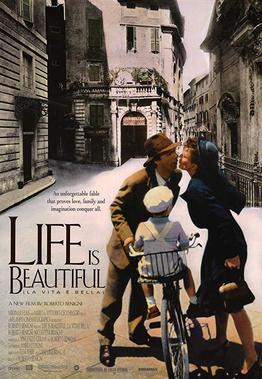
a Holocaust comedy after all those depressing dramas. “Life is Beautiful” is an Italian film that
was directed and co-written by Roberto Begnini.
He also starred in it. Begnini
loosely based the movie on the book In the End, I Beat Hitler by Rubino
Romeo Salmoni. He also was inspired by
his own father’s stories from WWII. He
was in the Italian army and switched sides when his country went over to the
Allies. Unfortunately, the elder Begnini
was captured by the Germans and put in a labor camp. He would tell his kids humorous stories to
distract them. The movie was a big hit
and critically acclaimed. It won the
Grand Prix at Cannes. It was nominated for six Academy Awards and won Oscars
for Best Foreign Language Film, Original Dramatic Score, and Actor. Begnini got the title from a phrase Leon
Trotsky wrote in his journal the day he was assassinated.
The
movie opens in Italy in 1939. Two guys
in a car without brakes barge into a gathering to greet the king. This establishes the movies low-brow humor. One of the clowns is Guido Orefice (Begnini)
who has come to town to get a job as a waiter in his uncle’s restaurant. He falls in love with his son’s elementary
school teacher. She is engaged to the
local rich asshole, so he is going to have to be creative. If pratfalls are your idea of creativity,
then he is the man for you. Spoiler
alert: the winning streak of charming
buffoons over wealthy jerks continues.
Years later, the Orefice family is living a beautiful life when lil’ ole
WWII comes along. Because Guido and his
son Giosue are Jewish, they are shipped to a concentration camp. Dora (Nicolletta Braschi – Roberto’s wife)
volunteers to join them. He does not
stop her! She is put in a different part
of the camp. Guido sends her messages
over the camp loudspeaker. He convinces
his son that the concentration camp is the elaborate setting for a game. If his son does everything he says, he will
earn points to win a tank. Shenanigans
ensue. I bet you never thought you would
hear the word “shenanigans” in a Holocaust movie review. It’s that kind of movie.
This
is a really hard movie to judge. I am
certainly not against black humor and it has its place in cinema. Obviously, it is unexpected in a Holocaust
movie. Perhaps the time was right for
it. God knows we have plenty of
Holocaust movies that are depressing.
But depressingly accurate in depicting the horrors of the camps. To his credit, Begnini took the approach that
the movie would be like a fairy tale. He
did not try to compete with the serious Holocaust films. The movie is best viewed as a fairy tale,
otherwise you might gag a bit.
Since
the movie is a dramedy, it is something of a roller coaster ride. Before it gets serious, the humor is
head-shaking. Is Begnini’s shtick the
current state of comedy in Italy? Since
the film is a vehicle for Begnini, your enjoyment is directly related to your
tolerance for his antics. He is the
Italian Robin Williams so factor that in when you decide whether to watch the
movie. To be honest, I am not a Williams
fan so I was not enamored with Begnini’s performance. In this respect, I disagree with the
Academy’s choice of him as Best Actor.
Amazingly, he was only the second actor to direct himself to a Best
Actor Oscar (the other was Laurence Olivier in “Hamlet”). Begnini beat out Tom Hanks in “Saving Private
Ryan” and Edward Norton for “American X”.
How in Hell did that happen? Did
Beatty/Dunaway read the envelope? I
found his brand of hilarity set in a Holocaust situation to be jarring. Plus, it just is not funny under any
circumstances. This is a problem for a
movie that is more comedy than drama. It
does not really show how bad the camp is.
Begnini pulls his punches in this respect or the movie would have been
even more whiplashing. But if you are in
for a centesimo, why not be in for a lira?
I suppose you would not make millions of lira if you took that bold
approach.
Will “Life is Beautiful” crack my Best War Movies
list? No, because it is my list and I
don’t care what the critics or the Academy Awards have to say. I also reserve the right to opine that
Roberto Begnini is not funny and this movie is a misfire. Is it too soon for a humorous Holocaust
movie? It will always be too soon.
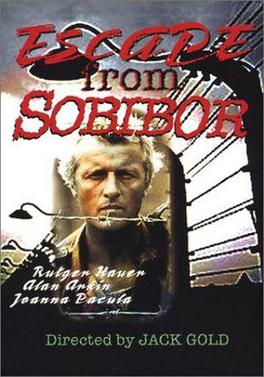
“Escape from Sobibor” was a
British made-for-TV movie that appeared in 1987.It was directed by Jack Gold and is based on
a nonfiction bookby Richard
Rashke.It is based on the most
successful escape from a concentration camp.A camp survivor named Thomas Blatt served as technical advisor.The camp was located in Poland and
approximately 250,000 Jews were murdered there.
The movie opens with three
inmates cutting through the wire and making a run through the mine field
surrounding the camp.A new train
arrives to waltz music. There is realistic chaos, but the Jews are in pretty
good shape and there is no evidence that any died on the trip.The “selection” occurs and most of the Jews
are taken to be “disinfected”.The
expendables march off waving bye to the lucky few who have skills
(seamstresses, tailors, etc.) or are adult men.A good scene and not overly emotional.
We are introduced to the main
characters.One of them is a new arrival
who is hiding a baby.Some of the other
women in the barracks are not thrilled about this.Another character is a man who is told what
actually happened to his wife and son when they went to the “showers”.Others get a similar revelation.
Life in the camp is tense.The woman’s baby is discovered and it does
not end well.I hope that Nazi bastard
gets his!During a work detail, thirteen
men escape but are soon caught.They are
ordered to select a partner to die with them or the guards will execute 50 at
random.Everyone is forced to
watch.It appears that escape attempts
have severe consequences at this camp.This causes the escape committee led by Leon Feldhendler (Alan Arkin) to
adjust the escape plan to include all600 inmates.
The seemingly impossible plan
gets juiced upon the arrival of some Soviet Jews in September, 1943.Many of them are prisoners of war.Their acknowledged leader is a charismatic
fellow named Aleksandr Pechersky (Rutger Hauer).He is called Sasha.Sasha is put in contact with Leon and agrees
to help with the escape.In fact, he
becomes the leader.His developing
relationship with a woman named Luka gives him an excuse to visit the Polish
Jews’ barracks for plotting purposes.The camp allows a shocking amount of socializing (which does allow for
character development and dialogue).It
is decided that the only hope for success is to kill the guards and exit
through the front gate.Home-made
weapons and reliable Jews are recruited to do the killing.
The big day arrives and there
are complications, naturally.Several of
the guards are lured into workshops on pretenses of measuring for boots and
clothing.The killings are appropriately
amateurish.Unfortunately, the scheme is
discovered before it reaches fruition and the alarm is sounded making the front
gate exit impossible.It’s every person
for himself at this point and after several moments of chaos, the leaders
determine that exit through the fence and across the mine field is the only
viable option.The randomness of death
is apparent as every step could be your last.This a powerful scene, if a bit cheesy.A postscript informs us that about 300 managed to make it into the
forest.
How accurate is the film?I have no major complaints with any of
it.The elements that seem most likely
Hollywoodized appear to be based on reality.My research confirmed that some of the Jews shipped to this camp did not
have a particularly nightmarish experience on the train.The disposal of most of the arriving Jews was
pretty standard procedure at any of the death camps.What the movie does not show and I found
interesting was Sobibor used exhaust fumes from a Soviet tank engine to do the
job in the gas chamber.It was the
policy of the camp to kill one inmate for every escapee although I could not
determine if they chose who would be murdered with them.Let us assume technical advisor Blatt vetted
this.
The main characters were real
people.Pechersky was an above average
Soviet soldier before his capture and he did have a strong personality.When he first arrived at the camp he got a
lot of cred for standing up to one of the more sadistic guards.He did have a relationship with a woman named
Luka, but claimed it was just platonic.She did not survive the minefield.Surprisingly, the camp had a reputation for allowing an amazing amount
of socializing. Feldhendler is
accurately depicted as the leader of the Polish Jews.The breakout is essentially as shown.Eleven S.S. guards were killed as well as an
unknown number of Ukrainian guards.They
did have to exit through the minefield with results as reenacted.
The film ends at the right moment
for entertainment purposes because what happened after was not very
positive.Pechersky led about fifty
survivors in the forest.He and the few
in the party who were also Soviet soldiers hatched a plan to sneak into the
local town to get food.They took most
of the groups’ weapons and then did not come back.Pechersky later claimed that it was every man
for himself.The movie conveniently does
not mention that the vast majority of the 300 were rounded up in the manhunt
and were executed along with all the inmates who did not get out of the camp.As a matter of fact, the camp was bulldozed
and trees were planted on the site after the incident.Many of the successful escapees died after
joining partisan groups.Only about 60
survived the war.Feldhendler hid in the
city of Lublin and ironically was murdered at the very end of the war.Pechersky survived the war, no surprise
there.
If we can just get through this fence, then cross the minefield, then get through the woods, then escape the man hunt, then survive the war ...
“Escape from Sobibor” is no
“Schindler’s List” but it is one of the better members of the Holocaust
subgenre.It deserves a substantial
amount of credit for covering a significant event that is not well known.Most Holocaust films depict the passivity of
the Jews.It is exhilarating to see them
shown fighting back.People need to know
that there was a successful escape (actually there were two).The movie does a service to history and the
strict adherence to what actually happened is an added bonus.
As entertainment goes, the film
is not great.This is mainly due to the
made-for-TV budget.The camp set is satisfactory,
but not memorable.The cinematography
and score are average.The strengths are
in the acting and characterizations.Hauer and Arkin are very good.Hauer won the Golden Globe for Supporting Actor.The cast is fine, if basically B-List.You do care about the characters and there
are some poignant deaths.The S.S. are
appropriately heinous.The Jews are
courageous.
In conclusion, “Escape from
Sobibor” is a must see for anyone interested in the Holocaust.It covers a unique event that should be
better known.Film can sometimes play an
important role in bringing history to the masses.As much as I complain about cinema abusing
that power, it is fair to emphasize the times cinema gets things right.
BACK-STORY:“Schindler’s List” was released in 1993 and immediately took
a position among the great movies of any genre.It was produced and directed by Steven Spielberg.Modestly, he tried to convince Martin
Scorsese, Roman Polanski, and Billy Wilder to direct the pic, but for various
reasons they turned him down.Spielberg
refused to make any “blood money” for the film.The movie is based on the novel Schindler’s Ark by Thomas
Keneally.Keneally was inspired to write
the book by one of the Schindlerjuden (“Schlinder Jews”).The movie was shot on location in Krakow,
Poland.The scenes at Auschwitz used a
replica outside the camp because Spielberg was refused permission to film in the
camp.The film won numerous awards.It was awarded Oscars for Picture, Director,
Adapted Screenplay, Cinematography, Art Direction, Editing, and Original
Score.Liam Neeson was nominated for
Best Actor and Ralph Fiennes for Best Supporting Actor.It was the most expensive black and white
film made up to then (topping “The Longest Day”).It had been 33 years since a black and white
movie had won Best Picture (“The Apartment”).It is #8 on AFIs latest list of greatest American motion pictures.
OPENING:The movie opens with words telling us that after the fall of
Poland, Jews were ordered to register and relocate to major cities.Krakow was one of those cities.Oskar Schindler (Neeson) strolls into the
film nattily dressed and exuding confidence.He goes to a night club and schmoozes some local Nazis.He is a playa and a free-spender.
SUMMARY:Schindler meets a Jewish accountant named Itzhak Stern (Ben
Kingsley).Schindler proposes a scheme
where wealthy Jewish men will invest in a factory making war supplies.Stern will run the firm and Schindler will
be the front man.He wants to make
money.At first Stern is repulsed by
Schindler and turns him down, but soon he has an unexplained change of heart
and the company is up and running.
Schindler is an amoral cad.He takes over the apartment of a wealthy
Jewish family and does not think twice about why it is available.He is also a grand womanizer.He and his wife have “an arrangement”.He is greedy and credits the war for his
success.He is very good at playing the
game.He bribes and flatters Nazi
officials for them to look the other way. Stern begins rounding up workers
from the Plaszow labor camp.Schindler
likes this because the workers are cheaper.The Nazis are outsourcing them.An awkward relationship develops between the two men and Schindler
rescues Stern from being deported to a death camp.He scolds Stern by telling him “what if I got
here five minutes later, then where would I
be.”
SS-Lieutenant Amon Goeth arrives
to take command of Plaszow.The movie
steps up to another level when Goeth agrees with the suggestion of a female
Jewish engineer and then immediately has her executed for making the
suggestion.This powerful scene warns
you to fasten your seat belt.Goeth is
going to be one of the most fascinatingly repulsive characters in any movie.This is hammered in by his balcony sniping of
Jewish inmates from his mansion overlooking the camp.
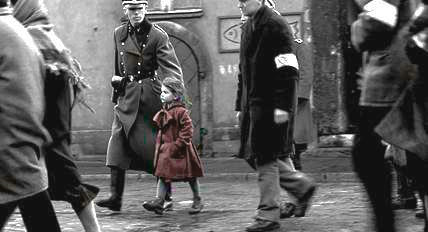
the little girl in the red coat
The next extended scene is the
famous clearing of the Krakow ghetto under Goeth’s supervision.The chaos, fear, and helplessness of the
Jewish families is powerfully depicted.There are many memorable small touches and several appalling visuals like
Jewish men being lined up in a row so one bullet can kill several at a time.Schindler witnesses this from a hill
overlooking the ghetto.His (and our)
attention is drawn to a little girl in a red coat who wanders through the
hellish environment.This departure from
the stark black and white cinematography is genius.The scene closes with the horrific blinking
buildings as the Nazi death squads locate and dispatch Jews who had hidden until after
dark. Pathetically, they thought they had safely weathered the storm.
Goeth having target practice
Schindler buddies up to Goeth
and gets him to allow Schindler to open a sub-camp at his factory .Schindler is in the process of changing from
viewing his workers as pawns to make profit to human beings worth saving.He takes particular interest in saving
Goeth’s Jewish housekeeper Helen (Embeth Davidtz) who lives under constant fear
of the mercurial Goeth’s moods.Schindler even manages to convince Goeth to use his power to forgive
rather than punish.Goeth tries saying
“I pardon you”, but it does not take.
Although the movie is not set in
a death camp, Spielberg manages to get in a scene with the selection
process. It's a depiction of naked Jews
having to jog in front of doctors.As
the “healthy” evidence the joy of surviving they are whiplashed by the singing
of the children who are being driven away in trucks.This is audience manipulation at its
best.It is a Spielberg movie, after
all.
At this point the transformation
(beatification?) is complete.Schindler
cons Goeth into spraying water on boxcars full of Jews waiting on the tracks to
go to Auschwitz. Goeth tellingly accuses
Schindler of being cruel.The other
Nazis find this act of humanity to be laughable.Schindler is now risking his life, but he
gets in trouble for something seemingly banal.He kisses a young Jewish woman at his birthday party.This is where the schmoozing comes in handy
as Schindler’s Nazi “buddies” bail him out.
When Schindler finds out the
whole camp is being sent to Auschwitz, he convinces Goeth (with the help of a
huge amount of money) to give him his workers.Thus is born the famous “list”.Each name on the list is going to cost him money, but Oskar prods Izhak
to add more and more.Schindler opens a
new plant in his home town in Czechoslovakia.He warns the Nazi guards to lay off the prisoners and insists on making
defective artillery shells.Transformation complete.Unfortunately, the train transporting the women gets routed to Auschwitz
in a seemingly contrived plot development that allows Spielberg to delve into
the horrors of a death camp.Mission
accomplished.The night arrival adds a
nightmarish and ominous aspect.This is
amped up when the women are sent to the “showers”.This could have resulted in the most horrific
scene in cinema history.
CLOSING:Thewar comes to
an end.Schindler makes a speech to the
guards shaming them into leaving without harming the Jews.Now the Jews are free and Schindler is on the
run as a potential war criminal.And
he’s broke.Stern and some of the others
collect whatever gold they can get their hands on and fashion a ring with a
Talmudic inscription:“Whosoever saves
one life saves the world entire.”Schindler gives a tearful going away speech
that laments not having done more.
In a slightly hokey post script,
the actors and the actual survivors they portray lay stones on the grave of
Schindler.It may be hokey, but it is an
excellent way to end the film and goes beyond the usual “this is what happened
to them” blurbs you sometimes see at the end of movies.It also lends credibility to the film.
RATINGS:
Acting – A+
Action -N/A
Accuracy -B
Realism -A
Plot -A
Overall -A
WOULD CHICKS DIG IT?Yes.It is not your
standard testosterone driven war movie.It
can be intense at times and certainly is emotionally draining.This is a warning to males and females.
HISTORICAL ACCURACY:This is a difficult movie to analyze for historical
accuracy.There is contradictory
evidence on many of the incidents in the film.However, based on my research, it appears that the movie is factually
accurate for the most part.Keneally is
a reputable author and his novel was well researched.He understandably labeled the book a novel
because he invented dialogue.This is
not particularly unusual in the field of historical fiction.Also, the Schlinderjuden have verified the
accuracy of the film.
Oskar Schindler’s personality
and modus vivendi are realistic.If
anything, he was a bigger cad than Neeson portrays him as.Emilie was certainly a forgiving wife.This was no one woman man.Neeson gets the charm right.What is downplayed a bit in the film is
Schindler’s voluntary involvement with the Nazis prior to Krakow.The movie leads you to believe he was a Nazi
just because it was good for business.This overlooks his more active role in the Abwehr (German intelligence) before arriving in
Krakow.
The role of Stern is apparently
close to the real Stern.The
“partnership” angle may be overplayed.There is evidence that the list was more the work of a Marcel Goldberg
and may not have had a lot of input from Schindler.Goldberg was a loathsome figure who accepted
bribes to get people on the list which resulted in people being removed from
the list.The Schindlerjuden did not
have fond memories of him and he would have made a poor character in this film.Some critics claim Schindler was in jail for
bribing Goeth at the time the list was compiled and that Stern was not working
for him any more at the time.I lean
toward Spielberg’s take on this issue.
Goeth is accurately
portrayed.The essentials are
there.He did snipe at inmates, but from
a hill (his house did not have line of sight to the camp).The evil "haunted mansion on the hill" was
justified in the film.When Goeth was
executed after the war for war crimes, it was specifically for killing over 500
Jews personally.It could be argued that
the real Goeth was more evil and without any redeeming qualities.It is highly unlikely that Schindler was able
to even temporarily humanize him.As far
as his creepy relationship with his Jewish housekeeper Helen, she appears to be
a fictional character.
The depiction of the massacre in
the Krakow ghetto is realistic.There
even was a little girl in a red coat although the movie does not try to be
accurate on her.She survived.Living conditions in the camp are well
done.The scene in Auschwitz gives a
good idea of what that camp must have been like.
The time line is admirably
correct.The movie does not take events
out of sequence.There is a simplifying
of how quickly his first plant went from having a few Jewish workers to all
Jewish workers, but this is cinematically excusable.
With regard to the anecdotal
events in the film, they are a mixed lot.Several are obviously fictional:Schindler rescuing Stern from deportation, Schindler witnessing the ghetto
evacuation from a hill, the Jewish engineer execution.The kissing of the Jewess at the birthday
party is true, however.
The most problematical scene is
the women being shipped to Auschwitz.It
appears to be added to the film for emotional manipulation.It is based on an incident at the same time
of some women being rerouted to a camp called Gross-Rosen.A name that doesn’t quite have the impact of
Auschwitz, does it?As to the women
being shoved into what appears to be a gas chamber, that is almost surely bull
shit.Highly effective bull shit.
Interestingly, the movie does
not go far enough in the redemption area.Schindler’s progression to sainthood may seem Hollywoodized, but it
leaves out all the efforts he made for his workers beyond giving them the security
of employment.He spent his own money
providing them food, clothing, and medical care.The movie underplays his encouragement of
their religious rituals which included Jewish burial rites.Most significantly, the screenwriter chose to
leave out an incident where Schindler accepted shipment of two boxcars of
literally frozen Jews and personally aided their recovery.One less justifiable omission is the role
that Emilie played at the second plant.She achieved sainthood herself by cooking for the workers (who got 2,000
calories as opposed to the usual 900) and caring for the sick.The movie gives her nothing to do except
stoically support her philandering husband.
Speaking of Hollywoodizing, the
closing pushes the limits of realism.Not surprising for a Spielberg film.The bit about the ring (as someone sniffed, you can’t melt gold the way
they did) and the final speech are on the cheesy side.It might have been a good idea to tack on the
actual survivor scene to leave that as the last image.
CRITIQUE:Is it possible to make a film about the Holocaust that shows
its horrors and yet is inspirational and has a happy ending?This would seem undoable without hitting a
hornet’s nest worth of derision.Amazingly, Spielberg has pulled it off.The achievement is awe-inspiring. This is especially impressive because
Spielberg stepped out of his comfort zone to make a movie that was not aimed at
14 year old boys.It is really his first
adult movie and he deserved to be rewarded for it.
The movie is technically top
notch.The choice to go black and white
was a daring gamble that pays off big time.It is now hard to imagine the movie in color.The cinematography was an easy choice for the
Oscar.The lighting enhances the
lensing.The look of the film is not
ostentatious, however.You do not marvel
at what you are seeing, you just register its proficiency.John Williams (who at first thought he was
not up to the seriousness of the film) is nicely understated and does not push
emotional buttons like you hear in many epic movies (including some of
Spielberg’s more recent films).His
Oscar was deserved.It was his last
victory.
The acting is fantastic.Neeson gives his best performance.He nails the complex personality of
Schindler.Schindler’s redemption arc
must not have been easy to play.The
character is refreshingly multi-dimensional .Neeson even handles the final speech without marring the rest of his
restrained work.Ralph Fiennes matches
him.Fiennes gained almost thirty pounds
by drinking a lot of beer to get ready for the role.He is the embodiment of malevolence.AFI placed Goeth at #15 on its list of Top 50
Villains (Goeth is the highest nonfiction character).Kingsley has a less flashy role, but his
portrayal of the wary and wily Stern is perfect.The supporting cast is solid.Special note goes to Embeth Davidtz as Helen
Hirsh who lives in constant fear of Goeth’s mood swings.The scene where he soliloquys to a petrified,
very vulnerable Helen and goes from positing that Jews are not subhuman vermin
to ruthlessly beating her is a strong scene with great acting.There are several scenes in the movie that
showcase the talents of the cast.
The plot is linear and
traditional.There are surprises within
the structure, but the general flow is toward your typical Spielberg positive
ending.Thankfully, the ending is
relatively true so it does not come off as contrived.Although there is no evidence for it, you
would think Spielberg looked hard for a Holocaust script that had a happy
ending.Those are pretty rare.(“Escape from Sobibor” had already been
filmed.)The themes are fairly
clear.Obviously redemption is one of
them.Some others are that evil exists
and can’t be cured.One man can make a
difference is another.Lastly, the movie
emphasizes the role of conscience in human behavior.Goeth’s lack of conscience makes him, not
Helen, subhuman.The film is
thought-provoking.You can’t watch the
movie without wondering what you would have done in the situations presented in
it.
CONCLUSION:“Schindler’s List” is the best Holocaust movie.You can argue that it is not relentlessly
bleak enough to truly replicate the horror, but that would have defeated the
purpose of reaching a mass audience.As
a high school teacher I have no problem with this compromise.The movie has enough horror to teach fools
that the Holocaust was horrific.There
is nothing wrong with having positive role models in a Holocaust film. Once again (I feel like a broken record), if you consider "Schindler's List" to be a war movie it is clearly underrated at #31. However, I have to admit that when I think of war movies, I do not think of this movie.
POSTER: Simple, effective, but inaccurate. grade = C
the trailer
TRAILER: The movie has no color and the trailer has no dialogue. The trailer is unclear what the movie is about (it looks like a concentartion camp movie), but it is intriguing. grade = A