I am working my way through
movies that could potentially make the field for my Best WWI Combat Movie
Tournament. It was suggested that I
consider the French film “A Very Long Engagement”. It has been sitting in my queue for some
time, but I have not been motivated to see it because of my impression that it
was not really a war movie. Let’s see.
The movie was released in 2004
and got some critical recognition. It
was nominated for Academy Awards for Art Direction and Cinematography. The movie was directed and co-written by
Jean-Pierre Jeunet and is based on a novel by Sebastien Japrisot. The movie is very French, but does include
Jodie Foster in the cast.
The movie opens with a shot of a
damaged crucifix in no man’s land.
Subtle. It is Jan. 6, 1917 and a
group of five condemned poilu are being led to their place of execution. We get a little back-story on each and a
flashback to their offense. It turns out
they all were court-martialed for self-inflicted wounds. Specifically, a bullet through the hand. The last is the twenty year-old Manech who is
suffering from shell shock. His method
was holding up a lit cigarette at night to attract the attention of a German
sniper. The creative punishment is for
the five to be shoved into no man’s land so the Germans can finish them
off. The movie then jumps two years to
his fiancé Mathilde (Audrey Tautou) who is pining for him in the picturesque
French countryside. She refuses to
believe he is dead and hires a detective to search for him. She gets involved too. Interviewing friends and family of the
ill-fated quintet allows for some fleshing out of the characters. This includes the Manach/Mathilde
romance. The film is very non-linear. There is a mysterious subplot involving a
prostitute named Tina Lombardi (Marion Cotillard) who is assassinating some of
the officers involved in the incident.
Another subplot has the wife (Jodie Foster) of one of the condemned trying
to get pregnant as per her impotent husband’s request. She has a brief affair with Biscotte’s best
friend Bastoche. Bastoche is the one who
accidentally shot himself in the hand while trying to kill a rat. There is something of an “Odyssey” feel to
the characters and tales. There is also
a mystery to be solved as apparently the punishment did not go as smoothly as
the villainous court-martial board had hoped.
Could some of the five have lived?
It would be amazing if they did.
But this is a movie, after all.
is it a war movie? well ...
“A Very Long Engagement” is an
interesting movie. Is it a war
movie? I would describe it as a
romance/mystery/war movie. Most of the
movie is set after or before the war.
There is not that much on the soldiers in the war. The combat is brief and there is little
soldier life. The movie does indict
French military justice, but it does not hammer that theme. Although four of the five self-mutilations
are related to the horrors of the fighting, the plot does not spend a lot of
time making us understand why the men were driven to this. You won’t get a feel for why the French army
mutinied from this movie. But the
punishment was really a plot device to set up the parted lovers template.
That plot needed a lot of
manipulation and disbelief suspension.
Since the movie was not really meant to be a traditional war movie, I
was able to overlook some of the outrageous plot developments. I think Jeunet meant for the film to be
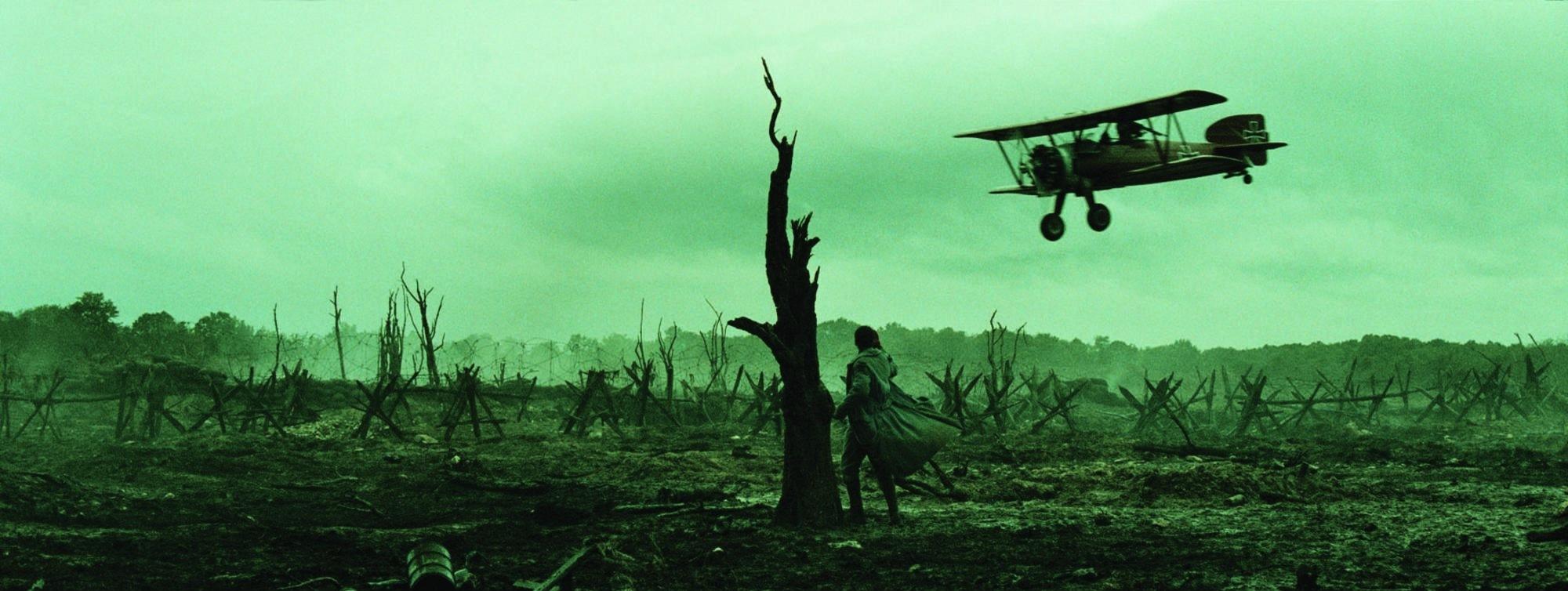
surreal in spots. For example, Bastoche
knocks down a German plane with a grenade.
More egregious is a regrettable scene that crosses the line by having a
hospital set up in a barrage balloon hanger with explosive results. I love massive fiery explosions as much as
the next guy, but come on! Much of the
plot is implausible, but what the heck.
After the five hand wound opening, you know what you are in for.
Damn, that plane is flying so low a person could knock it down with a grenade!
Once I got over the fact that
the movie was untraditional, I was able to enjoy the ride. The acting is excellent with Tautou perfect
as the spunky Mathilde. She is lame from
polio and plays a tuba. She is not the
only eccentric character. The detective
Pire (Ticky Holgado) brings a lot of fun in his search. Tina Lombardi is a bizarre, but mesmerizing
figure. Jodie Foster’s Elodie is more
than stunt casting, she’s a key to the mystery.
Speaking of eccentricities, the cinematography is the most memorable
thing about the movie. Bruno Delbonnel
has some pizazz to his craft. The movie
has some awesome visuals. He likes to
have double images appearing together.
One is the present and the other a flashback. To add spice, the flashbacks sometimes differ
from the original flashback, which is the way memory sometimes works. These baubles tend to overshadow some of the
film’s flaws. I need to see the movie
again to figure out what was up with that coded letter, for instance. I also am unclear why their commanding
officer tore up the pardons.
Pairing romance and war has not
been particularly successful for war movie fanatics like myself. This movie is an exception. It is not that it provided enough action and
violence. The film is definitely
balanced for both sexes. It really is
more geared towards the female audience, but guys won’t sigh throughout. That does not mean I did not shake my head a
few times. But it is what it is and
that’s not bad if you go in knowing that.
BACK-STORY:“The Dirty Dozen” created the
template for an entire genre of motley crew, suicide mission movies.It’s influence has been substantial.The movie was released in 1967 and was part
of the wave of more realistically gritty war movies like “Patton”.Director Robert Aldrich adapted it from the
bestselling novel by E.M. Nathanson, but made substantial changes.The film was made in England and took seven
months to complete.Production included
the construction of a chateau that was 240 ft wide and 50 ft high, surrounded
with 5,400 sq. yds. of heather, 400 ferns, 450 shrubs, 30 spruce trees and 6
weeping willows.It turned out to be so
substantially built that it could not be easily blown up so they had to
construct a flimsier section for the climactic scene.
The
cast was all-starish.The studio wanted
John Wayne for the Reisman role,but
Aldrich wisely insisted on Marvin (Wayne made “The Green Berets” instead).Jim Brown was still playing football, but
when the owner of the Browns gave him an ultimatum – football or moviemaking –
he announced his premature retirement.A
huge mistake admitted by the owner later.Trini Lopez was cast because he was a hot pop singer at that time
(“Lemon Tree”).When he decided his
singing career was more important than the completion of the movie, his
character suffers a premature death.The
dozen actors were supposed to be divided between the stars and the “who the
hell is that” group (known as the Back Six).However, one of the Back Six broke out to become a rising star.When Clint Walker refused to do the
impersonating the general scene, the unknown Donald Sutherland was tabbed and
parleyed it into higher billing and a role in a little film called “MASH”.Many of the cast were WWII veterans:Marvin (Marines – wounded on Saipan), Savalas
(Army), Bronson (Army), Borgnine (Navy), and Walker (Merchant Marine).
The
movie was a huge hit with audiences and with some critics.It was nominated for four Oscars;Best Supporting Actor (John Cassavetes),
Editing, Sound, and Sound Effects (won).
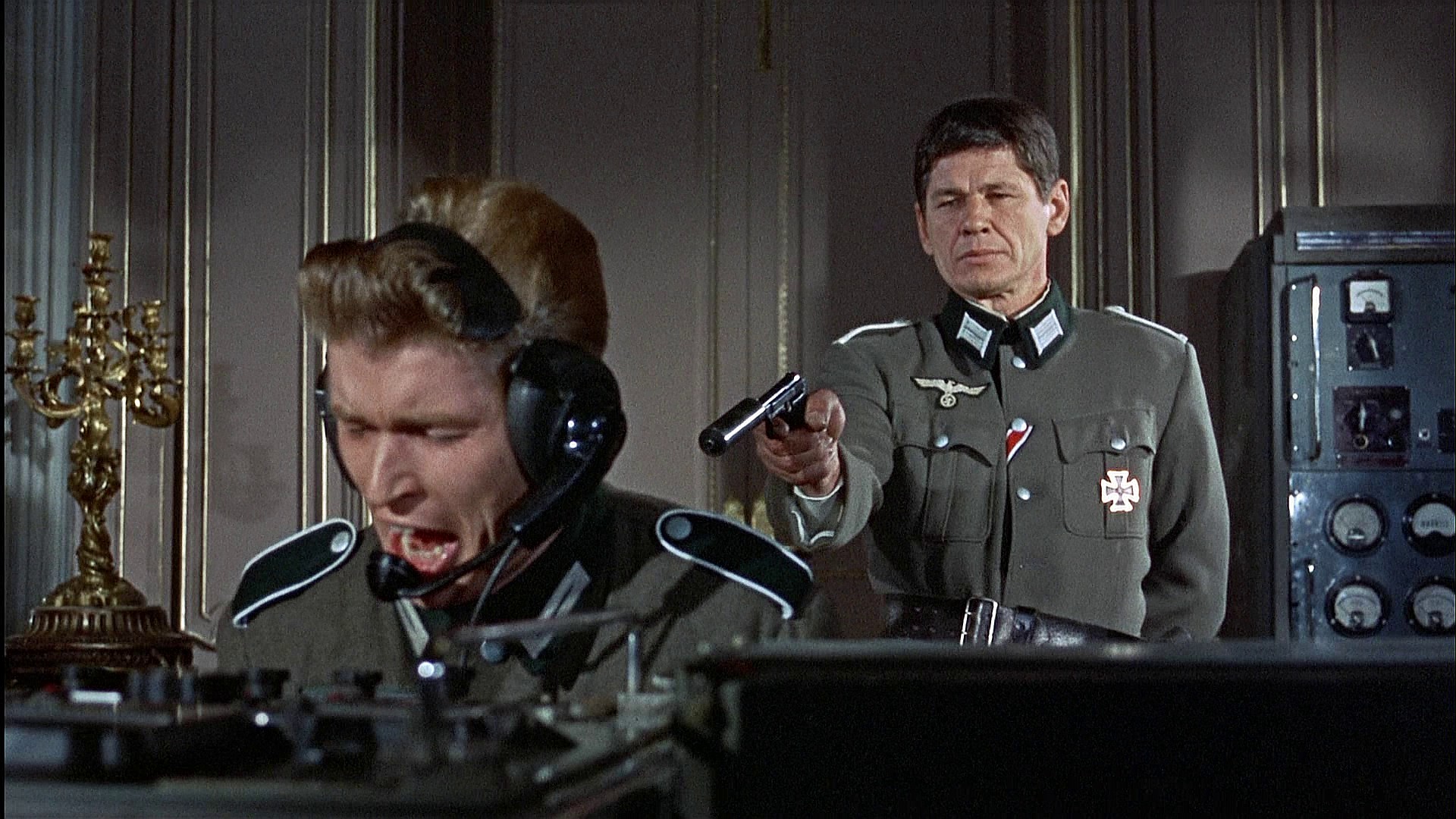
OPENING:Major Reisman (Lee Marvin) is
treated to a military execution.The
prisoner was condemned by a court-martial and is hanged.The scene is short, but impactful.This will not be an old-school WWII movie.
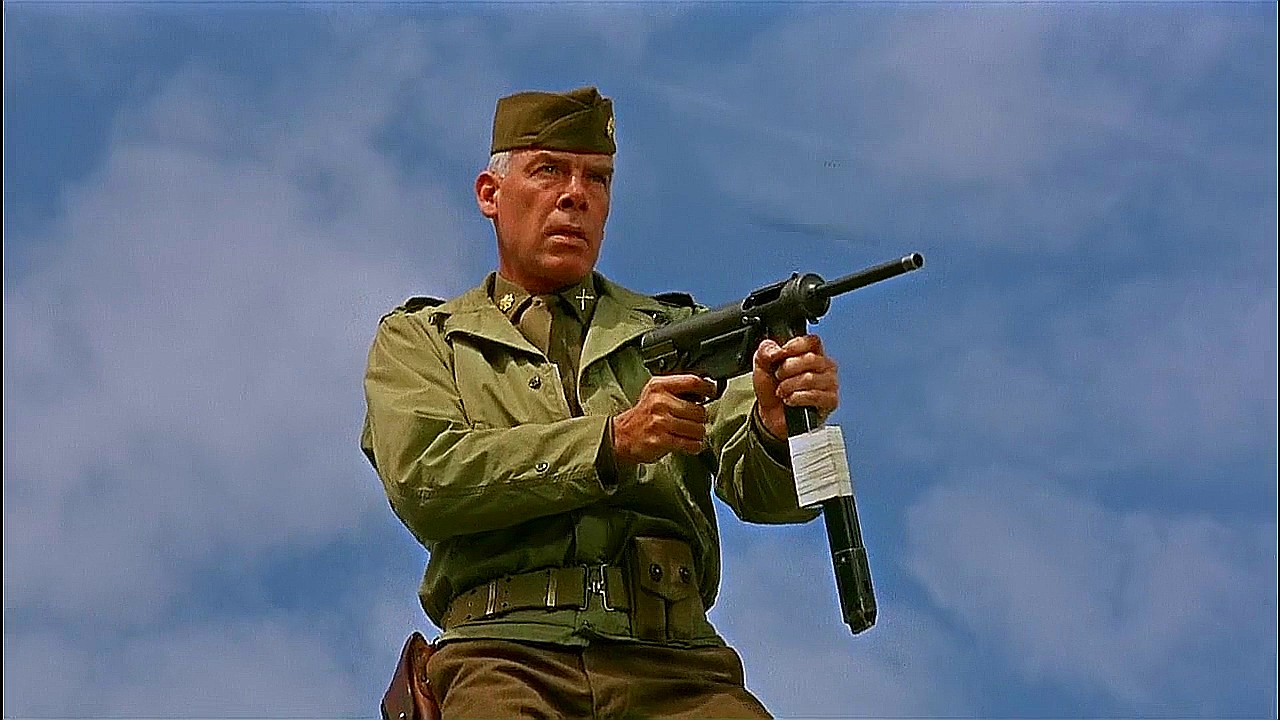
Reisman armed with the "official weapon of the Dirty Dozen"
SUMMARY:Reisman is called to a meeting
with Gen. Worden (Ernest Borgnine).It
is established that Reisman is a loose cannon, insubordinate, wise-ass.Perfect role model for the anti-authority,
anti-establishment Sixties’ generation.He is “volunteered” for Operation Amnesty.It’s a mission designed by a “lunatic” that
involves taking a dozen convicts on a suicide mission to kill as many German
staff officers as possible in a French chateau.Military intelligence, as they say.Piece of cake.
Reisman
goes to meet the twelve in their cells.We get a little background on some.They are a heterogeneous group, of course.Franko (John Cassavetes) is a malcontent
petty hood.Wladislaw (Charles Bronson)
is a stoical Pole.Jefferson (Brown) is
an uppity black.Posey (Clint Walker) is
a hillbilly who doesn’t like to be pushed.Maggot (Telly Savalas) is a psychopathic, Bible-thumping, woman-hater.(Just like the U.S. Army as depicted in some
Vietnam War movies.)Reisman explains
the deal.If you live, you get a
commutation.If anyone screws up in training,
everyone goes back to jail.
They
build a compound in the countryside as a bonding exercise.Please overlook the fact that getting this
group of individualistic, rule-breakers to construct buildings with no
discernible skill is quite unrealistic. The construction does allow for some
slapstick-type humor which gives Sutherland a chance to emerge.Next comes the training.Franko pockets some wire-cutters (there is a
shocking lack of tool security by the guards) and attempts to escape.He is stopped by Wladislaw and Jefferson in a
show of white/black teamwork.Later,
Franko leads a rebellion against their spartan conditions which unites the
dozen and results in revocation of grooming privileges.They are now the “dirty dozen”, get it?
A
visit to the parachute training school run by Reisman’s nemesis Col. Breed
(Robert Ryan) allows for more humor as Pinckley (Sutherland) impersonates a
general inspecting Breed’s troops.Pinckley:“Where are you from,
son?”Soldier:“Madison City, Missouri, sir.”Pinckley:“Never heard of it.”(Watch the
expression on the soldier’s face.Priceless).Breed sics two goons
wearing decidedly unmilitary hair cuts on Wladislaw in the latrine.He is rescued by Jefferson and Posey.Bonding accomplished.That’s all from parachute training school.
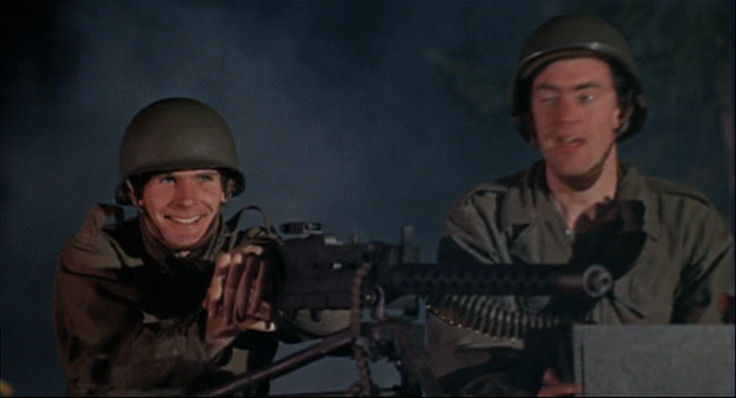
"Can you believe we're in this movie?"
Back
at camp, Trini Lopez sings a song about a “Bramble Bush” (apparently he was big
on songs about flora) because the audience demanded it.(See Ricky Nelson in “Rio Bravo”.)The song became a hit, by the way.Reisman brings in some hookers as a reward
for all their hard work at sublimating their bestial instincts.Hopefully eight women being shared by eleven
men fueled by alcohol (Maggot is wisely left on guard duty) won’t ruin six
weeks of character development.
Gen.
Worden agrees that the dozen will get the green light for their mission if they
can prove themselves at the upcoming war games.They have to seize Col. Breed’s headquarters.Spoiler alert:they cheat.They change arm bands to infiltrate enemy lines.They hijack an ambulance allowing Jefferson
to have one of the great lines in war movie history.When the ambulance driver complains about him
wearing the opposition’s arm band he deadpans:“That’s right – we’re traitors.”The capture of Breed is a highlight of the movie and brings the training
section to an exhilarating close.
Having
passed the test, it’s go time.At a last
supper set up to resemble the Da Vinci painting (and predating the MASH scene), the team goes over the mission.Maggot plays the part of Judas in a nifty bit of foreshadowing.Reisman has famously broken the plan into a
mnemonic device.Here is the entire list
for those of you who have not seen the movie twenty times.
1.Down to the road block, we've just
begun
2.The guards are through
3.The Major's men are on a spree
4.Major and Wladislaw go through the door
5.Pinkley stays out in the drive
6.The Major gives the rope a fix
7.Wladislaw throws the hook to heaven
8.Jimenez has got a date
9.The other guys go up the line
10.Sawyer and Lever are in the pen
11.Posey guards points five and seven
12.Wladislaw and the Major go down to delve
13.Franko goes up without being seen
14.Zero-hour - Jimenez cuts the cable, Franko cuts the phone
15.Franko goes in where the others have been
16.We all come out like it's Halloween
Wladislaw does some silencing
They
drop behind enemy lines and now there are eleven since Jimenez breaks his neck
in a lemon tree.Those who guessed that
they would all survive, sorry.That is
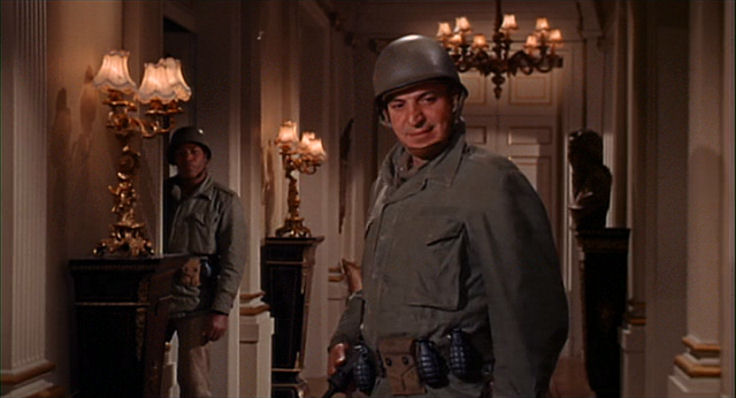
one impressive chateau.Reisman and
Wladislaw enter disguised as German officers.Meanwhile, the others hop to their tasks. Some of them are positioned
outside the chateau.Wouldn’t you think
that might be a good role for the clearly unstable Maggot?Instead, Reisman’s plan calls for him to
sneak into the upstairs where he proceeds to stab a strumpet and open fire on
Jefferson.What a Judas!Let the premature killing of Germans
begin.Or let the grease guns start
greasing.
A guy named Maggot loose in a Nazi brothel
Who
will survive among our intrepid psychopaths?We care, but not about how many of German women will be killed.The German officers and their gals have taken
refuge in the secure bunker leaving their lackeys to be grease gun fodder.They take some of the dozen with them,
especially the Back Six.Not specifying,
but here is the sequence:2.killed by German machine gun fire 3.killed by friendly fire4.blown up by his two grenades that created six explosions taking out the
chateau’s antenna5.killed by German sniper6.killed after slaughtering German reinforcements7.presumed dead with #6 (although
not shown – probably in his contract) 8
& 9.killed while foolishly thinking
they will make the sequel by escaping in a motor boat … 10.If you don’t know how Jefferson dies, you are
not a male between the ages of 50-70.And by the way, he didn’t make it this time either.Damn it! 11. killed while exalting over his survival.
The
climax involves some gasoline and hand grenades that turn the cozy bunker into
an inferno and provide the requisite Hollywood explosions.The survivors drive off into the night to
link up with the D-Day invasion forces.
CLOSING:The three survivors are in a hospital room awaiting their trial for war
crimes.Just kidding.We won the war, so any killing of civilians
was condoned.
RATINGS:
Acting =B
Action =8/10
Accuracy =N/A
Realism =D
Plot =A
Overall =B+
WOULD CHICKS DIG IT?Surprisingly, many did.I guess we would classify them as “bad
girls”.Seriously, the cast is very
manly.There is humor.The violence is not too bloody, although it
was pretty intense for the 1960s.The
language is pretty tame.It’s not really
a date movie.Guys will enjoy it, but
might regret exposing their girl to so much virileness.
HISTORICAL
ACCURACY:You’re joking,
right?Not according to author E.M.
Nathanson who claims he “heard" about the use of convicts for special missions.So much for research. Some judges and draft boards may have put petty criminals in uniform, but there is no record of condemned soldiers being given a second chance.Later, someone dug up the story of the
“Filthy Thirteen” to pacify people like me.The “Filthy Thirteen” was a pathfinder unit that did not like to do
things like salute officers, groom properly, or remain sober when not on a mission.Basically the WWII version of a Vietnam War
LRP unit.Sadly, they were not convicts
forced to go on suicide missions.Boring!
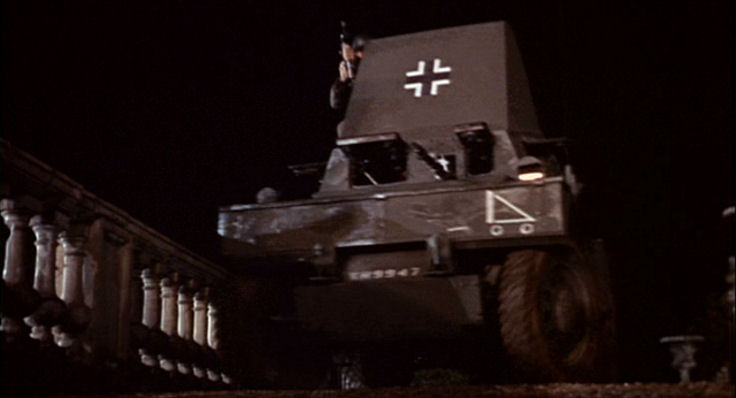
the Popemobile
There
are few inaccuracies that the audience could care less about.First, the Army did not hang any soldier
during the war.The only soldier
executed was Pvt. Eddie Slovik for desertion and that was by firing squad.Can’t really blame the movie for setting the
stage with that opening scene, however.We need to care that Maggot could get hung.Second, it seems that not every American
soldier was armed with a grease gun.Go
figure.They are so wicked looking.Didn’t we want to scare the Germans?By the way, anyone with any knowledge of WWII
weaponry can tell you that the grease gun was notoriously inaccurate.Not in the hands of these guys.Reisman is able to cut a rope inches below
one of his charges.Woe be it to any
German within its range.In the
commentary track that I listened to, Dale Dye nearly had a conniption over its
depiction.Third, they had to face a
German vehicle that looked like the Popemobile.Who designed that prop?It had
some eye holes that were vulnerable to the accurate fire of grease guns.
CRITIQUE:“The Dirty Dozen” has several
strong aspects to it.The acting is very
good.Marvin is the perfect
Reisman.He plays him with the right
amount of bravado and steely insubordination.The scene where he is briefed on the mission by Gen. Worden and his
lackey establishes him as an intriguing character. His wise-ass comments are cynically resonant.Reisman is very much a 1960s war movie
archetype.He reminds me of Steiner from
“Cross of Iron”.The rest of the name
actors are good.Savalas is very creepy
as Maggot.It shows his range that his
other famous role was Kojak.Bronson is
charismatic and likeable.Brown does a
remarkable job in his first major role.He does not look like an amateur.Richard Jaeckel gets a well-deserved turn as Reisman’s second in
command.Cassavettes steals the honors
with his characterization of Franko.You
can tell he is trying to steal the camera’s attention away from the
others.It is obvious he created his own
character beyond the script. He deserved the Academy Award nomination.
The
film is technically sound.The
cinematography is workmanlike, but not outside the box.There are no wow visuals in the film.The score is perfect for a macho film like
this.It is not pompous or overly
patriotic (although it does make use of some familiar martial music).It does not dominate any of the scenes and is
used to punctuate rather than pontificate.The sound effects are outstanding.I’m referring to the explosions, of course.
One
strange thing about the film is the lack of graphic bloodshed.The deaths are not “signal touchdown as you
twirl” style, but they are not splatteringly realistic either.Interestingly, “Bonnie and Clyde” came out
the same year.One of them was revolutionary
in depicting gunshot wounds.Similar to
this issue is the unsoldierly tame language.Regular Gis, let alone thugs like these, must have snickered at the
curses issuing from the dozens’ mouths.“Dirty” does not refer to their vocabulary.Some of their curses include:creeps, pig face, crumb, slob, bum.Apparently, “lovers” substituted for
“assholes”.This was the late sixties,
for gosh darn sakes! Take off the gloves.
As
far as the plot, you know going in that you will have to suspend
disbelief.Very little of what happens
has any foothold in reality.It was fun
to listen to Dale Dye’s commentary which takes the movie to task on numerous
issues.Basically, the movie would not
have been made if he had been the technical adviser.And yet, he is a big fan.The whole Maggot subplot is beyond
ridiculous, but fun.You could really
say that about the whole movie.In this
respect it does not differ from “The Guns of Navarone” and other movies of this
genre.And truly, it is less ridiculous
than its most recent descendant -“Inglorious Basterds”.
The
movie has the theme of military planners can sometimes be lunatics,but if you put an ass-kicking, rule-breaker
in charge the plan will be successful. Similar to "The Eagle Has Landed" in this respect.Another theme is even incorrigible criminals can be molded into a team
(if the choice is mold or be hanged).One theme that is not apparent is that war is Hell.This is the rare major war movie that is not
clearly anti-war.It basically glorifies
in the warrior ethos.Aldrich’s
statement that he wanted people “to know that war is hell” is a crock of crap.Most of the target audience did not leave the
theater detesting war.If they were
teary eyed, it was because of Jefferson’s failed run (reminiscent of Von
Ryan’s, by the way), not due to the slaughter of trapped German officers and their
paramours.That slaughter is a troubling
aspect of the film.The unit is not
conflicted about this task.In fact, the
best word for their facial expressions is gleeful.It’s a bit perplexing that few critics
focused on this war crime.To
paraphrase, if you win the war, there is no such thing as a war crime.(Ask the bombers of Dresden.)That usually refers to avoiding a trial, not
to depicting the “good guys” committing one with no consequences in a movie.
CONCLUSION:“The Dirty Dozen” is one of the
great guy movies in the war movie genre.It is required viewing for men of my generation.It created a template for numerous imitators
and some of them are superior to the original.I feel that “Kelly’s Heroes” and “Where Eagles Dare” are better and more
entertaining and yet neither made the Greatest 100.“The Dirty Dozen” obviously swayed the
nostalgic-minded panel.I’m not
interested in nostalgia.I am simply
judging the movies on how good they are.This one is good, but not great.
the trailer
TRAILER: The trailer is very good. It outlines the mission and identifies all the main characters. I especially like how they quote from the actor's as to how they interpreted their characters. A
the execution scene
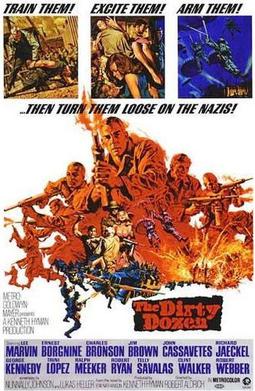
POSTER: The poster is very busy. I love the "Excite them!" part. Until I saw the poster I had no idea that the night with the prostitutes is what fueled their slaughter of the Germans. Those strumpets were actually quite patriotic. C
PRECURSOR? Check out my earlier review of "The Secret Invasion" and decide whether Altman should have been sued for plagiarism.