The History Channel has returned
to its roots when it was the Hitler Channel. It took Tom Hanks to convince the
bosses to carve out some time between programs like Pawn Stars and Ancient
Aliens. It will be 20 episodes and promises to be all encompassing. Here’s what
the first episode tells us about the series.
The first episode is entitled “The Beginning”.
It starts with a “graphic images” warning, but few people watching it will be traumatized
by what appeared in episode one. The series will undoubtedly show quite a few
dead bodies, but it will be more traumatizing to be reminded how bad some
humans can be to other humans. There is a good short introduction by Hanks and
he serves as the narrator for the series. (He narrates the great film at the WWII Museum in New Orleans.) For those not aware of it, the actor
has history cred. And not just because he has starred in some good to great WWII
movies. But he is not just an actor. He was very hands-on for “Band of Brothers”
and significantly did not take a role. I trust him.
Hanks is not one of the talking
heads. Those consist of mostly college professors, probably because they are
used to lecturing students, as opposed to historians whose main talent is
writing. (I bet the vetting of the experts included what percentage of their
students fall asleep in class.) Not surprisingly, the experts are not just
white males. Please don’t assume this makes the series “woke”. I did not notice
anything in the first episode that would indicate the series has a liberal agenda.
Unless you consider portraying both Hitler and Stalin as evil to be “woke”. (If
so, stop reading this and go f*** yourself.) There are some historians of note,
including Jon Meacham and Anthony Beevor. I have read extensively on the war
and taught it for decades, so I can vouch for the accuracy of what episode 1 covers.
There were only a few things I had never read about, so that’s a credit to it.
The episode begins oddly with the
invasion of Poland. I assume that was to get explosions in early to keep the
audience from leaving. Thankfully, after that taste, it flashes back to the Versailles
Conference and gives background leading to the invasion. However, it is just a
cursory look at events leading to the start of the war. In a series that has 20
episodes, I would think it would have allowed for a whole first episode dedicated
to how we got to Poland. The invasion of Poland should have been episode 2, but
you can’t have a whole first episode with no shots fired. Hitler gets some biographical
coverage, but there is no mention of the Reichstag Fire. The audience is left with
little understanding of how he came to power. Although I assume there will be
an episode on the Holocaust, the series does not wait for that to begin
coverage of the mistreatment of the Jews. The SS and the Einsatzgruppen are
introduced. And so are the NKVD as the series is not going to play nice with
Stalin. The Katyn massacre is mentioned. The episode concludes with the bombing
of Warsaw. Oddly, there is no mention of blitzkrieg. The series is not going to
be a treat for hard core military history buffs.
The obvious comparison would be to
the “World at War” series. Since that was my generations gold standard, “WWII
with Tom Hanks” clearly hopes to be the 21st Century equivalent. It
actually has more in common in format to Ken Burns’ Civil War and American
Revolution series. It compares well to them and benefits from the massive amount
of footage. Any topic the talking heads want to talk about has visuals to match.
Fans of “World at War” might find the colorized pictures jarring, but the History
Channel has prepared us for the colorization of the war. However, for this
series, the decision was made to use colorized photos, but not footage. And the
decision was made to forego the docudrama approach. I just finished watching
the excellent docudrama “Soviet Storm” about the Great Patriotic War and it is
superior to this series, if you want a heavy dose of strategy and tactics. For
your average viewer, the History Channel made the right decision on format.
I am happy to report that my fear of
it being pop history was unfounded. Although the very first expert is a
podcaster (Dan Carlin of Hardcore History, wearing a baseball cap), the series
does not try to sensationalize the war. It does skip boring stuff and
concentrate on the greatest hits. For instance, in the second episode, which
covers the invasion of France and the Battle of Britain, there is a long
segment on Dunkirk and little about Norway. Based on the
first three episodes, it appears the series will have problems with running out
of time to cover the episode’s topic and has no interest in carrying on in the
next episode. It just moves on to Operation Barbarossa in episode 3. Speaking
of which, that episode gets all the way to the Battle of Moscow.
Overall, I recommend the series and
I am looking forward to watching it. None of my red flags were confirmed. I was worried about the lack of maps, but there are seven in the first episode and they are animated. I can’t
be too hard on the History Channel because I don’t want to discourage it from airing
history. I do believe in redemption and I encourage the executives to try to get
into Heaven. Clearly they are concerned because this same week they are starting
a series on the Rise and Fall of the Roman Empire. You go months of nonstop
reality shows and then two history series in the same week?! I’ll take it. This
is what DVRs were made for.
“The Unknown Soldier” is
considered to be the greatest Finnish war movie.Directed by Aku Louhimies, it is the most
successful Finnish movie of the 21st Century and the most expensive
Finnish film ever.The movie is based on
a famous novel by Vaino Linna and it is the third version of the book.The production used over 3,000 extras, some
provided by the Finnish Defence Forces.The main actors were put through a boot camp to learn wilderness skills,
how to cross-country ski, and how to stay warm in the winter.
The movie covers a small unit of
Finnish soldiers in the Continuation War (1941-44).It opens with an intriguing scene.Two boys are swimming in a river and this
morphs into the same two being shot at as their unit retreats across the
river.One of them is killed.Their machine gun unit was originally
deployed in Eastern Finland in June, 1941.The government lies to them and proclaims that they are defending their
homeland from another (the Winter War had ended fifteen months earlier) attack
by the Soviet Army.Their first action
is in northern Karelia in July.They
attack and immediately go to ground due to Russian fire.Their captain arrives and leads a charge, but
is cut down.This will be the first of
many unpredictable deaths.The men respond
and capture the hill.The combat is
brief, but realistic.From here, the
movie settles into a pattern of rest and exposition followed by combat.In the quieter scenes, several characters are
developed typical of a small unit movie.There is the noble officer who grows into the job, the black marketeer
who is in it for the loot, the psychopath, the jokester, the innocent private,
etc.The main character is Corporal Rokka
(Eero Aho) who is a veteran of the Winter War.He has to leave his farm family to bring some experience to the unit. He is cynical and does not like
discipline.He also is a damned good
soldier who knows more than the officers.The movie follows these men as they campaign into the Soviet Union and
back again.Occasionally we are told
where they are so we know where the deaths occur.The movie fits squarely into the “who will
survive?” subgenre.You don’t have to be
a WWII nerd to figure their initial successes are going to turn around so we
can come full circle to that opening river crossing scene.
The Swedish members of my War
Movie Lovers Face Book group have been encouraging me to watch this movie for
some time.I didn’t need much convincing
since I am a big fan of foreign war films.I love Korean, Russian, and Japanese war movies, in particular.The only other Finnish war movie I had seen
was “Talvisota”.This is better.The acting is excellent, especially Aho.He created one of my favorite war movie
characters – Antti Rokka.If you like
Sgt. Steiner from “Cross of Iron”, you’ll like him too.When asked who he is, he responds: “I’m a
model for the gun industry.”He defies
authority (and gets away with it) more than most anti-heroes.He is the most distinct character, but the
others leave their mark as well.It’s an
ensemble effort.They portray the
soldiers realistically as only the higher officers are gung-ho.Their dialogue is not flowery and is a bit
terse as the movie does not have much banter.It focuses on the common soldiers and the effects of war on them.
The movie is firmly anti-war,
but not through graphic wounds and deaths.It’s hard core enough to get the point across, however.The combat is superior to most modern war
movies.It starts with brief scenes and gradually
the scenes get longer.Most of the
action occurs in forests and hand-held cameras put us with the men.We know most of the men are not going to
survive four years of it, but still the deaths are shocking in their
unpredictability.There is little on the
home front (although Rokka makes a couple of trips home to see his resilient
wife – a character that does not appear in the book) and the movie is not
interested in giving a big picture view of the war.The enemy is faceless and we get little on
command decisions.There is also nothing
about the German role.I would assume
the Finnish audience did not need these things.The movie is not big on strategy, but is strong on tactics.Their actions in combat ring true.They throw grenades and then charge, for
instance.They flank their enemy.The movie realistically depicts trench
warfare.
A non-Finnish viewer won’t learn
much about the war besides its effects on typical soldiers.What you will learn is the Finnish army was
not a typical army.One theme is the
army was not big on discipline.At one
point, they abandon a position against orders to hold at all costs. Rokka sums it up:“We ain’t here to die; we’re here to kill.”Another theme is while morale may seep away,
the men remain resilient.They sing a
lot.Although not propagandistic, the movie was
meant to honor the Finnish soldiers who fought in the war, but not mythologize
them. When outnumbered or outflanked, they run. There is little indication that they were
being used a pawns for their jingoistic and vengeance-minded government and by
their Nazi “allies”.
Don’t watch it as a history
lesson, although there was nothing I saw that was off-kilter.Watch it because it is very entertaining and
you’ll learn that Finland fought in WWII, albeit for the wrong side.And their soldiers may have been allied with
the Wehrmacht, but they were just regular Joosefs.
“Sands
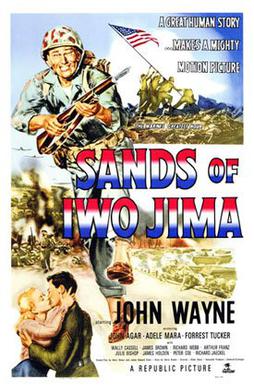
of Iwo Jima” is a John Wayne movie and he gives one of his best performances.He was nominated for Best Actor.Sgt. Stryker became his most iconic role and
he brings the full force of his charisma to it.The character is a bit more dimensional than his cowboy characters.He gets to play tough, empathetic, drunk,
morose, heroic.He is outstanding.The supporting cast is adequate and very old
schoolish.John Agar is the “I can’t
live up to my dead father who happened to be a mentor for Stryker” so I will
hate Stryker instead guy.Forest Tucker
is the Stryker foe.Throw in an
aggravating Italian Brooklynite for dubious comic relief.The actual war heroes inserted into the cast
can best be described as “not actors”.
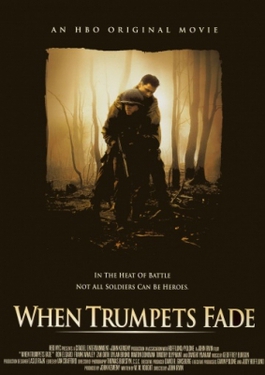
“When Trumpets Fade” is dominated by Ron Eldard as
the anti-hero David Manning.It is a
remarkable performance.The character is
far from stereotypical.He is a survivor
loaded with PTSD and a cynical anti-authority attitude who is thrust into an
authority position.Eldard plays him as
a guy who would have despised Stryker.The supporting cast is satisfactory.Martin Donovan is excellent as Capt. Pritchett.Zac Orth does good work as the "dead meat"
Sanderson.
FIRST QUARTER:
Sands of Iwo Jima8 When Trumpets Fade8
CLICHES:
“Sands of Iwo Jima” is not an iconoclastic movie.In fact, it helped set the template for war
movies until the 1960s.It begins with a dedication to
the Marine Corps (and is virtually a recruiting film).The unit is not as clearly defined as
heterogeneous as in many similar movies, but it is still a small unit
movie.You have a hero and a defined
mission (raising the flag).Conflict in
the unit (actually two – Stryker vs. Thomas, Stryker vs. Conway) is
resolved.You have the redemption in the
form of Conway who has daddy issues and is a reluctant warrior.You get rituals like a marriage and mail
call.
“When Trumpets Fade” was obviously made with
cliché-busting in mind.However, it is a
war movie so you do have some familiar elements.It has a dedication to the men who fought in
the Hurtgen Forest.There is a mission
(actually two), but reluctantly led by an anti-hero.You definitely have the leadership forced on
the main character trope, but the twist is that he fights against it and is
downright surly.Does Manning get
redemption?He would certainly have
sneered at that.There are no rituals
that I noticed.Kudos for reversing the
“fat guy with glasses must die” cliché.
HALFTIME SCORE: Sands of Iwo Jima14 When Trumpets Fade16 PLOT: “Sands of Iwo Jima” is your standard boot camp to
battle flic.Stryker inherits a motley
group of Marines and trains them in a tough love way for the realities of
battle.Meanwhile, conflicts within the
unit are developed so that combat can resolve them.There are two battle scenes.The first to establish heroism and the
realities of war (Tarawa).The second to show the
success of the unit evolution as it accomplishes a mission (Iwo Jima).The flow from training to off base to
training to combat is smooth and entertaining, if predictable.
“When Trumpets Fade” has an anti-hero thrust into
command of a squad of replacements.There is no training or bonding.Manning does not want to lead and does not care about his charges.The traditional early arc of a combat film is
dispensed with.The transitions are mainly
from Manning encountering authority to combat sequences.Similar to “Sands”, there are two main combat
scenes.Unlike “Sands”, these episodes
are basically the suicide mission variety.Both movies have the “who will survive?” vibe.
THIRD QUARTER: Sands of Iwo Jima 21 When Trumpets Fade25
COMBAT:
“Sands of Jima” has two big combat scenes- Tarawa and
Iwo Jima.In the first, Stryker takes
out a bunker in typical John Wayne fashion.Considering the potential inherent in the Battle of Tarawa, the movie is
surprisingly lacking in action.A
promised night banzai charge never materializes (WTF?) and only the first day of the
three day battle is shown.Big letdown.The Battle of Iwo Jima is more intense and
satisfying although it relies substantially on actual footage (but very well
used).The violence is very old school.There is little blood although we do get some
bullet wounds.Nothing women can’t
handle.However, men will probably cry
(you know what I’m talking about, guys).
“When Trumpets Fade” is from the VioLingo school
and intentionally pushes the envelope created by movies like “Sands”.It also has two major combat sequences.The first is the mission to take out the
artillery battery.Manning is forced to
shoot one of the replacements who has freaked out and is causing the rest to
panic.Sanderson uses a flamethrower to
roast the Germans.The second mission is
similar with the target being some emplaced tanks.This time grenades and Thompsons and Garands
are more de rigueur.The movie throws in
two larger group actions involving the graphic results of sustained artillery
fire. The wounds are graphic and bloody
and there are numerous delimbings.Plus
two losers of battles with flamethrowers.
FINAL SCORE: Sands of Iwo Jima27 When Trumpets Fade34
COLOR ANALYSIS: This was a great match-up between Old School and VioLingo. VioLingo is what I am trying out as my name for modern war movies that feature realistic violence and soldier talk and behavior. The two movies could not be more opposite. "Trumpets" is over the top in its "war is Hell" theme and "Sands" is one of the few war movies that is not definitively anti-war. It is almost like Stryker's death was written in because the director decided it was needed to soften the film's glamorization of war. Certainly, no one who watches "Trumpets" rushes out to join the Army, whereas many joined the Marines due to "Sands". Another fascinating match-up was that of hero Stryker vs. anti-hero Manning. The hero vs. anti-hero is a crucial difference between Old School and VioLingo. It will be interesting to see how future bouts between these schools will turn out. For example, "Guadalcanal Diary" against "Saving Private Ryan".
BACK-STORY:“The Dirty Dozen” created the
template for an entire genre of motley crew, suicide mission movies.It’s influence has been substantial.The movie was released in 1967 and was part
of the wave of more realistically gritty war movies like “Patton”.Director Robert Aldrich adapted it from the
bestselling novel by E.M. Nathanson, but made substantial changes.The film was made in England and took seven
months to complete.Production included
the construction of a chateau that was 240 ft wide and 50 ft high, surrounded
with 5,400 sq. yds. of heather, 400 ferns, 450 shrubs, 30 spruce trees and 6
weeping willows.It turned out to be so
substantially built that it could not be easily blown up so they had to
construct a flimsier section for the climactic scene.
The
cast was all-starish.The studio wanted
John Wayne for the Reisman role,but
Aldrich wisely insisted on Marvin (Wayne made “The Green Berets” instead).Jim Brown was still playing football, but
when the owner of the Browns gave him an ultimatum – football or moviemaking –
he announced his premature retirement.A
huge mistake admitted by the owner later.Trini Lopez was cast because he was a hot pop singer at that time
(“Lemon Tree”).When he decided his
singing career was more important than the completion of the movie, his
character suffers a premature death.The
dozen actors were supposed to be divided between the stars and the “who the
hell is that” group (known as the Back Six).However, one of the Back Six broke out to become a rising star.When Clint Walker refused to do the
impersonating the general scene, the unknown Donald Sutherland was tabbed and
parleyed it into higher billing and a role in a little film called “MASH”.Many of the cast were WWII veterans:Marvin (Marines – wounded on Saipan), Savalas
(Army), Bronson (Army), Borgnine (Navy), and Walker (Merchant Marine).
The
movie was a huge hit with audiences and with some critics.It was nominated for four Oscars;Best Supporting Actor (John Cassavetes),
Editing, Sound, and Sound Effects (won).
OPENING:Major Reisman (Lee Marvin) is
treated to a military execution.The
prisoner was condemned by a court-martial and is hanged.The scene is short, but impactful.This will not be an old-school WWII movie.
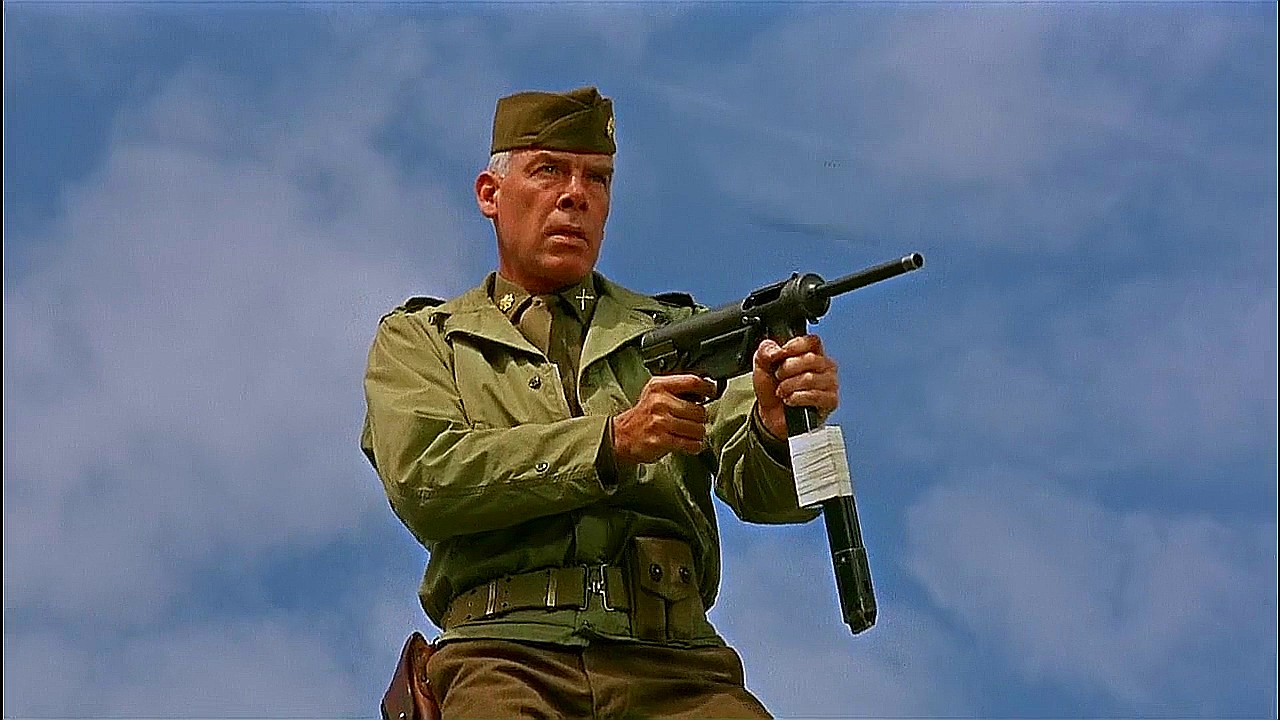
Reisman armed with the "official weapon of the Dirty Dozen"
SUMMARY:Reisman is called to a meeting
with Gen. Worden (Ernest Borgnine).It
is established that Reisman is a loose cannon, insubordinate, wise-ass.Perfect role model for the anti-authority,
anti-establishment Sixties’ generation.He is “volunteered” for Operation Amnesty.It’s a mission designed by a “lunatic” that
involves taking a dozen convicts on a suicide mission to kill as many German
staff officers as possible in a French chateau.Military intelligence, as they say.Piece of cake.
Reisman
goes to meet the twelve in their cells.We get a little background on some.They are a heterogeneous group, of course.Franko (John Cassavetes) is a malcontent
petty hood.Wladislaw (Charles Bronson)
is a stoical Pole.Jefferson (Brown) is
an uppity black.Posey (Clint Walker) is
a hillbilly who doesn’t like to be pushed.Maggot (Telly Savalas) is a psychopathic, Bible-thumping, woman-hater.(Just like the U.S. Army as depicted in some
Vietnam War movies.)Reisman explains
the deal.If you live, you get a
commutation.If anyone screws up in training,
everyone goes back to jail.
They
build a compound in the countryside as a bonding exercise.Please overlook the fact that getting this
group of individualistic, rule-breakers to construct buildings with no
discernible skill is quite unrealistic. The construction does allow for some
slapstick-type humor which gives Sutherland a chance to emerge.Next comes the training.Franko pockets some wire-cutters (there is a
shocking lack of tool security by the guards) and attempts to escape.He is stopped by Wladislaw and Jefferson in a
show of white/black teamwork.Later,
Franko leads a rebellion against their spartan conditions which unites the
dozen and results in revocation of grooming privileges.They are now the “dirty dozen”, get it?
A
visit to the parachute training school run by Reisman’s nemesis Col. Breed
(Robert Ryan) allows for more humor as Pinckley (Sutherland) impersonates a
general inspecting Breed’s troops.Pinckley:“Where are you from,
son?”Soldier:“Madison City, Missouri, sir.”Pinckley:“Never heard of it.”(Watch the
expression on the soldier’s face.Priceless).Breed sics two goons
wearing decidedly unmilitary hair cuts on Wladislaw in the latrine.He is rescued by Jefferson and Posey.Bonding accomplished.That’s all from parachute training school.
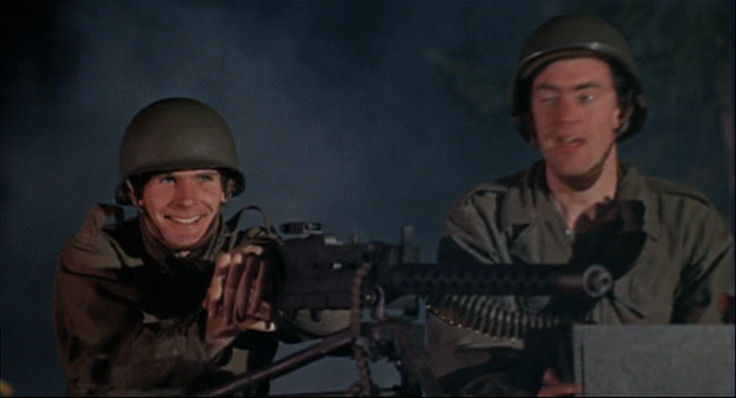
"Can you believe we're in this movie?"
Back
at camp, Trini Lopez sings a song about a “Bramble Bush” (apparently he was big
on songs about flora) because the audience demanded it.(See Ricky Nelson in “Rio Bravo”.)The song became a hit, by the way.Reisman brings in some hookers as a reward
for all their hard work at sublimating their bestial instincts.Hopefully eight women being shared by eleven
men fueled by alcohol (Maggot is wisely left on guard duty) won’t ruin six
weeks of character development.
Gen.
Worden agrees that the dozen will get the green light for their mission if they
can prove themselves at the upcoming war games.They have to seize Col. Breed’s headquarters.Spoiler alert:they cheat.They change arm bands to infiltrate enemy lines.They hijack an ambulance allowing Jefferson
to have one of the great lines in war movie history.When the ambulance driver complains about him
wearing the opposition’s arm band he deadpans:“That’s right – we’re traitors.”The capture of Breed is a highlight of the movie and brings the training
section to an exhilarating close.
Having
passed the test, it’s go time.At a last
supper set up to resemble the Da Vinci painting (and predating the MASH scene), the team goes over the mission.Maggot plays the part of Judas in a nifty bit of foreshadowing.Reisman has famously broken the plan into a
mnemonic device.Here is the entire list
for those of you who have not seen the movie twenty times.
1.Down to the road block, we've just
begun
2.The guards are through
3.The Major's men are on a spree
4.Major and Wladislaw go through the door
5.Pinkley stays out in the drive
6.The Major gives the rope a fix
7.Wladislaw throws the hook to heaven
8.Jimenez has got a date
9.The other guys go up the line
10.Sawyer and Lever are in the pen
11.Posey guards points five and seven
12.Wladislaw and the Major go down to delve
13.Franko goes up without being seen
14.Zero-hour - Jimenez cuts the cable, Franko cuts the phone
15.Franko goes in where the others have been
16.We all come out like it's Halloween
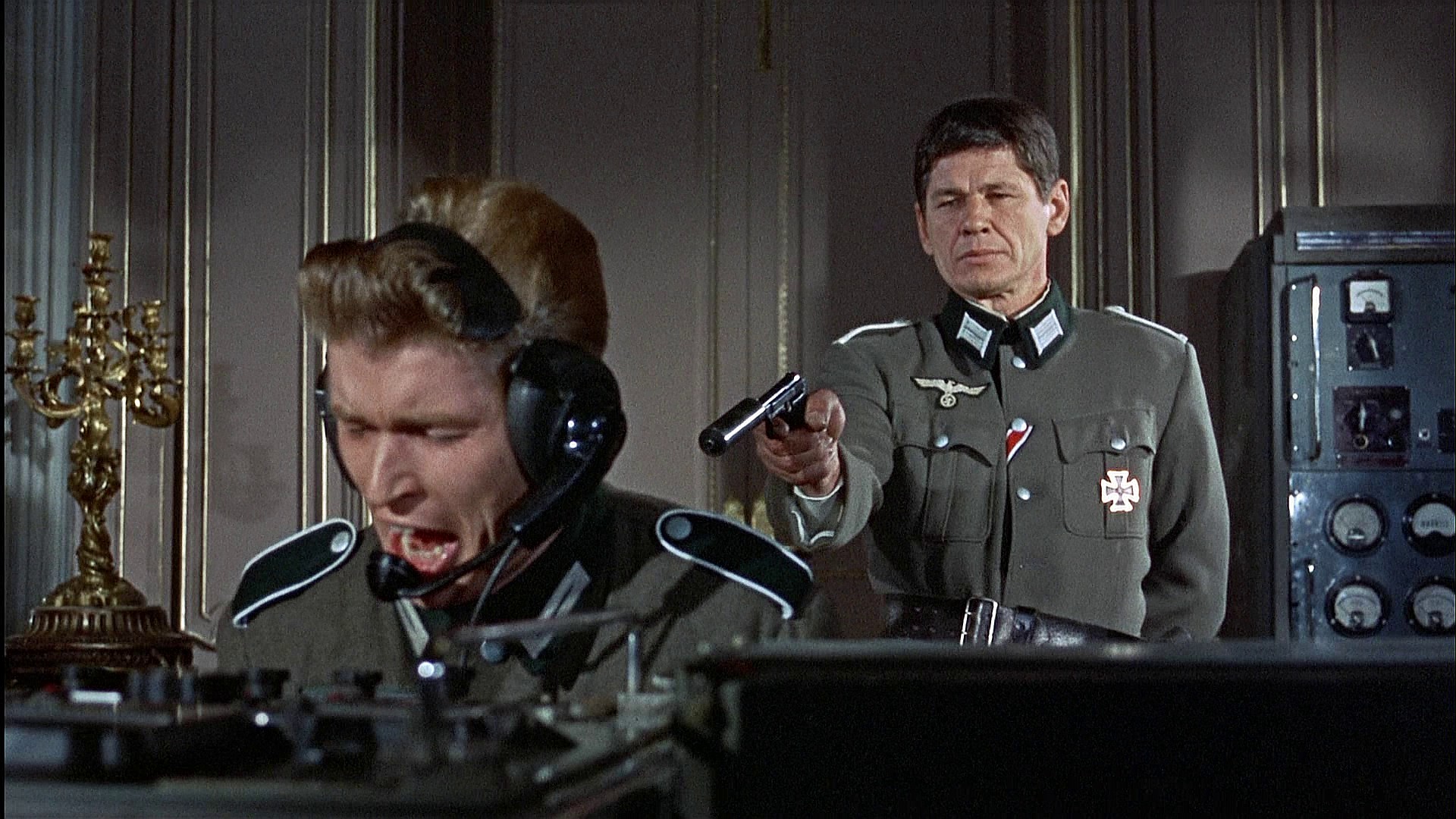
Wladislaw does some silencing
They
drop behind enemy lines and now there are eleven since Jimenez breaks his neck
in a lemon tree.Those who guessed that
they would all survive, sorry.That is
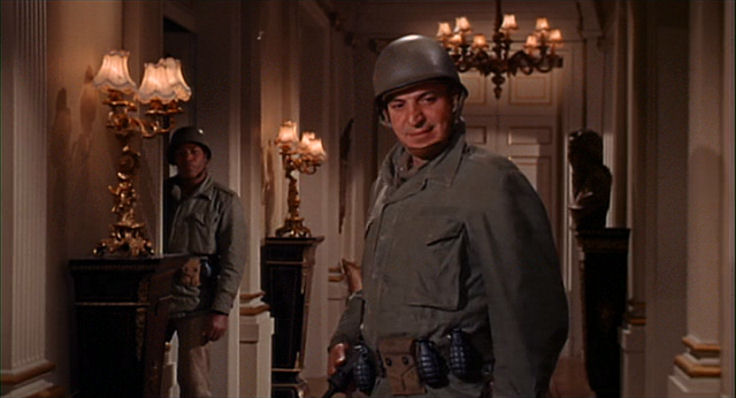
one impressive chateau.Reisman and
Wladislaw enter disguised as German officers.Meanwhile, the others hop to their tasks. Some of them are positioned
outside the chateau.Wouldn’t you think
that might be a good role for the clearly unstable Maggot?Instead, Reisman’s plan calls for him to
sneak into the upstairs where he proceeds to stab a strumpet and open fire on
Jefferson.What a Judas!Let the premature killing of Germans
begin.Or let the grease guns start
greasing.
A guy named Maggot loose in a Nazi brothel
Who
will survive among our intrepid psychopaths?We care, but not about how many of German women will be killed.The German officers and their gals have taken
refuge in the secure bunker leaving their lackeys to be grease gun fodder.They take some of the dozen with them,
especially the Back Six.Not specifying,
but here is the sequence:2.killed by German machine gun fire 3.killed by friendly fire4.blown up by his two grenades that created six explosions taking out the
chateau’s antenna5.killed by German sniper6.killed after slaughtering German reinforcements7.presumed dead with #6 (although
not shown – probably in his contract) 8
& 9.killed while foolishly thinking
they will make the sequel by escaping in a motor boat … 10.If you don’t know how Jefferson dies, you are
not a male between the ages of 50-70.And by the way, he didn’t make it this time either.Damn it! 11. killed while exalting over his survival.
The
climax involves some gasoline and hand grenades that turn the cozy bunker into
an inferno and provide the requisite Hollywood explosions.The survivors drive off into the night to
link up with the D-Day invasion forces.
CLOSING:The three survivors are in a hospital room awaiting their trial for war
crimes.Just kidding.We won the war, so any killing of civilians
was condoned.
RATINGS:
Acting =B
Action =8/10
Accuracy =N/A
Realism =D
Plot =A
Overall =B+
WOULD CHICKS DIG IT?Surprisingly, many did.I guess we would classify them as “bad
girls”.Seriously, the cast is very
manly.There is humor.The violence is not too bloody, although it
was pretty intense for the 1960s.The
language is pretty tame.It’s not really
a date movie.Guys will enjoy it, but
might regret exposing their girl to so much virileness.
HISTORICAL
ACCURACY:You’re joking,
right?Not according to author E.M.
Nathanson who claims he “heard" about the use of convicts for special missions.So much for research. Some judges and draft boards may have put petty criminals in uniform, but there is no record of condemned soldiers being given a second chance.Later, someone dug up the story of the
“Filthy Thirteen” to pacify people like me.The “Filthy Thirteen” was a pathfinder unit that did not like to do
things like salute officers, groom properly, or remain sober when not on a mission.Basically the WWII version of a Vietnam War
LRP unit.Sadly, they were not convicts
forced to go on suicide missions.Boring!
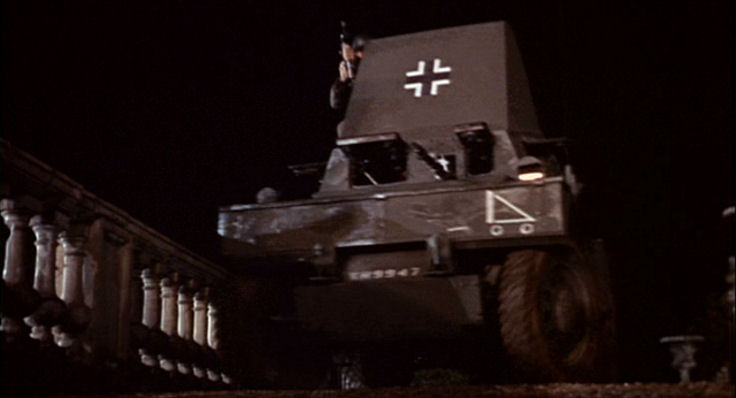
the Popemobile
There
are few inaccuracies that the audience could care less about.First, the Army did not hang any soldier
during the war.The only soldier
executed was Pvt. Eddie Slovik for desertion and that was by firing squad.Can’t really blame the movie for setting the
stage with that opening scene, however.We need to care that Maggot could get hung.Second, it seems that not every American
soldier was armed with a grease gun.Go
figure.They are so wicked looking.Didn’t we want to scare the Germans?By the way, anyone with any knowledge of WWII
weaponry can tell you that the grease gun was notoriously inaccurate.Not in the hands of these guys.Reisman is able to cut a rope inches below
one of his charges.Woe be it to any
German within its range.In the
commentary track that I listened to, Dale Dye nearly had a conniption over its
depiction.Third, they had to face a
German vehicle that looked like the Popemobile.Who designed that prop?It had
some eye holes that were vulnerable to the accurate fire of grease guns.
CRITIQUE:“The Dirty Dozen” has several
strong aspects to it.The acting is very
good.Marvin is the perfect
Reisman.He plays him with the right
amount of bravado and steely insubordination.The scene where he is briefed on the mission by Gen. Worden and his
lackey establishes him as an intriguing character. His wise-ass comments are cynically resonant.Reisman is very much a 1960s war movie
archetype.He reminds me of Steiner from
“Cross of Iron”.The rest of the name
actors are good.Savalas is very creepy
as Maggot.It shows his range that his
other famous role was Kojak.Bronson is
charismatic and likeable.Brown does a
remarkable job in his first major role.He does not look like an amateur.Richard Jaeckel gets a well-deserved turn as Reisman’s second in
command.Cassavettes steals the honors
with his characterization of Franko.You
can tell he is trying to steal the camera’s attention away from the
others.It is obvious he created his own
character beyond the script. He deserved the Academy Award nomination.
The
film is technically sound.The
cinematography is workmanlike, but not outside the box.There are no wow visuals in the film.The score is perfect for a macho film like
this.It is not pompous or overly
patriotic (although it does make use of some familiar martial music).It does not dominate any of the scenes and is
used to punctuate rather than pontificate.The sound effects are outstanding.I’m referring to the explosions, of course.
One
strange thing about the film is the lack of graphic bloodshed.The deaths are not “signal touchdown as you
twirl” style, but they are not splatteringly realistic either.Interestingly, “Bonnie and Clyde” came out
the same year.One of them was revolutionary
in depicting gunshot wounds.Similar to
this issue is the unsoldierly tame language.Regular Gis, let alone thugs like these, must have snickered at the
curses issuing from the dozens’ mouths.“Dirty” does not refer to their vocabulary.Some of their curses include:creeps, pig face, crumb, slob, bum.Apparently, “lovers” substituted for
“assholes”.This was the late sixties,
for gosh darn sakes! Take off the gloves.
As
far as the plot, you know going in that you will have to suspend
disbelief.Very little of what happens
has any foothold in reality.It was fun
to listen to Dale Dye’s commentary which takes the movie to task on numerous
issues.Basically, the movie would not
have been made if he had been the technical adviser.And yet, he is a big fan.The whole Maggot subplot is beyond
ridiculous, but fun.You could really
say that about the whole movie.In this
respect it does not differ from “The Guns of Navarone” and other movies of this
genre.And truly, it is less ridiculous
than its most recent descendant -“Inglorious Basterds”.
The
movie has the theme of military planners can sometimes be lunatics,but if you put an ass-kicking, rule-breaker
in charge the plan will be successful. Similar to "The Eagle Has Landed" in this respect.Another theme is even incorrigible criminals can be molded into a team
(if the choice is mold or be hanged).One theme that is not apparent is that war is Hell.This is the rare major war movie that is not
clearly anti-war.It basically glorifies
in the warrior ethos.Aldrich’s
statement that he wanted people “to know that war is hell” is a crock of crap.Most of the target audience did not leave the
theater detesting war.If they were
teary eyed, it was because of Jefferson’s failed run (reminiscent of Von
Ryan’s, by the way), not due to the slaughter of trapped German officers and their
paramours.That slaughter is a troubling
aspect of the film.The unit is not
conflicted about this task.In fact, the
best word for their facial expressions is gleeful.It’s a bit perplexing that few critics
focused on this war crime.To
paraphrase, if you win the war, there is no such thing as a war crime.(Ask the bombers of Dresden.)That usually refers to avoiding a trial, not
to depicting the “good guys” committing one with no consequences in a movie.
CONCLUSION:“The Dirty Dozen” is one of the
great guy movies in the war movie genre.It is required viewing for men of my generation.It created a template for numerous imitators
and some of them are superior to the original.I feel that “Kelly’s Heroes” and “Where Eagles Dare” are better and more
entertaining and yet neither made the Greatest 100.“The Dirty Dozen” obviously swayed the
nostalgic-minded panel.I’m not
interested in nostalgia.I am simply
judging the movies on how good they are.This one is good, but not great.
the trailer
TRAILER: The trailer is very good. It outlines the mission and identifies all the main characters. I especially like how they quote from the actor's as to how they interpreted their characters. A
the execution scene
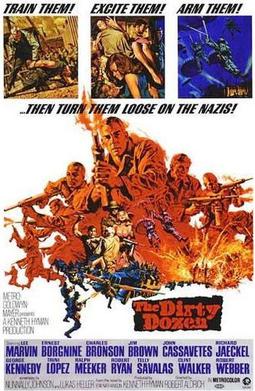
POSTER: The poster is very busy. I love the "Excite them!" part. Until I saw the poster I had no idea that the night with the prostitutes is what fueled their slaughter of the Germans. Those strumpets were actually quite patriotic. C
PRECURSOR? Check out my earlier review of "The Secret Invasion" and decide whether Altman should have been sued for plagiarism.