SYNOPSIS: In the
1880's in the American West, a group of Apache Indians led by a Geronimo-type
of leader named Ulzana escape from their reservation and start raiding, which
includes murdering and torturing. A
cavalry unit under a green lieutenant (Bruce Davison) is sent to track them
down. The cavalry is led by a seasoned scout named MacIntosh (Burt Lancaster)
and an Apache Indian tracker who has sided with the whites. It is a cat and
mouse game from here.
BACK-STORY:“Ulzana’s Raid” is a revisionist Western by
Robert Aldrich (“The Dirty Dozen”) which was released in 1972 toward the end of
the Vietnam War. It was filmed on location in Arizona and Nevada. It is loosely
based on a true story.Ulzana was an
Apache who went on a raid in Arizona in 1885.The movie has been described as an allegory about the Vietnam War.
TRIVIA:Wikipedia,
imdb
1.Screenwriter
Alan Sharp was inspired by “The Searchers”.He felt that three of the worst historic locales were Nazi Germany,
Turkey during WWI, and the American Southwest during the Indian Wars.
2.Since Burt
Lancaster was one of the producers, he got to edit his own version of the
film.His version was similar to
Aldrich’s, however.
3.The production
cost only $1.2 million and took only seven weeks of filming.
Belle and Blade=N/A
Brassey’s=3
Video Hound=N/A
War Movies=N/A
Military History=54
Channel 4=not on list
Film Site=yes
101 War Movies=no
OPINION:I
understand why some consider it to be a war movie, but in my opinion it is
clearly in the Western genre.With that
said, I do not think it is even a great Western.I believe it gets more love than it deserves
from critics because they like the criticism of the Vietnam War.If Aldrich meant to comment on America’s role
in the Vietnam War, he missed the mark because Ulzana and his Indians are not
sympathetic characters.It seems more
likely that Aldrich was trying to make a revisionist Western and in this
respect he was successful, but the 1970s were full of revisionist Westerns and
this is not one of the better ones.
“Too Late the Hero” is a Robert
Aldrich (“Attack!”) film set in WWII in the Pacific, but obviously channeling
Vietnam. It was released in 1970 to take
advantage of the success of Aldrich’s “The Dirty Dozen”. That did not work out as the movie was a box
office stinker. It could have been due
to the story being dusted off after sitting around a decade. Aldrich has only himself to blame as he
co-wrote, directed, and produced the movie.
However, he apparently did not do the casting as he did not want Cliff
Robertson as the lead and later, out of spite, did not let Robertson attend the
Oscars when he won for “Charly”.
Robertson plays a Japanese
translator for the U.S. Navy. He is transferred to a British unit on New
Hebrides for a special mission. Lawson
is a gold brick who is decidedly the opposite of gung-ho. The
mission is to cross the island to take out a radio station before the Japanese
can broadcast a warning about an approaching American convoy. When Lawson arrives at the British base he
witnesses the return of a British patrol.
They have to run across an open field under Japanese fire with their
mates cheering them on. I wondered if
this scenario would recur later in the film.
It turns out Lawson fits in
because the unit he is assigned to is full of kindred spirits. For some reason, the British commander has
assigned an officer with a dubious reputation (Denholm Elliott as Capt.
Hornsby) and given him a squad of losers worse than the Dirty Dozen. The most prominent of the group is Pvt.
Hearne (Michael Caine) who not only does not want to die for king and country,
but even suggests fragging Hornsby. Also
along is the poster boy for cowardice – Ronald Fraser as Campbell. Pvt. Jock Thornton (Ian Bannen) is the lone
warrior and he is nuts.
They start by walking across the
field to reach the jungle. The ambush of
a Japanese patrol results in some friendly fire casualties thus emphasizing the
incompetence of Hornsby and increasing the grumbling from a squad full of
natural-born grumblers. It also starts
the “who will survive?” count down. Hornsby
has to threaten Hearne with court-martial for insubordination and then Lawson
refuses to obey an order that would entail risking his precious ass. It’s a buddy film! It should have been called “Scared and
Scareder”.
The mission is successful, but
there are complications, naturally. They
discover a secret Japanese air field and it is now essential to the outcome of
the war that someone survive to report on it.
The return home is marked by increasing dysfunctionality among our elite
squad. Not everyone feels their skin is
worth risking for the thousands of lives in the convoy. Making the return trip more interesting is a
Japanese officer broadcasting over a loudspeaker. He offers a deal to prevent them revealing
the air field. Some want to take the
deal, but not our suddenly patriotic buddies.
The squad keeps getting whittled down, as is common in this
subgenre. I think you can guess who the
two open field runners are going to be.
“Too Late the Hero” is firmly in
the suicide mission subgenre. We wonder
who will survive, but do not care. There
is little character development in contrast to “The Dirty Dozen”. Other than Lawson, Hearne, Hornsby, Campbell,
and Jock, the rest are like Lever and Sawyer from the DD. The two main characters are unlikeable even for
anti-heroes. Plus their arcs are
implausible. Lawson goes from Madison in
the “Americanization of Emily” to Roget in “Paths of Glory” to Steiner in “Cross
of Iron” - all in one day! Hearne is even more ridiculous. He waffles between cowardice/insubordination/
betrayal and bravery. One moment he
suggests hiding in the jungle and to hell with the convoy, the next moment he
is suggesting stalking the Japanese officer!
At least Campbell is consistently loathsome. The acting is not as good as you would expect
from a cast featuring two A-list stars and a lot of recognizable British war
movie faces.
I remembered watching "Too Late the Hero" as a kid (it is hard to forget the ending) and
had an ominous wondering as to why I had never bothered to try to rewatch
it. Once again my long-term gut memory
was correct. The movie is a dud. It shows that most war movies made in the
late 60s – early 70s thought they needed a gimmick and needed an
anti-hero. It was also common to set the
movie in WWII, but use it to comment on the Vietnam War. It is the type of movie that makes no secret
of this by having a character described as a “long-haired conscientious
objector”. Aldrich decided to take some
liberties with the suicide mission subgenre, but it just doesn’t work. In spite of the gimmicks, the movie is
painfully predictable. It is slow
moving, but punctuated with bouts of action of the ammunition expenditure
variety. It is definitely not going to make my 100 Best War Movies list.
“Attack!”
is a 1956 film from Robert Aldrich (“The Dirty Dozen”) based on the play
“Fragile Fox”.The movie was low budget
and was shot on the back lot in just 35 days.Because of the plot, the Pentagon refused any cooperation.Shame!Aldrich had to rent two decidedly inauthentic tanks.This justs adds to the “charm” of the
film.(First use of the word charm in a
review of this movie.)
The
film is set in WWII Belgium before the Battle of the Bulge.A depleted American platoon led by Lt. Costa
(Jack Palance) is assaulting a pill box and gets pinned down.The company commander Capt. Cooney (Eddie
Albert) is a coward who refuses to support the attack.Costas survives and is in a bad mood, to say
the least.It turns out that Lt. Col. Bartlett
(Lee Marvin) is propping up Cooney for future patronage from Cooney’s father
who is an influential judge.Costas is
very cynical and the only thing that prevents him from fragging Cooney is his
friend Lt. Woodruff (William Smithers).
Woodruff is the buffer between Costas and Cooney.He wants Cooney gone, but doesn’t want his
friend in Leavenworth.
Bartlett
orders Cooney to capture the next town.Cooney decides a full scale effort (which would involve him facing
flying metal) is uncalled for and orders Costas to lead a squad into an Alamo
on the outskirts of the town.Before
leaving, Costas tells Cooney that if he leaves him hanging again, “I’ll shove
this grenade down your throat.”He
forgets to add “sir”.It’s “last stand”
time.Costas is shocked, shocked to find
that Cooney pulls a Cooney.
It’s
Hitler’s last great counteroffensive time as the Battle of the Bulge hits the
company.Bartlett arrives and literally
slaps Cooney into defending the town at all costs.Cooney does not have the cowardice slapped
out of him.Instead, he snaps and is
psychiatrist couch-bound.Unless Costas
has survived the Alamo.Indeed, Costas
arrives in a friggin’ fraggin’ mood, but is distracted by having to take out a
German tanks with a bazooka.He then
suffers one of the best woundings in war movie history.The final scene takes place in a basement
with Germans rampaging above.Things are
said, things are done.Issues are
resolved.Not a happy ending, but
satisfying.
Eddie Albert channeling the opposite of his WWII persona
Talk
about getting bang for your buck.The
only thing low budget is the sets and the tanks.This was Aldrich’s seventh movie and he is
definitely showing his style and panache.The film does have the stage vibe you often get when plays are
transferred to film, but he uses cinematic touches to negate that.His camera shoots through barriers and
doorways.There are shots from above and
diagonal views and deep focuses.It’s a
bit showy, but adds to the appeal of the movie.The score gets attention with sometimes discordant piano music.The acting is outstanding with Palance successfully
treading the line between scene-chewing and scene-stealing.It is a remarkable performance with
tremendous energy.Costas is one of my
favorite war movie characters.The rest
of the cast is perfect.Marvin is
loathsome and Smithers (in his first big role) is solid.Kudos to Eddie Albert (a war hero, as were
Palance and Marvin) for daringly playing against type.John Wayne would have never accepted a role
like that and he was not even a veteran.The supporting cast includes Buddy Ebsen, Robert Strauss, and Richard
F’in Jaeckel (of course).If you are of
my generation, you will feel very comfortable watching this movie.The combat scenes are fairly good for a
play, but you’ll remember the dialogue more than the action.The movie blends violence and exposition
well.There are some good lines.My favorite comes from Pvt. Bernstein
(Strauss), who after he encounters Bartlett and Cooney, says: “When you salute
them two, you have to apologize to your arm.”There is some good comic relief in the film.
after the war, he used his shooting skills to uncover some buubling crude
If
your heart goes out to the officers instead of the enlisted men, you might not
enjoy this movie.It is not so much
anti-war as it is anti-brass.It tends
to be moralistic in its anti-authority theme.Other themes include;the
military is like politics, the higher up you go the more corrupt the officers
are, and following orders can really suck.Released in 1956, it was a harbinger of the 60’s wave of modern war films.The fact that it is relatively unknown and
did not do well at the box office shows that Americans were not yet ready for
this type of flag furler.This is 2014 –
see this movie! It will definitely crack my 100 Best list.
P.S. Check out that awesome poster. Jack Palance is one of the few human beings that actually could pull a grenade pin with his teeth. And for once the tag line is accurate. And that is one kick-ass trailer. Old school style.
BACK-STORY:“The Dirty Dozen” created the
template for an entire genre of motley crew, suicide mission movies.It’s influence has been substantial.The movie was released in 1967 and was part
of the wave of more realistically gritty war movies like “Patton”.Director Robert Aldrich adapted it from the
bestselling novel by E.M. Nathanson, but made substantial changes.The film was made in England and took seven
months to complete.Production included
the construction of a chateau that was 240 ft wide and 50 ft high, surrounded
with 5,400 sq. yds. of heather, 400 ferns, 450 shrubs, 30 spruce trees and 6
weeping willows.It turned out to be so
substantially built that it could not be easily blown up so they had to
construct a flimsier section for the climactic scene.
The
cast was all-starish.The studio wanted
John Wayne for the Reisman role,but
Aldrich wisely insisted on Marvin (Wayne made “The Green Berets” instead).Jim Brown was still playing football, but
when the owner of the Browns gave him an ultimatum – football or moviemaking –
he announced his premature retirement.A
huge mistake admitted by the owner later.Trini Lopez was cast because he was a hot pop singer at that time
(“Lemon Tree”).When he decided his
singing career was more important than the completion of the movie, his
character suffers a premature death.The
dozen actors were supposed to be divided between the stars and the “who the
hell is that” group (known as the Back Six).However, one of the Back Six broke out to become a rising star.When Clint Walker refused to do the
impersonating the general scene, the unknown Donald Sutherland was tabbed and
parleyed it into higher billing and a role in a little film called “MASH”.Many of the cast were WWII veterans:Marvin (Marines – wounded on Saipan), Savalas
(Army), Bronson (Army), Borgnine (Navy), and Walker (Merchant Marine).
The
movie was a huge hit with audiences and with some critics.It was nominated for four Oscars;Best Supporting Actor (John Cassavetes),
Editing, Sound, and Sound Effects (won).
OPENING:Major Reisman (Lee Marvin) is
treated to a military execution.The
prisoner was condemned by a court-martial and is hanged.The scene is short, but impactful.This will not be an old-school WWII movie.
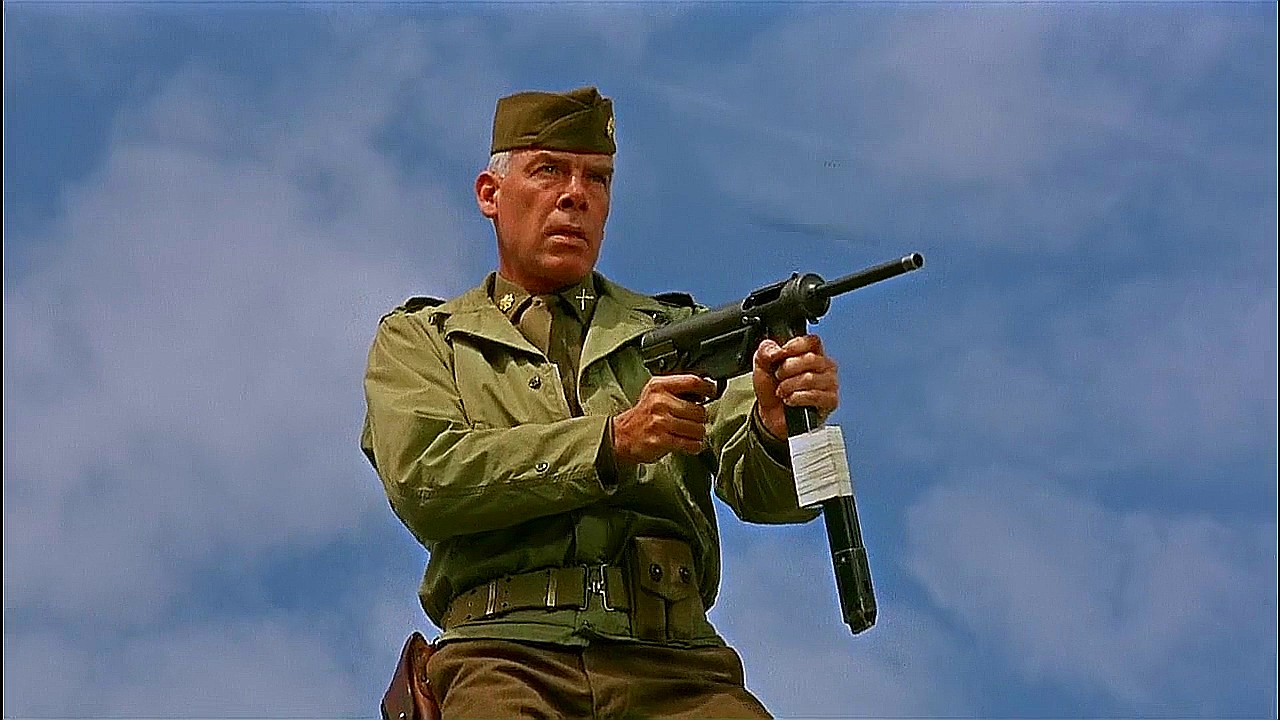
Reisman armed with the "official weapon of the Dirty Dozen"
SUMMARY:Reisman is called to a meeting
with Gen. Worden (Ernest Borgnine).It
is established that Reisman is a loose cannon, insubordinate, wise-ass.Perfect role model for the anti-authority,
anti-establishment Sixties’ generation.He is “volunteered” for Operation Amnesty.It’s a mission designed by a “lunatic” that
involves taking a dozen convicts on a suicide mission to kill as many German
staff officers as possible in a French chateau.Military intelligence, as they say.Piece of cake.
Reisman
goes to meet the twelve in their cells.We get a little background on some.They are a heterogeneous group, of course.Franko (John Cassavetes) is a malcontent
petty hood.Wladislaw (Charles Bronson)
is a stoical Pole.Jefferson (Brown) is
an uppity black.Posey (Clint Walker) is
a hillbilly who doesn’t like to be pushed.Maggot (Telly Savalas) is a psychopathic, Bible-thumping, woman-hater.(Just like the U.S. Army as depicted in some
Vietnam War movies.)Reisman explains
the deal.If you live, you get a
commutation.If anyone screws up in training,
everyone goes back to jail.
They
build a compound in the countryside as a bonding exercise.Please overlook the fact that getting this
group of individualistic, rule-breakers to construct buildings with no
discernible skill is quite unrealistic. The construction does allow for some
slapstick-type humor which gives Sutherland a chance to emerge.Next comes the training.Franko pockets some wire-cutters (there is a
shocking lack of tool security by the guards) and attempts to escape.He is stopped by Wladislaw and Jefferson in a
show of white/black teamwork.Later,
Franko leads a rebellion against their spartan conditions which unites the
dozen and results in revocation of grooming privileges.They are now the “dirty dozen”, get it?
A
visit to the parachute training school run by Reisman’s nemesis Col. Breed
(Robert Ryan) allows for more humor as Pinckley (Sutherland) impersonates a
general inspecting Breed’s troops.Pinckley:“Where are you from,
son?”Soldier:“Madison City, Missouri, sir.”Pinckley:“Never heard of it.”(Watch the
expression on the soldier’s face.Priceless).Breed sics two goons
wearing decidedly unmilitary hair cuts on Wladislaw in the latrine.He is rescued by Jefferson and Posey.Bonding accomplished.That’s all from parachute training school.
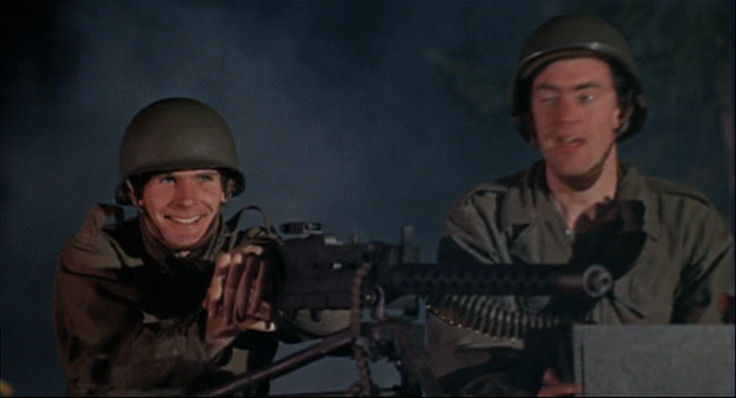
"Can you believe we're in this movie?"
Back
at camp, Trini Lopez sings a song about a “Bramble Bush” (apparently he was big
on songs about flora) because the audience demanded it.(See Ricky Nelson in “Rio Bravo”.)The song became a hit, by the way.Reisman brings in some hookers as a reward
for all their hard work at sublimating their bestial instincts.Hopefully eight women being shared by eleven
men fueled by alcohol (Maggot is wisely left on guard duty) won’t ruin six
weeks of character development.
Gen.
Worden agrees that the dozen will get the green light for their mission if they
can prove themselves at the upcoming war games.They have to seize Col. Breed’s headquarters.Spoiler alert:they cheat.They change arm bands to infiltrate enemy lines.They hijack an ambulance allowing Jefferson
to have one of the great lines in war movie history.When the ambulance driver complains about him
wearing the opposition’s arm band he deadpans:“That’s right – we’re traitors.”The capture of Breed is a highlight of the movie and brings the training
section to an exhilarating close.
Having
passed the test, it’s go time.At a last
supper set up to resemble the Da Vinci painting (and predating the MASH scene), the team goes over the mission.Maggot plays the part of Judas in a nifty bit of foreshadowing.Reisman has famously broken the plan into a
mnemonic device.Here is the entire list
for those of you who have not seen the movie twenty times.
1.Down to the road block, we've just
begun
2.The guards are through
3.The Major's men are on a spree
4.Major and Wladislaw go through the door
5.Pinkley stays out in the drive
6.The Major gives the rope a fix
7.Wladislaw throws the hook to heaven
8.Jimenez has got a date
9.The other guys go up the line
10.Sawyer and Lever are in the pen
11.Posey guards points five and seven
12.Wladislaw and the Major go down to delve
13.Franko goes up without being seen
14.Zero-hour - Jimenez cuts the cable, Franko cuts the phone
15.Franko goes in where the others have been
16.We all come out like it's Halloween
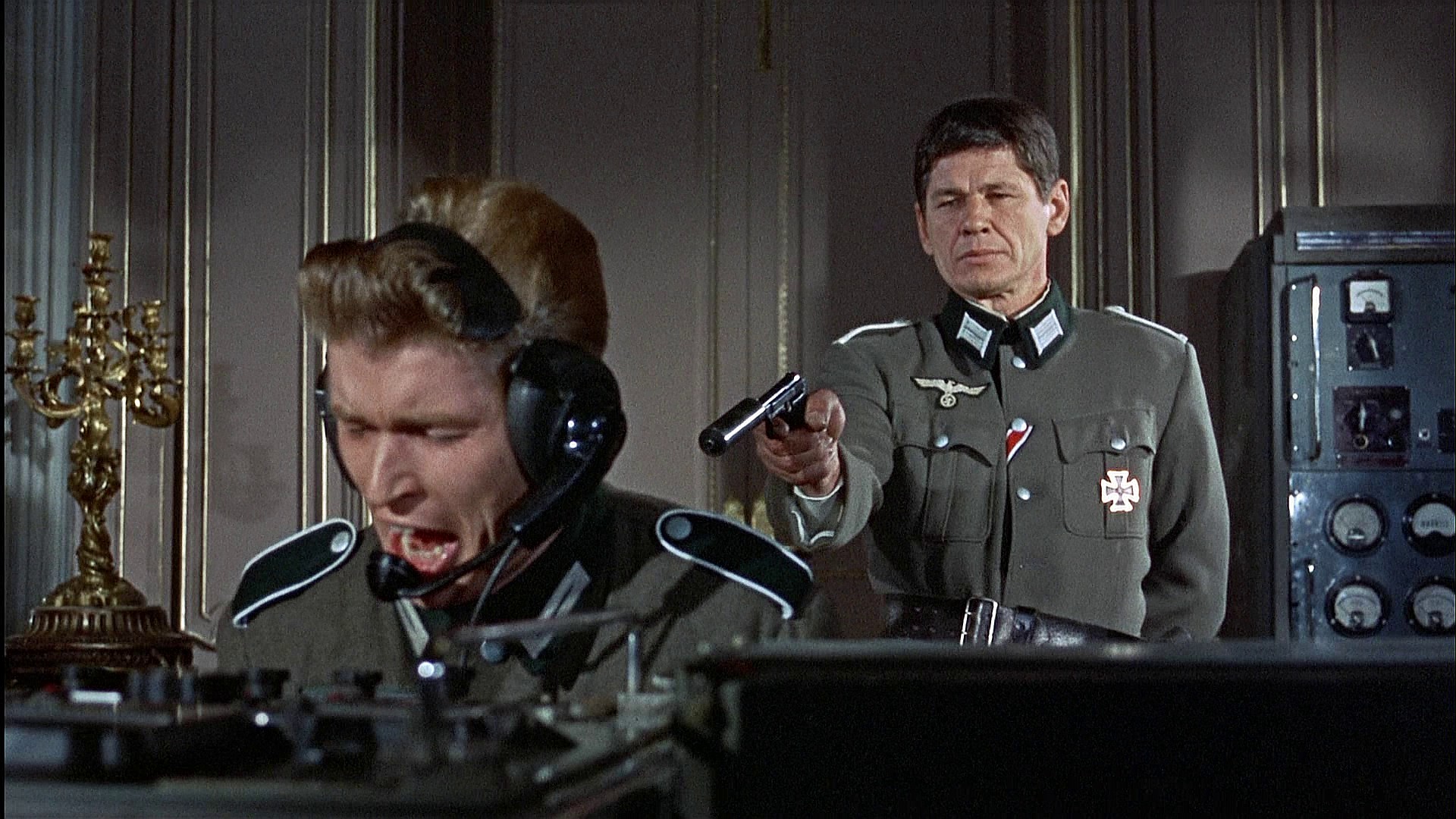
Wladislaw does some silencing
They
drop behind enemy lines and now there are eleven since Jimenez breaks his neck
in a lemon tree.Those who guessed that
they would all survive, sorry.That is
one impressive chateau.Reisman and
Wladislaw enter disguised as German officers.Meanwhile, the others hop to their tasks. Some of them are positioned
outside the chateau.Wouldn’t you think
that might be a good role for the clearly unstable Maggot?Instead, Reisman’s plan calls for him to
sneak into the upstairs where he proceeds to stab a strumpet and open fire on
Jefferson.What a Judas!Let the premature killing of Germans
begin.Or let the grease guns start
greasing.
A guy named Maggot loose in a Nazi brothel
Who
will survive among our intrepid psychopaths?We care, but not about how many of German women will be killed.The German officers and their gals have taken
refuge in the secure bunker leaving their lackeys to be grease gun fodder.They take some of the dozen with them,
especially the Back Six.Not specifying,
but here is the sequence:2.killed by German machine gun fire 3.killed by friendly fire4.blown up by his two grenades that created six explosions taking out the
chateau’s antenna5.killed by German sniper6.killed after slaughtering German reinforcements7.presumed dead with #6 (although
not shown – probably in his contract) 8
& 9.killed while foolishly thinking
they will make the sequel by escaping in a motor boat … 10.If you don’t know how Jefferson dies, you are
not a male between the ages of 50-70.And by the way, he didn’t make it this time either.Damn it! 11. killed while exalting over his survival.
The
climax involves some gasoline and hand grenades that turn the cozy bunker into
an inferno and provide the requisite Hollywood explosions.The survivors drive off into the night to
link up with the D-Day invasion forces.
CLOSING:The three survivors are in a hospital room awaiting their trial for war
crimes.Just kidding.We won the war, so any killing of civilians
was condoned.
RATINGS:
Acting =B
Action =8/10
Accuracy =N/A
Realism =D
Plot =A
Overall =B+
WOULD CHICKS DIG IT?Surprisingly, many did.I guess we would classify them as “bad
girls”.Seriously, the cast is very
manly.There is humor.The violence is not too bloody, although it
was pretty intense for the 1960s.The
language is pretty tame.It’s not really
a date movie.Guys will enjoy it, but
might regret exposing their girl to so much virileness.
HISTORICAL
ACCURACY:You’re joking,
right?Not according to author E.M.
Nathanson who claims he “heard" about the use of convicts for special missions.So much for research. Some judges and draft boards may have put petty criminals in uniform, but there is no record of condemned soldiers being given a second chance.Later, someone dug up the story of the
“Filthy Thirteen” to pacify people like me.The “Filthy Thirteen” was a pathfinder unit that did not like to do
things like salute officers, groom properly, or remain sober when not on a mission.Basically the WWII version of a Vietnam War
LRP unit.Sadly, they were not convicts
forced to go on suicide missions.Boring!
the Popemobile
There
are few inaccuracies that the audience could care less about.First, the Army did not hang any soldier
during the war.The only soldier
executed was Pvt. Eddie Slovik for desertion and that was by firing squad.Can’t really blame the movie for setting the
stage with that opening scene, however.We need to care that Maggot could get hung.Second, it seems that not every American
soldier was armed with a grease gun.Go
figure.They are so wicked looking.Didn’t we want to scare the Germans?By the way, anyone with any knowledge of WWII
weaponry can tell you that the grease gun was notoriously inaccurate.Not in the hands of these guys.Reisman is able to cut a rope inches below
one of his charges.Woe be it to any
German within its range.In the
commentary track that I listened to, Dale Dye nearly had a conniption over its
depiction.Third, they had to face a
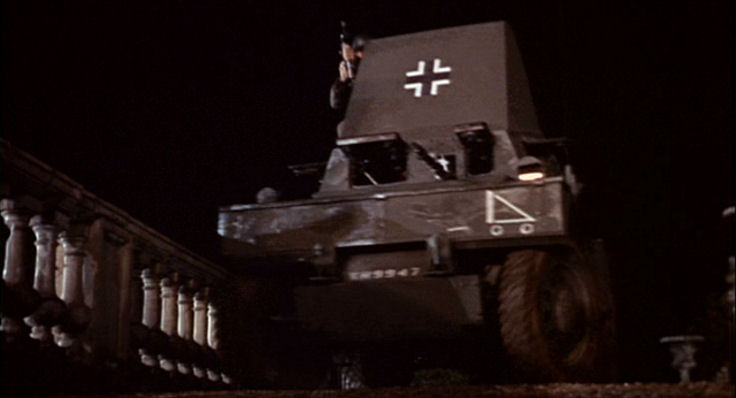
German vehicle that looked like the Popemobile.Who designed that prop?It had
some eye holes that were vulnerable to the accurate fire of grease guns.
CRITIQUE:“The Dirty Dozen” has several
strong aspects to it.The acting is very
good.Marvin is the perfect
Reisman.He plays him with the right
amount of bravado and steely insubordination.The scene where he is briefed on the mission by Gen. Worden and his
lackey establishes him as an intriguing character. His wise-ass comments are cynically resonant.Reisman is very much a 1960s war movie
archetype.He reminds me of Steiner from
“Cross of Iron”.The rest of the name
actors are good.Savalas is very creepy
as Maggot.It shows his range that his
other famous role was Kojak.Bronson is
charismatic and likeable.Brown does a
remarkable job in his first major role.He does not look like an amateur.Richard Jaeckel gets a well-deserved turn as Reisman’s second in
command.Cassavettes steals the honors
with his characterization of Franko.You
can tell he is trying to steal the camera’s attention away from the
others.It is obvious he created his own
character beyond the script. He deserved the Academy Award nomination.
The
film is technically sound.The
cinematography is workmanlike, but not outside the box.There are no wow visuals in the film.The score is perfect for a macho film like
this.It is not pompous or overly
patriotic (although it does make use of some familiar martial music).It does not dominate any of the scenes and is
used to punctuate rather than pontificate.The sound effects are outstanding.I’m referring to the explosions, of course.
One
strange thing about the film is the lack of graphic bloodshed.The deaths are not “signal touchdown as you
twirl” style, but they are not splatteringly realistic either.Interestingly, “Bonnie and Clyde” came out
the same year.One of them was revolutionary
in depicting gunshot wounds.Similar to
this issue is the unsoldierly tame language.Regular Gis, let alone thugs like these, must have snickered at the
curses issuing from the dozens’ mouths.“Dirty” does not refer to their vocabulary.Some of their curses include:creeps, pig face, crumb, slob, bum.Apparently, “lovers” substituted for
“assholes”.This was the late sixties,
for gosh darn sakes! Take off the gloves.
As
far as the plot, you know going in that you will have to suspend
disbelief.Very little of what happens
has any foothold in reality.It was fun
to listen to Dale Dye’s commentary which takes the movie to task on numerous
issues.Basically, the movie would not
have been made if he had been the technical adviser.And yet, he is a big fan.The whole Maggot subplot is beyond
ridiculous, but fun.You could really
say that about the whole movie.In this
respect it does not differ from “The Guns of Navarone” and other movies of this
genre.And truly, it is less ridiculous
than its most recent descendant -“Inglorious Basterds”.
The
movie has the theme of military planners can sometimes be lunatics,but if you put an ass-kicking, rule-breaker
in charge the plan will be successful. Similar to "The Eagle Has Landed" in this respect.Another theme is even incorrigible criminals can be molded into a team
(if the choice is mold or be hanged).One theme that is not apparent is that war is Hell.This is the rare major war movie that is not
clearly anti-war.It basically glorifies
in the warrior ethos.Aldrich’s
statement that he wanted people “to know that war is hell” is a crock of crap.Most of the target audience did not leave the
theater detesting war.If they were
teary eyed, it was because of Jefferson’s failed run (reminiscent of Von
Ryan’s, by the way), not due to the slaughter of trapped German officers and their
paramours.That slaughter is a troubling
aspect of the film.The unit is not
conflicted about this task.In fact, the
best word for their facial expressions is gleeful.It’s a bit perplexing that few critics
focused on this war crime.To
paraphrase, if you win the war, there is no such thing as a war crime.(Ask the bombers of Dresden.)That usually refers to avoiding a trial, not
to depicting the “good guys” committing one with no consequences in a movie.
CONCLUSION:“The Dirty Dozen” is one of the
great guy movies in the war movie genre.It is required viewing for men of my generation.It created a template for numerous imitators
and some of them are superior to the original.I feel that “Kelly’s Heroes” and “Where Eagles Dare” are better and more
entertaining and yet neither made the Greatest 100.“The Dirty Dozen” obviously swayed the
nostalgic-minded panel.I’m not
interested in nostalgia.I am simply
judging the movies on how good they are.This one is good, but not great.
the trailer
TRAILER: The trailer is very good. It outlines the mission and identifies all the main characters. I especially like how they quote from the actor's as to how they interpreted their characters. A
the execution scene
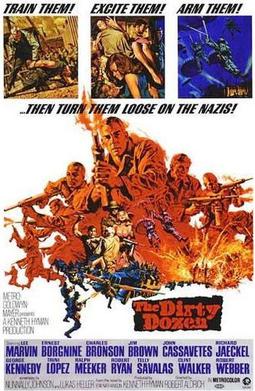
POSTER: The poster is very busy. I love the "Excite them!" part. Until I saw the poster I had no idea that the night with the prostitutes is what fueled their slaughter of the Germans. Those strumpets were actually quite patriotic. C
PRECURSOR? Check out my earlier review of "The Secret Invasion" and decide whether Altman should have been sued for plagiarism.
BACK-STORY: “Ulzana’s Raid” is a revisionist Western by Robert Aldrich which was released in 1972 toward the end of the Vietnam War. It was filmed on location in Arizona and Nevada. It is not based on a true story.
OPENING: On the San Carlos Indian Reservation sometime in the 1880’s, a group of Chiricahua Apaches led by Ulzana (Joaquin Martinez) steal some horses (considering their need for horses later, maybe they should have taken more than one each) and leave on a raid. A messenger arrives at Fort Lowell and the word spreads that “Ulzana’s gone out!” Grizzled Indian scout MacIntosh (Burt Lancaster) is sent to the agency to gather information.
SUMMARY: The commanding officer at Fort Lowell assigns a green Lt. DeBuin (Bruce Davison) to lead the pursuit with twenty troopers and two scouts – MacIntosh and a Chiricahua named Ke-Ni-Tay (Jorge Luke). Ke-Ni-Tay happens to be Ulzana’s brother-in-law. Besides pursuit, there are settler families that need to be warned. One crusty codger sends off his wife and son, but stays to defend his homestead. The woman and boy are ambushed at the same time a trooper arrives on the scene. He shoots the woman and then himself to avoid the inevitable torture. The Indian braves do the next best thing by cutting out his heart and tossing it around. These are not noble savages. Later, DeBuin’s unit finds the husband’s body tortured.
DeBuin is new to the West and wants to learn about the Apache’s and their culture. He is empathetic at first. After seeing the tortured corpse, he asks Ki-Ni-Tay “Why are your people mean and cruel?” The response is “it’s how they are.” Torturing a man means you acquire his power. Why did Ulzana leave the reservation? "Ulzana is at agency long time. His power is very thin. He had old smell in the nose. The smell of dog, of women, of children. Man with old smell in the nose is old man. Ulzana wants new smell. The smell of bullet. Pony running. For power!" (We married fathers have Hooters, they had the open plains.) MacIntosh encourages DeBuin to be realistic. “Hating Apaches is like hating the desert for not having water.” He also tries to teach the young LT how to fight the Apaches. “Remember the rules, first to make a mistake gets to bury some of his people.”
Ulzana is a classic guerrilla warrior. He tries to get an advantage over his pursuers by dismounting most of his men and having two warriors run the ponies in a loop to exhaust the bigger cavalry horses. This would probably have worked except that not only do the whites have the Yoda of Indian scouts in MacIntosh, but the T1000 of trackers in Ke-Ni-Tay. They see through the Indian ploy and do not fall for it. In fact, MacIntosh heads off the pony string killing one of the braves and depriving Ulzana of his horses. Although he has lost his empathy for the Apaches, DeBuin does stop some troopers from mutilating the Indian corpse.
At another farm, they find a raped woman who has been left alive by Ulzana so that the cvalry will be forced to split, sending some men with the woman back to the fort. Since MacIntosh sees through this strategy, he and DeBuin come up with a counterplan. MacIntosh and a few men (and the woman) will walk into the inevitable ambush and then DeBuin will swoop in and catch Ulzana with his loin cloth down. The humane DeBuin seems unconcerned with sending this distraught rape victim into an ambush which will be suicidal for at least some of the bait. Considering she is dressed as a soldier, you would think a soldier could have masqueraded as her.
The plan hinges on Ke-Ni-Tay eliminating the Indian who will be watching the main group. He is so good he is able to follow tracks over bare rock! Due to miscommunication, DeBuin moves prematurely and Ke-Ni-Tay has to catch up to the Indian before he warns Ulzana. Being super-tracker as well as super-warrior, Ke-Ni-Tay kills his prey in time.
Jaekel as the Sarge
Meanwhile, MacIntosh is ambushed in a canyon with predictable results for the poor bastards that are the bait. Mac, the sergeant (the ever-reliable Richard Jaekel), and the woman are forced to take refuge under a wagon. The sarge is killed and Mac is gravely wounded. Ulzana, who holds all the cards, orders two of his men to charge in the open and they are gunned down by MacIntosh. Wait, aren’t they guerrillas?
DeBuin arrives with bugle blaring (so much for surprise). Instead of flanking the Indians, he comes charging up the canyon. However, this tactic is sufficient to win the “battle” and rescue the few survivors.
CLOSING: Ke-Ni-Tay tracks Ulzana, but can’t locate him. Just kidding. The two confront each other and it looks like it will be a classic Western duel, except with Indians. Think again. Ke-NI-Tay shows Ulzana his son’s (and Ke-Ni-Tay’s nephew’s) bugle. This is the Apache way of saying I killed your son. Opting against vengeance, Ulzana sings his death song and kneels for Ke-Ni-Tay to shoot him in the back of the head. MacIntosh insists DeBuin leave him behind to die.
RATINGS:
Acting - 7
Action - 6
Accuracy - 6
Realism - 7
Plot - 5
Overall - 6
WOULD CHICKS DIG IT? Highly unlikely. There are no significant females in the movie and those that appear mostly have very bad things happen to them. This is very much a guys’ movie. It does not have a lot of violence, but some of it is graphic. It is definitely not a feel-good movie. If you took a date to it when it was in the theaters, the dinner better have been outstanding and even then don’t expect much after you leave the cinema.
ACCURACY: The film is not based on a true story which is a crying shame. Why make up Ulzana when there were similar and better actual historical figures like Cochise, Mangas Coloradas, Geronimo, and my choice – Victorio? Any one of their stories would have been more interesting and given Aldrich the opportunity to explore the same themes.
As far as Apache culture, the movie is fairly accurate although it does not cover anything but warrior culture. The discussions between DeBuin and Ke-Ni-Tay are enlightening as to how the warriors thought and fought. Their guerrilla tactics appear to be realistic, but if they were the great guerrilla warriors respected by historians, some of Ulzana’s decisions seem weak. The Apaches certainly knew the value of horses so the decision to go on the warpath with just one mount per raider is suspect. The ploy of dismounting and leading the pony string around looks like a Hollywood plot invention to me. Ulzana was well ahead of his pursuers and lengthening the distance. Giving up that gap does not strike me as something an intelligent Apache would have done.
There is little doubt that the Apaches could be hard on prisoners. They certainly tortured and mutilated prisoners, including other Indians. I cannot vouch for the “take their power” explanation. I do know that Indians tortured their foes because they expected the same treatment and saw it as a way to show their bravery. I have never run across reference to cutting the heart out and tossing it around. They did tend to cut off genitalia and stick it in the victim’s mouth, however. (You're welcome for that fun fact.)
The Apache did have a tendency to leave the reservations to conduct raids which were hard on white settlers. Geronimo and Victorio were good examples of this.
CRITIQUE: “Ulzana’s Raid” has the feel of a made for TV movie. It looks low budget and the cast (other than Lancaster) is underwhelming. Lancaster is his usual strong force and gives the film gravitas. Davison is surprisingly good as the naïve lieutenant. Jaekel is his reliable self and gets a meaty supporting role. Luke stands out as the stoical Ke-Ni-Tay. The rest of the cast is below average.
The score is stereotypical Western music. If you only heard the music, you would know immediately you were watching a Western. Some of it borders on ridiculous. The cinematography is fine, but although the terrain is similar you will not mistake this for a John Ford oater. The vistas are impressive.
The movie has been described as revisionist. This is spot on. Before you give it too much credit on this account, remember this was the seventies when most Westerns were outside the box. By revisionist, I mean it portrays both sides as shades of gray. However, there is no doubt who the bad guys are. The same bad guys as in most previous Westerns – the Indians. The revisionism is in the respect they are shown in their depiction and the less than saintly portrayal of the cavalry. Ulzana’s motives are briefly outlined, but not really debated. The torturing of victims dilutes any sympathy the audience might have for him.
Davison’s character is supposedly the conscience of the film. He is the opposite of the clichéd Indian hating officer. He wants to understand the Apache. As the film progresses his Christian principles are challenged by what he witnesses. Aldrich does a good job of not predictably going all the way down this path. DeBuin ends up a realist, not a racist. It is telling that at the end, instead of bringing Ulzana’s head back as proof or a trophy, he insists on burying the corpse.
The most memorable aspect of the movie is the relationship between MacIntosh and Ke-Ni-Tay. Their laconic friendship is like that of an old married couple. A nod is enough some of the time. Their mentoring of DeBuin is refreshing. They do not treat him as a rube, but there is some head-shaking. Ke-Ni-Tay is a strong character in his own right. He is loyal to his employer – the U.S. Army. He is super-Indian when it comes to tracking. I can’t help but point out that he is a traitor to his own people and chose the wrong side. He helps track down an Apache leader (and his own nephew) who are fighting for their way of life. And he kills them.
The film has been described as an allegory on the Vietnam War. I do not know if this is something the critics deduced or was an intention of Aldrich. If he intended the movie to comment on the war, he missed the target. Ulzana does not do a good impression of a Viet Cong. They did torture and mutilate, but I would think that is not the point Aldrich would be trying to make. A liberal, anti-war statement would have portrayed the Indians in a more positive light and the whites as more imperialistic and racist. It seems more likely that Aldrich was more interested in making an iconoclastically realistic Western.
CONCLUSION: I know I am beginning to sound like a broken record, but… Just as with "She Wore a Yellow Ribbon", this movie is a Western first and nothing else second. Perhaps the critics that decided it was an allegory on the Vietnam War insist that it then has to be a war movie. Sadly, regardless of what genre it is placed in, it is not a particularly good movie.


.jpg)