Showing posts with label court-martial. Show all posts

Saturday, December 23, 2017

FORGOTTEN GEM? King and Country (1964)


                “King and Country” is a WWI court room drama.  It was directed by Joseph Losey.  It was based on a play by John Wilson and a novel by James Lansdale Hodson.  The movie was low budget and was shot in only eighteen days.  It was a critical, but not box office success.   The movie is set during the Battle of Passchendaele on the Western Front in 1917.  It deals with the topics of shell shock and desertion.

                The movie opens with a shots of dead soldiers and a soldier memorial.  Vibe set.  Private Arthur Hamp (Tom Courtney) is in a cell awaiting court-martial for desertion.  Hamp, a volunteer and veteran, walked away from the trenches and headed home.  He was the only survivor from his original unit and is a classic shell shock candidate.  His assigned counsel, Capt. Hargreaves (Dirk Bogarde), is an asshole who is less than sympathetic.  He believes the party line on shell shock – it’s cowardice.  When he first interviews the naïve Hamp, there are soldiers bailing water in the trench in the background.  The very deep focus of the scene emphasizes the noteworthy cinematography of the black and white film.  Hamp tells him he cracked after he almost drowned in a shell hole.  He deserted when his unit was in the rear.  He is lucid and reasonable, but is surprised when he is told he faces the death penalty.  Hargreaves decides to go with a temporary insanity defense.  A man can only take so much – “so much blood, so much filth, so much dying.”

                “King and Country” has a similar feel to “Paths of Glory”, but is more play-bound.  There is no action, but it is not just set in a courtroom.  Hamp’s scenes are intercut with scenes of a few Tommies in the trench nearby.  Mates who are potential shell shock victims.  The set is authentically rainy and muddy.  They provide the gallows humor appropriate for the Western Front.  They capture a rat that they roust from a dead horse.  And then put the rat on trial for biting one of them!  The movie’s symbolism is not subtle, but it is appropriate.  The movie is dialogue-driven and, although it is not laden with memorable lines, screenwriter Evan Jones (“Victory”) handles the predictable trial with aplomb.  The movie is as predictable as a 1960s movie about WWI desertion would be expected to be.  Predictable especially if you have seen “Paths of Glory”.  However, the decision to play with the audience’s emotions by way of the twist in the court decision defies credulity if you have any knowledge of the British Army’s policy toward men like Hamp.  One unpredictable element is the Hargreaves character.  Bogarde is excellent (it was supposedly his favorite role), but his conversion from antipathetic to empathetic is not truly believable.  It’s a good thing for Hamp that he comes around because as a lawyer, he ranks with Dax.  Courtnay is also excellent as the naïve Hamp.  He reminded me of Pvt. Slovik.  Except that Slovik had more reason to be naïve.  Hamp, a veteran of three years, would certainly have had some experience with the military ethos.  He should have known he had as much chance as the rat.

                “King and Country” is a must-see for anyone interested in WWI movies.  It does not wink at anti-war sentiments.  It oozes (literally, with all the mud) that sentiment.  You won’t soon forget it.


GRADE  =  B+

Monday, August 29, 2016

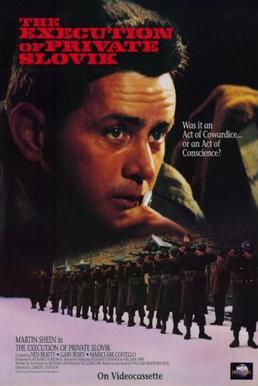
The Execution of Private Slovik (1974)


                “The Execution of Private Slovik” has been one of my great white whales for some time now. (Another is “Ice Cold in Alex”.)  I finally was able to watch it again after having seen it forty-two years ago when it appeared on NBC as a made-for-TV special.  The movie was based on a nonfiction book by William Bradford Huie published in 1954.  It was directed by Lamont Johnson.  He was nominated for an Emmy, as was the movie.  The movie won two Emmys for editing.  It also won a Peabody Award.  Originally, the movie was supposed to be made by Frank Sinatra, who was interested in the story.  However, Sinatra wanted to use a screenplay by Albert Maltz, but that was during the Cold War and Maltz had been black-listed as one of the Hollywood Ten.  Sinatra was accused of being a Communist sympathizer and the Kennedy campaign put pressure on him to drop the project.

                The movie opens in January, 1945 in France.  The execution is being prepared.  A member of the firing squad mentions that no American has been executed for desertion yet.  The consensus among the twelve men is Slovik (Martin Sheen) has it coming to him.  No one is thrilled to be part of the detail.  A chaplain named Father Stafford (Ned Beatty) bucks them up by proclaiming that “a higher authority has accepted moral responsibility”.  Do your duty.  When one soldier proposes purposely missing, another says “I’m not going to miss… He didn’t care about how many of us got shot up, so I’m not going to care about him.” 

                The movie now flashes back to how Slovik got to this point.  The narrative takes the form of characters reminiscing about Eddie.  Starting with the warden of the prison Eddie is being paroled from for theft.  The warden makes a point of stating that he could have predicted that the “sweet kid” would freeze or run the first time he was in combat.  Slovik gets a job and courts the bookkeeper of his employer.  They get married and are living happily, if poorly, with the comforting knowledge that as an ex-con he is designated 4-F and thus not draftable.  This changes on their first anniversary when they find out he has been reclassified 1-A.  “Greetings” is not far away.  It’s off to boot camp where Eddie is a sad sack, but good enough to be a replacement.  On his way to the front, he and his buddy Jimmy (Gary Busey) take refuge from a bombardment and it’s a turning point for him because he vows never to go through that again.  Maybe he won’t have to as the two stragglers end up with a Canadian rear unit for a few idyllic weeks.  However, all good things must come to an end as Eddie and Jimmy are eventually returned to their unit.  Eddie is up-front about his cowardice with his commanding officer and when the Captain is not sympathetic, Eddie flees.  The rest is history.

                “The Execution of Private Slovik” is like a well-acted docudrama.  I refer to it being semi-documentary because it is awesomely accurate.  You do not need to read Huie’s book.  There are no significant enhancements of the real story.  It shows you how entertaining the tale is even without enhancement.  But it’s not just the fact that you learn exactly what happened in the most famous case of military justice involving an American soldier in WWII.  It is more importantly a movie that helps right a wrong.  There is no doubt that the execution was an egregious injustice that taints the reputations of Gen. Norman Cota (commander of the 28th Division) and Gen. Eisenhower.  Both of whom refused to commute the sentence. There were 21,000 convictions for desertion of American soldiers during the war.  This was the only one of 49 death penalties for desertion that was not commuted!  It was the only execution by the U.S. military that was not for rape and/or murder of a civilian.  (There were 102 of those executions.)  Slovik was the proverbial example that was made because morale was shaky at this point in the war and the upcoming assault on Heurtgen Forest was going to be a rough one.  Slovik had incredibly bad timing for his confession.

                The movie is very competently made for a movie that had a budget of less than a million dollars.  The cast is minor with the only stars being Sheen and Beatty.  Sheen is outstanding and was nominated for an Emmy.  He nails the petty thief who is getting his life together when he is thrust into a situation he could not handle.  Surprisingly, the cinematography is noteworthy.  There is an intriguing mixture of high and low shots and some far shots.  Not what you would expect from a made-for-TV movie.  The plot is not melodramatic.  It is a bit simplistic, but I have already mentioned that it is true to the story.  The nonlinear structure works and the decision to tell the story partly through narration by different people was a good one.  The movie does a great job as a tutorial on how a court-martial and execution worked in WWII.  It gets all the little details right.  For example, if the condemned was not able to stand on his own, they would be strapped to what was called a “collapse board”.

                “The Execution of Private Slovik” was well worth the wait.  It is a must-see for not only war movie lovers, but fans of American History.  It is one of the most accurate war movies I have seen.  It is an important movie as it brings a travesty to the public.  To most, even knowledgeable Americans, Slovik was a trivia answer.  Who was the only American soldier executed for desertion in WWII?  You would have to assume that he must have done something incredibly cowardly that cost the lives of other Americans.  In 1987, President Reagan was persuaded to allow Eddie Slovik’s body to be exhumed and reburied next to his wife.  Maybe as an ex-actor, he was influenced by the movie.  I would like to think so.


GRADE  =  A-

Saturday, April 9, 2016

BOOK/MOVIE: Private Peaceful (2012)


                “Private Peaceful” is a young adult novel that is set in WWI.  The movie based on it was directed by Pat O’Connor and released in 2012.  The movie jumps in at the end with Private Peaceful having been found guilty in a court-martial trial and awaiting execution.  It then flashes back to England in 1908.  The Peaceful brothers are both hot for a classmate and kindred soul named Molly, but of course her father does not want his daughter going with any lower class lads (although Molly’s family is not exactly of the nobility).  Time passes and the Great War breaks out.  Charlie (Jack O’Connell) gets Molly (Alexandra Roach) pregnant which results in her exile to the Peaceful home.  Tommo (George McKay) volunteers for the war due to societal pressure and boredom.  Charlie follows soon after, although he believes the war only benefits the rich.

                Tommo and Charlie are in the same unit, which would not be unusual in the British Army.  A series of vignettes dip our toes in the horrors of the war.  The biggest horror is the cinematic hardass sergeant who for no good reason is out to get the Peaceful brothers.  Perhaps he is offended by their pussy last name.  I’ll tell you how big a horse’s ass he is.  He forbids the men to smoke – during the daytime!  The movie builds to a trench attack where the Peaceful brothers give Sergeant Hanley the offense he has been looking for. Queue the trial and a twist ending.  The Great War sucks greatly.

                “Private Peaceful” is a nice little movie, but it’s nothing special.  It is not surprising that it is based on a young adult novel and it shows.  It does not challenge the intellect.  It is not graphic.  It is simplistic and shallow.  None of the war scenes last very long. It frustratingly opens doors and then does not walk through.  For instance, they plan a trench raid to get prisoners.  Oh goody, some action.  Nope, the raid gets cancelled!  What little combat there is is small scale with random soldiers being mowed down.  That’s about as anti-war as the movie gets.  It does not hammer the nature of the war.  The trench is too pristine.  Charlie spouts a bit of pacifism, but does not really pursue it.  The movie is more anti-military with the court-martial being the punctuation.   There is little character development other than the love trio.  The sergeant is a stock villain.  There is no logic to his hatred, other than Charlie is a bit lippy.  One strength is the acting.  The cast is fine with O’Connell taking honors.  He has a lot of charisma.

                This is the rare case of my liking the book over the movie.  As my readers know, I feel that a movie should be able to improve on its source.  A screenwriter has the advantage to tweak the novel.  Although the movie “Private Peaceful” is not bad, it does not improve on the novel.  Michael Morpurgo is a good young adult writer.  He also wrote “War Horse”.  Surprisingly, the book’s biggest strength is its combat scenes.  There is an excellent trench battle, trench raid, and a gas attack.  Morpurgo writes panic well.  The novel describes the rats, lice, and rain.  The movie would have been better if it could have recreated the combat scenes.  I have to assume the budget did not allow it.  Just as the time constraints did not allow the movie to go into depth on the minor characters.  Reading the novel gives you a better feel for the villains.  In the book, Grandma Wolf comes to live with them and makes their lives Hell.  The Colonel shoots their dog.  In the book, the reason the Peaceful boys enlist is because he threatens to evict their family.  By the way, here is a good drinking game for you young adults.  Take a drink every time the song “Oranges and Lemons” is mentioned in the book.

                Other than the depth, the movie does cover the main scenes and themes of the book well.  The movie does not make any major changes.  For instance, Tommo’s chaste “romance” with Anna is virtually the same.  The biggest flaw in the movie is the botched handling of the twist ending.  It left me feeling duped.  (As per my modus operandi, I watched the movie before reading the book.)

                As a post script, I have something to say about one of the basic themes of the book/movie.  They indict the British military for its inhumane courts-martial policy.  The British Army had a huge number of offenses that called for the death penalty.  In 2006, the British government took the extraordinary step of pardoning the 306 Tommies that were executed for cowardice, desertion, or sleeping on duty.  Sleeping on duty!   My God!  When I imagine being in any war, one of my worst fears would be falling asleep on duty.  Lack of sleep was not an excuse for falling asleep?  Are you kidding me?  No wonder the U.S. Army gave out so much amphetamines in WWII.  Solved that problem, right?  But I digress.  The point I wanted to make is that in the book/movie we are obviously meant to feel that the court-martial and sentence are a travesty.  However, Charlie does disobey a direct order to get out of the crater and resume the attack.  The other soldiers obey the order, although reluctantly.  And yes, it is a suicidal order given by a villainous sergeant, but Tommo did not have life-threatening injuries.  You could argue that Charlie chose his brother over his mates.  That is understandable and perhaps justifiable, but his actions certainly fit a punishable offense.  Should circumstances have been considered by the court-martial?  Of course.  But if the army was executing men for falling asleep on guard duty, wasn’t Charlie’s offense worse?


GRADES =  Movie  B-  /  Book  B

Friday, December 27, 2013

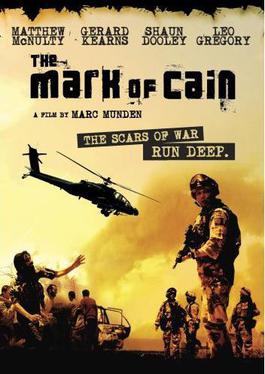
Christmas Day 3 - The Mark of Cain


On the third day of Christmas, my true love gave to me… three Cain-marked Brits


                “The Mark of Cain” is “based on extensive research, but is a dramatic work of fiction.”  I assume the research was about Abu Ghraib and similar incidents.  The made-for-TV British drama won a BAFTA and Amnesty International recognized it as a “Movie That Matters”.  It is a tale set in Basra, Iraq and then back home in Britain.

                When Mark (Gerard Kearns) and his buddy Shane (Matthew McNulty) arrive in Iraq, they and the other newbies are counseled on the need to avoid violations of the rules of war.  Their commander states that any unjustifiable killing of civilians will result in the “mark of Cain”.  A well-staged ambush results in the fiery death of their commander.  Vengeance is in the air and a “search and detain vigorously” raid nabs some suspects.  Cpl. Gant (Shaun Dooley) tells the men to lay off the detainees, but has a change of heart and leads the “interrogation”.  The reluctant Mark is peer pressured into joining in the “fun”.  Shane is a picture-taking participant.

                Upon return to Britain, Mark suffers from PTSD and guilt feelings which result in convenient flash-backs.  Shane suffers from picture showing-off and a snitching girl friend.  The two and Gant are charged with war crimes.  Gant and everyone up the chain of command scapegoat the two privates.  Mark admits he was caught between moral courage (the ability to report atrocities) and loyalty to his unit mates.  He now feels he chose unwisely and is torn apart by it.  Shane eventually comes to this conclusion as well.  He is pressured to plead guilty at his court-martial and take one for the team.  What will he do?

                The film is meant to be thought-provoking and basically succeeds although how we are to think is pretty much shoved down your throat.  Anyone unaware of the Abu Ghraib-type activities would be informed by this movie.  I think that was the point.  (What I learned was that the Brits pointed at wieners, too.)  It is not as heavy-handed as the Amnesty International endorsement would imply. 

The movie is balanced cinematically.  The ambush scene is of the new school variety.  Hand-held.  Quick cuts.  Realistic soldier reactions (ex.  one guy freezes).  The movie does a fine job setting up the torture by showing the stress (e.g., that coke can could be an IED) and fog of war (is having a lot of cash proof of insurgency?) the soldiers went through.  You are forced to wonder how you would have reacted if some of your mates were killed by faceless insurgents.  Iraq = Vietnam.  The home front scenes are also realistic.  Mark and Shane represent two extremes of soldier post-combat reactions.

                The movie is well made, especially for a TV production.  The cinematography is interesting.  The flashbacks work in teasing out the torture.  The acting is fine.  The three leads are effective although Gant’s switch from warning against atrocities to leading them is implausible.  Dooley does play slime-ball well.  Kearns is particularly poignant as the tortured torturer. 

The movie attacks some easy targets.  The military has a code of silence similar to the police.  Young men do bad things under war stress.  Military authorities tend to cover up crimes that they encouraged.  Hey British society, you have the mark of Cain.  Ours is way bigger than yours, however.  USA!  USA!  USA!

Good gift?  Sure, and it’s so Christmasy.  Actually I should throw in a Genesis reference here.

Grade =  B-