“Das Boot” is the gold
standard for submarine warfare movies. I have considered it to be a great movie,
but not outstanding because of one scene. I have read several books on submarine
warfare and the Battle of the Atlantic, so I know u-boat tactics. The tactics shown
in the scenes depicting the attempt to run the strait of Gibraltar seemed puzzling
to me, especially since the captain is portrayed as a good leader who would not
make any stupid mistakes. Recently, my opinion on this flaw in the movie has reared
its head again and has caused me to question whether I have been too harsh on
the captain for this. So, I have rewatched the pertinent scenes and read the book
version of the scenes to see if the movie followed the book and if so, was the
captain wrong.
In the movie, the sub is given orders to enter the
Mediterranean Sea by way of the Strait of Gibraltar. The captain is well aware
that this is a very risky mission because the strait is very well defended. It will
take a good plan and a lot of luck. He decides to approach the strait in the
dark on the surface. The boat will evade British ships to get close to the strait
and then dive and use the eastward current to save fuel and safely run through
the strait. No one on the crew questions the decision, but it is obvious some
of the officers are skeptical. The boat manages to maneuver through several
British ships and are within ten minutes of diving when the captain sends all
the conning tower personnel below deck except himself and the navigator. A
plane attacks and drops two bombs that damage the sub and wound the navigator.
The captain orders “prepare to abandon ship”, but he stays topside and orders
full speed ahead. The second officer guesses the captain is trying to reach shallower
water off the coast of Africa. When the sub runs into several British ships,
the captain is forced to dive. He plans to hold at 100 meters, but the damage
causes the boat to continue its dive until it bottoms out at more than 280
meters, well below crush depth.
Were the captain’s decisions good ones and do they
conform to the captain in the book? In the book, the captain’s plan is the same
as in the movie. No one questions them, but there is some doubt. Heading for
the strait on the surface in the daytime, they are forced to dive three times
because aircraft are spotted. None of the planes attacks. They are back on the
surface when night falls. They are ten minutes from diving when the plane
attacks. (In the book, the officers wonder how the plane was able to find them
in the dark which is appropriate because in October, 1941 the RAF’s radar on
planes would not have been known to the u-boat fleet.) The conning tower is hit and the deck gun is
destroyed. No one is wounded. The boat dives, but resurfaces due to the damage.
However, star shells turns the night into day, so the captain orders a dive to
100 feet (I am not sure why the movie went with meters.) The boat
continues to the bottom which is more than 825 feet deep.
The movie is close enough to the real incident,
considering it’s a dramatization. Obviously, the director and screenwriter were
not going to reenact three dives because of aircraft. And the dive to the
bottom is close to what happened. They did have rivets busting, by the way. It’s
not just a submarine movie cliché. However, the captain in the movie makes a
very puzzling decision to stay on the surface after the plane attack that
damages the sub. He does not explain his decision, but it seems like he would
not have known the damage would cause the sub to sink. His order to race towards
the African shallows is not explained, but we can give him the benefit of the
doubt and assume he knew the boat might sink and he wanted it to be in
shallower water. (That’s a big assumption.) This actually worked out because
although the sub does go way below crush depth, if it had sunk where it had
been damaged, it surely would have been crushed by the lower depth. Probably because
of time constraints the movie does not show the boat diving after the attack (which
would have been standard procedure), but having to surface because of damage.
The captain is then forced to dive because the alternative is being a sitting
duck. Because the movie edits out some of this, it makes the captain look like
a gambler who loses his bet. In the movie, it is insane to stay on the surface
after the plane attacks and clearly informs the warships about the sub. He does
not know that diving will result in sinking. In fact, since the ship draws fire
on the surface, it is likely the damage that causes the uncontrolled dive was due
to a shell hitting on or near the boat.
This analysis has led me to adjust my view on the movie’s
depiction of the Strait of Gibraltar sequence. I still feels the movie captain
makes a poor decision to stay on the surface after being attacked, but I am
willing to give him the benefit of the doubt because we don’t know what he is
thinking and the movie might have made decisions for dramatic effect. With that said, I still believe both the movie captain and the book captain were insane to go as far as they did on the surface, even at night. In the war, the u-boats that successfully ran the very well-defended strait did it submerged using the eastward current to narrow the speed loss from not being on the surface.
P.S. Let’s take the scenes a little further. The movie
covers the repairs to the sub and its surfacing very close to the book. And I
just want to add something that might not have been apparent to viewers. The
sub would not have survived if the Chief had gotten his wish to go home and/or
if the captain had shot Johann when he had his panic attack.
SUMMARY: A WWII submarine captain (Clark Gable) is
obsessed with sinking a Japanese destroyer nicknamed Bungo Pete. He is given
command of the U.S.S. Nerka over the current exec (Burt Lancaster) creating a
command and personality conflict. The captain is also a martinet. The captain
insists on going deep into enemy waters to sink his white whale.
BACK-STORY: This movie is based on the
best seller by Edward L. Beach, Jr. (a WWII sub commander). It was produced by
Burt Lancaster and cast him (a rising star) with Clark Cable (whose start was
fading). The two reportedly did not get along well during the shoot with Gable
upping the cost of production with his 9 to 5 work rate. This dysfunction may
have added to the realism of the movie which is based on a personality conflict
between the two leads. The technical advisor was a retired Rear Admiral. The
movie had the full cooperation of the U.S. Navy including use of a sub for
exterior shots, equipment for interior shots on the set, and submariners to
train the actors.
TRIVIA:imdb,
Wikipedia, TCM
1.Clark Gable and Burt Lancaster did not get
along during the shoot.Lancaster made
jokes about Gable’s age.Gable refused
to work past 5 and would leave in the middle of a scene.Since Lancaster was a co-producer and the film
ran overtime and overbudget, this became frustrating.Gable did not want to play a captain that
lost his command, he felt it did not fit his image.He sat out two days over this issue and only
returned when the script was changed so the captain lost command because of a
head injury.(Another example of an
actor insisting on something that made the plot worse.)
2.The actual Akikaze did not play the role of a
hunter as depicted in the movie.It was
sunk when it purposely intercepted a torpedo aimed at the carrier Junyo it was
escorting.
3.The actors in the sub crew went through
training on how to run a sub.The movie
has been commended for its accurate depiction of the attack procedure.
4.The older/younger commander dynamic was used
again by director Wise for the first “Star Trek” movie.He used the stationary subs hunting each
other in his “Wrath of Khan”.
5.This was Don Rickles’ first film.He was on a motor torpedo boat tender in
WWII.He was in charge of morale.Just kidding.
6.The movie starts off badly with Richardson’s
previous boat being sunk in Bungo Straits early in the war.First, a U.S. sub would not have been that
deep into Japanese waters at that time and if it was, there is no way the crew
could have been rescued.
7.The author Edward Beach did not like the
movie.He once commented that all the
studio did was buy the title.
8.The movie was basically a combination of
“Moby Dick” (with the Akikaze being the white whale) and “Mutiny on the Bounty”
(with its command dysfunction).
9.The movie was overshadowed at the box office
by “Operation Petticoat”.
Belle and Blade=4
Brassey’s=2
Video Hound=4.4
War Movies=3.1
Military History= #79
Channel 4=not on list
Film Site=yes
101 War Movies=no
OPINION:“Run Silent,
Run Deep” was one of my favorite books as a
teenager. This movie does not do justice to the book. The movie became a
showcase for two legendary actors, but that does not overcome some of the
ridiculous aspects of the film. The acting by the whole cast is noteworthy.
Rickles even adds some humor. (He gets to offer a guy “a
cookie”.) The movie is certainly entertaining
and better than average in the submarine subgenre.
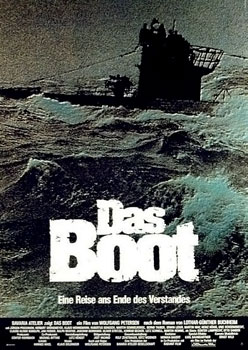
BACK-STORY:“Das Boot” (“The Boat”) is a German submarine
movie directed by Wolfgang Petersen.Originally the movie was going to be made by John Sturges starring
Robert Redford and then by Don Siegel starring Paul Newman.Thankfully, both projects fell through.It is based on the novel by Lothar-Gunther
Buchheim.Although fictional, Buchheim
used his experience as a correspondent on U-96 on a tour in 1941.The Werner (Herbert Gronemeyer) character is
based on Buchheim.Buchheim began as a
technical adviser, but had a falling out with Petersen because of what Buchheim
considered unrealistically enhanced dramatic license.The movie took three years to produce
(1979-81) and was the most expensive German film up to then.It was released in 1981 at 150 minutes and
then shown as a miniseries at 300 minutes.The version I am reviewing is the definitive Director’s Cut which clocks
in at 209 minutes.The original version
was a big hit in Germany and the U.S.It
was an even bigger critical success.It
was nominated for Academy Awards for Director, Cinematography, Adapted
Screenplay (Petersen), Film Editing, Sound, and Sound Effects Editing.Stunningly, it was not nominated for Foreign
Film.
OPENING:The movie opens at La Rochelle, France in the
autumn of 1941.We are informed that the
u-boat fleet is beginning to suffer heavy losses.By the end of the war only 10,000 of 40,000
submariners will have survived tne war.The Captain (Jurgen Prochnow), the Chief (Klaus Wennemann), and Werner
arrive at the base and Werner gets his first taste of the submarine service
when some of the drunken crewmen piss on their car as it passes by.(I don’t mean taste literally.)The enlisted are not the only ones
“preparing” for their next tour, the officers are partying at a French
cabaret.The scene is reminiscent of a
cinematic fighter squadron on a regular night except that these guys are going
to be away from debauchery for a couple of months.They party like there’s no tomorrow partly
because they know that is reality.
SUMMARY:The next day the U-96 sets sail.Werner is given a tour of the boat.It is very crowded and narrow.Spaces are filled with supplies, even one of
the two latrines.Sausages hang from the
ceiling.We are introduced to the key
members of the crew.There are 48 men on
board a boat that would have had 24 in peacetime.The First Watch Officer (Hubertus Bengsch) is
the only Nazi fanatic.The rest of the
officers are cynical and war-weary.The
Captain, in particular, makes biting remarks about the “braggarts” that run the
government and to needle the “Hitler Youth leader” (the FWO) insists on singing
“Tipperrary”.
The next twenty days are ones
filled with boredom. A sailor flicks a booger at another.This boredom switches to terror instantly
when the boat is surprised by a British destroyer.The sub dives below its maximum depth of 160
meters and withstands a depth charging.There is no warning of the explosions for the crew or the audience.For some reason, the destroyer gives up and
they move on to a convoy.They manage to
torpedo three freighters, but then its payback time for the escorts.The depth charging is much worse this
time.Leaks, flying bolts, a fire, and
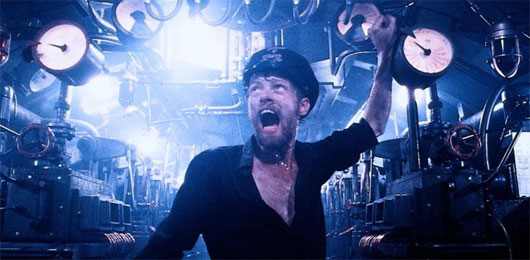
numerous close explosions cause extreme tension.The Captain remains stoical throughout, but
the Chief Mechanic Johann (Erwin Leder) cracks up and the Captain threatens to
shoot him.After several hours of
pounding, the British apparently run out of depth charges and they can breathe
easier and fresher air.
When the sub resurfaces, it
encounters a burning tanker.The Captain
decides to use a torpedo as the coup de grace thinking there is nobody on
board.Oops!They are constrained from picking up any
survivors.War is hell.Johann comes to apologize to the Captain,
thus establishing a redemption arc.The
boat stops in neutral Spain at the port of Vigo.The Germans have a ship set up for
resupplying u-boats.The officers are
wined and dined by ass-kissers who are clueless about the Battle of the
Atlantic.The contrast between the spic
and span noncombatants and the grungy submariners is telling.While on board the lap of luxury, the Captain
receives suicidal orders to run the Strait of Gibraltar to sink ships in the
Mediterranean.
The Captain makes the
head-scratching decision to run the gauntlet at night on the surface.They try to sneak past numerous patrol
vessels and ironically it’s a plane that catches them.They suffer bomb damage and are forced to
dive.It’s an unstoppable dive to the
bottom of the sea.The depth meter
needle stops at 280 meters.Well below
the maximum depth determined by the manufacturer.The list of problems is a mile long.Any one of which will prevent the boat ever
seeing the surface again.The Chief
proves to be an expert fixer and Johann gets to redeem himself.
"Take that, people who determine hull crush depth!"
CLOSING:Surprise,
the sub rises from the depths. Because
God has a conscience, the trip back to La Rochelle is uneventful.They come sailing into the base with smug
looks that are quickly wiped off by a sudden and extremely ironic air attack
that wreaks havoc and sinks the sub.The
sailor who had showed off the picture of his girlfriend is dead meat, but you
did not have to take a walk on the cliché side to die.This is one of the great final scenes in war
movie history.
WOULD CHICKS DIG IT?If they like sweaty, sallow Germans.The language and violence are not too
graphic.There is only one female
character, the cabaret singer.She’s
more for the guys in the audience than their girlfriends.Not exactly a role model.The movie has a horror movie feel to parts of
it, so there’s that aspect.
HISTORICAL ACCURACY:Analyzing this movie for historical accuracy is
problematic.The film is based on a
novel so it is hard to determine what in the novel is true.The movie does follow the book closely which
means the questions about accuracy focus on the book.There was a U-96 and it was commanded by
Heinrich Lehmann-Willenbrock for its first eight patrols.He was the 6th highest u-boat ace
based on tonnage.He won the Iron Cross.The submarine was credited with sinking 27
ships in 11 patrols.Buchheim (Werner in
the movie) was a Navy correspondent who was embedded for propaganda
purposes.It appears that the patrol he
based the book on was the 7th one.My research on that patrol shows that Buchheim enhanced the story quite
a bit.In fact, even if Buchheim used
incidents from other patrols, it is still hard to find the incidents that
appear in the book and in the movie.The
seventh patrol saw the sinking of only one freighter and one significant depth
charging.There was no Gibraltar
incident on any of the patrols.The
u-boat sailed from St. Nazaire (the movie understandably used La Rochelle
because the sub pens are intact there and were essential to the verisimilitude
of the film).It also returned to St.
Nazaire, but not to the reception shown in the film.U-96 was sunk under similar circumstances
when the submarine pens at Wilhelmshaven were bombed in 1945.
So, what could have happened?It seems likely the submariners partied hard
considering the u-boat service had the highest mortality rate of any service in
WWII for any country.Adm. Donitz did
make a habit of seeing off the individual boats.The depressed vibe may be a bit laid on, but
autumn 1941 was the first nonhappy time for the u-boats.In 1941, convoys became more effective and
more escorts came into play.Also,
anti-submarine technology improved with the use of ASDIC (sonar).The movie implies that the u-boat war was on
a path downward from then on, but in reality there was to be a second “happy
time” with the entry of the U.S.The
vibe in the movie is more appropriate for 1943 when the Battle of Atlantic was
clearly lost.It seems unlikely that the
depth of depression and cynicism would have sunk that low by autumn 1941.
The movie
accurately reflects the fear the pinging of sonar caused for the crew.By this stage of the war, Ultra was being
used to reroute convoys away from wolf packs.Of course the U-96 would not have been aware of this and the movie makes
no allusion to the code-breaking.The
movie does make a point of depicting the use of the Enigma machine to decode
messages from submarine command.The
u-boat crews were noted for being outspoken in their cynicism and the Captain
evidences that.As far as the Nazi on
board, this stock character has been criticized, but it seems likely there
would have been someone like him on board.Actually, I would have thought there would have been more than one
fanatic.While the incidents in the
movie can be questioned, the u-boat is as real as it can get.The movie interior was an exact copy of a
Type VII-C on display in the Chicago Museum of Science and Industry.
CRITIQUE:The effort that went into this movie is amazing.It reminds me of “Master and Commander”.I already mentioned the interior, but there
were also several models that were used for exterior scenes.One was an eleven foot long model used for
the ocean storms.It was hollow and
driven by a man laying inside on his stomach.The same model was borrowed by Spielberg for “Raiders of the Lost
Ark”.There were dolls on the tower that
were moved by remote control.For the
depth charge scenes, the interior mockup was on a hydraulic apparatus called a
gimbal that allowed for realistic (even dangerous) hurling of bodies and
objects.The filming in this tight
environment is incredible.A special
version of the steadicam was developed by cinematographer Jost Vacano who wore
padding so he could move and not be hurt by encounters with the walls and
hatchways. One of the great war movie
shots is when the crew rushes to the bow of the boat to speed the crash
dive.It is done in one continuous shot
with no cuts.The cinematography overall
is great.In the opening scene in the
Bar Royal, Vacano has a long shot where the camera moves around the room to
catch the revelry.
The
acting matches the technical virtuousity.The cast was relatively unknown even if Germany.Most went on to good careers.Prochnow is perfect as the Captain and
Wennemann matches him as the Chief.Gronemeyer is appropriately awed, wide-eyed, and terrorized by his
experiences as the neophyte Werner.Erwin Leder makes a good impression as Johann.It was his first acting role and you won’t be
able to forget his face.The entire cast was serious about making the
picture special.They all agreed to
avoid sunlight during the production to get the sallow look.The movie was shot in sequence so the men’s
beards reflected time at sea.The actors
went through a type of boot camp so they could maneuver through the cramped
interior smoothly.
There have been many submarine
movies.It is a subgenre that has had
great staying power and “Das Boot” (even though it is considered the last word
on submarine movies) is not even the last example. Hollywood still finds the cramped confines
conducive to drama.“Phantom” is just
the latest proof that the subgenre will never die.What makes “Das Boot” special is the way it
gets the life of the submariners right.The sailors behave as you would expect a German u-boat crew to
behave.Some veterans took umbrage with
the crude language, but that seems revisionist and the book (by an
ex-submariner) is even cruder.No movie
has depicted life on a WWII submarine better.Any submarine.At screenings in America,
when the statistic of 30,000 German submariners dying appeared on the screen,
the audience applauded.By the end of
the film, few rejoiced in the tragic exemplification of that stat.You care about these men.They are not the enemy.Speaking of which, the movie does not cut to
the anti-submariners.U-96’s foes are
faceless.
The plot is linear and somewhat
episodic.It builds nicely to its overt
anti-war message.It is not perfect,
however.The depth chargings are a bit
repetitive with each topping the last.By the end of the movie, the boat has had everything but the kitchen
sink thrown at it.The movie cannot
escape some of the clichés submarine movies are noted for.It is the opposite in all ways from “U-571”,
but it is not flawless. Judging from my
earlier analysis of submarine cliches, it features two very common ones.The sub has to go below “hull crush depth”
and yet the hull is not crushed.The sub
withstands not one, but three depth chargings with the depth charges exploding
alongside the sub.Unrealistically
close, by the way.It does avoid several
other tropes.There is no command
conflict.The captain is no Ahab hunting
his white whale.Noone is left on deck
during a crash dive and no debris and oil are released to fool the
hunters.Most importantly, the sub is on
a routine patrol.No special mission.
The biggest problem with the
movie is it is implausible in parts.Some of the set-ups are trite.The boat encounters the burning freighter to set up the emotional scene
where they back away from the drowning victims.The Captain threatens to shoot Johann so later he can redeem
himself.Redemption is a common theme in
war movies, but it’s the captain’s threat that makes no sense.I think he would have empathized with a
fellow submariner who had been on numerous patrols.My biggest problem with actions taken in the
movie is with the captain’s decision to try to run through the strait on the
surface.That was an act of insanity by
a leader who the movie has portrayed very positively before then.This reminds me of how Captain Miller in
“Saving Private Ryan” is a role model, but actually a moron
tactically-speaking.For a u-boat ace,
the Captain sure likes to stay on the surface when there are hunters nearby.
CONCLUSION:“Das Boot” is a very good movie, but it is not
great.I have to admit that in my
opinion it is slightly overrated.In the
worthy attempt to be firmly anti-war, it has a narrative arc that is
consistently downward.Each episode is
more depressing than the last until the twist of the ending.In my opinion, the plot would have been more
effective as a roller coaster ride than a downward spiral.This does conform to the novel, but movies
have the right to improve on their sources.“Das Boot” would have been better if it had included some of the thrills
of u-boat combat.There is too much prey
and not enough predator.The torpedoing
of the three enemy ships is given short shrift. The three depth chargings are
not.Is it the third greatest war movie
of all time?It is certainly in the top
twenty, but not in the top five.
RATINGS:
Acting-A
Action-7/10
Accuracy-B
Plot-B
Realism-B
Cliches-B-
GRADE=A
THE BOOK
The
movie tracks the novel closely.It opens
with the cabaret scene, but there is more talk of losses and miraculous
escapes.This better sets the tone of
the dangers of being on a u-boat.The
party is much wilder than it is reenacted by the film.The depth charge scenes are basically the
same as in the book only shorter and the book is told from the perspective of
one crew member – Werner.This gives you
an excellent feel for what he went through as the stand-in for the readers.The movie is able to show multi-perspectives
and the various efforts to make repairs.Because of the visual nature of movies, you get to see what it must have
been like to be on board a u-boat and you can imagine what is going on in their
heads.The movie leaves out some scenes,
but nothing major.Other scenes are
condensed.For example, the storm that
the sub endures is much more lengthy in the book (65 pages covering a two week
storm!).Score one for the movie on this
one.The movie completely skips the
return home after the Gibraltar disaster.This is another good edit considering the highlights of that part of the
voyage are not believable.Speaking of
editing, the book’s dialogue has a lot more sailors discussing sex.I would have to say that in this case my
theory that a war movie should be superior to the book it is based upon applies
to “Das Boot”.Buchheim has a tendency
to drag passages on.The storm scene in
particular is redundant and gets to be boring.The tweeks Petersen adds are improvements.In the book, the Captain does not finish off
the burning freighter and there is no dilemma about picking up survivors.He adds the navigator being wounded in the
air attack off Gibraltar.In the book,
no one is wounded on the patrol.Other
than those small or understandable changes, the movie is one of the best
adaptations of a novel that you can hope to see.It is hard to understand what Buchheim was
upset about.
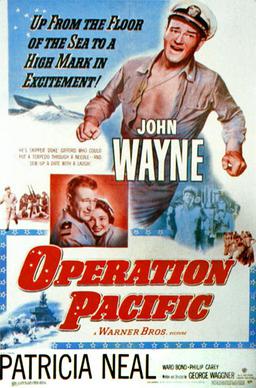
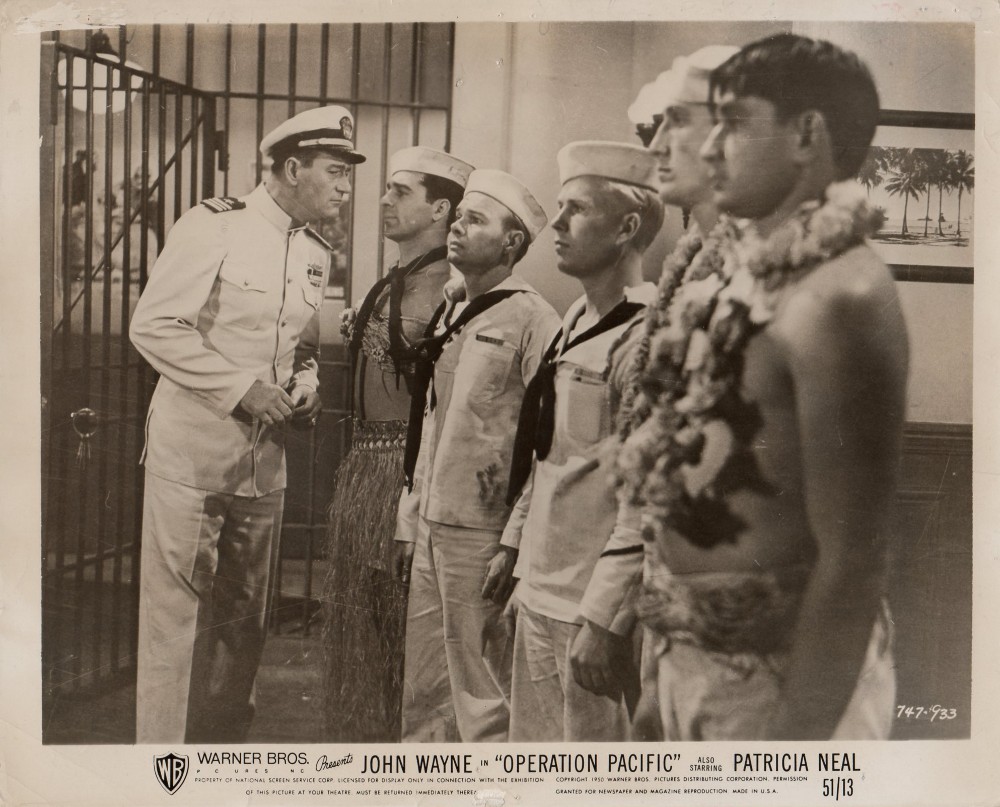
“Operation
Pacific” is a John Wayne WWII submarine movie released in 1951.It was directed by George Waggner (“The
Fighting Kentuckian”).The technical
adviser was Admiral Charles Lockwood, COMSUBPAC.The movie is dedicated to the “Silent
Service”.An opening narration tells the
viewers that after Pearl Harbor the subs had to carry the war effort in the
Pacific.52 subs and 3,500 submariners
were lost during the war.
The opening scene places us squarely in Old School
territory.Lt. Commander Duke (how
original!) Gifford (Wayne) paddles a boat in front of a screen while someone
off screen throws cups of water on him.He rescues a group of nuns and orphans.This was loosely based on the
rescue of some refugees by the USS Crevalle after the fall of the Philippines.
The kids proceed to run all over the sub, thus emphasizing the common theme of
the sub as a family. The problem is not
the damned kids, it’s the damned torpedoes.The Thunderfish fails to sink a fat juicy aircraft carrier because the
torpedoes fail to explode.We know this
because we see a model of a sub in a swimming pool fire torpedoes that literally
bump into the side of an aircraft carrier model.1950s special effects – got to love
them!Speaking of Old School, one of the
seamen actually says “I’m a monkey’s uncle”.
"Sorry sailor, these waters are closed"
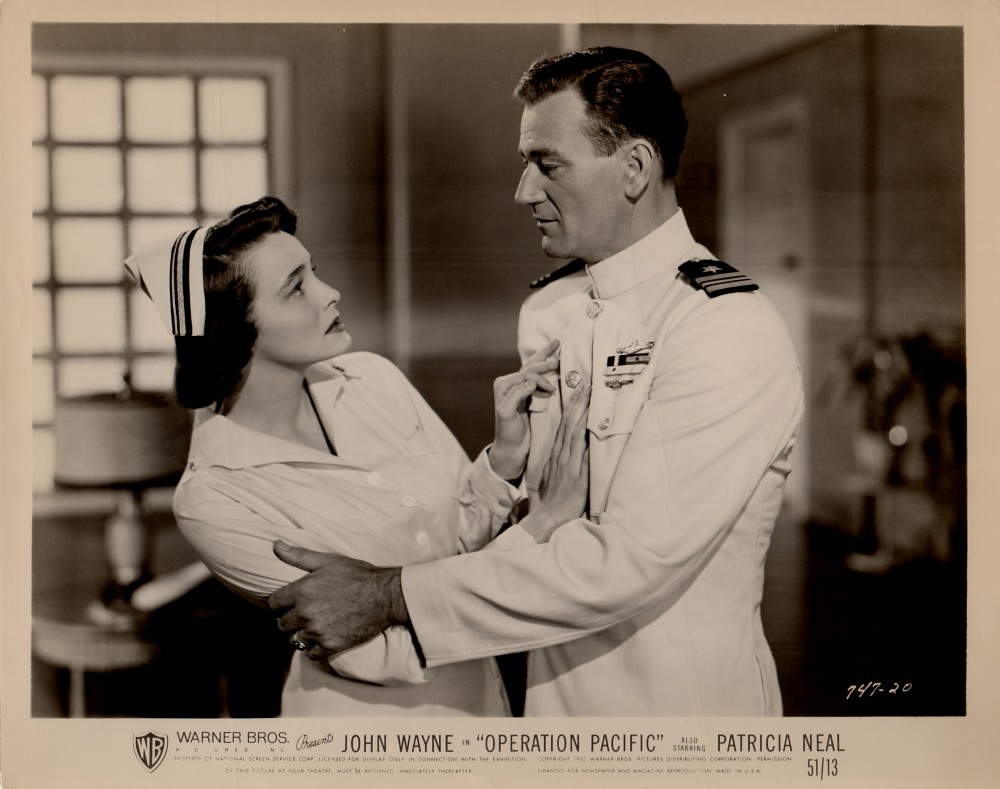
When the Thunderfish returns to Pearl, we enter the
romance phase of the movie.Groan!It seems Gifford is divorced from a nurse
called Mary Stuart (Patricia O’Neal).Would you believe they divorced because he chose the service over her
and their child?(Sounds like Sgt.
Stryker in "Sands of Iwo Jima".)He chose his sub family over
his real family.However, now that he is
back on shore, he wants Mary back.And
it’s not just because he misses the nookie.Love triangle alert! Capt. Perry’s (Ward Bond) kid brother wants Mary
also.Fat chance, even Perry wants
Gifford to win.While this chemistry-less
romance is exciting the females in the audience, the guys get the naval trope
of Gifford bailing out his crew after a drunken brawl.
the end to every shore leave
Back asea the Thunderfish montages its way through
the Japanese fleet.Some of this is real
footage.The Thunderfish would have won
the war itself if it wasn’t for those damned torpedoes.Queue the big set piece.They surface when a freighter raises a white
flag.Oops, it’s a disguised
warship!Those dastardly Nips.Actually,
the U.S. used Q-Ships in the Pacific and the Japanese did not.The Captain is wounded by machine gun
fire and orders the sub to dive while he is still on deck.This is
based on the Medal of Honor actions of Howard Gilmore.Gilmore was wounded in a duel with a gun boat
which the USS Growler had rammed.The
sub dove, but when it resurfaced there was no pay back on the Japanese
ship.Duke takes command and
resurfaces to ram and sink the Japanese ship.Revenge accomplished.Gifford in
command accomplished.
"Ramming speed!"
Enough is enough.Back at Pearl, the crew solves the torpedo problem by dropping them on
their noses. (The idea apparently comes from a
fourteen year old in the crew.)This actually happened, but it was done by
experts, not a sub crew.Surprisingly,
although everyone in the movie and in the audience is hoping for a
reconciliation, Mary jilts Duke.Oh,
well – it’s back to action.
There’s a wink-wink moment on this tour as the crew
gets to watch a submarine movie.It’s
clearly “Destination Tokyo”.The crew is
bored and finds it unrealistic.Get
it?They undergo a depth charging that
is not too clicheish.They sink a
carrier because the torpedoes work now.Then they end up in the middle of the Battle of Leyte Gulf which they
win by themselves.Not really, they get
some help.
"What do you mean the wrong actor is at the periscope?"
As submarine movies go, “Operation Pacific” is in the
middle of the pack.As Wayne war movies
go, it’s below average.It is definitely
Old School, but does avoid most of the tired clichés.There is no going below the maximum depth
scene.No rivets pop.There is no jettisoning debris to fake
sinking.The special effects are lame
even for 1951.I’m no fan of CGI but it
beats a model in a swimming pool.Yet,
the effects were praised at the time.Cheesy is still cheesy.Speaking
of – the music by Max Steiner is schmaltzy and I’m not just referring to the
romance scenes.There’s a laughable
moment when the Japanese fleet sails into sight with stereotypical Japanese
music playing.The cinematography is
fine.
The big flaw is the plot.The romance goes nowhere.Throwing in a challenger for Mary’s
affections is laughable.Either Duke is
going to have her or no one will.The
movie is also predictable.Perry is dead
meat as there is no chance John Wayne is going to stay subordinate to Ward
Bond!Some of the action is
ridiculous.This is especially true of
the scene where they ram the disguised freighter.Gilmore’s death was powerful enough without
Hollywoodizing it.
Classic or antique?Definitely antique.There are
many better sub movies.There are many
better John Wayne movies.


URtyQ~~60_35.JPG?set_id=880000500F)