Showing posts with label Wolfgang Petersen. Show all posts

Saturday, March 12, 2016

CRACKER? Troy (2004)


                I recently taught “The Iliad” for the fortieth time in my Western Civilization class, so I decided to rewatch “Troy” and review it with an eye to how close the movie retells the epic poem.   It seems appropriate that a web site that reviews war movies should examine a movie based on the first war story in Western literature.  Before you say “what took you so long?”, I want to point out that I did review the movie as part of my Best War Movie of the 21st Century Tournament.  (It defeated “The Last Samurai”, but lost to “Master and Commander”.)  This review will concentrate on the plot. So if you haven’t read “The Iliad” - spoiler alert.  And, come on, get that off your bucket list!  And, if you think watching this movie takes the place of reading Homer’s incredibly long poem, think again.  (But high school students trying to avoid reading the poem and using my review instead, you’re welcome!)

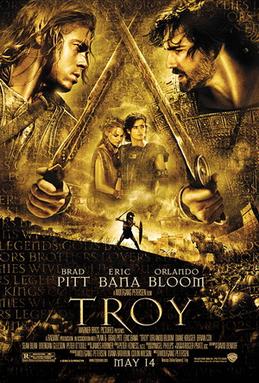
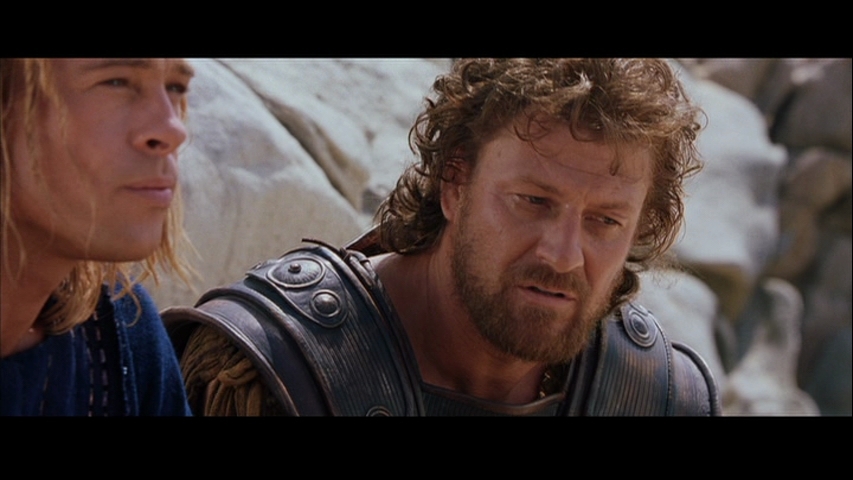
                “Troy” is actually the story of the entire Trojan War whereas “The Iliad” covers just six months in the ninth year.  A title card introduces the movie with background information pre-war.  King Agamemnon (Brian Cox) has united the Greek cities into a loose alliance, except for Thessaly. His brother Menelaus (Brendan Gleeson) is negotiating peace with Princes Hector (Eric Bana) and Paris (Orlando Bloom) of Troy. While the King of Sparta is making peace, his brother is making war with Thessaly.  Instead of a bloody battle, it is decided that each army will put up a champion for a duel.  Agamemnon’s champ is Achilles (Brad Pitt), which is awkward because they despise each other.  The duel ends with Achilles doing his signature move.  Meanwhile, back in Sparta, Menelaus’ wife Helen (Diane Kruger) is showing Paris more than the normal hospitality.  This could end up ramming (this is Ancient Greece) the peace treaty.  Especially when Helen elopes with Paris.  When Hector finds out, he decides bro and his ho before the entire population of Troy.  Menelaus goes crying to big brother, who uses the cuckolding as an excuse to conquer Troy.  If that is going to happen, the Greeks will need their main man Achilles.  Odysseus (Sean Bean) convinces Achilles to accompany the expedition in spite of it being suicidal for Achilles.  Achilles’ mother points out that it is better to die a glorious death and be remembered forever than to provide her with grandchildren.  Odysseus points out that since he is being played by Sean Bean, he is committing suicide also.
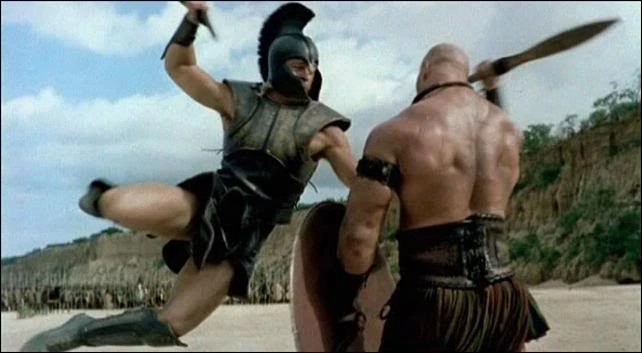
the move - as described by Homer

                Achilles leads the beach assault.  He and his Myrmidons avoid the fire arrows by getting into a testudo.  Romans, take note.  Achilles is a killing machine and the entire Trojan army retreats from him.  To add insult to injury, he desecrates the Temple of Apollo.  Hector rides to the rescue and finds out why Achilles is the J.J. Watts of the Greek army.  Achilles nobly spares Hector’s life because it is too early in the movie for that duel.  Or as Achilles puts it:  “It’s too early in the day for killing princes”.  The victory celebration is marred by Achilles and Agamemnon debating who deserves credit for the win.  Agamemnon’s argument is the king determines who gets the credit – and that would be me.  Achilles responds with:  “War is young men dying and old men talking”.  Oh, snap!  To emphasize where the power lies, Agamemnon insists on taking a beautiful captive girl named Briseis (Rose Byrne – Angelina Jolie not available?) away from Achilles and makes it clear she will not be just dusting his tent.  Achilles is so upset he says “you sack of wine!”  He’s more of a physical fighter than a verbal taunter.  Until his sex slave is returned, he will not kill any more thousands of Trojans.

                At a Trojan council meeting, Paris stops the debating by proposing a duel with Menelaus to end the war.  (The royal family rushes to place bets on Menelaus.)  The duel between the vengeance-minded brute and the wimpy, ladies-man goes as you would expect.  End of war and end of movie, right?  Except that the winner dies and the war continues with a phalanx battle.  Trojan archers from the city walls turn the tide and the Greeks retreat.  This would never have happened if Achilles were here, so Agamemnon returns Briseis who is so grateful to have that weight lifted from her chest that she falls in love with Achilles. Good sex is not enough to rekindle Achilles' blood-lust.  A night attack using fire-balls (Spartacus take note) puts the Greeks on the brink of having to accept that a semi-hot chick might not be returning with them.

                When the daylight comes, Achilles best buddy Patroclus (Garrett Hedlund) sneaks off in Achilles’ armor and leads a counterattack.  Like on a playground, everyone gathers around for the duel between the faux Achilles and Hector.  Patroclus may look like Achilles, but…  Achilles is not going to take this well.  But on the plus side, Achilles will stop his pouting and return to slaughtering.  But first, he has some unfinished business with Hector.  Achilles calls Hector out (literally) and they have the type of fight that you would expect from two superstar actors who refuse to use stuntmen and rely on robotic choreography.  The duel turns when Hector trips over the only rock located on the plain outside Troy.  In a great act of poor sportsmanship, Achilles drags the corpse back to the camp.  ( I assume this was not in the original script, but was an idea that came to the ever-competitive Pitt.)  Later, King Priam (Peter O’Toole) comes to beg his son’s body back and prove that he can still act circles around these young whippersnappers.  Patroclus is cremated in the third funeral pyre scene in the movie.  At this rate they are going to run out of coins to put on eyes.  This, by the way, is where “The Iliad” ends, but the movie goes on to conclude the war because too many theatergoers have money riding on who wins the war.
ladies, he wants you

                Odysseus (Sean Bean is still alive!) gets a bright idea for a way into the city.  The horse does look like it was built from ship timbers.  Nice prop!  Paris wants to burn it, but being the most unpopular man in Troy, no one listens.  During the night, Achilles and other sneaky Greeks initiate the sack of Troy.  Achilles is not interested in the fun stuff – looting, raping, killing.  He is on a quest to rescue Briseis.  Andromache and Helen escape, along with Aeneas – a character introduced so intellectuals can feel superior to the rest of the audience.  Google him.  Agamemnon stabs Priam in the back (literally).  And as though that does not bring enough hisses, he moves on to abusing Briseis.  She stabs him in the neck.  It’s like a gift for her boy-friend Achilles.  But before he can thank her, Paris puts an arrow in his ankle.  Lucky inaccurate shot!  The next three shots are more accurate.  Who wants to see Achilles die from an errant arrow to the ankle?  Paris and Briseis escape.  He knows a way out – he would!  Another funeral pyre.  Sean Bean survives!  Maybe there will be a sequel featuring Odysseus.  Is there a story that could be adapted into a screenplay?
a Trump rally

                My belief is that a movie should improve upon the book it is based upon.  “Troy” is a mixed bag in that respect.  It jettisons the ridiculous role played by the gods in the war, but then the screenplay changes the deaths of virtually every main character and messes with the ending in a move purely aimed at satisfying the audience.  In many ways the movie treats the audience as dummies.  This includes the simplistic theme of glory equals immortality.  This differs from Homer’s theme of “the wrath of Achilles” because Brad Pitt can’t be seen playing a jerk.  In reality, Achilles is one of the great heels in history.  The movie plays into the common ignorant belief that he was a hero.  For this reason, Pitt’s Achilles does not commit atrocities like cutting the throats of twelve prisoners at Patroclus’ funeral as he does in “The Iliad”.  The transformation of Achilles to an empathetic, lady-rescuer is laughable.   Although Achilles is not quite the brute of “The Iliad”, the other characters are spot on in their personalities.  The movie insists on making Agamemnon into a supervillain which is beyond Homer’s depiction of him as a dick.  The cast is all-star and they do a good job.  At least the men do, the female characters are weaker.  The biggest problem being the key role of Helen.  A little known Diane Kruger was cast and she is not up to playing the most beautiful woman in the Ancient World.  (Why not the modern “face that launched a thousand ships” – Jennifer Anniston?  Another case of a Pitt veto?)
she's pretty, but a thousand ships?

                “Troy” has all the strengths and weaknesses of an epic.  Director Wolfgang Petersen (“Das Boot”) knows how to make crowd-pleasing, big budget blockbusters.  He uses CGI well for the fleet and army scenes, but there are still a lot of extras in the film.  The sets are kitschy.  Basically what a modern interior designer imagined a Trojan palace would have looked like.  The dialogue matches the look.  It is pompous and heavy-handed.  “I will remember your name”.  (Because that is the theme of this movie.)  “I hate Achilles”.  (In case my scowl is not clear enough.)  The cinematography is showy.  There is a tracking shot over the beach that cribs from “The Longest Day”.  There is a sudden appearance of POV when Paris fights Menelaus.  Petersen can’t force explosions in, but he does manage to get rolling fire balls.  (Fire – the go-to effect until Alfred Noble revolutionized action movies.)  The score is what you would expect.  James Horner took over after test audiences found Gabriel Yared’s work too old-fashioned. I found Horner’s work too “Enemy at the Gates”.  Is it okay to plagiarize from yourself?  He actually was accused by some critics of stealing from several classical composers.

                As a combat film, the movie is visceral, but anachronistic.  If you read Homer, most of the fighting involves individual duels.  The movie stops to reenact the key duels, but the rest of the combat is basically a Hollywood melee.  The Greeks did not fight this way at that time.  The movie also pays lip service to the use of chariots, but in the “Iliad” every prominent warrior used a chariot to move to and retreat from the battlefield.  The role of archery is ginned up because Hollywood loves blizzards.  Hollywood also loves twists.  This explains why the Homer-challenged are fooled into thinking Hector has killed Achilles.  One good thing about the combat is it is not repetitive, like in Homer.  Each battle scene is different.  And they are spaced out so the movie does have a nice flow and no long boring stretches. 
"it's not so bad - dying, the gods know I've
done it enough times"

                “Troy” will not make my 100 Best War Movies list.  It is a great example of how Hollywood tampers with classic literature to make it more appealing to modern audiences.  I will be doing a “Homer vs. Hollywood” post in the future, but as a preview, “Troy” is far from a Cliff Notes version of “The Iliad”.  Please do not watch it and then take reading “The Iliad” off your bucket list.


GRADE  =  C   


Monday, July 14, 2014

#3 - Das Boot (Director’s Cut) (1997)


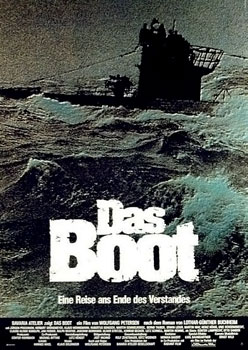
BACK-STORY:  “Das Boot” (“The Boat”) is a German submarine movie directed by Wolfgang Petersen.  Originally the movie was going to be made by John Sturges starring Robert Redford and then by Don Siegel starring Paul Newman.  Thankfully, both projects fell through.  It is based on the novel by Lothar-Gunther Buchheim.  Although fictional, Buchheim used his experience as a correspondent on U-96 on a tour in 1941.  The Werner (Herbert Gronemeyer) character is based on Buchheim.  Buchheim began as a technical adviser, but had a falling out with Petersen because of what Buchheim considered unrealistically enhanced dramatic license.  The movie took three years to produce (1979-81) and was the most expensive German film up to then.    It was released in 1981 at 150 minutes and then shown as a miniseries at 300 minutes.  The version I am reviewing is the definitive Director’s Cut which clocks in at 209 minutes.  The original version was a big hit in Germany and the U.S.  It was an even bigger critical success.  It was nominated for Academy Awards for Director, Cinematography, Adapted Screenplay (Petersen), Film Editing, Sound, and Sound Effects Editing.  Stunningly, it was not nominated for Foreign Film.


OPENING:  The movie opens at La Rochelle, France in the autumn of 1941.  We are informed that the u-boat fleet is beginning to suffer heavy losses.  By the end of the war only 10,000 of 40,000 submariners will have survived tne war.  The Captain (Jurgen Prochnow), the Chief (Klaus Wennemann), and Werner arrive at the base and Werner gets his first taste of the submarine service when some of the drunken crewmen piss on their car as it passes by.  (I don’t mean taste literally.)  The enlisted are not the only ones “preparing” for their next tour, the officers are partying at a French cabaret.  The scene is reminiscent of a cinematic fighter squadron on a regular night except that these guys are going to be away from debauchery for a couple of months.  They party like there’s no tomorrow partly because they know that is reality.

SUMMARY:  The next day the U-96 sets sail.  Werner is given a tour of the boat.  It is very crowded and narrow.  Spaces are filled with supplies, even one of the two latrines.  Sausages hang from the ceiling.  We are introduced to the key members of the crew.  There are 48 men on board a boat that would have had 24 in peacetime.  The First Watch Officer (Hubertus Bengsch) is the only Nazi fanatic.  The rest of the officers are cynical and war-weary.  The Captain, in particular, makes biting remarks about the “braggarts” that run the government and to needle the “Hitler Youth leader” (the FWO) insists on singing “Tipperrary”. 

                The next twenty days are ones filled with boredom. A sailor flicks a booger at another.  This boredom switches to terror instantly when the boat is surprised by a British destroyer.  The sub dives below its maximum depth of 160 meters and withstands a depth charging.  There is no warning of the explosions for the crew or the audience.  For some reason, the destroyer gives up and they move on to a convoy.  They manage to torpedo three freighters, but then its payback time for the escorts.  The depth charging is much worse this time.  Leaks, flying bolts, a fire, and numerous close explosions cause extreme tension.  The Captain remains stoical throughout, but the Chief Mechanic Johann (Erwin Leder) cracks up and the Captain threatens to shoot him.  After several hours of pounding, the British apparently run out of depth charges and they can breathe easier and fresher air.


                When the sub resurfaces, it encounters a burning tanker.  The Captain decides to use a torpedo as the coup de grace thinking there is nobody on board.  Oops!  They are constrained from picking up any survivors.  War is hell.  Johann comes to apologize to the Captain, thus establishing a redemption arc.  The boat stops in neutral Spain at the port of Vigo.  The Germans have a ship set up for resupplying u-boats.  The officers are wined and dined by ass-kissers who are clueless about the Battle of the Atlantic.  The contrast between the spic and span noncombatants and the grungy submariners is telling.  While on board the lap of luxury, the Captain receives suicidal orders to run the Strait of Gibraltar to sink ships in the Mediterranean. 


                The Captain makes the head-scratching decision to run the gauntlet at night on the surface.  They try to sneak past numerous patrol vessels and ironically it’s a plane that catches them.  They suffer bomb damage and are forced to dive.  It’s an unstoppable dive to the bottom of the sea.  The depth meter needle stops at 280 meters.  Well below the maximum depth determined by the manufacturer.  The list of problems is a mile long.  Any one of which will prevent the boat ever seeing the surface again.  The Chief proves to be an expert fixer and Johann gets to redeem himself.


"Take that, people who determine hull crush depth!"

CLOSING:   Surprise, the sub rises from the depths. 
Because God has a conscience, the trip back to La Rochelle is uneventful.  They come sailing into the base with smug looks that are quickly wiped off by a sudden and extremely ironic air attack that wreaks havoc and sinks the sub.  The sailor who had showed off the picture of his girlfriend is dead meat, but you did not have to take a walk on the cliché side to die.  This is one of the great final scenes in war movie history. 

WOULD CHICKS DIG IT?  If they like sweaty, sallow Germans.  The language and violence are not too graphic.  There is only one female character, the cabaret singer.  She’s more for the guys in the audience than their girlfriends.  Not exactly a role model.  The movie has a horror movie feel to parts of it, so there’s that aspect.

HISTORICAL ACCURACY:  Analyzing this movie for historical accuracy is problematic.  The film is based on a novel so it is hard to determine what in the novel is true.  The movie does follow the book closely which means the questions about accuracy focus on the book.  There was a U-96 and it was commanded by Heinrich Lehmann-Willenbrock for its first eight patrols.  He was the 6th highest u-boat ace based on tonnage.  He won the Iron Cross.  The submarine was credited with sinking 27 ships in 11 patrols.  Buchheim (Werner in the movie) was a Navy correspondent who was embedded for propaganda purposes.  It appears that the patrol he based the book on was the 7th one.  My research on that patrol shows that Buchheim enhanced the story quite a bit.  In fact, even if Buchheim used incidents from other patrols, it is still hard to find the incidents that appear in the book and in the movie.  The seventh patrol saw the sinking of only one freighter and one significant depth charging.  There was no Gibraltar incident on any of the patrols.  The u-boat sailed from St. Nazaire (the movie understandably used La Rochelle because the sub pens are intact there and were essential to the verisimilitude of the film).  It also returned to St. Nazaire, but not to the reception shown in the film.  U-96 was sunk under similar circumstances when the submarine pens at Wilhelmshaven were bombed in 1945. 


So, what could have happened?  It seems likely the submariners partied hard considering the u-boat service had the highest mortality rate of any service in WWII for any country.  Adm. Donitz did make a habit of seeing off the individual boats.  The depressed vibe may be a bit laid on, but autumn 1941 was the first nonhappy time for the u-boats.  In 1941, convoys became more effective and more escorts came into play.  Also, anti-submarine technology improved with the use of ASDIC (sonar).  The movie implies that the u-boat war was on a path downward from then on, but in reality there was to be a second “happy time” with the entry of the U.S.  The vibe in the movie is more appropriate for 1943 when the Battle of Atlantic was clearly lost.  It seems unlikely that the depth of depression and cynicism would have sunk that low by autumn 1941.

  The movie accurately reflects the fear the pinging of sonar caused for the crew.  By this stage of the war, Ultra was being used to reroute convoys away from wolf packs.  Of course the U-96 would not have been aware of this and the movie makes no allusion to the code-breaking.  The movie does make a point of depicting the use of the Enigma machine to decode messages from submarine command.  The u-boat crews were noted for being outspoken in their cynicism and the Captain evidences that.    As far as the Nazi on board, this stock character has been criticized, but it seems likely there would have been someone like him on board.  Actually, I would have thought there would have been more than one fanatic.    While the incidents in the movie can be questioned, the u-boat is as real as it can get.  The movie interior was an exact copy of a Type VII-C on display in the Chicago Museum of Science and Industry.


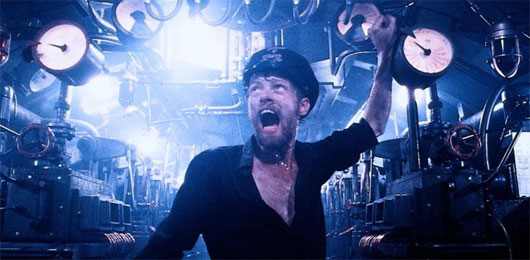
CRITIQUE:  The effort that went into this movie is amazing.  It reminds me of “Master and Commander”.  I already mentioned the interior, but there were also several models that were used for exterior scenes.  One was an eleven foot long model used for the ocean storms.  It was hollow and driven by a man laying inside on his stomach.  The same model was borrowed by Spielberg for “Raiders of the Lost Ark”.  There were dolls on the tower that were moved by remote control.  For the depth charge scenes, the interior mockup was on a hydraulic apparatus called a gimbal that allowed for realistic (even dangerous) hurling of bodies and objects.  The filming in this tight environment is incredible.  A special version of the steadicam was developed by cinematographer Jost Vacano who wore padding so he could move and not be hurt by encounters with the walls and hatchways.  One of the great war movie shots is when the crew rushes to the bow of the boat to speed the crash dive.   It is done in one continuous shot with no cuts.  The cinematography overall is great.  In the opening scene in the Bar Royal, Vacano has a long shot where the camera moves around the room to catch the revelry. 


                   The acting matches the technical virtuousity.  The cast was relatively unknown even if Germany.  Most went on to good careers.  Prochnow is perfect as the Captain and Wennemann matches him as the Chief.  Gronemeyer is appropriately awed, wide-eyed, and terrorized by his experiences as the neophyte Werner.  Erwin Leder makes a good impression as Johann.  It was his first acting role and you won’t be able to forget his face.    The entire cast was serious about making the picture special.  They all agreed to avoid sunlight during the production to get the sallow look.  The movie was shot in sequence so the men’s beards reflected time at sea.  The actors went through a type of boot camp so they could maneuver through the cramped interior smoothly.


                There have been many submarine movies.  It is a subgenre that has had great staying power and “Das Boot” (even though it is considered the last word on submarine movies) is not even the last example.  Hollywood still finds the cramped confines conducive to drama.  “Phantom” is just the latest proof that the subgenre will never die.  What makes “Das Boot” special is the way it gets the life of the submariners right.  The sailors behave as you would expect a German u-boat crew to behave.  Some veterans took umbrage with the crude language, but that seems revisionist and the book (by an ex-submariner) is even cruder.  No movie has depicted life on a WWII submarine better.  Any submarine.  At screenings in America, when the statistic of 30,000 German submariners dying appeared on the screen, the audience applauded.  By the end of the film, few rejoiced in the tragic exemplification of that stat.  You care about these men.  They are not the enemy.  Speaking of which, the movie does not cut to the anti-submariners.  U-96’s foes are faceless.


                The plot is linear and somewhat episodic.  It builds nicely to its overt anti-war message.  It is not perfect, however.  The depth chargings are a bit repetitive with each topping the last.  By the end of the movie, the boat has had everything but the kitchen sink thrown at it.  The movie cannot escape some of the clichés submarine movies are noted for.  It is the opposite in all ways from “U-571”, but it is not flawless.  Judging from my earlier analysis of submarine cliches, it features two very common ones.  The sub has to go below “hull crush depth” and yet the hull is not crushed.  The sub withstands not one, but three depth chargings with the depth charges exploding alongside the sub.  Unrealistically close, by the way.  It does avoid several other tropes.  There is no command conflict.  The captain is no Ahab hunting his white whale.  Noone is left on deck during a crash dive and no debris and oil are released to fool the hunters.  Most importantly, the sub is on a routine patrol.  No special mission.

                The biggest problem with the movie is it is implausible in parts.  Some of the set-ups are trite.  The boat encounters the burning freighter to set up the emotional scene where they back away from the drowning victims.  The Captain threatens to shoot Johann so later he can redeem himself.  Redemption is a common theme in war movies, but it’s the captain’s threat that makes no sense.  I think he would have empathized with a fellow submariner who had been on numerous patrols.  My biggest problem with actions taken in the movie is with the captain’s decision to try to run through the strait on the surface.  That was an act of insanity by a leader who the movie has portrayed very positively before then.  This reminds me of how Captain Miller in “Saving Private Ryan” is a role model, but actually a moron tactically-speaking.  For a u-boat ace, the Captain sure likes to stay on the surface when there are hunters nearby.

CONCLUSION:  “Das Boot” is a very good movie, but it is not great.  I have to admit that in my opinion it is slightly overrated.  In the worthy attempt to be firmly anti-war, it has a narrative arc that is consistently downward.  Each episode is more depressing than the last until the twist of the ending.  In my opinion, the plot would have been more effective as a roller coaster ride than a downward spiral.  This does conform to the novel, but movies have the right to improve on their sources.  “Das Boot” would have been better if it had included some of the thrills of u-boat combat.  There is too much prey and not enough predator.  The torpedoing of the three enemy ships is given short shrift. The three depth chargings are not.  Is it the third greatest war movie of all time?  It is certainly in the top twenty, but not in the top five.

RATINGS: 

Acting  -  A
Action  -  7/10
Accuracy  -  B
Plot  -  B
Realism  -  B
Cliches  -  B-

GRADE  =  A

THE BOOK

                The movie tracks the novel closely.  It opens with the cabaret scene, but there is more talk of losses and miraculous escapes.  This better sets the tone of the dangers of being on a u-boat.  The party is much wilder than it is reenacted by the film.  The depth charge scenes are basically the same as in the book only shorter and the book is told from the perspective of one crew member – Werner.  This gives you an excellent feel for what he went through as the stand-in for the readers.  The movie is able to show multi-perspectives and the various efforts to make repairs.  Because of the visual nature of movies, you get to see what it must have been like to be on board a u-boat and you can imagine what is going on in their heads.  The movie leaves out some scenes, but nothing major.  Other scenes are condensed.  For example, the storm that the sub endures is much more lengthy in the book (65 pages covering a two week storm!).  Score one for the movie on this one.  The movie completely skips the return home after the Gibraltar disaster.  This is another good edit considering the highlights of that part of the voyage are not believable.  Speaking of editing, the book’s dialogue has a lot more sailors discussing sex.  I would have to say that in this case my theory that a war movie should be superior to the book it is based upon applies to “Das Boot”.  Buchheim has a tendency to drag passages on.  The storm scene in particular is redundant and gets to be boring.  The tweeks Petersen adds are improvements.  In the book, the Captain does not finish off the burning freighter and there is no dilemma about picking up survivors.  He adds the navigator being wounded in the air attack off Gibraltar.  In the book, no one is wounded on the patrol.  Other than those small or understandable changes, the movie is one of the best adaptations of a novel that you can hope to see.  It is hard to understand what Buchheim was upset about. 


the trailer