Showing posts with label B-17. Show all posts

Saturday, January 27, 2024

Masters of the Air (2024)


            It has only taken eleven years, but we finally have the last part of the Spielberg / Hanks WWII trilogy.  It was 2012 when HBO first announced the project.  In 2019, HBO dropped and Apple + took over.  Filming began in 2021, but the Covid pandemic set the project back.  The series is based mainly on the book “Masters of the Air:  America’s Bomber Boys Who Fought the Air War Against Nazi Germany” by Donald Miller.  It concentrates on the 100th Bomber Group, which was known as the “Bloody Hundredth”.  First, that would have been a better title.  Second, don’t get too invested in any of the characters.  The first three episodes were directed by Cary Fukunaga (“Beasts of No Nation”).  The series cost about $250 million, which might explain the nine episodes, instead of ten.

            The series gets started by immediately explaining why the two main characters are named Buck (Austin Butler) and Bucky (Callum Turner).  This is our first clue that the teleplays will adhere to historical accuracy.  Major Gale “Buck” Cleven and Major John “Bucky” Egan are best friends in the 100th Bomber Group.  It is headed for Great Britain.  Bucky goes on ahead so we can have a stricken bomber scene in the first episode.  This will not be “Band of Brothers” which introduced the characters by way of boot camp.  The group follows along via Greenland.  Buck has to make a landing in gale force winds, proving he is a very talented pilot who is perpetually cool.  The first mission is to bomb u-boat pens.  The mission is aborted.  Another clue that the series will be fact-based. 

            By the second episode, the group has a new commanding officer.  This episode gives props to the ground crews.  Our first successful mission is to Norway.  It completes the redemption arc for sad sack navigator Lt. Harry Crosby (Anthony Boyle).  The other focus is on the bomber piloted by Lt. Curtis Biddick (Barry Keoghan).  Bucky has to decide whether to slow the group down to protect Biddick’s ship.  We get our second crash landing.  It’s not the “Bloody Hundredth” yet, but is already apparent that getting to 25 missions will be very difficult. 

            The cast can be underwhelming, but so were the casts of BoB and The Pacific.  Austin Butler is the only major star and he is perfect as Buck.  Those who haven’t seen “Elvis” are going to be exposed to a heavy dose of his charisma and good looks.  If the project wanted to draw female viewers, he was an outstanding choice.  It is probable that years from now, the rest of the main actors will be familiar faces.  And Maj. Gale Cleven will be famous, like Dick Winters.  I have not read the book yet, so I cannot affirm whether the other characters are actual people.  As of now, only Harry Crosby (who wrote a book entitled “Wing and a Prayer”) and Harold Huglin (the first commanding officer) have Wikipedia pages.  That will be changing.  I double checked on Cleven and he is based on a real B-17 pilot, but I did not read when he died.  One of the suspenseful factors in the series will be seeing who will survive.  It could be brutal.  And should be brutal.  As the air war was.

            Truthfully, after Cleven, the biggest star in the movie is the B-17 Flying Fortress.  It was the third most produced bomber in history after the B-24 Liberator and the Ju-88 (which is mentioned as attacking the “Bloody Hundredth”).  I pray B-24 veterans can tap into the homage to all bomber crews.  The B-17 is the third most famous plane from WWII (first and second being the Spitfire and the Mustang), but I doubt most viewers are familiar with it.  Everyone that watches the series will learn that it carried 10 crewmen.  That makes doing the math (or maths) is easy.  60 downed bombers meant 600 Americans either killed or captured (I think one of the threads will be covering a captured crew).  And viewers will learn that the bomber could take a beating.  Despite this, many will be going down.  There is a scene where the Yanks get into a discussion with some Brits about daylight bombing versus night bombing.  The snooty Limeys warn that the losses will be untenable.  Our boys accuse the Brits of trading safety for terrible bombing results.  This discussion was much too brief.  Hopefully, the series will return to it after some of the characters have died flying in broad daylight to bomb heavily defended targets.  It’s an issue that needs discussion. 

            Besides the actors and their characters, the other big question is how good the special effects are.  It is clearly apparent from the first two episodes that a lot of the $250 million went into visual effects.  They are amazing.  So good, that you will wonder whether they used actual B-17s for some taxiing and flight scenes.  They did create three replicas, one oversized model for interior filming (which is authentic).  The CGI is flawless.  That includes the belly landing.  We no longer need to pay a very  brave stunt pilot (Paul Mantz did it for $4,500) to crash land a Flying Fortress, like in “Twelve O'Clock High”.   The flak effects stand out.  It is those scenes that will make you wonder how anyone survived those missions.  And then you add in the fighters, which realistically whiz by in a blur.  How the heck did they ever manage to shoot any down?  And how did the gunners avoid hitting other bombers?  

            It’s too early to compare the series to the others in the trilogy.  The first two episodes set the hook.  The effects don’t disappoint.  The cast looks comfortable in their roles.  They went through a two-week boot camp with Dale Dye.  The dialogue gets the banter right.  Although there are some cliches, like the redemption for the navigator, the drinking scenes, and countingthe bombers when they return,  the series looks like it will be grounded in reality.  I saw nothing that caused me to shake my head.  I just hope viewers don’t find the series boring because it sticks to what actually happened to men like Cleven and Egan.  And I hope the series does not sugar-coat the losses.  Only one of four bomber crews reached 25 missions in 1943.  The series should be as brutal as “The Pacific”.  Here’s hoping I shed some tears.

GRADE  =  B+


Wednesday, June 12, 2019

WAR DOC: The Cold Blue (2018)


                With the ending of “Game of Thrones”, people have been considering cancelling their subscriptions to HBO.  Let me assure you, there is more to HBO than GoT.  I originally subscribed because of “Band of Brothers” and stayed with it through “The Pacific” and “Generation Kill”.  Before that, HBO gave us one of the best WWII movies – “When Trumpets Fade”.   I’ll hang onto my subscription as I wait for the series on the 8th Air Force.  Meanwhile, to tide war movie fans over, HBO provides us with a magnificent documentary on the bomber crews of the 8th.  Recently, fifteen hours of footage shot by William Wyler’s cinematographers in 1943 were discovered in the vaults of the National Archives.  The footage was comprehensive and included life at the bases and in the air.  Wyler and his three cinematographers flew on many dangerous missions.  Wyler (“Mrs. Miniver”) used the footage for his acclaimed documentary “The Memphis Belle:  A Story of a Flying Fortress”, which was released in 1944 and wowed audiences with its color photography.  Director Erik Nelson restored the footage and interviewed nine veterans. 

                The documentary begins with a reference to the “Memphis Belle”, but once the connection is made, the film becomes an tribute to all the bomber crews.  It is structured around chapters on various aspects of the veterans’ experiences.  There is no narration, but Nelson does provide title cards giving interesting facts and background information.  Some of the “chapters” are on topics like pre-flight, briefing, take-off, forming up, testing guns, flak, the bomb run, fighters, and the return.  Even the ground crews get their due.  The memories of the vets are coordinated with the footage flawlessly.  And we don’t see repetitive footage like in many similar documentaries.  All of it is color, and not colorized.  The visuals are stunning, especially the aerial views.  There is an ode to contrails.  It seems incongruous that war can be so beautiful, but the shots of the ground and the bombers in formation are amazing.  Nelson’s addition of the sounds of aerial combat and the mainly orchestral score complete the picture.
                  
                 I’m sure the 8th Air Force series will be very entertaining, but it might not be as informative as this doc.  Nelson does not hammer away at the various topics, but some themes develop.  One is that war requires young men because they do not think anything will happen to them.  This despite the title cards telling us that the chances of reaching 25 mission like the Memphis Belle did were not good.  It wasn’t just death that claimed the men, the conditions included freezing temperatures that made frost bite a problem.  The vets speak movingly about mates who were wounded and killed.  Another theme is the crew were like family and they all worked together to do their duty.  The documentary makes it clear that death was random and unpredictable.  At least you were with your mates, but it was very tough to see other bomber crews go down.  One of the veterans chokes up remembering a friend who died the day his son was born.  An unexpected theme is that the men did not care about the damage they were doing.  It was a job and the German people were on the receiving end of it.  Their comments covers footage of homeless Germans and their bombed-out cities.  The documentary finishes strong with interviews with the veterans so we get to see these remarkable men.  (They are all in their nineties now.)  Naturally, they don’t claim to be heroes, but the documentary belies that.  Although one of them charmingly points out that if he was a hero, he would have reupped.

                Considering its mission statement, “The Cold Blue” could not be better.  It is as close to perfect as any could expect.  In a nice touch, the film is dedicated not only to the 28,000 men who gave their lives, but specifically Harold Tannenbaum.  He was one of Wyler’s cinematographers.  His bomber went down over France.  That footage was lost, but his and the other two cinematographers was enough to put together this great documentary.  If you have HBO, you paid for it.  It’s worth the subscription. 

GRADE =  A+


Monday, March 11, 2019

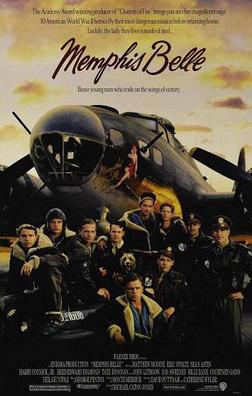
MEMPHIS BELLE (1990) vs. MEMPHIS BELLE (1943)


VS.  


“Memphis Belle” is a war movie directed by Michael Caton-Jones loosely based on the WWII war documentary by William Wyler.  How loosely based will soon be apparent.  The movie was co-produced by Wyler’s daughter Catherine.  It cost $23 million and made $27 million.  That’s one million dollars per historical error.

The movie is set in the summer of 1943 at an air base in England.  An Army public relations officer, Lt. Col. Derringer (John Lithgow), is there to inspire the home front with a story about the first B-17 crew to complete the  25 missions tour.  He introduces us to the men via voiceover.  They are a melting pot of American warriors.  A heterogeneous unit – imagine that.  The enlisted consist of a virgin, a reform school graduate, a Catholic boy, a ladies’ man, a farm boy, and a poet.  The Captain is a clean-cut and by the book.  His co-pilot is the opposite.  The bombardier had four years of medical school, or so he says.  The navigator is morose and cowardly.   According to Derringer, the American public is questioning the idea of daylight bombing.  Since the Memphis Belle is undergoing repairs, the crew has a front row seat for a crash landing that ends up in disaster.  Could this be a portent?

The next scene is a big dance in a hangar which is a pretty good period piece with 1940s clothing and British birds.  There is a chanteuse crooning Swing music and lots of jitterbugging.  In an homage to 1940s Hollywood, Clay (Harry Connick, Jr.) gets on stage to sing “Danny Boy”.  This reminded me of Ricky Nelson in “Rio Bravo”.  The morning briefing explains that the target is Bremen.  It is emphasized that the factory is surrounded by a hospital, school, residential area, and petting zoo (I added that last one).  Thank God we had precision bombing which if applied properly would avoid hitting anything but the factory.

Montage of preparation – arming, fueling, etc.  There is a delay in take-off so Danny (Eric Stolz) can recite one of his poems ( actually “An Irish Airman Foresees His Death” by W.B. Yeats ).  Nice touch, Danny Downer.  The take-off is majestic with appropriate music.  Cinematic magic turns the five available bombers into at least eight and CGI into more for the formation shots.  The mission is the kitchen sink of anything that could possibly happen to a bomber in WWII Europe plus a few that could only happen in a Hollywood film.  Perhaps a list would make this clear.

1.        The Memphis Belle almost collides with another B-17 in a cloud.  This movie would have sucked if the collision would have occurred!
2.       A small number of German fighters (actually Spanish Ha-1112’s masquerading as Me-109’s) attack and then run away so we can move on to the next problem.
3.       The lead bomber is shot down so the MB has to take the lead.  How cinematically convenient!
4.       There is a hole in the wing which causes them to lose a lot of fuel.  Start the clock.
5.       The target is obscured and Capt. Deerborn makes the decision to bring the entire squadron back around to avoid hitting the petting zoo.
6.       Rascal’s (Sean Astin) ball turret gets shot out from under him and he is left dangling.
7.       There is a fire on board.
8.       Danny is wounded and only med school volunteer Val (Billy Zane) can save him.
9.       A fire in an engine forces Deerborn to crash dive to put it out.
10.    One wheel won’t come down (hey, isn’t that what happened to the crash-landing bomber from the opening?)
11.    The fuel runs out so they are down to one engine.
12.    Virge almost falls through the bomb bay.

Here is another list – clichés in “Memphis Belle”.
1.        There are command issues between Deerborn and his co-pilot Luke (Tate Donovan).
2.       Virge talks about his future plans of opening a chain of hamburger joints.
3.       Virge has sex in the plane.
4.       The crew rags some rookies from “Mother and Country” – can I have your stuff when you get shot down?  Ha! Ha!
5.       Phil (D.B. Sweeney) thinks his number is up.
6.       The ground crews wait for the bombers to return and count them as they do.

This is one of the corniest war movies ever made.  At one point, Deerborn talks to the “Memphis Belle” in a  schmaltzy and wooden way.  Wooden would be the best description of Modine’s performance.  The rest of the cast reminds of “Platoon” in its potential, but does not stand up to the comparison well.  The script does not help them.  The dialogue is sappy and the performances are too sincere.  After bombing the target (perfectly), Deerborn says “Okay boys, we’ve done our job for Uncle Sam, now we’re flying for ourselves.”  Modern actors dropped into a cliché-ridden 1940s war movie plot.  They did buy into it and I bet some of them are embarrassed by their participation.  I imagine they had fun filming it and it sure was more pleasant for them than the “Platoon” cast.  No boot camp for these pretty boys.

The effects are a mixed bag.  The five B-17s add a lot of authenticity (one of them was destroyed in a take-off when it clipped a tree and burned completely).  The interior of the bomber looks like the real deal and the routines are proper.  The air combat is fine with decent radio chatter (unlike “Red Tails”, to name but one).  There’s lots of action which fits the goal of mindless entertainment.  Unfortunately, the CGI is inferior and jarring.  The word “fake” comes to mind.  One bit of corn that works effectively is narration of some letters from relatives of lost men over actual footage of bombers going down.

In conclusion, “Memphis Belle” is the “U-571” of air combat movies.  Corny.  Cliché-ridden.  Predictable.  Tactically farcical.  More importantly, I would describe both of them as obstacle porn.  A continuous string of problems to be overcome by the heroes.  If you are into that kind of entertainment and could care less about accuracy and realism, break out the pop corn and turn off your brain.

“Memphis Belle:  A Story of a Flying Fortress” is the celebrated documentary about the first bomber to complete 25 missions in the 8th Air Force.  It was directed by William Wyler (“The Best Years of Our Lives”) who at the time was a major in the U.S. Army Air Forces.  He bravely flew on several missions and ended up losing hearing in one ear.  One of his cinematographers was killed in action.  Wyler won best documentary for “The Fighting Lady” which was about an aircraft carrier.

His “Memphis Belle” is in Technicolor which must have enhanced the message intended by Wyler.  The purpose of the documentary was to bring the air crew experience home to the home front and inspire the public at a time when support for the bombing campaign was waning.  The narration is very propagandistic and anti-German.  Where the movie is dedicated to all the airmen who fought in the skies over Europe, Wyler dedicates his film to only the 8th Air Force. 

The doc covers the last mission from briefing to kissing the ground on return.  The basic arc is used in the movie, but obviously the 1990 reenactment adds a lot of Hollywood.  The doc does take a few liberties of its own.  The MB was not the first bomber to complete 25 missions.  It was chosen early on as the potential first because Wyler felt that Capt. Robert Morgan had a reputation for competency (and survivability) and he liked the name of the bomber (Morgan’s girl-friend).  Ironically, the back-up plane in case the MB did not make it (Hell’s Angels), actually won the race to go home after 25 missions.  As far as the last mission, in the doc it is against Wilhelmshafen and is fairly hairy.  The flak and fighters variety.  Most of the footage seen in the film (parts come from at least six other missions) was shot on a B-17 named Jersey Bounce because the MB was under repair.  It was the MB crew on board, however.  Speaking of which, none of the characters in the movie match the names or backgrounds of the actual crew.  Most importantly, the last mission of the MB was a milk run (against submarine pens at Lorient, France) which would have been boring for a documentary and death to a feature film.  Wyler was a Hollywood director, after all.  It does strike me as a bit unethical for a documentarian.  The documentary is much better quality than the movie, but you have to get past the jingoistic narration.

MOVIE  =  C
DOCUMENTARY  =  B


THE DOCUMENTARY 


Sunday, August 16, 2015

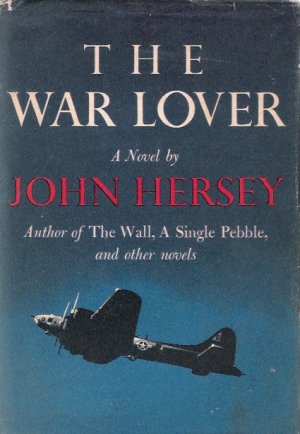
BOOK/MOVIE: The War Lover (1959/1962)


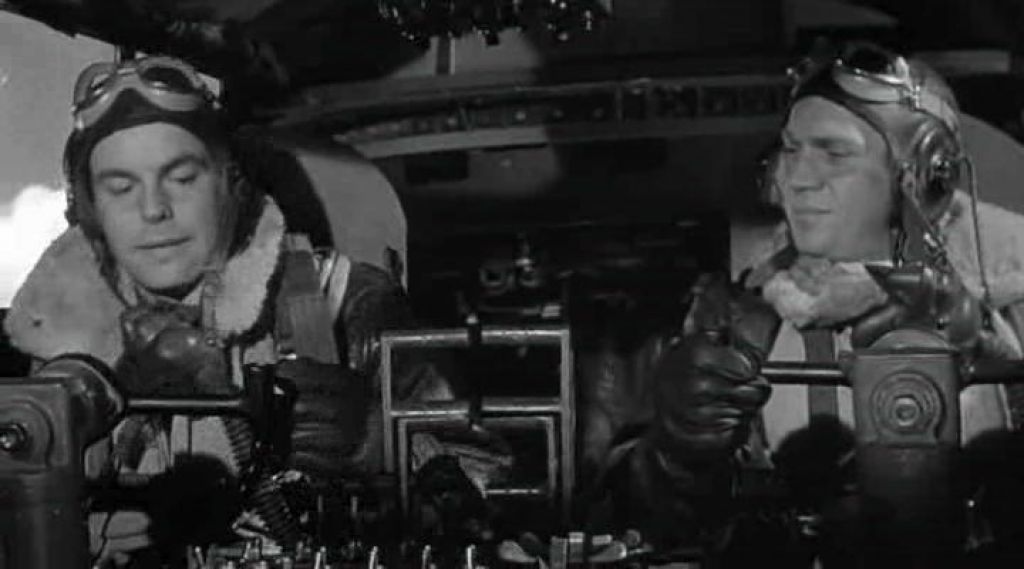
                “The War Lover” is a WWII aviation picture based on the best seller and Pulitzer Prize winning novel by John Hersey.  It was filmed in England and directed by Philip Leacock.  Two RAF bases were used for the exterior shots.  The producers found three B-17s in America.  Famous aviation writer Martin Caidin helped restore them and flew one across the Atlantic to be used in the film.  He wrote a book about the experience entitled Everything But the Flak.  A stuntman died during a stunt when he drowned parachuting into the English Channel.  Warren Beatty was first choice for the lead role but he turned it down because he had recently caused the breakup of Robert Wagner and Natalie Wood.  It would have been awkward if he acted with Wagner.  Steve McQueen got the part and was his usual difficult self.  He did not get along with Shirley Anne Field and once pushed so hard she went over a sofa and cut her lip.  In a subsequent kissing scene, she bit McQueen on his lip in revenge.  Director Leacock was lenient with McQueen’s contractual stipulation that he avoid racing cars during the filming.  McQueen proceeded to get into an accident, so those injuries from his fight with the Bolland character are not the result of make-up.
Awkward!

                The movie is set on an American bomber base in 1943.  “Buzz” Rickson (McQueen) is a hot shot pilot who rooms with his co-pilot “Bo” Bolland (Wagner).  Bo is your typical American airman who is just trying to survive the required 25 missions.  Buzz likes the war.  “The only trouble with this crummy war is it begins too early in the morning.”  Their bomber is nicknamed “The Body” and is on its seventh mission.  Their mission is to bomb submarine pens at Kiel.  By changing the nose art, the movie is able to make the three bombers look like a lot more on takeoff.  Due to cloud cover, the commanding officer aborts the mission, but Buzz goes below the cloud cover to bomb the target anyway.  He has an orgiastic look on his face as the bombs explode.  Back at the base, Buzz does not seem to care that one of the bombers that followed him ended up getting blown up.  The CO calls him on the carpet and accuses him of being insubordinate and irresponsible.  Since this is a war movie, his superiors put up with him because he’s such a crackerjack pilot.  The Air Force (actually Army Air Corps) loves mavericks.

                We have a maverick, how about a love triangle to go with that cliché?  Bo and Buzz meet a British bird at a dance.  Surprisingly, Daphne (Field) does not opt for the stereotypical brash American and instead chooses Buzz.  She realizes she would always be second best to the war in Buzz’s life.  Bo puts her first, but is she just a fling until he finishes his tour?  Although Bo will have to be like a sheep-dog watching out for the wolf, he idolizes Buzz as a pilot and leader.  So does the rest of the crew except the navigator Lynch who despises the amoral Rickson.   Buzz gets him transferred to a lesser pilot and as though that does not doom him enough, he proceeds to show Bo a picture of his wife and kids!  Why does the military give lectures on VD, but not on picture discipline?
"I'll bet you 50 bucks our last
mission is a milk run"

                Buzz continues to be insubordinate.  When a mission requires them to drop leaflets instead of bombs to kill Germans, he buzzes the field several times at very low altitude to show his displeasure.  The Doctor states that “Rickson is a good example of the fine line that separates the hero from the psychopath.”  (I wonder how many Medal of Honor winners this statement would apply to.)   There is no talk of grounding such a loose cannon.

                Before the last mission, the predictable hook up between Buzz and Daphne occurs.  Buzz shows up at her apartment, but she sees right through his macho bull-shit.  He does not attempt to charm his way out of this assessment.  “In war time, you don’t fall in love.  You make love.”  She gives as well as she gets.  “You can’t make love.  You’re twisted.  You can only make hate.”  Ouch!  When he returns to base, he implies that something went on which makes the next mission very awkward.  They don’t have a lot of time to glare at each other as they have to try to avoid the kitchen sink on this mission.  I counted ten problems.  That’s “Memphis Belle” territory.  At least the love triangle problem gets solved by subtraction.


                “The War Lover” is an underrated war movie.  It is well made with good cinematography and effects.  The sound effects are also well done.  You do feel you are along for the ride.  The interior of the bomber is realistic.  The flight procedures are rendered accurately.  As is usual for an air combat movie, the film takes off when it is in the air.  There is some good stunt work in the buzzing of the field, but the obligatory belly landing was borrowed from “Twelve O’Clock High”.  The plot is a little leaden on the ground. 
the real star of the film

The central theme that some warriors are in it for the thrill is worth exploring and this was a rare theme for a movie from the early 60s.  There aren’t that many war movies that have the hero as a psychopath.  Coincidentally, I also watched “The Hurt Locker” this week and the main characters in both movies have similar personalities and motivations.  McQueen’s performance has been criticized, but I found his style to be perfect for the role.  Who better to play a jerk than a jerk?  He’s the kind of actor who can act with just his eyes, which is helpful when you are wearing an oxygen mask.  Wagner is fine in a role that is not fully fleshed out.  It is never clear why he and Buzz are best friends considering their views on the war are opposite.  Field is the wild card and her performance is hard to analyze.  Daphne is not your usual pilot groupie.  Although she falls in love with Bo, she is realistic about the temporary nature of the relationship.  She is probably the strongest character among the three.  Her reaction to Buzz’ “seduction” is interesting.  The rest of the characters are not really fleshed out.  Lynch should have been more of a foil to Buzz.  The rest of the crew is nondescript.  There is no dysfunction.
“The War Lover” is probably not going to make my 100 Best War Movies list.  It is still a nicely entertaining war movie mainly because of the theme and the fact that it is not very predictable.  There is one death that you will not see coming (and two that you will see from a mile away).  The last mission, although crammed with “what next?”, is exciting and not head-shaking.  It is certainly a better movie than its closest companion – the pious “Memphis Belle”.  And it stars Steve McQueen.

How does it compare to the novel?  Needless to say, the novel is much more wordy.  Scratch that if you are going to cast McQueen.  For instance, in the book, when Buzz barges in on Daphne he ends up telling his life story.  The book is told from the perspective of Bo and he can be a bit of a whiner.  He also is less likeable because we see so much more of his personality.  The romance is of course fleshed out and the book makes Daphne out to be a more sympathetic girl who is truly in love, but also trying to make the best of the war situation.  Bo’s inability to fully commit to her is frustrating.  Hersey uses the Bo character as his device to make the point that there is nothing good about war and those that buy into it have either drank the propaganda kool-aid or they love war for its own sake.  The main incidents in the movie are from the book with some changes for the better.  Lynch is much more important in the book.  Bo is simpatico with him and is really broken up when he dies.   The movie makes the wise decision to put Lynch on the crew, but downplays his relationship to Bo.  Another good decision was to have Bo imagining the worst about Buzz’ visit to Daphne.  In the book, Daphne tells Bo what happened and he is upset more with finding out just how loathsome his former best friend is rather than seething over his sleeping with his girl.  Most importantly, the movie substantially changes the last mission for the better.  Not giving away the move ending for those of you who have not seen it, but here is what happens in the book.  They get hit in the nose and the bombardier loses a leg and his life.  The tail gunner bails out without telling anyone.  Buzz cracks up and Bo ends up flying the plane for the rest of the time.  They decide to ditch in the Channel, but Junior asks to bail out and does.  When the plane hits the water, Buzz decides to go down with the ship.

BOOK  =  B-

MOVIE  =  B+


Thursday, October 24, 2013

CLASSIC or ANTIQUE? Air Force (1943)


                “Air Force” is an homage to the branch by director Howard Hawks who was a veteran of the Air Corps in WWI.  Hawks had already made “The Dawn Patrol” and “Sergeant York”.  Hawks had the cooperation of the Army Air Force which provided several B-17s and other planes to depict Japanese aircraft.  The movie is essentially a small unit patrol film.  It covers the bleak early days of the war by following a B-17 bomber named “Mary Ann” and its plucky crew.  The bomber makes stops at Pearl Harbor, Wake Island, the Philippines, and Australia.  The bomber is meant to be the star of the film.  The movie was a big hit and was critically acclaimed at the time.  It won an Academy Award for Editing and was nominated for Cinematography, Original Screenplay, and Special Effects.  It was one of the first great war movies made during WWII.

                The film opens with an excerpt from the “Gettysburg Address” to make it quite clear this will be a patriotic movie.  The date is Dec. 6. 1941.  The “Mary Ann” is headed for Hawaii with eight other B-17s.  The crew is heterogeneous.  The gallant captain and co-captain, the naïve rookie, the crusty crew chief, the dude with daddy issues, the comic New Yorker, and the bad egg.  This last role is played by the biggest star – John Garfield.  Sgt. Winocki is the malcontent tail gunner who holds a grudge against the pilot Capt. Quincannon (John Ridgely) who washed him out of flight school.  He is going to be a pain in the ass.

                The “Mary Ann” arrives at Hickam Field on a day that will live in infamy.  When they pick up the attack on the radio, one of the crew says “I’ve still got a throwing arm.  I’ll heave a wrench if any of those monkeys comes close.”  There is a cool aerial view of Pearl Harbor in flames.  They are fired on by local Japanese.  When they land at Hickam and see the destroyed P-40s lined up on the field they are told “three vegetable trucks smashed their tails”.  What?  The movie passes on the canard that there were Japanese fifth columnists and saboteurs that participated in the attack.  The Hickam set is appropriately damaged.

                It’s on to Wake Island for a visit with the valiant defenders.  “Send us more Japs” they say.  Since there are no orphans on the island, they pick up a dog named Tripoli.  Its schtick is it barks whenever anyone mentions Mr. Moto (for those less than eighty years old, Mr. Moto was a Japanese detective who appeared in several movies before the war).  How cute and racist is that? 

                They land at Clark Field in the Philippines.  The stress of being at war has changed Wanicki’s attitude and now he is a gung-ho member of the team/family.  The crusty crew chief White (Harry Carey, Sr.) finds out his fighter pilot son has been killed.  He takes it stoically, but the audience doesn’t.  Jap basterds!  When they take off, they fight off a swarm of Zeros until they get hit and the crew has to bail.  Capt. Quincannon is badly wounded so Winocki takes the controls and makes a belly landing.  Redemption accomplished!  The captain dies in the hospital in a scene written by an uncredited William Faulkner.  End of movie, right?  Wrong.  Not happy enough.


                The crew works feverishly to repair the “Mary Ann” with the Japanese just down the block.  Crewmen holding Browning machine guns like Rambo take on a Japanese air attack by Zeros dropping bombs they don’t have.  (Why do filmmakers think fighter planes can drop bombs?)  Meanwhile the rookie is off volunteering as a gunner on a scout plane.  It gets shot down and when he bails out a dastardly Jap strafes him and then finishes him off when he hits the ground.  Revenge would be so sweet.  Request accepted.  They shoot down the Jap and then machine gun him as he gets out of the wreckage.  Sweet!  This is an exciting scene although completely ridiculous.  The sound effects are good and the effects of the crashing Japanese planes are well done.

                With Japanese soldiers closing in (and eating lots of lead), the “Mary Ann” takes off just in the nick of time.  They are headed for Australia when they sight a Japanese fleet and call for reinforcements.  A  montage of all available aircraft (actual footage) arrive at exactly the same time.  I think I saw the “Spirit of St. Louis” in the mix.  Patriotic music swells.  They blow up a battleship.  Japanese fighters attack and they shoot one down which crashes into a ship.  Kharma is a bitch.  Then they sink an aircraft carrier.  These Americans never miss.  Just like the B-17s at the Battle of Midway.  That fleet gets totally f***ed up.  We are so gonna win this war.  Buy war bonds!


"I heard you just fly right above the ship
and drop the bomb - piece of cake!"
                “Air Force” claims to be based on a true story.  Bull shit.  The only thing true about it is B-17s arrived at Pearl Harbor in the middle of the attack.  Everything after that is total fiction.  None of those B-17s went on to Wake Island or the Philippines.  The big naval battle could be based on the Battle of the Coral Sea.  The similarities end with there being water involved.  As far as I know, no B-17s sank any warships during the war in the Pacific (although they tried at Midway).  It is painful to watch the film accuse Japanese in Hawaii of participating in the Pearl Harbor attack.  By the way, the producers of the film publicized the fact that the real “Mary Ann” was lost in the Pacific after the film was finished.  This has been proven to be false.  I’ll stop short of calling this despicable.


the star of the film -
please, no autographs 
                “Air Force” is not bad considering it is overtly patriotic and propagandistic.  There are some exciting action scenes.  The special effects are decent if you keep reminding yourself that it was made in 1942.  The blending of the footage is well-intentioned but far from seamless.  The Editing Oscar was probably deserved.  The use of real bombers helps with authenticity.  This is diluted a bit by the use of AT-6 Texans and P-43 Lancers for Japanese Zeros, but what could you expect?  The interior shots are realistic.  Just as good as a submarine movie.

                The acting is satisfactory.  Nobody makes a fool of themselves, but noone stands out.  This was partly purposeful as Hawks wanted the bomber to be the main star.  The crew may be stereotypical, but they are likeable and the chemistry is there.  The banter is not forced or corny.  Some of their actions are.  Shooting down planes with hand-held Brownings.  Come on!

                You can’t watch the film without being aware of its purpose.  It was meant to fire up American audiences to continue the fight on the battlefields and on the home front.  It appeared in theaters when the war was still up in the air.  The film makes the case that our quality will defeat the Japanese quantity.  I guess in 1943 our quantitative advantage was not so obvious yet.       

                In an earlier post I examined WWII combat movie clichés by looking at “Wake Island” and “Bataan”.  “Air Force” is a companion to those two Old School flicks.  They helped establish the template for Old School WWII movies.  “Air Force” is dedicated to a branch of the armed services.  It has a hero (the bomber) and a mission.  The small unit is heterogeneous and includes a mascot (Tripoli).  The episodes alternate between action and preparation for the next move.  Conflict within the group (Winocki) is resolved by external pressure (the war).  A member of the group gets redemption.

                In conclusion, “Air Force” is a difficult movie to review.  You can go on the Internet to read reviews that were contemporaneous and give a feel of what experts felt about it when it came out.  But this is 2013.  The movie is entertaining, but just that.  It is terrible history, but not terrible cinema history.  It is undoubtedly a classic.  It is a must-see for war movie lovers.  Will it make my 100 Best list?  Possibly.

grade =  B-