Showing posts with label war short story. Show all posts
Friday, January 1, 2016
WAR SHORT STORY: A Daisy-Chain of Bandoliers
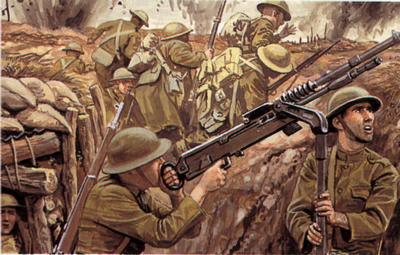
“A Daisy-Chain of Bandoliers” is set on the Western Front in WWI. The author was Private W.H. Cooperwaite who served in the 2nd Battalion, Durham Light Infantry. The story is obviously a fictionalized account of some incidents during his stay at the front. He tells the story in flashback form as at the beginning he is wounded by a German shell called a “Jack Johnson”. He assumes his readers will recognize that the large shell was named after a famous African)-American boxer. He points out that he was hit by shrapnel from the only one of eighteen shells that actually exploded. It is seldom you read about the high percentage of duds in WWI. The rest of the story is a series of vignettes. He mentions German atrocities like the murder of two young girls. The Germans can also be devious. He describes what he calls the “stretcher dodge” in which a German unit pretended to surrender and then when the Brits had been lulled into complacency, the Germans opened fire with machine guns concealed on stretchers. He goes on to tell of some combat incidents. He unit has to make a suicidal attack up a hill against a strong German position. A beloved officer goes down and several men die bringing him in only to have him die anyway. This serves as a good summary of the fighting on the Western Front, but Cooperwaite does not delve into the irony or symbolism of the incident. An interesting vignette is about a unit of Gurkhas stationed nearby. Cooperwaite describes a counterattack by the Turks featuring their curved knives. “They seemed all grin and knife as they returned.” The title comes from the concluding episode that involved delivering ammunition to the front line trench. They tie the bandoliers together into a daisy-chain to try to cover the last few yards, but this is futile - like the war.
“A Daisy-Chain of Bandoliers” is nothing special. In fact, Cooperwaite is not a particularly good writer. There are some aggravating grammar problems, for instance. He tends to write in soldier vernacular. He describes shells as creating “mischief”. There is no real connection between the vignettes. The story does not flow. Some of it is propagandistic and smacks of the early days of the war when the Germans were accused of all sorts of atrocities. I have found no evidence for the Germans using a “stretcher dodge”. I’m not saying it did not happen. I’m just skeptical about it. This skepticism colors my view of the whole piece, leaving me wondering if there is much value to it as a war story.
GRADE = D
Next story: "The Duke's Disappearance" by Thomas Hardy
Friday, February 27, 2015
FEBRUARY SHORT STORY READALONG: The Battle of Lake Borgne
The second story in our readalong is appropriately about the Battle of New Orleans. Appropriate because it is the bicentennial anniversary of the famous battle. Here in Louisiana we take that battle seriously and do not buy the bull crap that because it was fought after the Treaty of Ghent was agreed to, it was laughably useless. Would the British have given New Orleans back if they had taken it? Highly unlikely. You know why that is a big "what-if"? Because Andrew Jackson whipped British ass so we did not have to find out the answer to that question. The story is entitled "The Battle of Lake Borgne" by George Eggleston.
Most people, including Louisianians, don't know that the climactic showdown of January 8 was the third of three noteworthy actions. George Eggleston included the stories of these two neglected actions in his book "Strange Stories from History" which was published in 1886. Eggleston aimed his book of nonfiction short stories at a young audience and they read like adventure stories. Surprisingly, the stories are not "gosh-wow". The two I read as part of this project are on the Battle of Borgne and the "Battle in the Dark".
The "Battle of Lake Borgne" tells the story of the British assault on a small flotilla of American gunboats that were trying to prevent a British landing on the shore of Lake Borgne. Eggleston does an excellent job outlining the British and American strategies. We understand why the battle took place and the advantages and disadvantages of each side. This builds to the description of the action which has a ring of swashbuckling to it. Eggleston does exaggerate the fighting for his boyish audience (it actually lasted only five minutes), but he does not blatantly tamper with history. He is much more constrained than a movie would be.
The second story tells the tale of the night assault by Jackson on the British camp. Eggleston refers to Jackson's army as a "posse comitatus of ragamuffins". Possibly the only time that awesome phrase has ever been used in literature. His description of the chaos of the attack is outstanding. I have never read anything better that points out why generals are reluctant to roll the dice on night actions. This passage, more than the main battle of January 8, confirms what a bad-ass Jackson was. Eggleston makes the pitched battle in pitched dark exhilirating. Since most readers will not know the outcome, there is quite a bit of suspense. I loved the description of how units would identify themselves and then wade in if it turned out they were on opposite sides. Needless to say there was a friendly fire issue.
Eggleston closes the story with an aftermath that outlines the importance of the tactical defeat for the Americans. He only briefly touches on the main battle, but manages to destroy that old chestnut that the Americans used cotton bales as part of their barricades. You the man, Eggleston!
At first I was a little upset that the story was nonfiction. I assumed all the stories would be fictional. I read enough nonfiction already. However, because of the nature of Eggleston's style and the audience he was writing for, the story reads like fiction. Since I have a bit of the fourteen year old boy in me, I really enjoyed it. It has a certain verve to it. More importantly, Eggleston is quite complimentary of the British. He is not just stoking the flames of patriotism. He credits bravery when he sees it. Not only is the story entertaining, but it does a better job on the history of the battles than I found in several encyclopedia entries.
GRADE = A
Next up: The Boy Commander of the Camisards
Subscribe to:
Posts (Atom)
