Sunday, December 5, 2010

Cinema Code of Conduct


Thanks to All About War Movies http://allaboutwarmovies.com/ for sending this to me.  Below is what All About posted.  Here is what he said: 

"As most of you will be aware, Mark Kermode and Simon Mayo are the hosts of the finest film show that the UK has to offer. The former is a film critic who’s words have graced the pages of numerous newspapers and magazines, is a regular presence on the nation’s TV screens and has even been lampooned by Vizcomic and had his huge, flappy hands mocked on The Thick Of It. Simon Mayo is perhaps one of Britain’s most recognisable and popular radio presenters. Many of us spent our youth listening to him on BBC Radio 1 only to follow him to his afternoon slot on BBC Radio 5 Live and then to BBC Radio 2 where he currently presents the popular Drivetime show. Mayo has also been slightly maligned on The Thick of It. The two doctors present Kermode and Mayo’s Film Review; two hours of film discussion, interviews, reviews and the home of the occasional ‘Kermodian rant’ – wittertainment at its finest.

     Over the past few weeks they have been inviting listeners to help them compile a code of conduct for watching films in the cinema, a list of rules that many of film bloggers would agree with, and have even had the decency to provide a poster…"

     Each web site is asked to add their own #11, so here goes.

#11 - No snickering!  Do not laugh at ridiculous moments in serious movies.  Just because you are intelligent enough to recognize something is implausible or inaccurate, do not ruin the experience for the average viewer.  We want to be entertained, not educated!

     Anyone who follows this site knows I am one of those know-it-alls that this rule is aimed at.  In my defense, I always try to cover my mouth to stifle my laughter.  For example, when the villains landed via Higgins boats in the recent "Robin Hood".  Guffaw!

Visit the original site at http://www.bbc.co.uk/programmes/b00lvdrj

Saturday, December 4, 2010

#90 - Battle of Britain


BACK – STORY: “Battle of Britain” was released in 1969 and was specifically meant to be a tribute to “the few”. The movie fits into the sub-genre of old-school all-star epics with vignettes supporting the main story line. It’s sisters are “The Longest Day” (1962) and “The Battle of the Bulge” (1965). In some ways it can be viewed as England’s response to those earlier films. It was directed by Guy Hamilton of “Goldfinger” fame. The screenplay is based on the book The Narrow Margin by Derek Wood and Derek Dempster. The book gives a traditional retelling of the Battle of Britain and thus the movie stands as the definitive film treatment of the battle. It is not a revisionist film.


The film was big budget and it shows. Not only did the producers round up most of the great British actors of the time, but they went to a lot of trouble and expense to round up military hardware appropriate for a 1940 air battle. They assembled 12 Spitfires and 3 Hurricanes to represent the Royal Air Force. The Spanish Air Force cooperated with 17 ME -109s, 32 Heinkels, and 2 Junker 52s. The total of around one hundred aircraft made the movie the 35th largest air force in the world at the time. During the filming, more bullets (in the form of blanks) were fired than in the actual Battle of Britain.

The movie has a very impressive list of technical advisers which included famous aces Adolf Galland and Robert Stanford Tuck. Several airfields that were part of the battle were used in the film. The scenes at RAF Fighter Command were filmed at the headquarters of Fighter Command. Air Chief Marshal Hugh Dowding's original office was used.

OPENING SCENE: We see refugees moving down a road in France in 1940. At an air base nearby, British pilots are informed that the Germans are just down the road. They hurriedly take off leaving the “lame duck” aircraft to be strafed by German fighters.

SUMMARY: Air Chief Marshal Dowding (Sir Laurence Olivier) decides that sending more aircraft into the meat-grinder of France would be waste of precious resources needed for the upcoming battle for control of the skies over England. The German ambassador visits his British equivalent in Switzerland and gives the typical “surrender and avoid destruction” ultimatum. The British diplomat keeps his upper lip stiff and responds with "We're not easily frightened. Also we know how hard it is for an army to cross the Channel — the last little corporal to try it came a cropper. So don't threaten or dictate to us until you're marching up Whitehall! ...and even then we won't listen!" This exchange establishes a theme of the movie: the bulldog British versus the hubris-filled Germans. These national characteristics are personified by Dowding and Goring in the film.


At a British air field one of our trio of Squadron Leaders, “Skipper” (Robert Shaw), is training a new pilot. He takes him up for a mock dogfight. When the rookie hears Shaw’s “takatakatakataka” in his headphones he knows he is dead. Another theme is established: England is in a race against time to get enough qualified pilots in the air to replace its losses.
real Heinkels
In the inevitable romantic subplot, we meet Squadron Leader Colin Harvey (Christopher Plummer) and his wife Maggie (the lovely, but acting-challenged Susannah York) who works in command and control. He wants her to leave her position and transfer with him to Scotland. She does not want to (being a patriotic feminist) and they part coldly. Unfortunately, this is not the last time we peak in on their relationship.

the airfield bombing
At a German briefing on their strategic situation, it is revealed that the RAF has to be destroyed before England can be successfully invaded. It is decided that the RAF will be destroyed on the ground. The first attacks are by Stukas on radar stations. Because the Spanish Air Force did not have any Stukas, radio-controlled models had to be used for this scene. Spitfires pounce on them and without exception the models blow up on cue. There is even a mid-air collision and a fake-looking dive into the ground. Luckily for the movie, the Germans quickly withdrew the Stuka from battle because of its status as a sitting duck. This means the rest of the movie will feature actual planes in combat. By the way, the Stukas are shown leveling off to drop their payloads which is inaccurate because they were dive-bombers and thus would have released during a 60-90 degree dive path.

Next, even though the radar stations have not been taken out of commission, the Germans shift their focus to the air fields. We witness one of those bombings with a series of impressive fireworks. “Skipper” scrambles during the raid, but in a strange screenplay decision, his unit sees little action other than a rookie getting lost and shot down.

The next scene is a jump of I don’t know how many days. One of the problems of the film is we are not told when the next scene is taking place. A related problem is the characters are not clearly identified. In the combat scenes, for instance, all the pilots look alike with their headgear. The scene is probably set on August 15 (Eagle Day). the official start of the all-out German effort. German Heinkels from Norway join in the assault thinking the RAF can’t be in two places at one time. They are wrong and suffer heavy losses in a nice scene that features shots from inside the bombers. The bombers are unescorted in the movie because the producers could not find any ME – 110s to be totally accurate.

In a move similar to “The Longest Day”, the movie switches back and forth to give the British and German command perspectives. The audience learns that there is a disagreement in British Fighter Command on how to deploy the fighter units. Dowding and Air Vice Marshal Park (Trevor Howard) favor using the fighters to defend the air bases and intercept bomber formations as quickly as they can be scrambled. This means smaller formations making contact with the German bombers. On the other hand, Air Vice Marshal Trafford Leigh-Mallory pushes the “big wing” tactic of attacking the bombers with large formations.

Leigh-Mallory: "It's better to shoot down fifty bombers after they hit their targets than ten before."

Park: "Remember that the targets are my airfields, Leigh-Mallory, and you're not getting fifty, you're not even getting ten!"

This debate is accurately depicted in the film, but there was no actual confrontation between Park and Leigh-Mallory as acted out.

Back to the smoochy stuff. Wake up girls! The Harveys meet in a hotel. They are still arguing, but do kiss. This is where their relationship is left at – unresolved and we don’t care! A bombing raid on London occurs because of an accidental dropping by a German bomber. Here the movie does a good job of teaching how a mistake by a wayward enemy bomber provokes Churchill to launch a raid on the lit-up-like-a Christmas-tree German capital (which the German pilot and co-pilot just so happen to be visiting). Goring had promised Hitler that if Berlin was ever bombed “his name would be Meier”, so he shifts the focus of the air campaign from destroying the RAF to fulfilling Hitler’s desire for revenge by terror bombing London. Goring visits his fighter command and is told by the cigar-chomping Major Falke (modeled after Galland) that what he needs is “a squadron of Spitfires” (an actual quote from Galland).

In an excellent scene, the Blitz comes to London. We get views from within and above the city. The city is on fire and the firefighters are doing their duty. A pilot Sgt. Andy (Ian McShane) returns home to find his family in a shelter. He goes off to help a trapped family and returns to find the shelter has been destroyed. Tragic, but effective. He keeps a stiff upper lip and returns to combat.

The Polish get their props as we see them going up for training and then disobeying orders to weigh into a German bomber unit. This is one of the few humorous moments in an otherwise somber film.

We are treated to several dogfights that are among the best in non-CGI war movie history. This includes a magnificent extended scene which is basically silent except for the score and some radio chatter. It appears the filmmakers decided the audience needed a break from the somewhat redundant dogfight scenes. Nice call. It is the best scene in the movie and most memorable.

FINAL SCENE: The Germans pull their invasion force back from the French ports. Dowding gazes at a clear sky. Churchill: “This is not the end; it is not even the beginning of the end, but it may be the end of the beginning”. Another version of the film uses the more appropriate: "Never in the field of human conflict was so much owed by so many to so few".

RATINGS:

Action - 8

Acting - 7

Accuracy - 9

Realism - 7

Plot - 6

Overall - 7

WOULD CHICKS DIG IT? I doubt it. Other than the wimpy romantic subplot, this is pretty much a guy movie. I do not know very many women who are into air combat.

ACCURACY: “Battle of Britain” is a commendable attempt to pay homage to the RAF pilots and commanders who saved England during one of the darkest hours in its history. Anyone who knows little about the event and the participants will come out of the film with a basic knowledge of the battle. However, it helps if you already know some of the facts because in some instances the movie assumes you know the big picture already.

The chronology is accurate, but we are not clearly given an idea about the dates of events. It is hard to determine how much time has transpired between some scenes. For a movie that prides itself on having the German characters speak German, it seems odd that subtitles could not have been used to identify the various historical people and the dates of events.

I have a problem with the composite characters. Are you telling me there were not enough true to life participants to build a movie around? Why have a Major Falke when you could have Adolf Galland himself? Where is Robert Stanford Tuck? How about Douglas Bader?

The movie is justifiably famous for its air combat scenes. These are accurately depicted to the best of the film-makers ability. The aircraft are as close to the real thing as could be expected. The ME-109s look a little strange with their Spanish noses, but they are versions of the famous fighter plane. We do see more of the Spitfires than is warranted (Hurricanes did 60% of the heavy lifting in the battle), but this is due to the fact Hamilton had a lot more Spitfires to work with. Similarly, the movie has Spitfires and Hurricanes together in units going into combat, which is not actually the way the units fought.

CRITIQUE: “Battle of Britain” is a good movie, but probably does not deserve the fondness many war movie buffs have for it. As a tutorial, it does a fine job in informing about this important event in history. It is fair-minded and does not treat the Germans as evil and the British as saints. In fact, it is not even very patriotic, which is surprising considering it was made in England in the 30th anniversary of the beginning of WWII. It covers both strategy and tactics so you get the pilots perspective as well as what the commanders were thinking.

Some of the weaknesses are the unclear time-line and the cursory character development. The movie jumps around from character to character and even from the English to the Germans that you do not learn much about any one person. This, of course, is a common problem for movies like this. “The Longest Day” did a great job with its minor characters, but few other all-star epics have been able to pull it off. In this respect, BOB is closer to “Midway”. In fact, it even has a distracting romantic subplot like “Midway”. Unlike “Midway”, BOB makes better use of its cast. The heavy-weights (with the exception of Olivier) are put in officer rather than high command roles. This allows Shaw, Plummer, and Micheal Caine (Squadron Leader Canfield) to put their stamps on their roles. They are all effective.

The dogfights are spectacular, but tend to be repetitive as the movie goes along. The stand-out is the “silent” scene which is almost surreal. Interestingly, the score for this scene is from the original composer and differs from the more bombastic, patriotic music that backs the rest of the movie. Unfortunately, given the state of war movies in the Sixties, the bloodshed is not realistic. The deaths are basically your ketchup bottle exploding variety. Sometimes men are wounded by bullets that leave no holes where they would have had to penetrate the plane!

CONCLUSION: “Battle of Britain” is the best movie on its subject. It could have been better, but it could also have been much worse. The producers tried hard and deserve to be credited with a game effort. You can learn a lot from this movie and if you hate to read it’s the best tutorial you will get. However, I feel it is overrated at #90 or at least I can confidently say that some of the movies I have seen on this journey are better than BOB. For instance, “Tora! Tora! Tora!” is similar, yet superior to it. Tora’s air combat is just as good, if not better. It has no silly love story. It covers more of the “greatest hits” of its event and does it more clearly. It also balances the opposing sides’ views and screen-time better.

Sunday, November 28, 2010

SHOULD YOU READ IT? "Black Book"

     
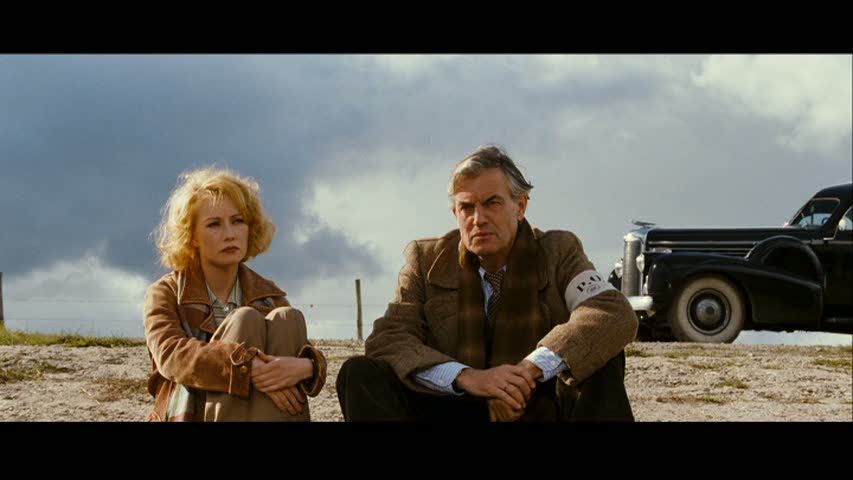
“The Black Book” is a Dutch movie about the Resistance during WWII. It was directed with his usual flair for sex and violence by Paul Verhoeven. It is indisputably the greatest war movie to come out of Holland. It was released in 2006 and is well-respected among critics and audiences. It does have its haters, however.

Ellis and Muntze and his stamps

       The film is the fictional story of Rachel Stein (played by the strikingly beautiful Carice van Houten). It is set in Sept., 1944 with the Allies in the process of liberating Holland. After her Jewish family is slaughtered in an ambush by a German patrol boat and she is the sole survivor, she hooks up with a Resistance cell led by Gerben Kuippers. Rachel changes her name and her hair color (all of it, as the movie titillatingly shows) so she can go, literally, undercover in Gestapo headquarters. She seduces an S.S. officer named Muntze and then they proceed to fall in love even though he deduces that she is Jewish (but does not realize she is a spy, at first). The movie manages to fit in some singing by van Houten which fits her characters previous career as a singer. During one of the parties she recognizes the number two man as the evil Nazi (Franken) who led the massacring of her family.

      Rachel (Ellis) is quite the plucky heroine. She plants a bug in the headquarters. She helps chase down the Dutch collaborator who set up her family. Things turn sour for her after a raid on the basement of the headquarters to rescue Kuippers' son from torture fails bloodily because of a mole and she is cunningly fingered by Franken by way of the bug. Now she is wanted by the Resistance as a traitor.

       Muntze is also on the run because he is too humane for an S.S. officer. He tried to make a deal with the Resistance to stop reprisal and counter-reprisal now that the war is lost for the Germans. He and Ellis eventually get together, but they do not live happily ever after. The movie now becomes a whodunnit and a chase movie rolled into one. Turning off your brain would be advisable at this point because much of what occurs in the last hour is unrealistic and some of it draws unintended laughs. For example, Ellis is overdosed with insulin by the “guess who” villain, but when he or she goes on the balcony to the acclaim of the crowd, Ellis scarfs down a “we’ve been liberated by the Allies” chocolate bar to miraculously save herself. By the end of the movie everyone who deserves to die is dead, including some who did not deserve to die.

      When I finished watching this movie my first reaction was negative. The magical chocolate bar and the firing squad death of one of the main characters strained credulity beyond my tolerance. While the insulin scene is just your typical movie escape from death against logical odds, the execution of a German officer by German firing squad after the German surrender seemed at first glance to be absolutely ridiculous and inexcusable! I was not the only one who protested this historical inaccuracy, but a little research found a germ of truth in it. It seems the Canadians did allow the Germans to execute two deserters after their jurisdiction should have ceased. However, the movie character is not a simple deserter, but instead a German officer who undoubtedly would have been kept alive for interrogation value alone.

Ellis and Kuipers waiting for the villain to die

      This is also the kind of movie that when you look back at it, you see numerous big holes in the plot. You realize what amazing coincidences had to happen to advance the story. Also, to fool you as to who the real traitor is, he or she does things that are not consistent with the character.

With all that said, I recommend you read this movie. Enjoy it for its entertainment, not its historical accuracy. If nothing else, it will keep you thinking about its flaws for days after. Few movies have that kind of impact for good or ill. Oh, and did I mention that van Houten is hot and often unclothed?

GRADE  =  B-

Friday, November 26, 2010

#82 - A Walk in the Sun


BACK-STORY: “A Walk in the Sun” is a faithful rendering of the novel by Harry Brown. It was released in 1946 and is in black and white. It is set in 1943 during the invasion of Salerno in the Italian campaign in WWII. Production began after actor Burgess Meredith (who served as the narrator in the film) urged that the book be made into a movie. The director was Lewis Milestone of “All Quiet” fame. The U.S. Army cooperated in production by providing weapons, including American weapons masquerading as Germans. The Army also vetted the script suggesting two minor changes. The movie was greeted positively by audiences and critics. It was rereleased in 1951 as “Salerno Beachhead”.


OPENING SCENE: In an unorthodox use of credits, we are introduced to the main characters by face and name. The narrator tells us a little about each in a folksy way.  They are members of the Texas Division.  They are from all over the United States, however.  The platoon includes an Italian-American, a factory worker, a minister's son, a farmer, a Southerner, and, of course, a guy from Brooklyn. Then to make things more intriguing, the ballad begins and will reappear periodically throughout the film. The men are on a landing craft heading for Salerno.  We get our first taste of what’s to come as the men engage in typical soldier conversations. The big incident is the mortal wounding of their lieutenant as he incautiously looks over the side of the craft. The men take this setback in stride indicating both the enlisted/officer divide and the hardened attitude of combat veterans.

SUMMARY: The platoon lands on a quiet stretch of beach and digs in. The audience craving for action and violence is introduced to the reality of battles – there are large stretches of boredom and individual soldiers (and even small units) are usually clueless about what is going on elsewhere on the battlefield. Anyone expecting the talking to end at this stage of the movie is quickly disabused of that hope. However, the conversations are fascinating and feel like they come out of the mouths of G.I.s, not a Hollywood screenwriter trying to imagine what soldiers would talk about. We get a lot of 1940s slang so for those of you are not old enough here is a glossary of just a few of the terms:

loving = stands in for the "f word" (this is a 1946 war movie, remember)

take a powder = relax

hit the dirt = get down (used mostly when strafing is possible)

sure as little apples = very sure

hoist tail = get up

shake it = move quickly

take ten = take a break

doughfoot = soldier (variation of doughboy)

in the pink = healthy

And the term that was used at least ten times – “butt”. This refers to a cigarette as in “butt me” if you want one. This being a 1940s war movie, be careful of second hand smoke because these actors smoke every chance they get. The unit even has a pet phrase – “nobody dies”. This serves as a hoped for self-fulfilling prophecy. Audience, do not fear – it is not an accurate prediction of the upcoming events. By the way, the phrase eerily foreshadows “Hamburger Hill” and its “It don’t mean nothing”.

     The plot is simple. The unit is sent on a mission to destroy a bridge and take a farm house.  They are not told why. The rest of the movie is a series of action scenes interspersed with bouts of conversations. The soldiers talk about home, their futures (one keeps predicting that they will be in the Army all the way through the “Battle of Tibet”), food (one dreams of eating an apple), etc. Thankfully, no one pulls out a picture of his future wife, thus avoiding certain death. The men have developed an admirable small unit comradeship which allows them to constantly joke and provoke. My favorite exchange is when one of the privates asks Sgt. Tyne (Dana Andrews) if he can smoke. Tyne’s one word response is “Burn”.

     They meet two Italian (“Eyties”) deserters. They are portrayed in typical Hollywood fashion as amiable dupes of Mussolini. This being a small unit war movie, there is of course an Italian-American in the heterogeneous platoon who can interrogate them. In a nod to “the fog of war”, they don’t know much about what the platoon will be facing up ahead. Soon after, the unit is strafed by a T-6 Texan playing a ME-190. They jump into a ditch in a scene reminiscent of the French jumping into the German trench in “All Quiet”. (I wonder if Milestone sued himself).

     More marching, talking, and smoking. The comedy team of Friedman (George Tyne) and Rivera (Richard Conte) have the following typical exchange. Friedman: “When I run out of butts, you’ll be in a fine mess.” Rivera: “I’ll find a new friend”. Their leader Sgt. Porter is a victim of what they called “combat fatigue” back then - post-traumatic stress disorder to us. The men take it in stride and are understanding if not very sympathetic. Windy Craven (John Ireland as the soldier who composes letters home in his head) says “you don’t have to be bleeding to be wounded…. He has built a foxhole in [his mind].” Sgt. Tyne takes over because a guy’s gotta do what a guy’s gotta do.

     In a cool scene, they ambush a German armored car by throwing what seems like fifty grenades and hammering it with the M-60 until it crashes into a tree. One of the men sprays Thompson bullets through an opening resulting in a dead hand protruding. You are left to imagine the inside of the vehicle. Rivera, the heavy machine gunner, is exhilarated which is an accurate depiction of combat adrenaline.

     They reach the farm house which looks serenely threatening. Tyne sends a patrol which promptly reveals the house is occupied by Germans, to the mortal detriment of two of the men. The scene does accurately reveal the American army’s tactic of sending humans to discover an enemy position by exposing themselves to enemy fire. It also reflects the randomness of combat deaths. It is pure luck who survives.

     Tyne develops a plan suggested by Windy.  Being a good commander, he is open to suggestions.  When the plan is outlined one of the men comments: “There are 3 ways to do things: the right way, the wrong way, and the Army way.”

FINAL SCENE: Sgt. Ward (Lloyd Bridges) leads a squad that wades upstream to blow the bridge with grenades. At a synchronized time, Rivera’s M-60 machine gun rakes the farm house as the rest of the platoon launches a frontal assault. The movie realistically tallies up the death toll, but the deaths are old school (bloodless, arms flying upward when hit = cliché #29). When the last bullet is fired, mission accomplished. Craven adds the post script: “Dear Francis, we just blew a bridge and took a farm house. It was so easy, so terribly easy.” The ballad swells.

RATINGS:

Action – 5

Acting – 8

Accuracy – N/A

Realism – 7

Plot – 8

Overall – 8

WOULD CHICKS DIG IT? I doubt it. There is not even a whiff of a woman in it. I would think most women, especially modern women, would find the conversations either perplexing or boring. However, if your significant other likes talking, there is certainly enough to satisfy anyone. Be prepared for the “why don’t you communicate with me like they do?” line. This movie has a lot of bromance before the term was coined.

CRITIQUE: I have to admit I have a soft spot for this movie. Since teachers can not show R-rated movies even in a Military History class, this movie is in my rotation. It fits one of the themes of my class: how soldiers behave. “Walk” does an outstanding job giving my students an idea of how soldiers talk and interact. Few war movies are truer to the sense of humor of American G.I.s. It also accurately portrays the “hurry up and wait” nature of combat. Most war movies spend way too much time on the fighting and way too little on the waiting.

     The second theme I use the movie for is small unit tactical decision-making. Before we watch the last scene, the students imagine what their plan would be. Although the movie depicts the West Point solution to the problem, you can debate if a frontal attack is the best approach.

     The acting is good throughout the ensemble. No one hams it up. Even Huntz Hall (of Bowery Boys fame) is impressive. He gets to argue that a human is more complex than a leaf. (That sounds silly, but is actually deep.) Dana Andrews as Tyne is the reluctant, but dutiful leader. He is not heroic and makes mistakes. In one shockingly bad decision, he allows the medic to scout ahead and he promptly gets killed. He wears the mantle of command uncomfortably, but ably.

     There is not a lot of action and the violence is far from graphic, so modern audiences may find it boring. My students do not really appreciate it. It is also the most talkative war movie I can think of. With that said, the talking is often humorous and revealing of what soldiers actually think about. The thoughts are true to nature, but this being a 1940s movie some censoring has occurred. Vietnam War soldiers did not coin the “loving” f-word, after all.

ACCURACY: The movie is not based on any actual incident. The invasion of Salerno did start out as a “walk in the sun” as depicted in the movie. I have already commented on the accuracy of the soldier talk and behavior. The tactics also ring true. The seeming lack of emotions in dealing with fallen comrades is probably exaggerated to match the mood of the film, but battle-hardened men could conceivably be callous at this point.

CONCLUSION: “A Walk in the Sun” is unique in some respects. I know of no other war movie that has narration plus a ballad throughout the film. By the way, this approach predates “High Noon”. Granted, the song is very corny, but it is different.

     The dialogue is memorable. Several lines are brilliant. Tyne: “It’s a funny thing how many people you meet in the army that cross your path for a few seconds and you never see ‘em again.”

     "A Walk in the Sun" does not have the reputation of many other circa WWII movies, but it is one of the best.  It is not amped up with action like most other movies from that time.  It is also not as in your face patriotic, but it is also not pacifistic.  It has more natural humor than a vast majority of the John Wayne type features.  In some ways it is unique which makes it more interesting.