Saturday, March 9, 2013

WWII COMBAT MOVIE CLICHES: Wake Island (1942) and Bataan (1943)


           In preparation for my “March Madness:  WWII Ground Combat Films”, I have been reading a book by Jeanine Basinger entitled  The World War II Combat Film.  Ms. Basinger has a very interesting section where she outlines the standard clichés that exist in WWII combat films.  Here is my summary of those traditional elements:

1.  the film has a dedication to a branch of the military or a group memorialized in the film  /  there may also be a thank you for military cooperation
           -  this could be words on the screen or narrated

2.  a group of men, led by a hero, undertakes a mission with a defined objective
                -  the mission usually involves holding something or moving towards something
3.  the group is heterogeneous
                -  multi-ethnic, different branches of the military, different socio-economic classes, different parts of the country (including Brooklyn), etc.
                -  the group might include a mascot

4.  the group has an observer or commentator
                -  usually a journalist or diarist
5.  the hero has leadership forced on him
                -  usually because the commander gets killed
6.  episodes alternate in opposites
                -  night then day / action then rest / safety then danger / comedy then tragedy / dialogue then action

7.  conflict within the group is resolved because of external pressure
                -  two soldiers who dislike each other /  different command philosophies between officers

8.  rituals connect the group to the past
                -  celebration of holidays / burial of comrades

9.  military rituals
                -  mail call / cleaning weapons / discussion of the future / talk about food or girls

10.  a member of the group gets redemption
                -  he screwed up in the past /  he’s an ass hole

                Two of the granddaddies of the Ground Combat Film subgenre are “Wake Island” (1942) and “Bataan” (1943).  These two films not only helped create the template for future WWII combat films, but for war movies in general.  Even in the 21st Century, the clichés are still commonly found in war films and will probably continue into the next century.

                “Wake Island” was in production before the battle was even over.  It was the first major combat film released after Pearl Harbor and was meant as a morale booster, although it memorialized a losing effort.  As the credits roll, the producers refer to the Marine Corps and insist the story is accurate.  The dedication compares the battle to other fights to the death (Valley Forge, Custer’s Last Stand, the Lost Battalion – only one of which fits the analogy, by the way).

                “Wake Island’ is not really a small unit dynamics movie.  It does not develop numerous characters within the unit.  There is a mascot – a dog named Skipper.  It does have the conflict angle, in fact it has two.  Two of the Marines, Randall (William Bendix) and Doyle (Robert Preston), are constantly ribbing each other.  Their dialogue is often funny (even today) and they provide comic relief.  Randall is clicheishly due to leave the military, but will of course stay to fight.  The other conflict is between the head of the civilian contractors McClosky  (Albert Dekker) and the Marine Col. Cadon (Brian Donlevy).  Both these conflicts will be resolved as the duos die fighting in the same fox holes.

                Word of Pearl Harbor means the Japanese are coming.  Their mission becomes to hold the island against Japanese attack.  The objective is to hold to the last.  This is a “last stand” movie.   It does not take long for the enemy to arrive.   Air bombardment does substantial damage and then a fleet arrives.   Caton allows the Japanese ships to come in close for their shore bombardment and then the Marine batteries give them hell.  Later, a pilot (whose wife died at Pearl Harbor) goes on a suicide mission to sink a Japanese cruiser.  In a war movie, those who have the least to lose or the most to lose are doomed.  The screenwriters made an interesting decision not to have him crash into the cruiser (luckily not making him a kamikaze role model) and thus allowing for the cliché of a funeral with words said over the grave.

                During non-bombardment time, Randall and Doyle discuss food and future plans (Randall wants to be a pig farmer).   Defense against an air attack results in one of the pilots bailing out and getting strafed by the dirty Japs.  They cheat, we don’t.   The action alternates between pyrotechnics and exposition.

                The film concludes with the Japanese invasion.  The last stands occur in machine gun nests.  The doomed warriors are still joking.  Caton and McClosky find common ground as ex-college football players and current Jap killers.  A post script promises they did not die in vain and there will be pay back by the American public in its righteous indignation.

                “Bataan” was an inevitable response to the box office success of “Wake Island”.  It was dedicated to the American and Filipino forces that fought to give the U.S. time to respond to the invasion of the Philippines.  This is another “last stand” movie (obviously influenced by “The Lost Patrol”).  A heterogeneous unit of 13 is given the mission to blow up a bridge and defend the crossing.  The objective is to hold off the Japanese as long as possible.  The audience is well aware that few if any will survive.  Unlike “Wake Island”, this film is more of a “who will die next?” movie.

                We are introduced to the members of the squad early and it is revealed that the heterogeneity is mainly contrasting military roles.  For instance, there is a sailor, a medic, a cook, a pilot, a mechanic, a scout, etc.  Most interestingly, one of them is a black demolitions expert.  Even more interesting, his race is not at the forefront.  There is some multi-ethnicity in the unit, but the screenwriters do not play this up.  The conflict is the dislike-type as Sgt. Dane (Robert Taylor) has a past with malcontent Todd (Lloyd Nolan).  Dane is forced into command when the Captain becomes the first to die.  There is a burial with words said over the grave. 

                The rest of the film alternates between action which whittles down the 13 and down time for defensive preparations, airplane repairs, and talking (mostly by the loquacious Len played by Robert Walker).  The banter is not the ribbing sort of “Wake Island”.  There is some comic relief from the Latino Ramirez (Desi Arnez), but the movie is light on humor.  Dane does not crack a smile until he laughs hysterically while battling literally from his grave.

                The deaths are spaced out and are not repetitive.  Some are cliché:  don’t celebrate after shooting down a plane, don’t try to sneak through enemy lines, self-sacrifice to destroy an objective, climbing a tree, standing up in a machine gun nest, someone has to die of disease, PTSD suicide charge.  The minorities die early and badly (ex. lynching – not the black guy).  There is some redemption for Todd (who is an escapee from military justice) although he refreshingly remains an ass hole to the end.

                I will later review these two movies as war movies.  For now, I plan to use them as the standards to compare the March Madness entries against.  I propose the theory that the less similar a combat movie is to these granddaddies, the better the movie is likely to be.  In other words, the less clichés, the better.  Not that “Wake Island” and “Bataan” are bad movies.  “Wake Island” is a remarkable achievement considering when it was made.  It holds up much better than many more recent fare.  The effects are well-done, especially the explosions.  The acting is solid.  The dialogue is good and sometimes quite humorous.  The action is brisk.  Importantly, it is fairly accurate and not overly propagandistic.

                “Bataan” is not as good, but is still very entertaining.  As you could read above, it is more cliché-ridden and this weighs it down.  The acting is fine by the ensemble.  It was shot on a soundstage which gives it an artificial look although I admit it was one hell of a stage.  While not meant to have much humor, I found myself laughing at some of the deaths.  There are some ridiculous and downright silly combat moments.  Both films feature old school ”twirling touchdown call” deaths.  The violence in “Bataan” is more intense, but there are long stretches of quiet when you are left to wonder what the hell are the Japanese doing?  “Bataan” is not based on a true story and the scenario is unrealistic.  It is more overtly propagandistic and much more racist toward the Japanese (“no tail baboons”).   

Wednesday, March 6, 2013

SHOULD I READ IT? Kanal (1956)


                “Kanal” (sewer) is a Polish movie set in Warsaw during the Warsaw Uprising  against the German occupiers in 1945.  It was directed by Andrzej Wajda (“Ashes and Diamonds”).  It is the second in a trilogy that began with “A Generation” and was followed by “Ashes and Diamonds”.   He was a member of the Polish Resistance in WWII and wove some of his remembrances into the film.  The script was written by a survivor of the sewers.  It was released in 1957.  It was awarded the Special Jury Prize at the Cannes Film Festival.

                The film begins with narration that explains the Warsaw Uprising is nearing its tragic end.  (The date is Sept. 25, 1944 and it is day 56 out of 63.)  Lt. Zadra leads a company of the Home Army that is down to 43 members.  “These are the tragic heroes.  Watch them closely, for these are the last hours of their lives.”  So this is going to be a “who will survive?” small unit movie and the answer to the question is 0%.  So much for suspense.  You might try guessing who will be the last to go.

                A masterful tracking shot shows us we are in the hands of an auteur.  To the sounds of gunfire, the camera tracks our tragic heroes from front to back.  A fatalistic attitude permeates the film.    A German attack using Goliaths (remote-contolled tracked mines) is defeated and a sudden lull in the fighting allows for character development.  The unit spends some time in a fairly intact bourgeoisie house.  We meet several of the doomed unit including two females:  Helinka the messenger girl and Daisy the sluttish blonde.  Most bizarre is a composer named Michal who has attached himself to the unit to provide music, apparently.  After this interlude in Purgatory, its down into Hell (the sewers) to relocate to the center of the city since the Germans are closing in.

                Daisy offers to guide the remaining 27 and assures Zadra it will be a piece of cake (which by the way, you do not want to eating for the rest of this movie).  You know, the same thing Athenian youth were told when they entered the Labyrinth.  Except the Labyrinth was not flowing with human waste.  Surprise, the group is soon lost and divided into sub-groups.  The sewers are claustrophobic, eerie, and confusing.  The music matches them.  It and the scenes become increasingly surreal.  We already know this will not end well, but it is interesting to see how each character will meet his or her end.  One of them reaches the end of a pipe emptying into the Vistula River, but bars block the exit.  This is not the feel good movie of 1957.  Michal goes insane and starts playing an ocarina like the Pied Piper.  One of the girls commits suicide when she learns her sewage soaked boy-friend is married.  Another member dies from a booby-trapped grenade.  At the last minute, Stalin orders his armies forward and they rescue the Home Army and expel the Germans from Warsaw.  Just kidding.

                This is a fascinating movie.  It is the kind that you watch mesmerized by the skill of the director.  The cinematography is amazing.  The music is riveting.  The characters are interesting (especially Daisy) and the acting is good.  These are not heroes, they are just humans who refuse to quit even though they have no optimism.   The dialogue is simple.  (You don’t have to read much!)  No patriotic speeches.  The sets are outstanding.  The outdoor scenes are appropriately rubble-strewn.  And the sewers are sewers.  This is one of the slimiest movies ever.  Thank God it’s not available in smellovision!

                The movie has educational value.  Most Americans know little of the Warsaw Uprising.  The Polish Resistance timed the uprising with the approach of the Soviet Army.  The Germans would be caught between the anvil and the hammer.  The very valiant Poles took over much of central Warsaw and were on their way to success when…  Josef Stalin decided he preferred to have the Nazis kill the valiant Poles and save him the trouble later.  The Germans were quite capable of doing the dirty work.  Barricades slowed them, but they had the firepower as we say.  They did use Goliaths as depicted in the film.  They also used Stukas wantonly.  25 % of the buildings in the city were destroyed.  After 63 days, it was over.  

                The themes are fairly obvious.  The futility of war.  The fog of war.  The hopelessness of being Polish in warfare.  I read it described as hopeless heroism.  You know, the kind that gets you to charge tanks on horseback.  Something else apparent is how tiring warfare can be.  These Poles drip (sorry) exhaustion.  If you think you could never fall asleep in a sewer, think again.  I like that kind of realism.  Too many war movies dispense with the effects the elements have on soldiers.

                This is a must see movie.  It is also a must not eat before seeing movie.  Oh, and don’t watch it if you are already depressed.

grade =  A

Monday, March 4, 2013

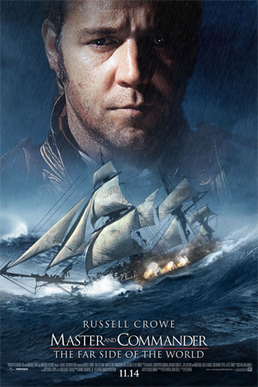
WAR MOVIE LEADERSHIP: Master and Commander


1. How would you describe Aubrey's leadership style?

            Aubrey is a crew’s captain.  He empathizes with his men and understands them.  He recognizes their superstitions like the whole “Jonah” thing.  He also believes in discipline and punishes one of the men who disrespected an officer.  It was obvious he understood what motivated the sailor, but rules are rules.  He refuses to reduce the grog ration to prevent future incidents because he understands how important that treat is for the men.  He is idolized by the men partly because he is successful (which means more prize money for them) and he is considered to be lucky.  He clearly does not ask them to do anything he would not do himself.
            Aubrey also maintains a good relationship with his officers.  He drinks with them in a good fellowship way and listens to them, although his decisions are final.  The way he deals with Hollom is instructive.  He tries to be sensitive, but is firm.  Although he sees the crew’s viewpoint, he tries to buck up Hollom and help him reach his potential.  He trusts his subordinates and gives them opportunities to lead.

2. Is Aubrey motivated more by pride or duty?

            I have to say it’s mainly pride, he even admits he has gone beyond his orders.  At one point he says after the enemy had gotten behind him a second time that he would not let it happen again.  Lucky for him his leadership style has created a surplus of good will that he taps into.  Great commander soften show this motivation, including his idol Nelson.  I have to add that along with hubris, he also has great faith in his abilities. 

3. Contrast the philosophies of Aubrey and Maturin? Who is right?

            Although Aubrey treats his men fairly and is not the type of martinet that was common in the Royal Navy back then, he certainly fits the British model of a captain being all-powerful on his ship.  Once he makes up his mind, he can be stubborn.  He also believes the end justifies the means.  For example, he cheats to win the final battle.  He knows you don’t get in trouble if you win.  Aubrey is the prototype man of war, Maturin is the man of science.
            Maturin, being a doctor and a liberal intellectual, is more concerned with the well-being of the crew than with the success of the ship.  He is a democrat on a ship which is a dictatorship.    He understands this, but still can’t help but voice his “radical” opinions.  He barely conceals his distaste for the traditions of the Navy.  He strongly believes that scientific discovery trumps a single ship victory.
            Both men are flexible in their philosophies which allows them to be friends.  Maturin abandons his quest for “the white whale” in order to save his friends life.  Maturin, obviously a pacifist, joins in the boarding and even kills a Frenchman.  It is a fascinating relationship.
            I personally think Maturin is right. Not only is the defeating of a single French privateer unlikely to have any significance in the war, but for a 28 gun ship to challenge a 44 is reckless. If Aubrey had failed (and he should have - he had to cheat to win), it would not only have been disastrous to his crew, but also to his career. Was Magellan (who travelled around the world, but lost the majority of his men) more important than Darwin (who stopped in the Galapagos Islands)?


MARCH WATCHALONG:  Twelve O'Clock High
1.  Was Maj. Gen. Pritchard right to relieve Davenport?
2.  Describe Savage's leadership philosophy and style.
3.  Was Savage right in the way he handled the unit?

Saturday, March 2, 2013

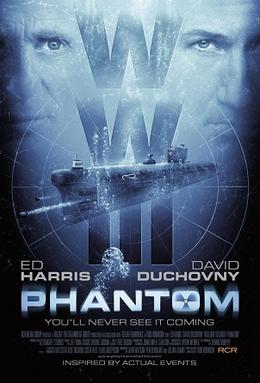
NOW SHOWING: Phantom (2013)


      Did you know that we came close to WWIII in 1968?  Neither did I.  “Phantom” takes the disappearance of a Soviet sub in the South Pacific that year to imagine a KGB plot to start a nuclear war between the U.S. and Red China.  Slap an “inspired by actual events” label on it and run with it.   This movie snuck up on me.  I think I saw one commercial for it.  I doubt it will be a blockbuster as it seems to have been dumped in the doldrums of February.
                The movie opens with a crusty, worn-out Captain Demi (Ed Harris) anticipating retirement before the cryptic admiral assigns him an old rust bucket that happens to have been his first boat.  The mission is classified and mysterious.  The Captain asks “do you think we can be redeemed for the things we’ve done?”  Wow, he just came  right out and mentioned redemption.  Also, I think we can expect some back-story.
                The sub takes on two KGB agents and a special gizmo welded to the deck.  The lead KGB agent named Bruni (David Duchovny) has a history with Demi.  More back-story coming.  Capt. Demi has some demons to where I thought maybe I had walked into a horror movie.  He pops pills and drinks and has frenetic flashbacks that turn out to harken back to an accident on his first cruise that resulted in numerous deaths.  The incident also resulted in a brain injury that gave him epilepsy which causes fits.  For some reason, Harris insisted on acting for his pay check.  Commendable.
                An encounter with an American sub establishes the Cold War submarine cat and mouse paradigm.  They release noise makers and dive to escape.  Later, they encounter a tanker and Bruni insists that Demi get close enough to scrape it.  At this point the Captain is reluctantly following orders, but he soon grows suspicious of Bruni’s motives.  It turns out the device is called “The Phantom” and is a type of cloaking device that mimics another ship’s sound echo.
                When Bruni decides to routinely surface to report their position, Demi countermands the order and takes command of the ship by gunpoint.  The crew loyal to the captain are locked up, but not monitored.  You’d think the KGB would be good at monitoring.  Demi figures out that the boat has gone rogue and Bruni wants to start a war.  The good guys take three separate actions.  The Captain rigs a distress signal to summon another warship.  The exec (William Fichtner) organizes the retaking of the boat.  Our newly wed officer goes off to disable the warhead.
                The distress signal quickly brings a Soviet attack sub that is apparently under orders to sink them, thus proving the rogue theory.  Bruni admits they are trying to start a war by firing the nuke at the U.S. fleet and making them think it came from a Chinese sub.  The reason is the U.S. has just developed something called “Dark Star” (not “Star Wars”) that will shoot down all Soviet missiles and give the U.S. a first strike capability which they will use because Bruni opines “that’s what we would do”.  Demi argues that America would not do such a thing because they value life.  His empathy for America does not sway the hard core Commie who is bent on winning the Cold War before the Americans can.  But first, there’s that pesky Soviet sub.  Demi is given temporary command to save them in the duel.  He does this by crippling the other sub (which strangely takes none of the countermeasures they had taken earlier). 
               At this point the plot dissolves into age-old sub clichés (hint:  rivets popping) and regular war movie cliches (wedding ring droppings), plot twists (not everyone among the loyals can be trusted), wanton violence (to prove Bruni is evil KGB), plot holes (exactly how did Bruni get the launch code?), and a shootout to make it an action movie.  We’re all here today so I’m sure you can figure out the bad guys don’t win.  Oh, and there is some redemption.

                The movie was not as bad as I expected.  I don’t think that will make much difference to the investors.  There was only one other person in the theater.  After what happened with “K-19”, who the Hell would green light a Soviet submarine movie?  At least they didn’t waste money on accents.  The acting is actually satisfactory.  Harris is excellent, as usual.  He brings gravitas to the role.  Fichtner is a likeable second.  The problem is Duchovny.  There is no chemistry between him and Harris.  He slums through the role.  He’s no Gene Hackman to Denzel Washington (“Crimson Tide” reference).  Speaking of which, this movie never seriously makes a case for Bruni’s point of view.   There is no real conflict.
                The set is good.  The interior does look like that of an old diesel sub.  This could be one of the most cramped subs in cinema.  The workings of the sub seem authentic.  Maybe they had a Russian technical advisor.   If so, he didn’t help much with tactics.  For example, the movie makes a big deal out of launching “decoy torpedoes”.  I’m no expert, but I would think a decoy torpedo would be used to lure incoming torpedoes away from the sub.  However, in this movie they are used to blow up the incoming ones.
                 The special effects are low rent.  All the sub shots are in darkness and the torpedo runs are straight out of a WWII sub movie.  The CGI (I assume the subs were rendered this way) are not jarring because of the darkness.  The cinematography is nothing special.  Typical sub stuff.  Lots of closeups.  Some following through the corridors.  The soundtrack is unobtrusive and just used to set the mood.
                In conclusion, “Phantom” is an average sub movie.  I have seen much worse and much better.  It was adequate entertainment and since I only invested $6.50 in it, it’s not my problem that someone was idiotic enough to produce it.  As I have said before in previous “Now Showing” posts, we war movie lovers need to be thankful for whatever we get.
grade =  C