Showing posts with label war movie cliches. Show all posts

Saturday, March 9, 2013

WWII COMBAT MOVIE CLICHES: Wake Island (1942) and Bataan (1943)


           In preparation for my “March Madness:  WWII Ground Combat Films”, I have been reading a book by Jeanine Basinger entitled  The World War II Combat Film.  Ms. Basinger has a very interesting section where she outlines the standard clichés that exist in WWII combat films.  Here is my summary of those traditional elements:

1.  the film has a dedication to a branch of the military or a group memorialized in the film  /  there may also be a thank you for military cooperation
           -  this could be words on the screen or narrated

2.  a group of men, led by a hero, undertakes a mission with a defined objective
                -  the mission usually involves holding something or moving towards something
3.  the group is heterogeneous
                -  multi-ethnic, different branches of the military, different socio-economic classes, different parts of the country (including Brooklyn), etc.
                -  the group might include a mascot

4.  the group has an observer or commentator
                -  usually a journalist or diarist
5.  the hero has leadership forced on him
                -  usually because the commander gets killed
6.  episodes alternate in opposites
                -  night then day / action then rest / safety then danger / comedy then tragedy / dialogue then action

7.  conflict within the group is resolved because of external pressure
                -  two soldiers who dislike each other /  different command philosophies between officers

8.  rituals connect the group to the past
                -  celebration of holidays / burial of comrades

9.  military rituals
                -  mail call / cleaning weapons / discussion of the future / talk about food or girls

10.  a member of the group gets redemption
                -  he screwed up in the past /  he’s an ass hole

                Two of the granddaddies of the Ground Combat Film subgenre are “Wake Island” (1942) and “Bataan” (1943).  These two films not only helped create the template for future WWII combat films, but for war movies in general.  Even in the 21st Century, the clichés are still commonly found in war films and will probably continue into the next century.

                “Wake Island” was in production before the battle was even over.  It was the first major combat film released after Pearl Harbor and was meant as a morale booster, although it memorialized a losing effort.  As the credits roll, the producers refer to the Marine Corps and insist the story is accurate.  The dedication compares the battle to other fights to the death (Valley Forge, Custer’s Last Stand, the Lost Battalion – only one of which fits the analogy, by the way).

                “Wake Island’ is not really a small unit dynamics movie.  It does not develop numerous characters within the unit.  There is a mascot – a dog named Skipper.  It does have the conflict angle, in fact it has two.  Two of the Marines, Randall (William Bendix) and Doyle (Robert Preston), are constantly ribbing each other.  Their dialogue is often funny (even today) and they provide comic relief.  Randall is clicheishly due to leave the military, but will of course stay to fight.  The other conflict is between the head of the civilian contractors McClosky  (Albert Dekker) and the Marine Col. Cadon (Brian Donlevy).  Both these conflicts will be resolved as the duos die fighting in the same fox holes.

                Word of Pearl Harbor means the Japanese are coming.  Their mission becomes to hold the island against Japanese attack.  The objective is to hold to the last.  This is a “last stand” movie.   It does not take long for the enemy to arrive.   Air bombardment does substantial damage and then a fleet arrives.   Caton allows the Japanese ships to come in close for their shore bombardment and then the Marine batteries give them hell.  Later, a pilot (whose wife died at Pearl Harbor) goes on a suicide mission to sink a Japanese cruiser.  In a war movie, those who have the least to lose or the most to lose are doomed.  The screenwriters made an interesting decision not to have him crash into the cruiser (luckily not making him a kamikaze role model) and thus allowing for the cliché of a funeral with words said over the grave.

                During non-bombardment time, Randall and Doyle discuss food and future plans (Randall wants to be a pig farmer).   Defense against an air attack results in one of the pilots bailing out and getting strafed by the dirty Japs.  They cheat, we don’t.   The action alternates between pyrotechnics and exposition.

                The film concludes with the Japanese invasion.  The last stands occur in machine gun nests.  The doomed warriors are still joking.  Caton and McClosky find common ground as ex-college football players and current Jap killers.  A post script promises they did not die in vain and there will be pay back by the American public in its righteous indignation.

                “Bataan” was an inevitable response to the box office success of “Wake Island”.  It was dedicated to the American and Filipino forces that fought to give the U.S. time to respond to the invasion of the Philippines.  This is another “last stand” movie (obviously influenced by “The Lost Patrol”).  A heterogeneous unit of 13 is given the mission to blow up a bridge and defend the crossing.  The objective is to hold off the Japanese as long as possible.  The audience is well aware that few if any will survive.  Unlike “Wake Island”, this film is more of a “who will die next?” movie.

                We are introduced to the members of the squad early and it is revealed that the heterogeneity is mainly contrasting military roles.  For instance, there is a sailor, a medic, a cook, a pilot, a mechanic, a scout, etc.  Most interestingly, one of them is a black demolitions expert.  Even more interesting, his race is not at the forefront.  There is some multi-ethnicity in the unit, but the screenwriters do not play this up.  The conflict is the dislike-type as Sgt. Dane (Robert Taylor) has a past with malcontent Todd (Lloyd Nolan).  Dane is forced into command when the Captain becomes the first to die.  There is a burial with words said over the grave. 

                The rest of the film alternates between action which whittles down the 13 and down time for defensive preparations, airplane repairs, and talking (mostly by the loquacious Len played by Robert Walker).  The banter is not the ribbing sort of “Wake Island”.  There is some comic relief from the Latino Ramirez (Desi Arnez), but the movie is light on humor.  Dane does not crack a smile until he laughs hysterically while battling literally from his grave.

                The deaths are spaced out and are not repetitive.  Some are cliché:  don’t celebrate after shooting down a plane, don’t try to sneak through enemy lines, self-sacrifice to destroy an objective, climbing a tree, standing up in a machine gun nest, someone has to die of disease, PTSD suicide charge.  The minorities die early and badly (ex. lynching – not the black guy).  There is some redemption for Todd (who is an escapee from military justice) although he refreshingly remains an ass hole to the end.

                I will later review these two movies as war movies.  For now, I plan to use them as the standards to compare the March Madness entries against.  I propose the theory that the less similar a combat movie is to these granddaddies, the better the movie is likely to be.  In other words, the less clichés, the better.  Not that “Wake Island” and “Bataan” are bad movies.  “Wake Island” is a remarkable achievement considering when it was made.  It holds up much better than many more recent fare.  The effects are well-done, especially the explosions.  The acting is solid.  The dialogue is good and sometimes quite humorous.  The action is brisk.  Importantly, it is fairly accurate and not overly propagandistic.

                “Bataan” is not as good, but is still very entertaining.  As you could read above, it is more cliché-ridden and this weighs it down.  The acting is fine by the ensemble.  It was shot on a soundstage which gives it an artificial look although I admit it was one hell of a stage.  While not meant to have much humor, I found myself laughing at some of the deaths.  There are some ridiculous and downright silly combat moments.  Both films feature old school ”twirling touchdown call” deaths.  The violence in “Bataan” is more intense, but there are long stretches of quiet when you are left to wonder what the hell are the Japanese doing?  “Bataan” is not based on a true story and the scenario is unrealistic.  It is more overtly propagandistic and much more racist toward the Japanese (“no tail baboons”).   

Tuesday, December 21, 2010

CRACKER? "9th Company (9 Rota)"


     “9th Company” is a Russian movie released in 2005. It was “inspired” by events surrounding the defense of Hill 3234 in Afghanistan by 9th Company, 345th Guards Airborne Regiment in January, 1988. The movie was a big hit in Russia because it emphasized the heroic sacrifices made by Russian grunts in a forgotten war. The film won the Russian equivalent of the Best Picture Oscar. It could be described as Russia’s answer to “Platoon” and “Full Metal Jacket” with a dash of “Hamburger Hill” thrown in.

     The movie introduces us to a typical war movie squad which is heterogeneous including the sensitive artist and the psycho. They bond during boot camp which is similar to the cinematic American boot camp. The drill sergeant is mean and takes the approach that they are not human, they are s***, but he will make them into men. They go through the usual obstacle course (one even crushes his nuts on a beam ala “Stripes”), crawling under wire, bayonet drill, and the rifle range. There is no fat guy that everybody hates, but there is a sensitive guy who almost quits. The movie does a good job showing how soldiers bond. It may be cliché, but it’s realistic. The soldier talk rings true because no matter the nationality, soldiers talk about the same things.

     Before being shipped off to Afghanistan, they are lectured briefly on the conditions there. Muslims have different views on life and death, you are safe in the villages because of the rules of hospitality, and oh, by the way, no one has ever conquered Afghanistan. See ya!

     They arrive at Bagram Airfield in Afghanistan 153 days after induction. When they arrive, a departing veteran gives one of them his lucky amulet. Sucks for the other people on the plane because you can guess what happens next. Cliches cross borders, apparently.

     When they arrive at their outpost, their sergeant is like a clone of the boot camp DI. He beats up a soldier who falls asleep on guard duty. The men are “savages”, but of course our boys will not end up like them. The Afghani army are called “greenies” and remind you of the ARVN (our equally dependable allies in Vietnam). The mujahideen are called “muj” and remind you of the Viet Cong. In an interesting scene, they catch the local muj leader (who they actually respect as a fellow warrior) and as he is backing away he trips and one of them kills him. (I keep saying “one of them” because to tell the truth, it is hard to distinguish the characters.)

     The movie has several pyrotechnical, balls to the wall, combat scenes. One is a convoy ambush where much ammunition is expended. The squad chases the muj who disappear into tunnels (ala the Viet Cong). They follow underground into the village where one of them is killed by an innocent-looking child (like Vietnam). Rockets destroy the village (like Vietnam).

     The big set piece is the siege of the hill. They are choppered in to set up a position on a hill overlooking a road that the Soviet high command is determined to open up to friendly traffic. The mujahideen attacks in waves. There are lots of graphic hand-to-hand combat and shocking deaths. If you watch the movie with someone else, bet before hand on how many of our boys will survive. (Tip: do not bet that all of them will live happily ever after.) The testosterone level is very high. Americans will doubly enjoy this scene because we can enjoy all the killings! (Sorry, I forgot we are friends with the Russians now.) The movie ends with them winning, but abandoning the hill (ala “Hamburger Hill”) and being forgotten by the Russian public.

      This is an excellent war movie for certain guys. You know who you are. Unfortunately, the core audience for this type of film usually does not like to read, so the subtitling creates a dilemma. As a war movie aficionado, it is fun to see the elements that harken back to beloved Vietnam War movies. You get three for the price of one with this movie:

Platoon – camaraderie of the soldiers / drunken carrying on / human wave attacks / tunnels

Full Metal Jacket – boot camp

Hamburger Hill – victory thrown away / who will survive?

     As far as accuracy, the movie gets a B. There was a battle on a Hill 3234 and the strategic situation was as the movie implies. The enemy did make 12 human wave attacks (possibly under the influence of drugs). All of them were repulsed. Contrary to the movie, the unit was consistently resupplied and medevaced. Also, the movie (surprise!) amps up the casualties. It was bad enough in reality with 34 of the 39 either killed or wounded. The hill was abandoned after the battle. By the way, there apparently was a Snow White who “entertained” the troops before they left boot camp.

     The acting is okay. It is hard to follow who is who. (Maybe Russians say the same about “Platoon”.) The combat is intense, but kind of Hollywoodish. The soldier life is realistically portrayed which supports my theory that all soldiers are basically the same, no matter the nationality.

     Will it crack the 100 Best War Movies of All Time? Possibly. For now, watch it as a companion to “Charlie Wilson’s War” and “Restrepo” and you will understand the wars in Afghanistan better. Then e-mail your Congressman and urge him to do the same.

GRADE  =  B+

Monday, November 15, 2010

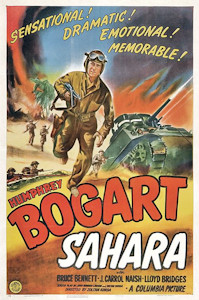
#83 - "Sahara"

BACK-STORY: “Sahara” was released in 1943, two months after the surrender of Italy. It is dedicated to the IV Armored Division which was training in the Borego Desert of California where the movie was filmed. The Army provided equipment for the production including the M3 Lee tank. Most of the Germans are played by American tankers. The movie is based on an incident in the Soviet photoplay “The Thirteen”. It earned three Oscar nominations – Sound, Cinematography, and Supporting Actor (J. Carrol Naish).


OPENING SCENE: In the Libyan desert, a lone tank named “Lulu Belle” gets a radio message to retreat southward in the face of the German (Rommel) breakthrough after the fall of Tobruk. “Good luck and scram!” They come under realistic artillery fire. The engine breaks down (cliché alert - #25), but being Americans they fix it with a wrench. The tank crew is led by Sergeant Joe Gunn (Humphrey Bogart) and he loves his tank saying that Lulu Belle is “like a dame, if you don’t feed her she doesn’t go anywhere”. They head south.

SUMMARY: They encounter the survivors (five Englishmen and a Frenchman) from a field hospital who decide to go with them. The movie now becomes a “who will survive?” suicide mission war film. At one stop, to change the fuel mixture, a young Lloyd Bridges shows off a picture of his girlfriend (cliché #1). Guess who is the first to die? They pick up a Sudanese soldier named Tambul (Rex Ingram) who has an Italian prisoner (Naish). Gunn is unmoved by the Italian’s pleading and showing of pictures of his family. They leave him behind, but Gunn changes his mind soon after (cliché #18).

A German plane strafes them, but misses the tank on all four passes. They fire once and shoot him down! The pilot is captured. He is your stereotypical arrogant jerk Nazi. He does not want the black guy to frisk him because he is inferior. (Could this foreshadow something? Stick around) Guess who is mortally wounded by the strafing? Hint: his pretty girlfriend will be very sad.

They plunge on to take refuge at the ruins of an old water hole through a realistic sand storm. This is possibly the driest movie ever. Make sure you have water handy while watching it. There is a well at the ruins, but it has only a slight drip of the precious liquid. They collect it in mess tins and each gets three swallows, including the prisoners (message: we are humane no matter what). We get the typical soldier talk about back home.

They ambush a German scout car capturing two Germans and Joe bribes the weaker with water to reveal an entire battalion is heading their way desperate for water. (Guess what his fanatical Nazi comrade does to him when he gets a chance?) Should they commit suicide by staying to defend the no-water hole against 500 Germans or turn tail and run? Gunn argues for staying. He insists that the audience will feel short-changed if there is not a big fight with lots of Germans getting killed. Just kidding. He actually plays the patriotic card by mentioning London, Moscow, Bataan, and Corregidor. (If you don’t recognize these references, a 1943 audience sure did).

Waco (Bruce Bennett) goes off in the scout car to get the cavalry. Meanwhile, our heroes prepare for the siege by digging in and placing German mines. The Germans come swarming forward and don’t even have to step on the mines for them to explode. They are forced to retreat. Gunn offers to trade water for food and later water for weapons in order to buy time and fool them on how much water they have. In one of the lulls, the German pilot (blonde, blue-eyed Kurt Krueger) argues with Giuseppe. The Italian claims that Italian soldiers only wear the uniform, they don’t give their souls. He speaks passionately about the evils of Hitler and the enslavement of his people. The German stabs him, naturally. He tries to escape but Tambul kills him in an appropriate way (in actual filming Ingram almost killed Krueger before “cut” was called).

The siege continues including mortar fire from the Germans. One by one, the good guys go down as we approach the over/under number. Joe keeps spirits up with statements like “we are doing it because we are stronger than them…They have never known the dignity of freedom.” Occasionally we cut away to the now on-foot Waco gamely pressing on.

FINAL SCENE: The Germans launched their last assault that will overwhelm the only two survivors (one is Bogart, of course), but instead of attacking they throw down their weapons and beg for water! Too bad there is no water. But wait, it turns out that a mortar explosion opened up a vein of water and it is now gushing out. The cavalry finally arrives. The movie closes with Joe reciting the names of the dead heroes as sappy music swells. A reference is made to the British holding at El Alamein.

RATINGS:

Action - 6

Acting – 9

Accuracy – 7


Realism – 6


Plot – 8


Overall – 8

WOULD CHICKS DIG IT? Not if they insist on female characters. The acting is good. It stars Humphrey Bogart as Humphrey Bogart. It has moments of talkiness. It is not non-stop killing. In general, I would have to say it does not have a lot of appeal to modern females.

CRITIQUE: “Sahara” is very much a product of its times. It is a classic black and white, made during WWII war movie. It fits solidly into the “small unit fighting against great odds” sub-genre. It is also a good example of a siege movie (similar to “The Alamo”). Although it was filmed at a time that the Allies were still unsure of victory, it is not heavy on propaganda. It does have its preachy moments and certainly taps into patriotism, but it is not heavy-handed.

One of the fascinating aspects of “Sahara” is the Italian character Giuseppe. One wonders if the timing of the movie (it was filmed during the Italian army’s collapse in North Africa and just prior to Italy’s surrender) led to the rather sympathetic treatment of Italians. It appears that the film-makers realized that the Italians were no longer a threat and the healing process could begin with this movie. Contrast the fanatical Nazis who are robotic followers of Hitler to the pitiable Italian who was merely a dupe of Mussolini. Naish’s nomination as Best Supporting Actor is also a statement about attitudes toward Italians in 1943. Another intriguing character is Tambul. Here we have a black man portrayed in a positive light. He is intelligent and brave - rare for a 1940s movie. Kudos to the screenwriter.

One flaw in the movie is the numerous clichés. (See my post on war movie clichés.) I found six classics in this movie. Some cannot really be faulted because they were so ingrained in old-school war movies that thinking outside the box would have been highly unorthodox. For example, having soldiers get shot with no bullet hole or blood is just the way it was in 40’s movies. Asking for the actors to sweat realistically in the desert is another pipe dream. (I read about how the make-up artist gave them a sweaty look, but I saw little evidence of this on the screen.) Hell, the actors in “The Thin Red Line” are not sweating on tropical Guadalcanal and that movie was made in 1998!

ACCURACY: The movie is loosely based on the fact that in June, 1942 a small detachment of American tanks joined the British 8th Army to get experience in desert warfare. I doubt any got into any combat implied by the opening of the movie. But when I saw the movie I assumed Hollywood had forced an American tank into the British army, so I was pleasantly surprised to find there was some justification for the scenario.

Since the siege was not based on an actual battle, I have no complaints about it. It is highly unrealistic, however. A very small group holding off 500 (equipped with mortars) can only happen in Hollywood. Also, I would assume any competent German commander would have maneuvered his force in a way that would have made it impossible for a few men to defeat attacks at several points. I admit that if enemy commanders used this common sense tactic, there would be no “siege against great odds” movies. That would be a shame because it is an interesting sub-genre.

CONCLUSION: “Sahara” is the rare made-during-wartime war movie that holds up years later. Its strengths are in the acting and the plot. It does not go overboard in patriotism and propaganda. The characters are interesting, if a bit stereotyped. Gunn’s trickery in faking the German commander into thinking they have plenty of water is fun. Although unrealistic in the outcome of the siege, most of the good guys don’t survive which is logical. Joe Gunn is a good role model for leadership. He is strict, but not stubborn.

I do not know where “Sahara” will end up on my list, but I think Military History magazine was justified in including it in the top 100. It is well worth the watching.


Next:  #82 - A Walk in the Sun

Saturday, September 25, 2010

WAR MOVIE CLICHES

In my last post, I made reference to some war movie cliches.  In my opinion, no movie genre has as many cliches as war movies.  One of the things I look for in my reviews is recurrences of these cliches.  The general idea is that the less cliches - the better the movie.  However, one of the appeals of war movies for some is they are formulaic.  This can be comforting.   Here is my list which is pretty much off the top of my head so I would welcome suggestions.


1.  If you show a picture of your girlfriend or wife, you are dead meat.
2.  A shamed soldier will redeem himself, often at the cost of his life.
3.  At least 1/3 of suicide mission members will not return. 
4.  If you brag about going home soon, you're going home in a box.
5.  In a tight situation, if you are an extra or unknown actor, you are going to die.
6.  Stupid officers survive.
7.  The fat guy always dies.
8.  All small units are heterogeneous.  The Southern guy is a rube.  The shortest guy is a jerk.  The Italian is a killer.  The college guy is too smart for this group.  The oldest guy is wise.  One will be from Brooklyn.  The fat guy is hopeless as a soldier.  One of them is a writer.  One of them was the class clown.  One of them loves animals more than people.
9.  Soldiers do not sweat, even in the tropics or desert.
10.  Enemy uniforms always fit, in case you need a disguise.
11.  A soldier who taks about getting married will not live to reach the altar.
12.  New replacements are dead meat, don't befriend them.
13.  Every unit has a "scrounger" who can find anything anywhere.
14.  Kids and dogs can not be killed in a barrage or bombardment.
15.  If two branches are represented in a bar - there will be a brawl.
16.  All subs can go way below their maximum depth.
17.  A bullet in the arm will not prevent you from using that arm.
18.  The overly strict officer will go soft at a critical moment.
19.  The tough disciplinarian will be hated at first, but will earn the respect of his men.
20.  Boot camp enemies will become friends.
21.  Innocent and naive soldiers will become disillusioned.
22.  When a sub is undergoing depth charging, it will release a recently dead sailor through a torpedo tube to fool the enemy.
23.  A bomber crew will witness the destruction of another crew that they befriended - there will be no parachutes.
24.  The featured bomber will lose at least one engine and have at least one crewman wounded.
25.  The featured tank will have engine trouble.  If it is an American tank, someone in the crew will fix it with a wrench.
26.  If the movie features a pair of BFFs - one will die and usually saving the other.
27.  A reciever of a "Dear John" letter will lose his will to live.
28.  Heavy machine guns can be fired constantly with no fear of damaging the barrel.
29.  If the movie was made before the 1960s, wounds will not bleed.
30.  Main characters never get caught by MPs.
31.  The schemer in boot camp will save the day later.
32.  Parents always take death notices stoically.
33.  Rivets will pop during a depth charging.
34.  Sailors on shore leave will always get in trouble with the MPs.
35.  Radio operators always wear glasses.
36.  Ground personnel will stow away on a bomber to get a taste of combat.  They will get chewed out by their commander, but he'll understand.