Showing posts with label Bataan. Show all posts

Monday, December 15, 2014

CLASSIC or ANTIQUE: So Proudly We Hail (1943)


                “So Proudly We Hail” was inspired by the nurses in the Philippines at the beginning of WWII.  Director Mark Sandrich read a story about ten nurses who escaped from Corregidor.  He and screenwriter Alan Scott ( who received an Academy Award nomination for his script) interviewed the ladies and even hired Eunice Hatchitt as technical adviser.  Hatchitt did a lot of eye-rolling over the petulant behavior of the three leading ladies in the film.  The movie was based on the book by Juanita Hipps (“I Served on Bataan”).  The “Angels of Bataan” served first on Bataan and then Corregidor before the lucky few were evacuated and the unlucky majority were imprisoned for the rest of the war.  The movie had the cooperation of the War Department, the Army Nurses Corps, and the American Red Cross.  The movie was a box office hit and was nominated for four Oscars (Best Supporting Actress, Cinematography, Original Screenplay, and Visual Effects).
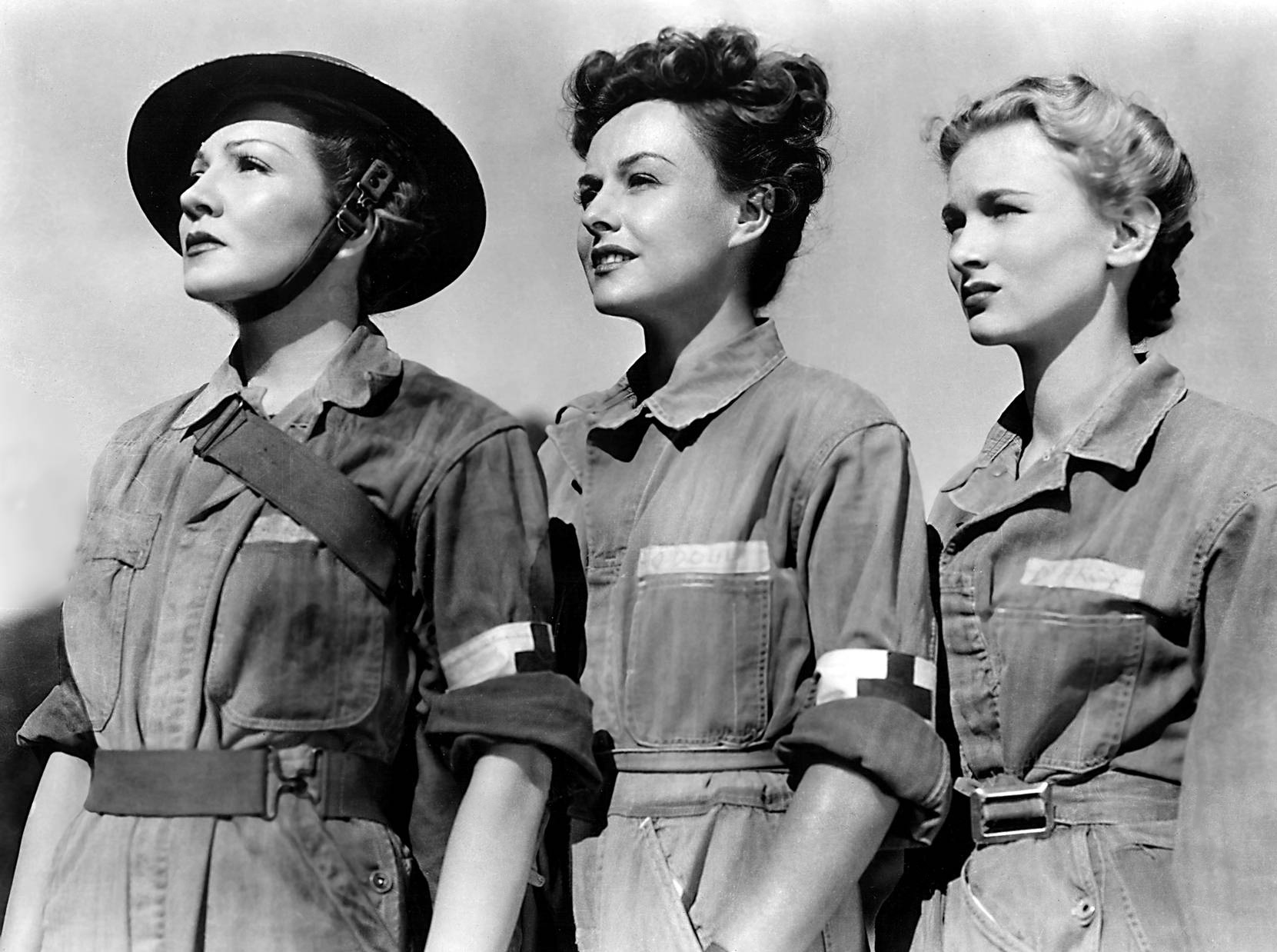
Colbert, Goddard, and Lake

                The film opens in May, 1942.  Eight nurses are in the Philippines.  Lt. Janet “Davy” Davidson (Claudette Colbert) has been wounded.  Suddenly they are on a cruise ship.  We’ve jumped to the end of the war and Davy has lost her will to live.  A doctor prescribes flash backs.  We are introduced to our trio of celebrity nurses as they sail to the Philippines.  Davy is the mother hen, Joan (Paulette Goddard) is the slutty one, and Olivia (Veronica Lake) is the vengeance –minded, Jap hating war widow.  Davy is romantically involved with Lt. Summers (George Reeves eight years before Superman) and gets to bathe him so the ladies in the audience might consider joining the nursing corps.  Meanwhile Joan is flirting with a hayseed named Kansas (Sonny Tufts).  Olivia is being unsociable, even with the other nurses.  What a bitch!  They don’t realize the Japs killed her husband.  At a Christmas party on board the ship, a Chaplain gives a speech to the audience telling them to have faith in the things America stands for. 

                When they reach Bataan, they are assigned to a hospital.  Olivia gets herself assigned to the Japanese prisoner ward.  Will she cold-bloodedly murder?  John shows up.  Unwounded. What the…?  John and Davy go on a moonlit walk and spend the night in a dugout – wink, wink.  The Japanese show up before the girls can bug out.  Olivia lets her peek-a-boo hair down and pulls a grenade out of her bra.  That is not a euphemism.


Put that hair down, put those hands up
                At the new hospital, John ( what is this guy? a hospital groupie?) gives Davy a monkey that of course is named Tojo (because they look alike).  The head nurse’s son dies after having his legs amputated.  She represents all the moms who have lost sons in the war.  The damned war keeps intruding on the romantic subplots.  “I don’t know if that’s an air raid warning or mess call.  Either way it’s a warning”.  LOL  Those bastard Japs even bomb the hospital with the huge red cross on it.  We wouldn’t do that.

                The gals are evacuated to Corregidor.  So is John, who has finally managed to get himself wounded.  A doctor removes his shrapnel (“it’s probably good American steel” – non-Greatest Generation, this is a reference to scrap iron sold to Japan before the war).  The hospital is located in the Malinta Tunnel.  There is a plug for Red Cross blood.  One nurse gets the “heebie jeebies”.  Davy and John honeymoon by a howitzer before he goes on a suicide mission to get quinine.  “I’ll be back”.  Liar.  Joan says goodbye to Kansas.  “So long, kid”.
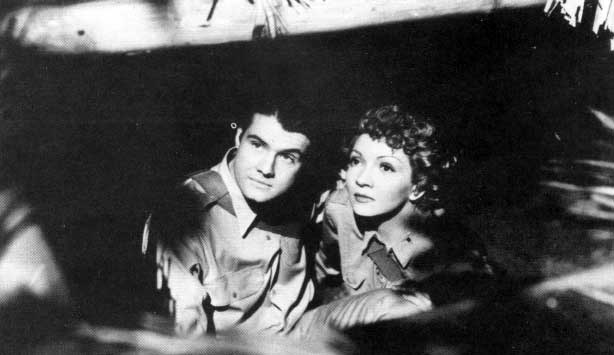

Davy and John in the Honeymoon Suite
                “So Proudly We Hail” is better than you would expect.  It is fairly realistic in depicting the lives of nurses in the Philippines.  They were in fact very sexy and had romances with soldiers.  Actually, according to the movie, two thirds of nurses had affairs and one third were married to soldiers who were killed in the war.   And they were able to keep their hair perfectly coiffed.  The movie is entertaining in a 1940s war movie aimed at females sort of way.    There is some pretty good humor and some of it is even intentional.  The dialogue is better than average for this type.  It is only occasionally schmaltzy.  The speeches did not make me throw up in my mouth.  Surprisingly, the movie deserved its visual effects nomination.  The bombing scenes are well done.  There are some effective pyrotechnics.  The acting is good and no one embarrasses themselves.  The three ladies are fine (and I do mean fine).  Goddard got a Best Supporting Actress nod.  She plays 1940s trollop well.    Colbert is her usual solid self. Lake is not much of an actress, but I don’t think anyone cared.  Excuse me, is that a grenade in your bra?  Oh, and there are some men in the cast as I recall.  One of them played Superman.

                Classic or antique?  Classic because of the recognition for the nursing corps.  This is what sets it apart from other wartime war movies.  It could have been much worse.

 
Grade =  C+

Saturday, March 9, 2013

WWII COMBAT MOVIE CLICHES: Wake Island (1942) and Bataan (1943)


           In preparation for my “March Madness:  WWII Ground Combat Films”, I have been reading a book by Jeanine Basinger entitled  The World War II Combat Film.  Ms. Basinger has a very interesting section where she outlines the standard clichés that exist in WWII combat films.  Here is my summary of those traditional elements:

1.  the film has a dedication to a branch of the military or a group memorialized in the film  /  there may also be a thank you for military cooperation
           -  this could be words on the screen or narrated

2.  a group of men, led by a hero, undertakes a mission with a defined objective
                -  the mission usually involves holding something or moving towards something
3.  the group is heterogeneous
                -  multi-ethnic, different branches of the military, different socio-economic classes, different parts of the country (including Brooklyn), etc.
                -  the group might include a mascot

4.  the group has an observer or commentator
                -  usually a journalist or diarist
5.  the hero has leadership forced on him
                -  usually because the commander gets killed
6.  episodes alternate in opposites
                -  night then day / action then rest / safety then danger / comedy then tragedy / dialogue then action

7.  conflict within the group is resolved because of external pressure
                -  two soldiers who dislike each other /  different command philosophies between officers

8.  rituals connect the group to the past
                -  celebration of holidays / burial of comrades

9.  military rituals
                -  mail call / cleaning weapons / discussion of the future / talk about food or girls

10.  a member of the group gets redemption
                -  he screwed up in the past /  he’s an ass hole

                Two of the granddaddies of the Ground Combat Film subgenre are “Wake Island” (1942) and “Bataan” (1943).  These two films not only helped create the template for future WWII combat films, but for war movies in general.  Even in the 21st Century, the clichés are still commonly found in war films and will probably continue into the next century.

                “Wake Island” was in production before the battle was even over.  It was the first major combat film released after Pearl Harbor and was meant as a morale booster, although it memorialized a losing effort.  As the credits roll, the producers refer to the Marine Corps and insist the story is accurate.  The dedication compares the battle to other fights to the death (Valley Forge, Custer’s Last Stand, the Lost Battalion – only one of which fits the analogy, by the way).

                “Wake Island’ is not really a small unit dynamics movie.  It does not develop numerous characters within the unit.  There is a mascot – a dog named Skipper.  It does have the conflict angle, in fact it has two.  Two of the Marines, Randall (William Bendix) and Doyle (Robert Preston), are constantly ribbing each other.  Their dialogue is often funny (even today) and they provide comic relief.  Randall is clicheishly due to leave the military, but will of course stay to fight.  The other conflict is between the head of the civilian contractors McClosky  (Albert Dekker) and the Marine Col. Cadon (Brian Donlevy).  Both these conflicts will be resolved as the duos die fighting in the same fox holes.

                Word of Pearl Harbor means the Japanese are coming.  Their mission becomes to hold the island against Japanese attack.  The objective is to hold to the last.  This is a “last stand” movie.   It does not take long for the enemy to arrive.   Air bombardment does substantial damage and then a fleet arrives.   Caton allows the Japanese ships to come in close for their shore bombardment and then the Marine batteries give them hell.  Later, a pilot (whose wife died at Pearl Harbor) goes on a suicide mission to sink a Japanese cruiser.  In a war movie, those who have the least to lose or the most to lose are doomed.  The screenwriters made an interesting decision not to have him crash into the cruiser (luckily not making him a kamikaze role model) and thus allowing for the cliché of a funeral with words said over the grave.

                During non-bombardment time, Randall and Doyle discuss food and future plans (Randall wants to be a pig farmer).   Defense against an air attack results in one of the pilots bailing out and getting strafed by the dirty Japs.  They cheat, we don’t.   The action alternates between pyrotechnics and exposition.

                The film concludes with the Japanese invasion.  The last stands occur in machine gun nests.  The doomed warriors are still joking.  Caton and McClosky find common ground as ex-college football players and current Jap killers.  A post script promises they did not die in vain and there will be pay back by the American public in its righteous indignation.

                “Bataan” was an inevitable response to the box office success of “Wake Island”.  It was dedicated to the American and Filipino forces that fought to give the U.S. time to respond to the invasion of the Philippines.  This is another “last stand” movie (obviously influenced by “The Lost Patrol”).  A heterogeneous unit of 13 is given the mission to blow up a bridge and defend the crossing.  The objective is to hold off the Japanese as long as possible.  The audience is well aware that few if any will survive.  Unlike “Wake Island”, this film is more of a “who will die next?” movie.

                We are introduced to the members of the squad early and it is revealed that the heterogeneity is mainly contrasting military roles.  For instance, there is a sailor, a medic, a cook, a pilot, a mechanic, a scout, etc.  Most interestingly, one of them is a black demolitions expert.  Even more interesting, his race is not at the forefront.  There is some multi-ethnicity in the unit, but the screenwriters do not play this up.  The conflict is the dislike-type as Sgt. Dane (Robert Taylor) has a past with malcontent Todd (Lloyd Nolan).  Dane is forced into command when the Captain becomes the first to die.  There is a burial with words said over the grave. 

                The rest of the film alternates between action which whittles down the 13 and down time for defensive preparations, airplane repairs, and talking (mostly by the loquacious Len played by Robert Walker).  The banter is not the ribbing sort of “Wake Island”.  There is some comic relief from the Latino Ramirez (Desi Arnez), but the movie is light on humor.  Dane does not crack a smile until he laughs hysterically while battling literally from his grave.

                The deaths are spaced out and are not repetitive.  Some are cliché:  don’t celebrate after shooting down a plane, don’t try to sneak through enemy lines, self-sacrifice to destroy an objective, climbing a tree, standing up in a machine gun nest, someone has to die of disease, PTSD suicide charge.  The minorities die early and badly (ex. lynching – not the black guy).  There is some redemption for Todd (who is an escapee from military justice) although he refreshingly remains an ass hole to the end.

                I will later review these two movies as war movies.  For now, I plan to use them as the standards to compare the March Madness entries against.  I propose the theory that the less similar a combat movie is to these granddaddies, the better the movie is likely to be.  In other words, the less clichés, the better.  Not that “Wake Island” and “Bataan” are bad movies.  “Wake Island” is a remarkable achievement considering when it was made.  It holds up much better than many more recent fare.  The effects are well-done, especially the explosions.  The acting is solid.  The dialogue is good and sometimes quite humorous.  The action is brisk.  Importantly, it is fairly accurate and not overly propagandistic.

                “Bataan” is not as good, but is still very entertaining.  As you could read above, it is more cliché-ridden and this weighs it down.  The acting is fine by the ensemble.  It was shot on a soundstage which gives it an artificial look although I admit it was one hell of a stage.  While not meant to have much humor, I found myself laughing at some of the deaths.  There are some ridiculous and downright silly combat moments.  Both films feature old school ”twirling touchdown call” deaths.  The violence in “Bataan” is more intense, but there are long stretches of quiet when you are left to wonder what the hell are the Japanese doing?  “Bataan” is not based on a true story and the scenario is unrealistic.  It is more overtly propagandistic and much more racist toward the Japanese (“no tail baboons”).