BACK-STORY: “Glory” was inspired by screenwriter Kevin Jarre’s
viewing of Augustus Sainte-Gaudens’ memorial to the 54th
Massachusetts Regiment in Boston. His
research relied on the letters of Robert Gould Shaw, Lay This Laurel by
Lincoln Kirstein, and One Gallant Rush by Peter Burchard. Edward Zwick (“Courage Under Fire”) directed
with a limited budget of $18 million.
Shelby Foote (of Ken Burns’ “Civil War” fame) was the technical
advisor. Morgan Freeman took a pay cut
to appear in the movie because he was determined to be a part of the enhancing of
African-American history. The movie was
critically acclaimed, but only a modest box office success ($27 million). It won three Academy Awards – Best Supporting
Actor (Denzel Washington), Cinematography (Freddie Francis), and Sound
Mixing. It was nominated for Art
Direction and Film Editing.
OPENING: Words tell
us Robert
Gould Shaw was the son of a wealthy Boston abolitionist. He was 23 at the start of the movie. The movie’s action begins at the Battle of
Antietam. Shaw is an officer prodding
his unit across a field into the teeth of Rebels ensconced behind a fence. Shells explode (typical of a Civil War film’s
inability to depict cannister) and the Yanks are shredded. One man’s head explodes (thus earning the
film its unwarranted R- rating). Shaw is
wounded when a Minie ball grazes his neck.
He returns to consciousness upon being nudged by a grave-digger. This being Antietam, the fighting has moved
to a new area of the battlefield as the incompetent McClellan launches another
piecemeal assault. Shaw learns of
Lincoln’s Emancipation Proclamation while being patched up at a field
hospital. An amputation takes place in
the background.
SUMMARY: Back at home in Boston, Shaw is discombobulated by
the contrast of brain-splattering combat with the genteel upper crust gathering
at his parents’ home. A slammed window
also subtly reminds us of his post-traumatic stress. Shaw is introduced to Frederick Douglass and
is stunned to learn a “colored regiment” is going to be recruited and the
governor wants him to command. His boozy
friend Cabot Forbes (Cary Elwes) agrees to be his exec and his childhood nerdy
black friend Thomas (Andre Braugher in his film debut) is the first
volunteer. Any doubts about the acting
chops of the cast are over at this point.
The new recruits are
greeted at training camp with racist taunts from the white soldiers and this is
their Yankee comrades! We are introduced
to the core black ensemble of the belligerent runaway Trip (Washington), the
fatherly ex-grave digger Rawlins (Freeman), the stuttering hick Jupiter (Jihmi Kennedy),
and the book worm Thomas. When asked
what he has been doing since he ran away, Trip says “I’ve been running for
President… I ain’t gonna win though”.
Trip takes an instant dislike to Thomas.
The field slave versus the house slave dynamic.
Shaw will have to grow
into his leadership role and is uncomfortably aware of this. He brings in an Irish drill sergeant named
Mulcahy (John Finn) to verbally flog the men into soldiers. His “tough hate” and Shaw’s officer class
aloofness toughens the men (with Thomas’ arc being the exemplar). There are hurdles along the way like a
Confederate proclamation that any black soldier taken captive would be returned
to slavery (and death to their white commanders). They all quit and go home. Just kidding.
Along with the Trip/Thomas dysfunction, there is tension between Shaw
and Forbes with Forbes feeling that Shaw is too harsh with the men. Forbes feels the regiment is a stunt that will
never sniff combat. This comes to a head
with the punishment of Trip for desertion (actually AWOL for shoes). A superstar is born with Washington’s
flogging scene. This is a turning point
for Shaw as he begins to find a middle ground between martinet and
milquetoast. When Trip leads a boycott
of the inequity in pay for black soldiers, Shaw joins in. The success of the training is capped with a
well-staged parade through the streets of Boston. There is no dialogue, just very evocative
music. The camera plays on faces in the
unit and in the crowd. Pride on display.
The 54th is
shipped to occupied South Carolina. This
time they march past slaves, giving them a vision of the future. The 54th is teamed with a unit of
contraband (slaves freed by Union forces) soldiers. The two units are sent on a raid to Darien,
Georgia. The contraband commander is an
ex-slave owner Col. Montgomery (Cliff De Young) who knows how to handle “monkey
children”. He is a fanatic who believes
“Secesh has got to be swept away by the hand of God like the Jews of old”. Montgomery pulls rank and forces Shaw to order
a war crime by the 54th.
Shaw has to blackmail
Gen. Hunter to allow him to get some of his men killed in combat. Whites will only respect black soldiers if
they are blooded. What follows is a
sharp little encounter at James Island, South Carolina. This is one of the great Civil War combat
scenes (and is reminiscent of the Little Round Top sequences in
“Gettysburg”). The 54th
stands its ground against Rebel cavalry (the film used special “falling horses”
trained to fall on command) and then goes toe-to-toe with infantry. This devolves into a melee that is intensely
realistic and visceral. Respect earned.
With the victory at
James Island, the 54th has earned the right to get slaughtered for
liberty. They are tasked for Charleston
where the siege of Fort Wagner continues unabated. Shaw volunteers to lead the assault and the
evening and morning are rife with foreboding.
That evening the men have a revival style meeting where they each
testify. The highlights are sincere
turns by Trip, Jupiter, and Rawlins.
Trip has come full circle from black sheep (sorry) to accepted member of
the family. The next morning on the
beach as the unit prepares for its bout with destiny, Shaw releases his horse
in recognition that this is a suicide mission.
Shaw has also come full circle as his men chant his name. Shaw asks who will carry the flag if the
flagbearer falls and Thomas volunteers.
Book worm no more.
 |
| "Last one in the fort is a rotten egg!" |
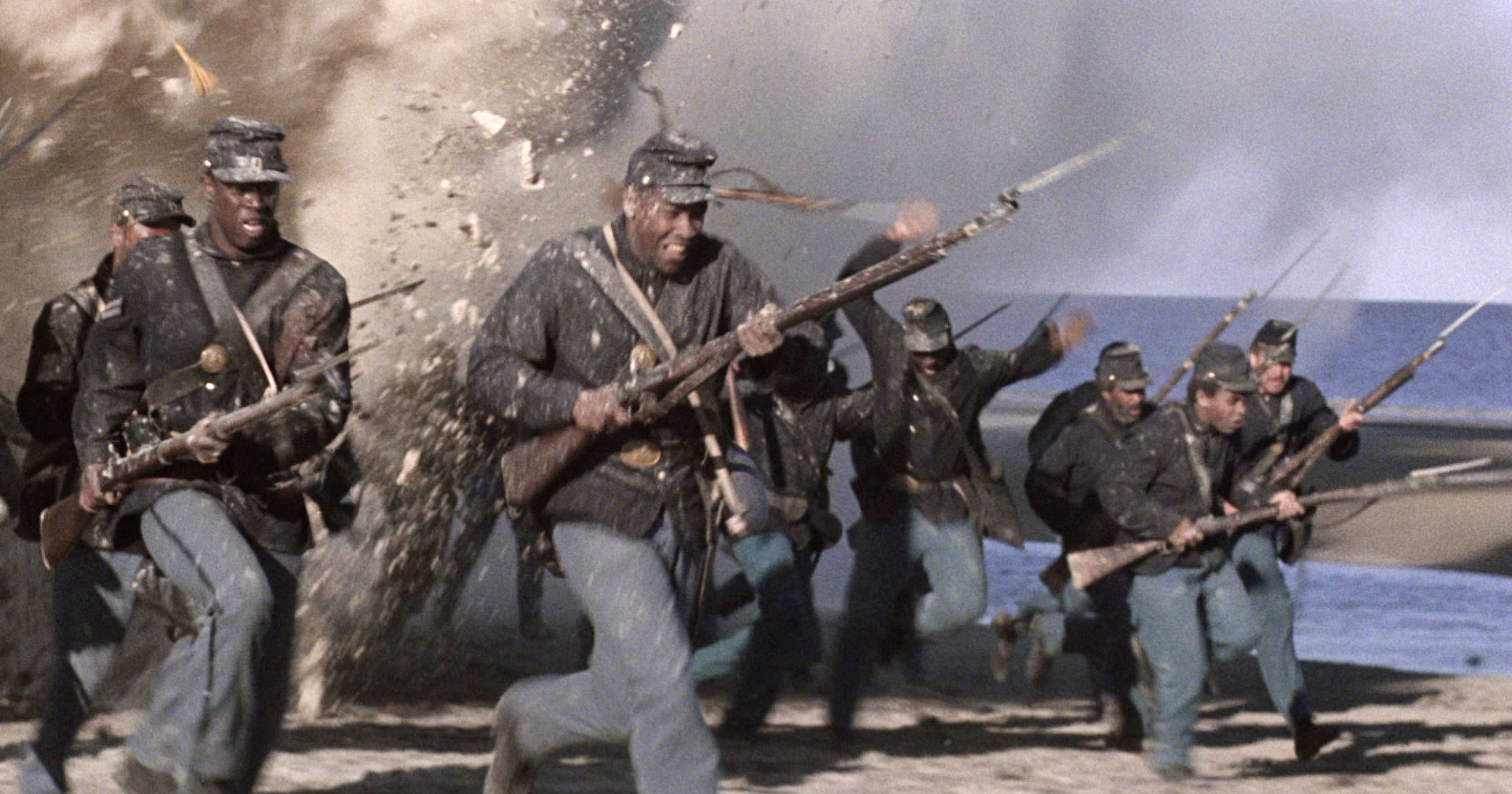
CLOSING: The men double time over the beach with musical
accompaniment which transitions to the sounds of battle. Cannonading forces them to take refuge in the
dunes and wait for nightfall (so it can be more dramatic cinema-wise). The night is lit by flares (rockets?) and
punctuated by grenades. Shaw orders the
renewal of the charge and the men struggle across a ditch lined with stakes. Shaw is killed on the upslope of the parapet
and Trip grabs the flag and follows him into the afterlife. Shaw’s death inspires the men to bash their
way into the fort and perhaps they might just pull it off. The belated appearance of cannister ends that
dream. Surprise, historically ignorant
audience expecting the usual Hollywood happy ending. As a post script, Shaw is buried with the
enlisted men.
WOULD CHICKS DIG IT? Although there is no significant female character,
the movie is clearly not intended for just a macho audience. Shaw’s mother (Jane Alexander) was left
mostly on the cutting room floor and a hinted romance for Shaw with a teacher
in South Carolina was completely edited out.
Although Rated-R, the film is far from graphic (with the exception of
the decapitation) and the language is not full of four-letter words. Mothers will love the fact that Shaw writes
home to his mommy.
 |
| "Hey, the script said we win" |
HISTORICAL ACCURACY: “Glory” is an excellent example of a movie that
takes the basic historical facts and constructs a narrative around them to
bring recognition to a military unit in a way that is attractive to a
mainstream audience. The film does a lot
of tweaking of the facts, but none of it is egregious and all of it advances
the narrative arc.
The 54th
Massachusetts Regiment was the brainchild of Gov. Andrew. Frederick Douglass was a leading influence
for the creation of all-black units as a means of getting respect for
African-Americans and giving them a stake in the future of the Union. Andrew began the process after Lincoln issued
the Emancipation Proclamation. Two of
Douglass’ sons volunteered for the unit.
The 54th Massachusetts was the first regiment recruited in
the North. The 1st South Carolina
Volunteers was already in existence. The
film glosses over the difficulty of recruiting enough Massachusetts blacks to
fill out the unit. In fact, Andrew had
to send recruiters throughout the North.
The unit was comprised almost exclusively of freed blacks. A runaway slave like Trip would have been a
rare exception. Speaking of which, none
of the members of the unit (other than Shaw) were real people.
Capt. Shaw was at
Antietam, but his unit was not involved in any charges similar to that of the
movie. He saw no serious fighting. However, he did receive a neck wound from a
spent bullet. When Gov. Andrew offered
command of the regiment, through Shaw’s abolitionist father, Shaw turned it
down at first. He reconsidered over
night and accepted. The second in
command was Lt. Col. Norwood Hallowell.
Forbes bears little resemblance to him.
On the other hand, the depiction of Shaw is spot on. He was 25 and looked younger. Broderick gets the evolution from
in-over-his-head rookie colonel to confident leader down pat. His ruminations are based on Shaw’s actual
letters. The movie does omit Shaw’s
courtship and marriage to Anna Haggerty.
The movie undoubtedly
fleshes out and enhances the trials Shaw and the unit go through in training. The template is appropriate. The unit was assigned to Readville, Mass. for
boot camp. When Shaw arrived, the men
already had their “blue suits”. The
Mulcahy (John Finne as one of the great cinematic drill sergeants) character is
fictional, but does reflect the antipathy of many Irish toward blacks during
that era. The flogging of Trip uses
dramatic license because AWOL offenses were normally treated with spread
eagling or some similar punishment. I
found no evidence the unit was deprived of shoes by the quartermaster although
the general theme of neglect feels genuine.
I also found no evidence that Shaw had a rocky road to gaining the men’s
respect. That arc may not have been
accurate, but it is absolutely crucial to the theme of growing into leadership
and is a strength of the screenplay.
This arc builds to the mutiny over the pay. This is classic tweaking. Congress did allocate $10 (minus $3 for
uniforms) for black soldiers. The twist
is Shaw initiated the protest. And the
pay issue did not come up until they had reached South Carolina. The Confederate government did issue a
proclamation threatening to enslave any blacks captured in uniform and to
execute their white officers.
The parade through
Boston is accurately depicted. The
parade was witnessed by Douglass, William Lloyd Garrison, and John Greenleaf
Whittier as well as Shaw’s parents. The
arrival at Beaufort, South Carolina is realistic as well. The unit was greeted by freed slaves. Beaufort was part of the Port Royal
Experiment in which Northern abolitionists educated the newly freed slave
children.
The raid on Darien,
Georgia is substantially accurate. The
54th was paired with the 2nd South Carolina Volunteers
under Col. James Montgomery. Montgomery
was the jerk the movie portrays. He did
utter the line “they will be swept away by the hand of God like the Jews of
old”. He did order his undisciplined
contraband soldiers to sack the town.
Shaw did reluctantly participate in the atrocity as depicted in the
film.
Their first combat
experience came about from a letter Shaw wrote to Gen. Strong (not from
threatening Gen. Hunter with exposure of his corruption). They were moved to the Charleston area and
received their baptism of fire on July 16, 1863 in a spirited skirmish between
pickets that involved four of the companies on James Island. The 54th
retreated slowly to allow the 10th Connecticut to withdraw. There was Confederate cavalry involved, but
it is doubtful they charged an untouched unit as is shown in the movie. That would have been unrealistic
tactically. The depiction of volleys
followed by a bayonet charge and then hand-to-hand was typical of Civil War
combat. This action did earn the respect
of the white units.
The prelude to the
attack on Ft. Wagner was well researched.
Shaw did have a premonition of death.
He did give a stack of letters to Edward Pierce of the N.Y. Daily
Tribune. He did send off his horse. However, Gen. Strong asked him to lead the
assault, not the other way around. Also,
it was Strong who asked who would pick up the flag and it was Shaw who said he
would.
The charge is close to
the truth. The locale for the filming
and the fort itself are authentic. There
was a stake filled moat and a rampart.
For cinematic purposes, the movie starts the charge in the daylight when
it actually began after dusk. Shaw did
lead the charge (which would not be out of the ordinary for a war where
casualty rates for officers were greater than for the enlisted). The Rebels opened fire at about two hundred
yards with cannon fire. At the moat, the
unit was hit by massed musket fire. Shaw
was shot at the crest of the rampart and fell into the fort. (The movie dubiously leaves out the story of
Sgt. William Carney who earned the Medal of Honor for planting the flag on the
parapet and then despite several wounds getting it back to the camp. He
famously said, "Boys, I only did my duty; the old flag never touched the
ground!") Several of his men followed Shaw in, but most of the unit was forced to
retreat. The adrenalin-fueled run led by
Forbes is pure fiction, but cool.
The aftermath of the
battle is true to the facts. Shaw was
buried in a mass grave by the Confederates in an act intended to dishonor
him. Tellingly, Shaw’s parents insisted
he remain interned with his men after the fall of the fort. The movie gives the impression the unit was
devastated by the attack. In reality the
unit suffered 272 casualties out of 600 men.
45% is very high, but this means more than half were not even wounded.
 |
| a different take on Shaw's death |
The Battle of Fort
Wagner did not mark the end of the 54th’s service. It covered a Union retreat at the Battle of
Olustee in Feb., 1864. It made an
unsuccessful assault on a strong entrenched position at Honey Hill in November. Lastly, it participated in one of the last
actions of the war when it attacked a Rebel force defending an abandoned
fort. In a reversal of Fort Wagner, the
Confederates fled and the 54th suffered only two dead.
 |
| Matthew Brodererick: serious actor |
CRITIQUE: “Glory” has no weaknesses. The acting is stellar. The cast is amazing and balanced as a team
effort. The standout is Washington, of
course. His Best Supporting Actor nod
was possibly the most deserving ever. He
is absolutely mesmerizing when he is on screen.
The scene where he is flogged is a tour de force. That tear!
The rest of the ensemble does not just stand around and watch him. All of the major roles could not have been
better played. Freeman is his usual solid
self. Andre Braugher made his film debut! Talk about coming out the blocks fast. On the other end of the spectrum is Jihmi
Kennedy who had the only significant role of his aborted career. The sweetness of his Jupiter balances the
belligerence of Trip. Cary Elwes is an
excellent foil for Broderick. (He and
Broderick did not get along during the shoot, by the way.) The biggest shock here is Broderick. He would seem to have been an obvious weak
link, but he holds his own. The critics
who faulted his “shaky” performance did not realize that it is an accurate
depiction of a young man thrust into a difficult position. Critics seem to have overlooked the use of
Shaw’s own words to show his feelings.
Broderick acts like the man who wrote those letters and he looks like
him, too. And don’t forget the
reenactors that lend their special skills to any quality Civil War movie. The movie was partly filmed at Gettysburg
during the 125th anniversary.
The
film is technically sound. Edward Zwick
did not have a massive budget, but he does a great job. The training camp set and the Fort Wagner re-creation
are outstanding. The uniforms and
weaponry are accurate. The sound effects
were Oscar worthy. Most impressive is
the musical score by James Horner (“Enemy at the Gates”, “Braveheart”). He makes awesome use of the Harlem Boys Choir
to give parts of the score a hymnal quality.
It is absolutely incredible that the music did not get an Academy Award
nomination!
The screenplay is
solid, but breaks no new ground. The
themes include the rookie commander who grows into his leadership role and adjusts
his by the book approach to the personality of his unit. You also get the obligatory redemption arc of
Trip. It was a nice touch to have him
decline carrying the flag, but otherwise his evolution was comfortably
predictable. A double dose of cliché came
with Trip and Thomas coming to respect each other and the antagonistic white
unit learning to respect the 54th.
The heterogeneous small unit ensemble is nothing new, but was essential
to the plot. It goes without saying that
the film has an anti-war bent.
“Glory” has an
excellent blend of combat action and dialogue which is rare for a war
movie. The two combat scenes are among
the best ever. The James Island skirmish
comes as a big payoff for all the training scenes. They earned the right to die, which was
another theme. It is worth the wait and
a great prep for the climactic assault.
In fact, the flow from scene to scene throughout the movie is
commendable. Zwick places the parade in
the middle of the film as a halftime interlude.
Best of all is the scene with the soldiers “testifying” before the final
day of many of their lives.
 |
| Rawlins testifies |
The dialogue is what
helps the movie stand out as a war movie.
This includes one of my favorite exchanges in movie history:
[Trip and Thomas are about
to fight when Rawlins steps in]
Rawlins:
Look, goddamn it! The whole world gotta stomp on your face?
Trip:
Nigger, you better get your hands off me!
Rawlins:
Ain't no niggers around here! Understand?
Trip:
Oh, I see, so the white man give you a couple a stripes, and suddenly you start
hollerin' and orderin' everybody around, like you the massa himself! Nigger,
you ain't nothin' but the white man's dog!
[He starts to walk away,
Rawlins stops him and slaps him]
Rawlins:
And what are you? So full of hate you want to go out and fight everybody!
Because you've been whipped and chased by hounds. Well that might not be
living, but it sure as hell ain't dying. And dying's been what these white boys
have been doing for going on three years now! Dying by the thousands! Dying for
*you*, fool! I know, 'cause I dug the graves. And all this time I keep askin'
myself, when, O Lord, when it's gonna be our time? Gonna come a time when we
all gonna hafta ante up. Ante up and kick in like men. LIKE MEN! You watch who
you call a nigger! If there's any niggers around here, it's YOU. Just a
smart-mouthed, stupid-ass, swamp-runnin' nigger! And if you not careful, that's
all you ever gonna be!
CONCLUSION: “Glory” and I have a long relationship. I saw the making of documentary on CBS before
the movie came out. I remember being
very skeptical about whether it would be good.
I also questioned the casting of Ferris Bueller as Col. Shaw. My fears were for naught, thankfully. I took my American History classes to see it
(which would be impossible now that there is a ban on R-Rated movies for school
purposes – thus eliminating virtually all modern war films). I was already covering the 54th
Massachusetts in my Civil War unit so the story was not new to me. I’ve always gone out of my way to highlight
individuals and groups that deserve recognition, but have been overlooked by
the curriculum. And not just for African-Americans. All Americans should know this story and
cinema can play this role.
Unfortunately, cinema often botches the one chance to get it right (e.g.
“Braveheart”). But occasionally, the
ignorant masses get a rousing history lesson like in “Glory”, “The Lost
Battalion”, and “The Great Raid”.
The placement of “Glory” in the top ten is certainly
warranted. In truth it could be argued
that it is the best war movie ever made.
It has great acting. It has some
remarkable combat reenactment. It is
technically outstanding. The score is
iconic. It is historically accurate for
the most part and where it fudges, it does so to advance the story-line. Most importantly, its infotainment at its
most magnificent.
RATINGS:
Acting - A+
Action – 7/10
Accuracy – B
Plot - A
Realism - A
Overall = A+
the trailer
Rawlins chastises Trip