“Gray Lady Down” was an addition
to the venerable submarine subgenre of war movies. It was based on the novel by David Lavalee
entitled Event 1000. That title
refers to U.S. Navy terminology for a rescue of a sunken submarine’s crew. It was directed by David Greene (“Friendly
Fire”). It attempted to tap in to the
craze for disaster films in the 1970s, but barely made a blip at the box
office. The movie stars Charleston
Heston sporting his Moses beard. The
production got cooperation from the Navy and the Department of Defense. The USS Trout was loaned to stand in for the
movies USS Nautilus. Footage and a
full-scale model were provided by “Ice Station Zebra”.
It’s Commander Blanchard’s
(Heston) last cruise before a desk job. Should
be a piece of cake, right? On a foggy
night, the sub is running on the surface when they encounter a Russian
freighter that lacks radar. Since the
Nautilus does have radar, you would think it could easily avoid a
freighter. However, what would be entertaining
about that? The resulting collision
tears a giant hole in the engine room and the sub goes down in deep water. Well below crush depth, of course. The American-built sub withstands the
pressure, but settles precariously on a ledge.
The angle makes rescue by a DSRV (Deep Submergence Rescue Vehicle)
problematical. The DSRV goes down and it
looks like the rescue will go off without a hitch until a “gravity slide”
covers the escape hatch. Complications,
complications. What we need here is an
iconoclastic genius! Keith Carradine -
enter stage right. Carradine plays Lt.
Gates. Gates commands an experimental
mini-sub named after him. It’s called
the Snark. Fresca product placement! Leaks, mechanical breakdowns, command
dysfunction, etc. ensue. The dominoes
elicit the following line from Heston:
“I’m beginning to feel like a one-legged man in an ass-kicking
contest.” (A line recycled probably from the
uncut version of “The Ten Commandments”.) Somehow the movie manages to throw in an
underwater explosion. If you have seen
any disaster movies, you know there will be survivors and some who sacrifice so
there will be. Did you think the Navy
cooperated with a movie that showed its DSRV as a failure? Do you think
recruitment to the submarine service would be improved by having the crew
perish? Cooperation comes with some
script vetting, after all.
“Gray Lady Down” is not as bad
as you would expect. It is middle of the
road for the subgenre. And, by the way,
I’m not sure it really is a war movie.
Unless you want to believe my conspiracy theory that the Soviet
freighter meant to sink our sub. (Or how
about this one? Commander Blanchard
purposely disregarded his radar in order to provoke World War III so he would
be able to avoid the desk job.)
Regardless, it certainly is a submarine movie. This is proved by the escalating series of
crises common to this subgenre. You get
many of the greatest hits - flooding
compartments, lack of communication, fear of crushing, and so forth. All of this drama is competently
performed. The cast is fine. The recognizable stars are strong, especially
Carradine. His character is stock, but
he brings a twinkle to it. He balances
Heston’s pomposity. I have to admit that
Heston does not chew the scenery as a much as usual. However, the supporting cast is weak. It includes Christopher Reeve in his film
debut. (You know you are in trouble if
Moses and Superman can’t save you.) The
special effects are those of a made-for-TV movie. But at least they are not laughable. The music also reminds of a TV movie.
Will “Gray Lady Down” crack my
100 Best War Movies list? Obviously
not. But it is a fairly entertaining
movie.
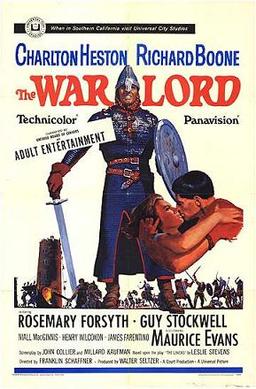
“The War Lord” is a different type of medieval
movie. It was a personal project for
Charleston Heston who optioned the play “The Lovers” by Leslie Stevens. He got Franklin Shaffner to direct it. This was three years before he teamed up
again with Heston for “Planet of the Apes” and five years before “Patton”. The film was an attempt to bring a more
authentically gritty view of the Middle Ages.
It is one of the rare medieval movies that are not epic in scope. This might partly explain why it did not do well
at the box office.
Orson Welles narrates that in 11th Century
Normandy powerful dukes ruled their lands and provided protection from
Viking-like raiders called Frisians. A
knight named Chrysagon (Heston), fresh from a Crusade, has been given charge of
a Druid village. He and his band of
knights-errant arrive just in time to kick some Frisian ass. Chrysagon duels with the Frisian leader, but
he gets away. Chrysagon is less than
thrilled with his task. He and his men,
including his brother Draco (Dean Stockwell) and his bro Bors (Richard Boone),
look down on the Druids because of their pagan
beliefs and the fact that they are peasants.
The knights occupy the keep that overlooks the village. Small scale tale, small scale castle.
Chrysagon meets the village hottie Bronwyn (Rosemary
Forsyth) and he is so confused about his feelings for her that he does not rape
her. When her betrothed Marc comes to
him for the customary permission to marry, Chrysagon reluctantly agrees. Draco reminds Chrysagon of the “droit de
seigneur” which gives nobles the right to sleep with a virgin bride first. He thinks that is a good idea and promises to
return her at dawn. When the sun comes
up and she does not come out, Chrysagon has a rebellious village on his
hands. A rebellious village that makes
an alliance with the Frisians. A rousing
siege of the keep ensues. Ladies, you
get to watch Charleston Heston fight in his loin cloth! Although anachronistic explosions are
eschewed, we still get lots of fire.
This is a strange movie, especially for a movie that
was made before the modern era of realism.
Chrysagon is not an anti-hero, but it is hard to tell whether we are
supposed to view him as a hero. Is it
admirable that he refuses to rape a peasant girl? Is he rewarded with her because of his
restraint? The romance that the movie is
framed around is different, but not necessarily more realistic than in most
medieval movies. I am sure the movie
does not want Bromwyn to be viewed as the villain, but she turns her back on a
man that she seemingly was in love with and then betrays the entire village. Both the central characters show little
concern for the consequences of their actions.
This is justified by way of the common movie trope of “love conquers
all”.
There’s a lot to like in the movie. The acting trio of Heston, Stockwell, and
Boone is strong. Less can be said for
Forsyth. She is in over her head and
does little other than look lovely. There
is some interesting cinematography with some deep focus for the interior scenes
and quite a bit of stationary camera scenes.
The music is almost continuous, but not pompous. The action is what sets the movie on a higher
plane than your typical medieval romance.
I was surprised to find that the movie does clearly fit into the war
movie genre. The assault on the tower is
well done and shifts the movie into a higher gear midway through. The stunt work is noteworthy. There are a lot of falls in the film. The deaths are not laughable and some are
special. One character is impaled by a
tree!
As far as accuracy, the movie deserves some
kudos. The interiors of the keep are
authentically sparse. The clothing is appropriate
for the time period. The knights wear
chain mail, open-faced helmets, and carry kite shaped shields. The siege tactics fit the scenario. The besiegers use a battering ram and a siege
tower. The defenders respond with
boiling oil. There is a bit more use of
bows by the defenders than would be common and the catapult hurling fire balls
is pure Hollywood, but these can be forgiven.
The biggest groaner is the use of droit de seigneur to catalyze the
drama. It tosses in the qualification
that the girl must be returned by dawn.
Not that this is the first or last time a movie will use this disproved
myth to defame the nobility. At least in
1965, the knowledge of this falsehood was not well-known, unlike the egregious
“Braveheart” of 1995. Other slurs on
history include the fact that there would not have been a Druid village in
France by this time. But then we would not get to see what
Hollywood imagined a Druid wedding celebration was like. Lots of dancing,
drinking, and wanton sex. Basically a
frat party. The Frisians were no longer
raiding France in the 11th Century, but at least they don’t have
horns on their helmets.
Although the movie has a mixed record on historical
facts, it gets a lot of credit for the bigger picture of medieval life. It goes out of its way to be realistic on
some aspects of the feudal system. It
clearly depicts the gap between the nobility (even lowly knights) and the
peasants. More rare is the noble family
dynamics that are dramatized. (The movie
is not in a league with “The Lion in Winter”, but what movie is?) Draco is seething with resentment toward his
older brother because being the eldest gave you all the advantages. In general, the movie does a fair job of
showing how unglamorous the time was.
Seamy in a 1965 allowable way, of course.
Does it end up on my 100 Best War Movies list? Possibly.
It certainly belongs on a list of the Top Ten Medieval War Movies. Not that there is a lot of competition.
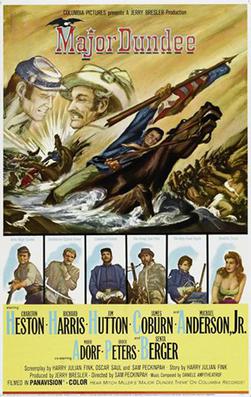
“Major Dundee” is a Sam
Peckinpah film with a very troubled history.Peckinpah’s version of the film never made it to the theaters.The studio did some substantial cuts after a
disastrous early screening.The film was
cut 12 minutes for its run.Later, those
minutes were added for the restored version that I have reviewed here.If Peckinpah had had his way the movie would
have run 4 hours and 38 minutes!The
film was shot in Mexico and it was an unpleasant production.Peckinpah was drunk most of the time and was
very hard on the cast and crew.At one
point, Charleton Heston actually charged at the director on horse.
The movie is set in 1864 during
the American Civil War.Heston plays a
Maj. Dundee who for unspecified reasons has been demoted to commandant of a
prison camp in the New Mexico Territory.Not only is he guarding Confederate prisoners, but he is having to deal
with Apache Indian raiders.The movie
opens with Dundee coming upon the scene of an Indian massacre.The raiders are 47 Apache led by Sierra
Charriba.They have taken four boys
captive.Dundee becomes obsessed with
rescuing the boys and more importantly for his career resurrection, harpooning
Sierra Charriba.
Dundee needs the Rebel prisoners
to volunteer for his hunt.The
complication is that the leader of the Rebels is an ex-friend and now bitter
enemy.Tyreen (Richard Harris) resents
the fact that Dundee voted to court-martial him because of a dueling incident
before the war.Dundee pardons Tyreen
from being hanged in order to get his reluctant support.It’s agreed that Dundee and Tyreen will not
claw each other’s eyes out until the mission is completed, but that does not
keep them from evidencing their mutual dislike in every scene.
The motley unit of Yankees,
Rebels, and even some “coloreds” march out on their quest.They head straight into Mexico.Wait, can they do that?(Ask Gen. Pershing)They get ambushed by the Indians while
crossing a river and lose most of their supplies.Dundee decides to attack a French outpost to
resupply and to get the French involved because the more the merrier.While sojourning in the town, Dundee hooks up
with a feisty senorita named Teresa (Senta Berger).Guess who else is interested in her?The extended stay in the town is great, if
you enjoy watching drinking and dancing.If you are watching for Peckinpah action, not so great.Finally they leave with the French in hot pursuit.
The external threat does not
solve the unit’s dysfunctionality.One
of the rebels (Warren Oates) is caught deserting and Tyreen executes him to
deprive Dundee of the pleasure.Tyreen
swears vengeance, naturally. Teresa arrives to have a tryst with Dundee.During one of their encounters, Dundee takes
an arrow in the leg.Dundee spends
another boring stretch in another village recuperating.He is nursed by a different beautiful
senorita until Teresa discovers them in the act.Dundee goes on a bender because the toughest
guy in the West is ashamed.Tyreen has
to convince him to get over it and come back so the movie can continue.
The Indian problem solved, it’s
just a matter of returning to New Mexico.Unfortunately, those pesky French are still on their tail and block them
at a river crossing.Peckinpah violence
ensues.Every time a body hits the water
so does a gallon of blood.It’s
redemption time.Do the French win?Do you know anything about history?
Speaking of history, there is a
small germ of accuracy to it.During the
Civil War, the Union did accept service from captured Rebels.These “Galvanized Yankees” were used in the
West for Indian fighting.Most famously,
they helped put down the Minnesota Sioux Uprising of 1862.They also were stationed along the Mexican
border to deal with the Apache, Arapaho, and Navaho.There was no invasion of Mexico for them to
participate in and there were no problems with their service.
Peckinpah meant to make an epic
and blamed the studio for preventing that accomplishment.It is doubtful that his envisioned final product
would have been a masterpiece.The
truncated version has long sections that are boring and one can only imagine what a
four hour version would have been like.The film got mixed reviews when it came out, but it has gained a
following over the years.I feel the
original opinions are more on target.The movie could possibly have been great, but even the restored version
is far from great.
The acting is not as big a
problem considering the two leads.These
notorious scene-chewers keep themselves under control for the most part.The supporting cast is fine.There are lots of familiar Peckinpah
faces.James Coburn has fun as a crusty
scout and Warren Oates dies significantly.James Anderson, Jr. plays the narrator/bugler.As an actress, Senta Berger is lovely.
The screenplay is a mash-up of
“Moby Dick” and “Mutiny on the Bounty”.Dundee is the obsessed Ahab chasing his white whale.As far as the unit dynamics, Dundee is the
martinet Bligh to Tyreen’s chivalrous Christian.The dynamic between Dundee and Tyreen does
work in spite of the cat versus dog simplicity of it.Heston boldly plays the dislikable Dundee
which certainly went against virtually all his other career choices.Harris is perfect as his more noble
foil.He embodies the Southern spirit well.
The movie is competently made by
the drunken Peckinpah.He takes
advantage of the Mexican landscape for some awesome scenery.The action scenes are harbingers of “The Wild
Bunch”, but only hint at where Peckinpah was heading.One technical flaw is the poor score.Unbelievably, the studio junked Peckinpah’s
music for what we hear in the film.How
bad could the original score have been?
Cracker?No, partly because it does not fit my
definition of a war movie, but mostly because it’s just not that good.
BACK-STORY: “El Cid” is an historical epic about the legendary Spanish medieval hero Don Rodrigo Diaz de Vivar, known as El Cid. It was released in 1961 and was directed by Anthony Mann. It is in the same genre as “Ben Hur” and similarly stars Charleton Heston. His co-star Sophia Loren had a $200/week hairdresser allowance. The film was shot mostly in Spain. It was nominated for Academy Awards for Art Direction, Original Music Score, and Best Song. The movie was a box office hit and was well received by critics.
OPENING: The setting is Spain in 1080. The narrator explains that the Iberian Peninsula is divided between Christians and Moors. The evil Emir Ben Yusuf (Herbert Lom) scolds his fellow Muslims for being wimps and vows to conquer Spain, Europe, and then the world! We first meet El Cid as he rescues a cross from a burning church. How Christ-like of him, but not surprising from the most loyal, chivalric, and talented knight of medieval Spain.
SUMMARY: On his way to his wedding, Don Rodrigo captures two Moorish emirs in battle, then refuses to turn them over to the king’s representative. Instead, he sets them free with their promise not to take up arms against the king. One of them, Al-Mutamin, later saves Rodrigo’s life and becomes his friend. When he reaches the court, Rodrigo is charged with treason. He is reunited with his fiancé Jimena (Sophia Loren) and we get the corny romantic interlude typical of movies like this. He gets into a duel with Jimenez’ father and kills him in one of the best duels in filmdom. Lots of clanging. Jimenez is a hot-blooded Spanish senorita who naturally now hates Rodrigo and wants him dead.
ready for the joust
When another king challenges Ferdinand to combat of champions to resolve a border dispute, Rodrigo volunteers to redeem himself. The charge of treason apparently having been forgotten, the king accepts. The joust is awesome. Possibly the best ever filmed. Guess who wins? Back in the king’s good graces, Rodrigo marries Jimena even though she still dreams of his death (it’s an honor thing).
When Ferdinand dies, he is succeeded by his oldest son Sancho. Younger brother Alfonso and sister Urraca scheme for the throne. In a ridiculous scene, Sancho is assassinated by a traitor working for Urraca. Rodrigo forces Alfonso to swear he did not have anything to do with the killing, thus earning banishment by the new king. On his way into exile, the Cid helps a leper. What a guy.
Several years pass before El Cid is recalled by Alfonso because Ben Yusuf is coming and the people of Spain demand their champion return. The tension with Alfonso is still apparent and the king refuses Rodrigo’s advice to avoid battle and instead lay siege to the key city of Valencia. They part company with El Cid heading for Valencia on his own. On the way he visits Jimena and his twin daughters (who he has never seen) at the nunnery. They have been living there during his exile. She loves him now. He is also joined by his Moorish friend Al-Mutamin.
Alfonso gets his ass kicked off screen and then holds Jimena hostage to get El Cid to come to him. A previously villainous noble helps Jimenez escape and they join the Cid at Valencia. The impending arrival of Ben Yusuf’s fleet forces Rodrigo to hasten the siege. He catapults bread over the walls to incite a rebellion by the starving populace. They kill the evil Emir Al – Kadir and evict his minions, the Black Guard (this is one of those movies where all the bad guys where black).
Now in control of the city, the Cid decides to sally forth and a huge, well-staged battle ensues. El Cid is wounded by an arrow in the chest.
CLOSING: The doctors tell Rodrigo he must have the arrow removed if he wants to live, but the recovery will prevent him from leading the morrow’s attack. Or he could leave it in and lead the attack, but die. After explaining his noble reasons to Jimena, he opts for choice number two. Alfonso arrives that night, he has seen the light and reconciles with El Cid. The Cid dies happy having remained loyal to this jerk of a king.
The next morning, the Cid is tied to his horse and leads his army out the front gate causing panic in the Moorish attackers who believe either it’s a ghost or the live Cid, either way they are toast. It is easily the best acting of Heston’s career. If he were still alive, the Cid would have killed Ben Yusuf in single combat, but since he’s dead it’s left to his corpse-laden horse to trample Ben Yusuf to death. In Hollywood-think, that’s the next best thing. El Cid goes riding off into the sunset and into the mists of legend.
RATINGS:
Action - 8
Acting - 7
Accuracy - 6
Realism - 6
Plot - 8
Overall - 8
WOULD CHICKS DIG IT? Of course. It’s a romance with two superstars. The interiors are breath-taking and so are the costumes. El Cid is a chivalric dream. The perfect man. The action is nongraphic. Plus, it’s not really a war movie, so sell it as an historical romance.
ACCURACY: The problem is that although Don Rodrigo Diaz de Vivar is a real person, El Cid is a legendary figure. The movie is definitely based more on the legend than the person. The historical consultant was Spanish historian Ramon Menendez Pidal who relied on the Poema de Milo Cid which is a medieval chansons de geste that has dubious historical value. The movie alters and simplifies the story. This is acceptable because the real Don Rodrigo was a complex individual. He probably was more chivalric than most knights, but he basically was a soldier-for-hire. In fact, he often served Moorish masters against Christians.
Spain was divided along the lines presented in the movie. Ben Yusuf was a powerful emir from North Africa who invaded Spain. There is no evidence that Don Rodrigo paroled two emirs to earn the enmity of Ferdinand, but he did fight a trial by combat similar to the movie’s. He did not kill Jimena’s father. The whole dysfunctional marriage was Hollywood. In fact, Jimena was a niece of King Alfonso and it was apparently a political marriage.
There was a power struggle between the siblings and the assassination was similar to that depicted in the film. El Cid did force Alfonso to swear innocence, but his banishment was more likely the result of his having been loyal to Sancho and resentment of his popularity. It is during this exile that he hires out, mainly for emirs like Al Mutamin. He did lay siege to Valencia and took control of it, but not for the good of Spain. He wanted his own fiefdom. He and Jimena ruled for three years before Ben Yusuf arrived. By that time, El Cid had died of natural causes. Also, the city ended up falling when Alfonso decided it was not worth the trouble.
CRITIQUE: “El Cid” was better than I thought it would be. Although I am a big fan of “Ben Hur”, most of the old-school historical epics seem so outdated and overblown. This movie has some of those characteristics, but it is highly entertaining and accurate enough to pass the sniff test. Its strengths overcome its flaws.
Some of the flaws include a sappy love story and twirl your mustache type villains. Heston and Loren do not have much chemistry and the ups and downs are not realistic. I doubt Herbert Lom’s Ben Yusuf is considered politically correct in today’s Muslim-tolerant atmosphere. However, the movie is surprisingly even-handed in its depiction of the Moors. There is a nice balance of evil and good Christians and Muslims. The main flaw is El Cid is too perfect. He is unbeatable as a warrior, at one point he defeats a dozen knights virtually singlehandedly. He is totally loyal to his lords, even when they are corrupt and trying to kill him. He is the perfect mate, being understanding when his fiancé despises him and tries to have him killed.
The strengths include the wonderful (if too brightly lit) castle interiors and the “Ben Hur” style score that does a great job setting the mood. The 70mm Technicolor is vibrant. The action is crisp and is three for three with the duel, the trial by combat, and the beach battle. The ending is memorable, even though its ridiculous.
CONCLUSION: “El Cid’ is a spectacle in the grandest sense of the word. It is epic in its scale. It is old-school Hollywood at its best, not its worst. It is not firmly in the war movie genre, but that makes it more appealing to a broader audience. Its placement at #63 seems about right. It is certainly better than most of the movies behind it and I suspect it will be superior to many of the movies ahead. One thing is for sure, it will be the only one where a dead hero wins a battle.




_01.jpg)