Since I have the Holidays off, I have decided to see if I can watch and review 12 movies and post them over the next twelve days. Probably too ambitious, but what the heck. Anyway, here goes.
THE TWELVE DAYS OF CHRISTMAS:On the first day of Christmas, my true love
gave to me:one God in a cockpit…
“God is My Co-Pilot” is a flag-waving
WWII movie released in 1945.It is based
on the smash hit autobiography of Robert Lee Scott, Jr.Scott served as a technical advisor and did
some stunt flying for the film.It is
true to his story and certainly retains the spiritual theme.The film had the full cooperation of the Air
Force which provided several P-40s and B-25s and AT-6s to masquerade as Zeros.
A montage takes Scott (Dennis
Morgan) from jumping off a roof with an umbrella to a secret mission to India
as a bomber pilot.Along the way he gets
his first sermon from the family black guy about the need for God instead of
luck in the cockpit.Scott remains
skeptical for most of the film.The
interlude in India gets the requisite exotic locale in and clues us in on two
facts.One, there are belly dancers in
India.Two, WWII air crewmen said things
like “jiminy crickets” and “jumping jehosafats”.God would approve.
After a stint flying the Hump
into China, Scott hooks up with Gen. Chennault (Raymond Massey) and Father “Big
Mike” (Alan Hale).He is assigned a
fighter and helps defend the base against an attack led by the legendary “Tokyo
Joe” (Richard Loo).This is one of the
most hilarious scenes in war movie history as the opposing pilots trash talk
through the dog fight.Naturally the
Japanese speak American.Here is a
sampling:
Tokyo Joe:“Okay, you Yankee Doodle Dandies, come and get it.I’m going to drop one right in Chennault’s
lap.Where are you gangsters?Come on up and get a load of that scrap metal
you sold us.”
Johnny:“Now
repeat after me.Your mother was a
turtle, your father was a snake and you’re a good Jap.”
Crew chief:“Why you dirty retail monkey!”
Johnny:“One meatball in the side pocket.”
Scott turns into the star of the unit and his home
town follows him like Joe Dimaggio.He
duels with Tokyo Joe, but they both run out of ammo before they run out of
zingers.He flies Father Mike through a
storm which inspires the priest to give a sermon about what a wonderful
co-pilot God would be.The sun emerges
as though to smack Scott upside the head.In the climactic duel, Tokyo Joe is outnumbered two to one and even the
samurai sword he carries on board does not make up for Scott’s co-pilot.
“God is My Co-Pilot” is unique in balancing its
flag-waving propaganda with cloying religiousity.That is not a winning combination, although
the movie was a hit with those patriotic Bible-thumping rubes that made up
1940s audiences.Sorry, greatest
generation grandparents, I couldn’t help that one.Even if you take out the sermons and the lame
taunting, the dialogue is atrocious.The
music matches it.The action is
fair.The dog fights are not “Wings”
worthy, but they are swirling.We get a
lot of cockpit views and bullet holes in the glass indicating death.Planes tend to blow up and no one parachutes.The movie has a large amount of droning.The acting is average.Earnest, but not scene-chewing.
Was it a good Christmas present?If God is asking – yes!Otherwise, I would have preferred a lump of
coal.
“We Were Soldiers” was based on
the acclaimed best seller We Were Soldiers Once…And Young by Lt. Col.
Harold Moore and journalist Joseph Galloway.The book is a non-fiction account of the Battle of Ia Drang in the
Vietnam War.The movie was written, directed,
and produced by Randall Wallace of “Braveheart” and “Pearl Harbor” infamy.
The film opens with a scene set
in 1954 during the First Indochina War pre-Dien Bien Phu.A French unit is ambushed in the Ia Drang
Valley (the Valley of Death) by the Vietminh led by Nguyen Huu Anand wiped out.The action is graphic with “Saving Private
Ryan” style cinematography (quick cuts, slo-mo, POV).It’s a great opening and sets the theme of
“how will the American experience be different?”
The body of the film begins at
Fort Benning, Ga (it was filmed on location) in 1964.Back when America was innocent, naïve, and
overconfident.And clueless about
nonconventional warfare in a jungle environment.Moore (Mel Gibson) arrives with his idyllic
family of supportive wife and perfect kids.A 1950s TV family in a 2000s war movie that wants to be a John Wayne
movie.
Plumley and Moore - comedy team
Moore is in command of a new
type of unit – air cavalry.Helicopters
will take the role of horses.The unit
is the 7th Cavalry and in case you don’t get the reference, the
movie hammers the fact that the 7th was Custer’s unit and you know
what happened to them!We get the
obligatory training montage.The movie is an excellent study in
command.Moore is the classic “lead by
example” commander.He is also very
hands-on in his leadership.This
includes counseling his young officers.For instance, he has a talk with a new father named Lt. Geoghegan (Chris
Klein) in a chapel.The scene is
cringe-inducing with overt religiousity and sappy dialogue.Geoghegan is saintly and soon to be a papa with his new bride (and thus doomed).Moore offers a prayer that concludes with
asking God to disregard the enemy’s prayers and help us kill the “little
bastards”.Hilarious!
Geoghegan and Moore pray to prey on our enemies
The movie makes a concerted
effort to integrate the families into the narrative.Moore tells his daughter that war is when
some people in another country try to take the lives of people and then
soldiers like daddy have to go over and try to stop them.This is not a bad analysis of what the public
was told the war was about in 1964.The
movie introduces us to the officers’ wives.Julie Moore (Madeline Stowe) is the sorority mom.When orders come, the men are enthusiastic
about going off to test their manhood, the wives are stoically nervous.
The unit is sent to the Central
Highlands in 1965.The air cavalry
experiment is about to begin.That
experiment is simple – use mobility to “find the enemy and kill them”.Their first mission is to land in an enemy
area and provoke combat.Hopefully not
against ten to one odds.Oops!Hueys led by Maj. Crandall (Greg Kinnear)
drop them in a clearing designated LZ X-Ray.The tactics are realistic as the Americans come charging off the
choppers guns blazing and immediately establish a perimeter.Things go wrong immediately as the gung-ho
Lt. Herrick (Marc Blucas) goes chasing after an enemy scout and gets himself
killed (“If I have to die. I’m glad to give my life for my country.”) and his
platoon cut off in a position called The Knoll.Sgt. Savage (Ryan Hurst) takes command.The trials the Lost Platoon will go through are incredible.A few men holding out against huge numbers of
the enemy.The fighting gets so
desperate Savage calls artillery fire down on his own position.
Inside the perimeter, it’s a
macrocosm of what the Lost Platoon is going through.The landing at LZ X-Ray was like kicking an
ant pile.It turns out there is a NVA
battalion commanded by now Col. An stationed in the hills nearby and they are
up for a fight.Even against the vaunted
U.S. Army.The battle is a series of
enemy assaults and Moore’s attempts to plug the holes with his courageous
few.Crandall’s helicopters participate
by bringing in reinforcements and supplies and medevac the wounded under
fire.They also bring in an intrepid
photojournalist named Joseph Galloway (Barry Pepper).At one point, the NVA get to the command post
and Galloway grabs an M-16 and fights for survival, like everyone else.
At this point the movie jumps to
the home front where the wives are coping with separation, but not death.Then the first telegrams arrive.Julie Moore and Barbara Geoghegan (Keri
Russell) take over delivering the death notices.It’s extremely poignant and effective.Wouldn’t it be extra poignant if one of the
telegrams is for one of them?
Mrs. Geoghegan and Mrs. Stowe delivering telegrams
Meanwhile, day two dawns to more
of the same.Now the VC have joined in,
for Christ’s sake!Geoghegan and a black
soldier make a two man assault so racism can be eliminated and Geoghegan can
leave his body in no man’s land to be found by Moore later.Hail, Hollywood!The enemy break-through in several places and
it begins to look like those Custer premonitions will come to fruition. It gets so bad Moore has to call for “Broken
Arrow” (when all available aircraft drop ordinance on a unit about to be
overrun).Some friendly fire napalm
roasts Pfc. Nakayama because he had made the mistake of bragging about his new
born.Two proud fathers, two doomed
soldiers.The movie implies the Broken
Arrow incident turns the tide.Soon
after, another attempt to reach the Lost Platoon is successful.Savage takes a short breather and then
reenters combat because if you have a name like that …
Napalm + Hollywood = box office dynamite
On the third day, An plans an
all-out assault to finish off the exhausted Americans and thus convince the
Yankees that South Vietnam is a bad investment.This will be the ultimate vindication for his “grab them by the belt
buckle” solution to American artillery and air support.Col. Joshua Chamberlain, I mean Lt. Col.
Moore, looks at the situation and decides it calls for a bayonet charge.“Fix bayonets!”Moore (Gibson) leads the charge.The enemy are too surprised to fire their
weapons.However, the thrill of the
chase carries our heroes smack into the well- defended enemy bunker
complex.Get more telegrams ready,
including one for Julie Moore.But wait,
the air cavalry arrives in the form of Crandall in a Huey gunship and he
proceeds to Gatling and rocket the enemy to smithereens.USA! USA! USA!
An licks his wounds and prepares
for the long haul.The media arrives
like vultures to report the great “victory”.Moore is the last to leave, as he promised.The rest is history. Spoiler alert: we lost.
This is a schizophrenic movie.Parts of it are great and parts are not.Not surprising for a movie that tries to be
accurate and entertaining in equal measure.Wallace insisted the movie was as accurate as possible (the same bull
shit he spewed about “Braveheart”) and most of it is.The parts that are aimed at the general
audience make a war movie lover squirm.The Moore family scenes are not pathetic, but it’s obvious Wallace meant
to make the opposite of the unpatriotic, impious Vietnam flicks like “Platoon”,
“Apocalypse Now”, “Full Metal Jacket”, and “The Deer Hunter”.The pre-battle training sequence is
simplistic and heavy in foreshadowing.For instance, Herrick is a tightly-wound glory hound who is likely to
get his men into a trap. Sure ‘nuff.The references to Custer’s Last Stand are too
maladroit.
The trite pre-Vietnam scenes
come to an abrupt end when the unit gets shipped overseas.That scene is powerful with a building score
and no dialogue.In no time at all, they
are in battle.The action is
consistently intense and some of the effects are spectacular.This movie has more combat than a vast
majority of war movies.And yet, believe
it or not, the actual battle was even more intense and violent than the movie.The tactics are realistic for both
sides.The movie is excellent on
helicopter participation in the fighting and air and artillery support.The napalm shots are breathtaking (get
it?).There is even a “mad minute”
moment to get the enemy to reveal their positions.One problem I had was the lack of emphasis on
the role of M-60s in holding off human wave attacks.It could be argued that “We Were Soldiers”
comes closest to accurately portraying a Vietnam battle.
The movie is rolling along
nicely until it jumps the shark with Moore going out in the dark to find
Geoghegan.It is inconceivable that a
commander would risk his life in a situation like that.The scene was obviously forced in to confirm
Moore’s pledge not to leave any men behind.More tears get jerked with the telegram for Barbara.But Wallace saves his best for last with the
abysmal bayonet charge topped off with the Crandall massacre of the remainder
of the enemy.Wallace forces a happy
ending into what was a pretty level-headed narrative.This reminded me a lot of “Pearl Harbor”.Worse, the success of American grit and
firepower in winning the battle dilutes the explicit moral that America will
have a hard time in Vietnam.
The last ten minutes of the
movie prevent it from being a very good movie, but it still ends up being good
and better than most Vietnam War movies.The acting is good if a bit too earnest and the cast is able.The actors were put through a boot camp.Mel Gibson is not aggravating and gets
Moore’s personality right.It’s obvious
Gibson was comfortable playing a man as religious as he is.Greg Kinnear is strong as Crandall and
Pepper’s late appearance as Galloway gives the movie a second wind.Making the most impact is Sam Elliot as Sgt.
Major Plumley.It’s acting in his sleep,
but the character is a lot of fun, if clicheish.He gets some great lines and provides some
welcome humor without cracking a smile.He does not say a lot, but it’s all quality.Unfortunately, much of the dialogue could
easily fit into a 1940s war film.When
Moore asks Galloway what he is doing there, Galloway says “because I knew these
dead boys would be here.”At one
point,Moore says “There’s nothing wrong
except that there’s nothing wrong.”Apparently, the dialogue is accurate, but it seems hokey.
The movie is technically
proficient as would be expected for a movie costing $70 million.Wallace may be shaky as a screenwriter, but
he does a good job directing.The action
scenes incorporate all the bells and whistles of modern war movies.There are some hand-held shots.There is some slo-mo.Blood splatters on the camera lens.It is a very violent movie.The make-up crew did a remarkable job on some
horrendous wounds. Someone counted the
number of KIAs – 305.The sound effects
are great.The lighting in the night
attacks is admirable.The score is fine
and restrained.
The movie has some admirable
goals.Wallace wants the audience to get
a feel for what military wives go through.Having a military mother and having lived on a base while my father flew
in Vietnam I can attest to the authenticity of the home front scenes.The telegram scenes are not in the book and
may be Hollywood, but they are refreshing for this macho genre.We certainly did not need another stale
romance or love triangle.Stowe is great
as Julie Moore.WWS has a strong female
vibe.Another example of balance is the
coverage of the enemy.This is not
“Black Hawk Down”.The communists are
not faceless.Gen. An (Don Duong) is
sympathetically rendered as are his men. One soldier gets to keep a diary with his
girl’s picture in it and then gets to try to bayonet Col. Moore. They are brave but there is definitely a drone
quality to them.Wallace goes out of his
way to cover their tactics and even implies they will win the war.
Some people sneer at the unambiguous
religiousity of the film and Gibson’s involvement in the film caters to this
criticism.However, my research shows
that Moore is indeed a devout Catholic so the characterization is true to form
although obviously forced into the film (probably at the insistence of Gibson).Considering how a vast majority of war movies
purposely ignore religion, we can excuse WWS for purposefully including God.It has more scenes with religion than any ten
war movies.Hell, even An says a prayer.Another jarring element is the squeaky
cleanness of the American soldiers.This
ain’t “Platoon”.There is no drug use or
sociopathic behavior.Although I would
put the movie in the VioLingo school, I do not think the f word was used a
single time.(Considering the graphic
violence, Wallace’s decision to sanitize the language is bizarre.)Before you cry bogus, this is fairly close to
the 1965 Army especially when you consider these would not be draftees and they
are in an elite unit.They should be
naïve, enthusiastic, and patriotic.
In conclusion, “We Were
Soldiers” could have been the best Vietnam War movie if Wallace had not pulled
his punches in the end.For someone who
wanted to make the most accurate Vietnam War battle movie, it is infuriating
that he would taint his admirable effort with a phony happy ending.Especially when the truth would have fit his
purpose so much better.Still, if you
overlook the bayonet charge, the battle is as good as you are going to get, the
wives get their just due, the soldiers of both sides are positively depicted,
the enemy is sympathetically portrayed, and the movie is an excellent study in
command.Nothing’s perfect.
“What Price Glory?” was based on
a play by Maxwell Anderson and Laurence Stallings. It is mainly set in the Western Front of WWI.Both movies are credited with creating the
buddy film. They also created one of the enduring war movie clichés - the battling rivals in love and war. This is appropriately known as the Quirt/Flagg trope.
The Raoul Walsh silent version
begins in China where Flagg (Victor McLaglan) is sweet on a prostitute named
Mabel.He gets into a knock down fight
with his big rival Quirt (Edmund Lowe).The film then jumps to the Philippines where Quirt steals Flagg’s
Filipino girl friend.This is supposed
to be hilarious and maybe it was in the Twenties.
Now that we know that Quirt and
Flagg are frenemies who are always after the same girl we are off to the
Western Front in 1917.Flagg is now a
Captain in command of a company stationed in a French village.Flagg is billeted at the local tavern where
he begins to woo the saucy owner’s daughter Charmaine (Delores Del Rio).Because this is technically a war movie, the
company gets sent to the front for some action.They attack across no man’s land in a pretty good set piece with plenty
of explosions.To make sure the audience
does not enjoy the war Flagg says:“There’s something rotten about a world that’s got to be wet down every
thirty years with the blood of boys like those.”
Okay, with that out of the way,
it’s back to the village for more wooing.Guess who shows up to complicate the romance?Flagg goes off on a ten day pass to wine and
wench thus leaving Quirt to move in on Charmaine.She is receptive because he’s a U.S. Marine
and they are pretty interchangeable.When Flagg returns he is confronted by Charmaine’s father who demands
that the Marine who “wrecked” his daughter get hitched to her and throw in 500
francs.He is referring to Quirt and
Flagg is guffawing as the mayor is called in to officiate the wedding.Close call as Charmaine doesn’t cotton to being sold.Bugles!Time for another combat interlude.
Quirt, Charmaine, and Flagg
This time it’s a night
attack.Explosions go off like a pack of
firecrackers as our heroes cross no man’s land.The action is fast-paced and dynamic.There are deaths, including the “momma’s boy” who dies in Flagg’s
arms.Lt. Kiper rants about the futility
of war and asks “what price glory now?”
I won’t ruin the ending for
you.I know you will want to watch the
movie to find out who gets Charmaine, but since I mentioned that this was the
first buddy film you can bet Quirt and Flagg go marching off hand in hand.
#$%^&*! (subtitled: You are a big poop head!)
This is a typical silent film in
that the acting is hammy and the soundtrack is incessant.McLaglan is actually pretty good and Del Rio
is spicy (thank goodness we did not have to hear her Mexican accent).The rest of the cast grossly overacts.They have one character who must have thought
he was the Jim Carrey of his day.His
big schtick is doing raspberries.His
constant mugging is supposed to be hilarious, but comes off as desperately
creepy.The humor is basically slap
stick with what passed for witty lines.Like: “why don’t you blow your brains out?”One reason why the movie is famous is because
McLaglan and Lowe were actually swearing at each other which resulted in
complaints from lipreaders.How quaint!Someone needs to put out an updated version
with accurate subtitles.Apparently
noone had problems with the number of ass shots thrown in.We see each significant female’s derriere
before we get to know their face.
The movie is more of a romance than
a war movie.The two combat scenes are
adequate, but are thrown in to break the monotony of the romance.The company spends no time in the trenches.They go off twice to cross no man’s land and
then it’s home to the village for wining and wenching.War is Hell – is what the movie is trying to
say, ineffectively.The romance is lame
and I did not care who got the girl.The
two main characters are not to root for.As far as competition with “The Big Parade”, get serious!
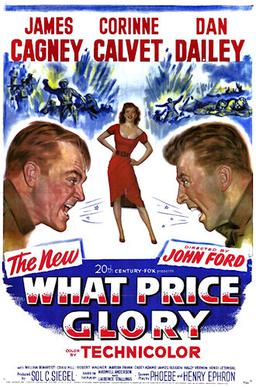
The 1952 version was directed by
John Ford and stars Jimmy Cagney (Flagg) and Dan Dailey (Quirt).The plot is essentially the same, but there
is a lot more physical humor and some songs.The movie actually has a credit for “dances staged by”.As a war movie lover, I can tell you that you
never want to see that at the beginning of a war movie!Nor do you want to endure songs being sung by
characters.The combat is periphery
again and unrealistic.Ford does not
seem to have his heart in the action scenes.He does have Quirt and Flagg going into no man’s land together
(helmetless) and arguing in conveniently placed shell craters.The movie has a weird vibe by mixing humor
and drama less than deftly.
Charmaine and Quirt
Cagney and Dailey must have been
told they were making a silent movie because they do some serious
scene-chewing.Cagney is basically
playing Cagney.It is an embarrassing
performance.There is no chemistry
between the leads.Corinne Calvet is
lovely as Charmaine, but cannot act.We
also get a very young Robert Wagner as Pvt. Lewisohn.
The 1926 version is not a good
war movie.It is overrated as
entertainment, but deserves credit for introducing the Quirt/Flagg trope that
will reappear in many future movies – not just war movies, by the way.The remake is inferior although the fact that
it is in sound probably makes it more watchable for most viewers.I would not recommend either.
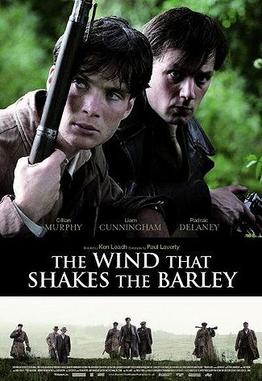
“The Wind That Shakes the
Barley” is a war movie set In Ireland in 1920 during the Irish War of
Independence.It was a multinational
production directed by Ken Loach.It was
filmed on location in Ireland.The movie
was a big hit with critics and won the Palme D’Or at Cannes in 2006.It did very well at the box office in
Ireland.
The movie opens with some lads
playing a game that I had to read is called “hurling”.No wonder things are so tense.The guys get rounded up by thuggish
paramilitary types because they have violated the law against public
gatherings.One of the hurlers is
defiant and gets beaten to death.One
theme of the movie is that the British are dicks.
The movie is the tale of the
O’Donovan brothers.Damian (Cillian
Murphy) has a bright future ahead as a doctor.He is pragmatic and not interested in fighting for independence because
he feels it is unattainable.This is in
contrast to his older brother Teddy (Padraic Delany) who is the leader of the
local IRA brigade.Teddy tries to
convince Damian to join the cause, but is unsuccessful until Damian witnesses
the abuse of some railroad workers by some Black and Tans.
The violence is back and
forth.The IRA members gun down some
British in a pub.This is followed by
one of the rebels named Chris being coerced into ratting out his mates.The result is Teddy, Damian, and others are
captured in the woods.Teddy is tortured
by having his fingernails pulled out.This is not done graphically and is brief.Movie over, right?Nope.A sympathetic British soldier allows most of them to escape!“I don’t want your deaths on my conscience.” That’s going to be a hard sell with his
comrades, but there are no consequences and no manhunt to recover the
prisoners.Unrealistic.
Damian is in temporary command
(nepotism much?) as Teddy recovers.It
falls to Damian to execute the traitorous Chris who happens to be a good
friend.Leadership sucks!The naïve, pragmatic doctor wannabe is
getting into this rebellion thing.He
joins the brigade in an ambush of a British convoy on a rural road.The twenty or so British are killed (no one
is wounded – that’s excellent shooting!).The British decide to evacuate Ireland.Just kidding.Can you say
retaliation?This comes in the form of
burning farms including that belonging to his girlfriend Sinead’s family.Damian has to impotently watch her get her
hair cut off while hiding in the woods.Powerful scene, but it ends abruptly.
Before the next tit-for-tat,
word arrives that the war is officially over.A treaty has been negotiated with the British government giving the
southern part of Ireland dominion status.There is a great scene in a movie theater where the audience reaction
indicates the polarizing nature of the compromise.This polarization is also reflected within the
brigade.The debate is fascinating.It’s between the old schoolers like Teddy who
are willing to accept the potential of peace and the new schoolers like Damian
who want nothing less than the whole enchilada.Have you noticed that Teddy and Damian have switched attitudes?Neat, huh.
Teddy joins the new Irish Army
because irony is a staple of movies like this.Speaking of which, ironically Teddy and his new mates use some tactics
suspiciously like those British dicks.Meanwhile, Damian’s crew carries on in the old style and he gets himself
captured in a raid to steal weapons.Will Teddy be able to convince him to see the light and come over to the
dark side?
The film is not based on a true
story, but it has some fragments of history in it.The basic picture is accurate.The Irish War of Independence was a series of
violent confrontations between the Irish Republican Army and British soldiers
(either the “Black and Tans” or the auxiliaries) who supplemented the Royal
Irish Constabulary.These soldiers were
infamous for atrocities against civilians and destruction of property. A lot of this was provoked by IRA attacks
that targeted the RIC and British supporters like the Black and Tans and the
auxiliaries.This included ambushing and
attacks on police stations and barracks.The movie accurately depicts the nature of the war.
The ambush in the movie is
clearly modeled after the famous Ambush at Kilmichael in County Cork .17 Auxiliaries were killed by the IRA in a
manner similar to the film.This event
occurred one week after Bloody Sunday (when the RIC fired into a crowd at a
football match in retaliation for the assassinating of fourteen British
operatives earlier in the day).After
the ambush, the British retaliated by burning homes.County Cork was put under martial law and
became a hot bed of the rebellion.
Although none of the characters
are real people, Damian was inspired by Ernie O’Malley.O’Malley was a legendary figure in the
IRA.He specialized in attacking
barracks to acquire weapons.At one
point he was captured, but was allowed to escape by a sympathetic British
soldier.This took place in Kilmainham
Gaol.The jail was the sight of some
executions of IRA prisoners.The movie
used the site for some scenes.He
carried on the fight after the treaty and was eventually wounded and captured
in a shootout with Free State police.He
escaped execution because of his medical condition.He spent several years in prison.
“The Wind That Shakes the
Barley” is a thought provoking movie.I
did not know much about the Irish War of Independence before this film.It is certainly more historical than “The
Informer”.Even though it is not a true
story, it is very informative about the dynamics of Ireland during that rough
period.This being a movie, it can be
criticized for demonizing the British.It seems like every group of British soldiers has a sadist in it.Most of the British are cartoonish.Loach did come under some heat for his
supposedly anti-British vibe.Hello, he
was aiming at an Irish audience.The
movie was very popular in Ireland – mission accomplished.
The movie is well-acted.Murphy does a fine job as Damian and the rest
of the cast is good.The movie could
have used subtitles for those thick Irish accents.The cinematography is top notch by Barry
Ackroyd.The scenery is lushly green.The dialogue is a strength.The debates clearly delineate the opposing
sides within the IRA with regard to the treaty.The movie may not be fair to the British, but it is balanced in its
coverage of the pro-treaty and anti-treaty factions.
The movie is a bit heavy-handed
in its themes.Besides that the British
suck, Loach also trots out the old “end justifies the means” trope.We also get a strong dose of war corrupts and
war is hell.The film is a bit
predictable and has some clichés.Damian
is the reluctant warrior who grows into rebelliousness.The brothers end up on opposing sides.The younger is more impulsive, the older is
more practical.At least that’s how they
end up.They start out the
opposite.There is a brief period in the
film where they are on the same page because their arcs intersect.This is entertaining, but predictable.
“The Wind That Shakes the
Barley” is a good, but not great movie.The pickings must have been slim at Cannes that year.I enjoyed it and learned a lot from it.It does a service to history and is
entertaining at the same time.Be aware
that it is a bit on the depressing side.Damian’s side did lose, after all.Will it crack my 100 Best list?Unlikely, but you should still watch it.