Showing posts with label Mel Gibson. Show all posts

Sunday, November 6, 2016

NOW SHOWING: Hacksaw Ridge (2016)


                “Hacksaw Ridge” is the new war film by Mel Gibson.  It is Gibson’s first movie in a decade.  The last having been “Apocalypto”.  Gibson’s earlier war movies were “Braveheart” and “We Were Soldiers”.  This one differs since it concentrates on a pacifist instead of a warrior.  But it has a similar religious vibe to “We Were Soldiers”.  The movie was fourteen years in development before Gibson brought it to fruition.  He spent a relatively sparse $45 million on it.  The filming took place mainly in New South Wales.  Robert Schenkkan and Randall Wallace wrote the original script, but thankfully Andrew Knight was brought in to polish it.  The movie premiered at the 73rd Venice Film Festival and received a ten minute standing ovation.  The movie is the true story of the first practicing conscientious objector in Congressional Medal of Honor history – Desmond Doss.  (Alvin York was a conscientious objector, but he decided to participate in battle as a regular infantryman.)  Doss earned his decoration on Okinawa in WWII.

                The movie opens with a violent combat scene replete with slo-mo, flames, flying bodies, etc.  A prayer is recited over the chaos.  This brief taste leads to a flashing back to sixteen years earlier in the hills of Virginia where Desmond Doss (Andrew Garfield) is dealing with a father who is a bitter WWI veteran who hits the bottle and occasionally his wife.  His mother is a religious woman who instills a love of the Bible in her son.  The family has a framed copy of  the Ten Commandment and the Lord’s Prayer.  Cain killing Abel is a prominent illustration.  Desmond grows up strictly believing the Sixth Commandment and also caring about his fellow human beings.  His saving a man who severs an artery in an accident foreshadows his future medical interests.  He meets a nurse named Dorothy (Teresa Palmer) in a kill two birds with one stone scene. Their 1940s romance goes as you would expect.  When Desmond volunteers for the Army, she sends him off with a Bible.  He goes because he wants to serve his country, but not kill for it.  He ends up at Fort Jackson for boot camp and when he meets the other guys, they seem nice - until they find out on the rifle range that he refuses to even touch a rifle.  At this point, his mates and superiors try to convince him that the military life is not for him.  Since we have seen the opening scene, we know his stubbornness will be rewarded with an all expenses paid trip to the tropical paradise of Okinawa.

                When they arrive at Hacksaw Ridge, they are welcomed by truck-loads of dead bodies and the thousand yard stares of the unit they are replacing.  Next thing you know, they are standing at the base of a cliff looking at some cargo nets that they must ascend to sweep the Japanese defenders off the ridge and thus win the war for the Allies.  Stop eating your popcorn because this shit is about to get real.  And really noisy.  And Doss is about to get really busy.

                “Hacksaw Ridge” is a surprisingly competent return for Mel Gibson.  I was definitely skeptical when I first heard about the movie.  I was intrigued with the subject matter, having mentioned Desmond Doss in my American History classes.   When my wife and I went to the WWII Museum this past summer, we spent time at the tribute to Doss as a Medal of Honor recipient.  A longer version of the interview shown before the movie’s credits is on display.  That interview makes clear the man’s deep religious convictions which naturally led me to fear what the religious Gibson might do with that theme. (I found “We Were Soldiers” to have laid on Col. Moore’s faith a little thick.)  Thankfully, “Hacksaw Ridge”, while it has numerous religious references, did not cause me to cringe.  For instance, many soldiers carried Bibles in WWII and Doss does not do any preaching.  There is a Christ on the crucifix image towards the end but it is subtle, especially for Gibson.  In other words, the film is not trying to convert anyone and appears to be a sincere attempt to bring the remarkable story of Doss to  the masses.

                The movie is well-made, but not memorable.  Not worthy of a ten minute standing ovation. The cast is fine with only a miscast Vince Vaughn causing head-scratching.  Interestingly, Vaughn is the only American actor in a movie where all the principal characters are American.  He plays the stereotypical gruff sergeant, but his boot camp schtick is that of Don Rickles more than R. Lee Ermey.  It is hard not to view it as stunt casting.  I am not big fan of Andrew Garfield, but he is satisfactory as Doss.  The role does not require a lot of heavy lifting as Doss is really one-dimensional.  Unlike his closest equivalent in cinema, Alvin York, he does not undergo a conversion experience and he doggedly maintains his original pacifist beliefs.  Garfield appears to have watched “Forrest Gump” a few times to prepare for the role.  There is some chemistry with Palmer as Dorothy, but the romance is straight out of a WWII movie made in WWII.  At least we get to know her a bit.  I can’t say the same for Doss’ comrades.  If Vaughn’s Sgt. Howell did not give a few nicknames in the obligatory barracks scene, they would have no personalities whatsoever.  The screenwriters only fleshed out Pvt. Smith (Luke Bracey) to be the embodiment of the units’ condescension toward the “cowardly” Doss and the respect Doss would earn on Okinawa.  Sam Worthington as Capt. Howell is solid in what is essentially the same cliché that Vaughn is playing.

                This could be a very polarizing movie.  The audience when I saw it was mostly senior citizens.  I can see where they enjoyed the biographical part of the feature, but then the movie shifts into combat porn midway through I doubt they expected to see a lot of entrails or rats eating corpses. (But there is little cursing in the film!)  The commercials claim that “Hacksaw Ridge” is the best war movie since “Saving Private Ryan”.  Sorry, no.  SPR revolutionized war movies by coming the closest to recreating what the soldiers experienced.  Since then some movies have been in the same league – Black Hawk Down, Flags of Our Fathers, Letters from Iwo Jima. We Were Soldiers, and Lone Survivor.  Others have taken the what I call “exteme realism” route.  The theory behind these movies is that because war is hell, the more hellish you depict it, the more realistic it will be.  Movies of this ilk include Pearl Harbor, Flyboys, Behind Enemy Lines, 13 Hours, and Fury.  And countless straight to DVD titles.  Since SPR, these types of combat porn movies have tried to top SPR by throwing a kitchen’s sink worth of weapons, explosions, flames, entrails, and gallons of blood.  More is not better.  Let me give you one example.  In SPR, a flamethrower is used to finish off a pillbox.  In HR, flamethrowers are used to roast charging Japanese.  The first example is an accurate depiction of use of that weapon, the second is not.  Here is another example.  In SPR, Capt. Miller drags an upper torso along the beach.  In HR, Smitty uses an upper torso as a shield as he wastes several Japanese in a Ramboesque spree.

                In conclusion, I recommend “Hacksaw Ridge” as a biopic, not as a war movie.  The movie is commendably accurate in bringing the story of one of America’s great heroes to the screen.  Desmond Doss deserved this movie and if jazzing it up with ridiculous combat was required to green light it after fourteen years, then so be it.  The combat is gonzo and reminded me of the Korean style as in movies like “Taegukgi”.  The difference is “Taegukgi” is clearly fictional and the combat is supposed to be entertainingly over the top.  I fear that American audiences who are not familiar with that style will mistake it for reality.  For instance, there are more bayonet stabbings in this movie than in the entire war in the Pacific.  If you want to know what it was like on Okinawa, watch the Okinawa episode of “The Pacific” miniseries.  If you want to learn about Desmond Doss, watch “Hacksaw Ridge”.

GRADE  =  B

HISTORICAL ACCURACY:  Desmond Doss did not volunteer for the war.  He was drafted.  However, he could have claimed a deferment due to his shipyard job.  He did claim conscientious objector status and was allowed to become a medic.  The movie is partly accurate in showing the animosity his beliefs fueled within his unit.  But the men were not as upset about his refusal to carry a weapon as they were with his refusal as a Seventh Day Adventist to work on Saturdays.  The men considered this to be shirking.  They let their feelings be known when they would pelt the praying Doss with shoes and epithets.  They called him “Holy Jesus” and Holy Joe”.  There were no beatings and the Smitty character is fictional.  (One soldier did threaten to kill him the first time they entered combat.)  His superiors (Hammel and Glover) did encourage him to quit and the movie does a fair job with the Section 8 and the court-martial.  The Army backed down, not because of intervention by Doss’ father, but because it realized that prosecuting him was a political mistake. 

                Doss did marry a nurse named Dorothy, but they met in a church and he was not prevented from making their wedding.  She did give him a Bible when he left for war.  His parents are well depicted.  His mother was the key to his religiousity.  His father was an embittered veteran with alcohol problems.  However, the incident involving the gun was between his father and an uncle, not his mother.

                The movie gives the impression that Doss’ unit first saw combat in Okinawa.  (And does not bother to explain what they were doing from 1942 to 1945.)  In actuality, the 77th Division fought on Guam and then Leyte in the Philippine campaign.  They were battle hardened.  And by Okinawa Doss had earned their respect. He earned a Bronze Star on Leyte.  The movie implies the men were still skeptical about him when they climbed the ridge.  They did go up on cargo nets.  The assault was successful at first with several pill boxes taken out with few casualties.  (One of the few tactical accuracies in the film has the men providing covering fire for Smitty as he sneaks up and throws in a satchel charge.)  A night attack by the Japanese swept Doss’ unit off the escarpment.  (The Japanese rarely launched banzai attacks in the daytime.)  He did stay and lowered wounded by way of a special sling he had learned in Virginia.  He later admitted to saving 50 men while the movie used the Medal of Honor citation number of 75.  He did pray to “help me get one more”.

                 The second assault was delayed as the men waited for Doss to pray and that assault did take place on his Sabbath.  The movie depicts this assault as though it was a routing of the Japanese.  (The scene reminded me of Gibson’s ridiculous feel-good ending in “We Were Soldiers”.)  In reality, evicting the Japanese from the escarpment was not via a heroic charge, but was done through painstaking and painful taking of enemy positions like caves.  The movie does not clearly portray his other feats.  On May 2, he rescued a soldier exposed in a position two hundred yards forward.  He also treated four wounded men very close to a cave entrance and dragged each back.  On May 5, he aided an artillery officer who was under fire.  And carried a wounded soldier one hundred yards soldier from where he had been pinned down.  On May 21, Doss was wounded by a grenade while in a fox hole at night.  He took 17 pieces of shrapnel in his leg.  When he was being moved five hours later, he rolled off his stretcher to bandage a wounded man.  Later that day, he was wounded by a sniper.  They did target medics.  He made a splint out of a rifle stock and crawled back 300 yards under fire.  He did lose his Bible in the process, but it was not returned by his searching mates until he was on a hospital ship.  Gibson decided that reenacting his actual wounding and selfless actions afterwards would be considered fictionalized by the audience.  And yet, it was okay to have Doss pulling Howell on a shelter half while Howell uses his grease gun to hold off pursuing Japs!  You can’t make this stuff up.  Oh, wait… 

P.S.  Dear Mel, during warfare soldiers occasionally have to reload.  I saw no examples of that in your movie.   

Tuesday, November 11, 2014

HOLLYWOOD or HISTORY: We Were Soldiers


                I earlier reviewed “We Were Soldiers” and then reread We Were Soldiers Once… And Young by Harold Moore and Joseph Galloway.  The director and screenwriter of the movie, Randall Wallace, claimed the movie was as accurate as you could get.  But given his track record of “Braveheart” and “Pearl Harbor”, I was skeptical.  Here are some things that happened in the movie.  Which are true and which are Wallaceisms?

1.  The French Group Mobile 100 was ambushed in the Ia Drang Valley in 1954 and wiped out by a unit of Vietminh led by Nguyen Huu An
2.  During boot camp at Fort Bragg, a radio operator picked up a fire fight in Vietnam.
3.  Moore was a devout Catholic.
4.  Moore and Geogehegan had a heart to heart in a chapel after the birth of Geogehagen’s baby.
5.  Moore told his daughter that war was when some people in another country try to take the lives of other people and then soldiers like daddy have to go over and stop them.
6.  Moore’s unit was the 7th Cavalry – Custer’s old unit.

7.  Sgt. Plumley was a crusty veteran of WWII with a gruff personality and leadership style.
8.  The Lost Platoon got “lost” because Herrick chased after an enemy scout as soon as they landed.
9.  Herrick’s last words were:  “If I have to die. I’m glad to give my life for my country.”
10.  They blew up trees to create a new landing zone.
11.  Metzker was killed when he gave up his place on a medevac helicopter.
12.  Galloway arrived on the night of the first day.
13.  Mrs. Moore and Mrs. Geogehagen delivered the telegrams to the other wives.
14.  Moore prayed over the dead bodies.
15.  Geogehagen and a black soldier were killed out in front of the American lines.
16.  They peed on the mortar tubes to cool them down.
17.  Plumely told Galloway he could not take pictures lying down and soon after he told the wounded “Prepare to defend yourselves”.
18.  A soldier jumped on a grenade to save some of the woundeds lives.
19.  When the position was about to be overrun, Moore called for Broken Arrow.
20.  Jimmy Nakayama was mortally wounded by friendly napalm and never saw his new-born baby.  Some of his flesh came off in Galloway’s hands.
21.  The Lost Platoon was finally rescued when Nadal’s platoon fought its way to them.

22.  Westmoreland ordered Moore to leave the battlefield to brief him, but Moore refused.
23.  Moore went into no man’s land at night to recover Geogehagen’s body.
24.  Moore led a bayonet charge that forced the enemy to retreat and then helicopter gunships decimated the enemy before Moore’s men walked into a trap.
25.  Crandall took over medevacing the wounded because the assigned unit refused to come in under fire. 


 THE ANSWERS
 1.  The French Group Mobile 100 was ambushed in the Ia Drang Valley in 1954 and wiped out by a unit of Vietminh led by Nguyen Huu An.  HISTYWOOD  The French Mobile 100 was ambushed several times during the war but never was wiped out.  It is unclear whether An participated in any of these attacks.  An is a significant figure in Vietnamese history.  He ably commanded units in the siege of Dien Bien Phu and was in command in the Battle of Ia Drang.  He rose to generalship and was highly regarded by Giap.  His forces were instrumental in the capture of Saigon at the end of the war.
2.  During boot camp at Fort Bragg, a radio operator picked up a fire fight in Vietnam.  HISTYWOOD  They actually picked up a forward air controller directing an air strike.  This was apparently not omenous enough for Wallace.
3.  Moore was a devout Catholic.  HISTORY
4.  Moore and Geogehegan had a heart to heart in a chapel after the birth of Geogehagen’s baby.  HOLLYWOOD
5.  Moore told his daughter that war was when some people in another country try to take the lives of other people and then soldiers like daddy have to go over and stop them.  HISTORY
6.  Moore’s unit was the 7th Cavalry – Custer’s old unit.  HISTORY
7.  Sgt. Plumley was a crusty veteran of WWII with a gruff personality and leadership style.  HISTORY  “Old Iron Jaw” (which he is not called in the movie) served in WWII and made four combat jumps with the 82nd Airborne and another in the Korean War.  As far as I could tell, his personality is accurately depicted.
8.  The Lost Platoon got “lost” because Herrick chased after an enemy scout as soon as they landed.  HISTYWOOD  Fighting was already taking place when Herrick was sent into a support position and proceeded to chase several enemy.  Herrick was not killed as quickly as the movie indicates.  Sgt. Savage did take over leadership.
9.  Herrick’s last words were:  “If I have to die. I’m glad to give my life for my country.”  HISTORY  Most of the “cheesy” soldier lines were accurate.
10.  They blew up trees to create a new landing zone.  HISTORY
11.  Metzker was killed when he gave up his place on a medevac helicopter.  HOLLYWOOD  Metzker was killed as he was about to board Crandall’s ship.
12.  Galloway arrived on the night of the first day.  HISTORY  However, Moore had already met Galloway and had given him permission to come.
13.  Mrs. Moore and Mrs. Geogehagen delivered the telegrams to the other wives.  HISTORY  At least according to Wallace.
14.  Moore prayed over the dead bodies.  HISTORY  It’s unclear whether An did any praying.
15.  Geogehagen and a black soldier were killed out in front of the American lines.  HISTYWOOD  Geogehagen was not making a two man attack.  He was killed instantly when he got out of his fox hole to rescue a dead black soldier.
16.  They peed on the mortar tubes to cool them down.  HISTYWOOD  These types of things happened in warfare, but this incident was not mentioned in the book.
17.  Plumley told Galloway he could not take pictures lying down and soon after he told the wounded “Prepare to defend yourselves”.  HISTORY
18.  A soldier jumped on a grenade to save some of the wounded’s lives.  HISTORY  Sgt. Charlie McManus won the Medal of Honor for this act. 
19.  When the position was about to be overrun, Moore called for Broken Arrow.  HISTORY
20.  Jimmy Nakayama was mortally wounded by friendly napalm and never saw his new-born baby.  Some of his flesh came off in Galloway’s hands.  HISTORY
21.  The Lost Platoon was finally rescued when Nadal’s platoon fought its way to them.  HOLLYWOOD  The unit was actually reached by a reinforcing unit and there were no shots exchanged in getting to Savage and his men. 
22.  Westmoreland ordered Moore to leave the battlefield to brief him, but Moore refused.  HISTORY
23.  Moore went into no man’s land at night to recover Geogehagen’s body.  HISTYWOOD  Moore did find the body, but it was in daytime.
24.  Moore led a bayonet charge that forced the enemy to retreat and then helicopter gunships decimated the enemy before Moore’s men walked into a trap.  BULL CRAP  Moore did have the men fix bayonets before pushing the perimeter out after the battle was over and he did lead the movement, but there was no contact.  The whole movie charge and the intervention of Crandall is a painfully obvious attempt at a happy ending.  Keep in mind that a true ending would have included the ambushing of 2/7 as it marched to LZ Albany for egress after the fighting was seemingly over.  People who insist we never lost a battle in Vietnam conveniently overlook this disaster (which is covered in the book).  I do not insist that this downer of an ending should have finished the movie, but don’t substitute fantasy that is the total opposite.
25.  Crandall took over medevacing the wounded because the assigned unit refused to come in under fire.  HISTORY  Crandall started out bringing in troops, but switched to medevacing because of the circumstances.  He made a total of 14 trips and was awarded the DFC which was upgraded to the Congressional Medal Of Honor by Pres. G.W. Bush in 2007.  It is highly unlikely he pulled a pistol on another pilot like in the movie and he could not have led the counterattack because his chopper was unarmed.
RATING =   .72


 CONCLUSION:  ''We Were Soldiers" is above average in accuracy and surprisingly factual for a Randall Wallace and Mel Gibson.  This does not completely make up for their historical malpractice in "Braveheart", but at least shows they have some sense of shame.  However, it is most likely that what accuracy manages to sneak in is due to Moore and Galloway watching over their shoulders.  Unfortunately, nothing could stop Mel and Randall from tacking on the egregious happy ending that has John Wayne written all over it.  Hadn't we gotten past this type of jingoistic, crowd-sating trope by the 21st Century?   

Sunday, August 31, 2014

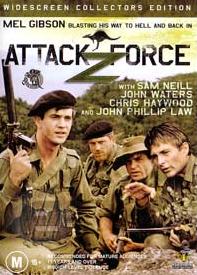
FORGOTTEN GEM? Attack Force Z (1982)


                “Attack Force Z” is an Australian movie that is most known for starring young future stars Mel Gibson and Sam Neill.  It was directed by Tim Burstall and was filmed in Taiwan.  The movie was premiered at Cannes, but after that was only shown briefly in Australian theaters.  It was a flop.  It was based on a true story.  There was a Z Special Force which was an elite unit of Australian volunteers that was part of Gen. Douglas MacArthur’s army in the Pacific.  It conducted missions behind enemy lines and was similar to the OSS.  The movie claims to be an “honest retelling” of one of those missions.

                The movie opens in January, 1945 as five commandoes land on an island via kayaks launched from a sub.  They are led by Capt. Kelly (Gibson).  Their mission is to rescue the survivors of a downed plane.   An early encounter with a Japanese bunker results in the wounding of one of them and his subsequent stoical dispatching by Sgt. Costello (Neill).  These guys mean business.  They hook up with a local resistance leader who uses martial arts against a Japanese patrol.  Is this the first use of kung fu in a war movie?  There are some problems, but they eventually locate their targets which turn out to be an American government official and a Japanese defector who holds the key to a quicker Allied victory over the Japanese.   A romance is thrown in between the top billed John Philip Law and a native girl.  Queue the sappy music.  In the climax, the village stands against a Japanese unit to aid in the escape of the commandoes.  In a crescendo of violence, the movie lives up to its “who will survive?” nature.   Answer:  20 %. 

                “Attack Force Z” (also unknown as “The Z Men”) is a low budget resume white-out target.  The acting is not the problem.  Gibson and Neill show promise, but Law (who had achieved fame as the blind angel in “Barbarella”) shows that he is properly obscure.  The plot is shaky.  Parts make no sense and it would be best to not think too much while watching it.  A Japanese defector who wants to reveal important secrets?  Ridiculous.  There is some low budget action movie violence that should keep the combat porn demographic happy.  The deaths are not silly and they are fairly graphic.  It certainly goes out with a bang (but not a loud bang because the heroes use silencers on their sub machine guns). 

As to the claim of historical truth, I’m afraid I’m going to have to call “shenanigan” on that one.  The movie is clearly based on Operation Opossum.  In 1945, Z Special Force was tasked to rescue the Sultan of Temate.  Thirteen members landed on the island on orders from MacArthur.  They made contact with the Sultan, but the next day had to defeat several boatloads of Japanese soldiers that landed near the village.  The Japanese were wiped out in a firefight.  The Australians lost only their commander.  The Sultan and his family were evacuated by PR boat and taken to meet MacArthur.

Forgotten gem?  Appropriately forgotten and certainly not a gem.

Grade  =  C     

Tuesday, December 24, 2013

We Were Soldiers (2002)


                “We Were Soldiers” was based on the acclaimed best seller We Were Soldiers Once…And Young by Lt. Col. Harold Moore and journalist Joseph Galloway.  The book is a non-fiction account of the Battle of Ia Drang in the Vietnam War.  The movie was written, directed, and produced by Randall Wallace of “Braveheart” and “Pearl Harbor” infamy. 

                The film opens with a scene set in 1954 during the First Indochina War pre-Dien Bien Phu.  A French unit is ambushed in the Ia Drang Valley (the Valley of Death) by the Vietminh led by Nguyen Huu An  and wiped out.  The action is graphic with “Saving Private Ryan” style cinematography (quick cuts, slo-mo, POV).  It’s a great opening and sets the theme of “how will the American experience be different?”

                The body of the film begins at Fort Benning, Ga (it was filmed on location) in 1964.  Back when America was innocent, naïve, and overconfident.  And clueless about nonconventional warfare in a jungle environment.  Moore (Mel Gibson) arrives with his idyllic family of supportive wife and perfect kids.  A 1950s TV family in a 2000s war movie that wants to be a John Wayne movie.

Plumley and Moore - comedy team
                Moore is in command of a new type of unit – air cavalry.  Helicopters will take the role of horses.  The unit is the 7th Cavalry and in case you don’t get the reference, the movie hammers the fact that the 7th was Custer’s unit and you know what happened to them!  We get the obligatory training montage.    The movie is an excellent study in command.  Moore is the classic “lead by example” commander.  He is also very hands-on in his leadership.  This includes counseling his young officers.  For instance, he has a talk with a new father named Lt. Geoghegan (Chris Klein) in a chapel.  The scene is cringe-inducing with overt religiousity and sappy dialogue.  Geoghegan is saintly and soon to be a papa with his new bride (and thus doomed).  Moore offers a prayer that concludes with asking God to disregard the enemy’s prayers and help us kill the “little bastards”.  Hilarious!

Geoghegan and Moore pray to prey
on our enemies
                The movie makes a concerted effort to integrate the families into the narrative.  Moore tells his daughter that war is when some people in another country try to take the lives of people and then soldiers like daddy have to go over and try to stop them.  This is not a bad analysis of what the public was told the war was about in 1964.  The movie introduces us to the officers’ wives.  Julie Moore (Madeline Stowe) is the sorority mom.  When orders come, the men are enthusiastic about going off to test their manhood, the wives are stoically nervous.

                The unit is sent to the Central Highlands in 1965.  The air cavalry experiment is about to begin.  That experiment is simple – use mobility to “find the enemy and kill them”.  Their first mission is to land in an enemy area and provoke combat.  Hopefully not against ten to one odds.  Oops!  Hueys led by Maj. Crandall (Greg Kinnear) drop them in a clearing designated LZ X-Ray.  The tactics are realistic as the Americans come charging off the choppers guns blazing and immediately establish a perimeter.  Things go wrong immediately as the gung-ho Lt. Herrick (Marc Blucas) goes chasing after an enemy scout and gets himself killed (“If I have to die. I’m glad to give my life for my country.”) and his platoon cut off in a position called The Knoll.  Sgt. Savage (Ryan Hurst) takes command.  The trials the Lost Platoon will go through are incredible.  A few men holding out against huge numbers of the enemy.  The fighting gets so desperate Savage calls artillery fire down on his own position.


                Inside the perimeter, it’s a macrocosm of what the Lost Platoon is going through.  The landing at LZ X-Ray was like kicking an ant pile.  It turns out there is a NVA battalion commanded by now Col. An stationed in the hills nearby and they are up for a fight.  Even against the vaunted U.S. Army.  The battle is a series of enemy assaults and Moore’s attempts to plug the holes with his courageous few.  Crandall’s helicopters participate by bringing in reinforcements and supplies and medevac the wounded under fire.  They also bring in an intrepid photojournalist named Joseph Galloway (Barry Pepper).  At one point, the NVA get to the command post and Galloway grabs an M-16 and fights for survival, like everyone else.

                At this point the movie jumps to the home front where the wives are coping with separation, but not death.  Then the first telegrams arrive.  Julie Moore and Barbara Geoghegan (Keri Russell) take over delivering the death notices.  It’s extremely poignant and effective.  Wouldn’t it be extra poignant if one of the telegrams is for one of them?

Mrs. Geoghegan and Mrs. Stowe
delivering telegrams
                Meanwhile, day two dawns to more of the same.  Now the VC have joined in, for Christ’s sake!  Geoghegan and a black soldier make a two man assault so racism can be eliminated and Geoghegan can leave his body in no man’s land to be found by Moore later.  Hail, Hollywood!  The enemy break-through in several places and it begins to look like those Custer premonitions will come to fruition.  It gets so bad Moore has to call for “Broken Arrow” (when all available aircraft drop ordinance on a unit about to be overrun).  Some friendly fire napalm roasts Pfc. Nakayama because he had made the mistake of bragging about his new born.  Two proud fathers, two doomed soldiers.  The movie implies the Broken Arrow incident turns the tide.  Soon after, another attempt to reach the Lost Platoon is successful.  Savage takes a short breather and then reenters combat because if you have a name like that …


Napalm + Hollywood = box office dynamite
                On the third day, An plans an all-out assault to finish off the exhausted Americans and thus convince the Yankees that South Vietnam is a bad investment.  This will be the ultimate vindication for his “grab them by the belt buckle” solution to American artillery and air support.  Col. Joshua Chamberlain, I mean Lt. Col. Moore, looks at the situation and decides it calls for a bayonet charge.  “Fix bayonets!”  Moore (Gibson)  leads the charge.  The enemy are too surprised to fire their weapons.  However, the thrill of the chase carries our heroes smack into the well- defended enemy bunker complex.  Get more telegrams ready, including one for Julie Moore.  But wait, the air cavalry arrives in the form of Crandall in a Huey gunship and he proceeds to Gatling and rocket the enemy to smithereens.  USA! USA! USA!

                An licks his wounds and prepares for the long haul.  The media arrives like vultures to report the great “victory”.  Moore is the last to leave, as he promised.  The rest is history.  Spoiler alert:  we lost.

                This is a schizophrenic movie.  Parts of it are great and parts are not.  Not surprising for a movie that tries to be accurate and entertaining in equal measure.  Wallace insisted the movie was as accurate as possible (the same bull shit he spewed about “Braveheart”) and most of it is.  The parts that are aimed at the general audience make a war movie lover squirm.  The Moore family scenes are not pathetic, but it’s obvious Wallace meant to make the opposite of the unpatriotic, impious Vietnam flicks like “Platoon”, “Apocalypse Now”, “Full Metal Jacket”, and “The Deer Hunter”.  The pre-battle training sequence is simplistic and heavy in foreshadowing.  For instance, Herrick is a tightly-wound glory hound who is likely to get his men into a trap.   Sure ‘nuff.   The references to Custer’s Last Stand are too maladroit.  

                The trite pre-Vietnam scenes come to an abrupt end when the unit gets shipped overseas.  That scene is powerful with a building score and no dialogue.  In no time at all, they are in battle.  The action is consistently intense and some of the effects are spectacular.  This movie has more combat than a vast majority of war movies.  And yet, believe it or not, the actual battle was even more intense and violent than the movie.  The tactics are realistic for both sides.  The movie is excellent on helicopter participation in the fighting and air and artillery support.  The napalm shots are breathtaking (get it?).  There is even a “mad minute” moment to get the enemy to reveal their positions.  One problem I had was the lack of emphasis on the role of M-60s in holding off human wave attacks.  It could be argued that “We Were Soldiers” comes closest to accurately portraying a Vietnam battle.

                The movie is rolling along nicely until it jumps the shark with Moore going out in the dark to find Geoghegan.  It is inconceivable that a commander would risk his life in a situation like that.  The scene was obviously forced in to confirm Moore’s pledge not to leave any men behind.  More tears get jerked with the telegram for Barbara.  But Wallace saves his best for last with the abysmal bayonet charge topped off with the Crandall massacre of the remainder of the enemy.  Wallace forces a happy ending into what was a pretty level-headed narrative.  This reminded me a lot of “Pearl Harbor”.  Worse, the success of American grit and firepower in winning the battle dilutes the explicit moral that America will have a hard time in Vietnam.


                The last ten minutes of the movie prevent it from being a very good movie, but it still ends up being good and better than most Vietnam War movies.  The acting is good if a bit too earnest and the cast is able.  The actors were put through a boot camp.  Mel Gibson is not aggravating and gets Moore’s personality right.  It’s obvious Gibson was comfortable playing a man as religious as he is.  Greg Kinnear is strong as Crandall and Pepper’s late appearance as Galloway gives the movie a second wind.  Making the most impact is Sam Elliot as Sgt. Major Plumley.  It’s acting in his sleep, but the character is a lot of fun, if clicheish.  He gets some great lines and provides some welcome humor without cracking a smile.  He does not say a lot, but it’s all quality.  Unfortunately, much of the dialogue could easily fit into a 1940s war film.  When Moore asks Galloway what he is doing there, Galloway says “because I knew these dead boys would be here.”  At one point,  Moore says “There’s nothing wrong except that there’s nothing wrong.”  Apparently, the dialogue is accurate, but it seems hokey.

                The movie is technically proficient as would be expected for a movie costing $70 million.  Wallace may be shaky as a screenwriter, but he does a good job directing.  The action scenes incorporate all the bells and whistles of modern war movies.  There are some hand-held shots.  There is some slo-mo.  Blood splatters on the camera lens.  It is a very violent movie.  The make-up crew did a remarkable job on some horrendous wounds.   Someone counted the number of KIAs – 305.  The sound effects are great.  The lighting in the night attacks is admirable.  The score is fine and restrained.

                The movie has some admirable goals.  Wallace wants the audience to get a feel for what military wives go through.  Having a military mother and having lived on a base while my father flew in Vietnam I can attest to the authenticity of the home front scenes.  The telegram scenes are not in the book and may be Hollywood, but they are refreshing for this macho genre.  We certainly did not need another stale romance or love triangle.  Stowe is great as Julie Moore.  WWS has a strong female vibe.  Another example of balance is the coverage of the enemy.  This is not “Black Hawk Down”.  The communists are not faceless.  Gen. An (Don Duong) is sympathetically rendered as are his men.   One soldier gets to keep a diary with his girl’s picture in it and then gets to try to bayonet Col. Moore.  They are brave but there is definitely a drone quality to them.  Wallace goes out of his way to cover their tactics and even implies they will win the war.

                Some people sneer at the unambiguous religiousity of the film and Gibson’s involvement in the film caters to this criticism.  However, my research shows that Moore is indeed a devout Catholic so the characterization is true to form although obviously forced into the film (probably at the insistence of Gibson).  Considering how a vast majority of war movies purposely ignore religion, we can excuse WWS for purposefully including God.  It has more scenes with religion than any ten war movies.  Hell, even An says a prayer.  Another jarring element is the squeaky cleanness of the American soldiers.  This ain’t “Platoon”.  There is no drug use or sociopathic behavior.  Although I would put the movie in the VioLingo school, I do not think the f word was used a single time.  (Considering the graphic violence, Wallace’s decision to sanitize the language is bizarre.)  Before you cry bogus, this is fairly close to the 1965 Army especially when you consider these would not be draftees and they are in an elite unit.  They should be naïve, enthusiastic, and patriotic.

                In conclusion, “We Were Soldiers” could have been the best Vietnam War movie if Wallace had not pulled his punches in the end.  For someone who wanted to make the most accurate Vietnam War battle movie, it is infuriating that he would taint his admirable effort with a phony happy ending.  Especially when the truth would have fit his purpose so much better.  Still, if you overlook the bayonet charge, the battle is as good as you are going to get, the wives get their just due, the soldiers of both sides are positively depicted, the enemy is sympathetically portrayed, and the movie is an excellent study in command.  Nothing’s perfect.

grade =  A-
trailer
broken arrow

Monday, April 25, 2011

#67 - BRAVEHEART


BACK-STORY: “Braveheart” is a war movie that was released in 1995. It stars Mel Gibson as the Scottish patriot William Wallace. Gibson did not want to act in the movie (he felt he was too old for the part), but the studio refused to finance it without the superstar appearing. Gibson also directed the movie. It was a critical and box office success. It won the Best Picture Oscar and Gibson was awarded Best Director. It captured a total of five Oscars. The movie was filmed in Scotland, although most of the extras for the battle scenes were from the Irish territorial army. The screenplay was written by Randall Wallace who also did Gibson’s “We Were Soldiers” script. He based the story on a medieval poem about Wallace by Blind Henry. Wallace claims to be a descendant of the hero. The movie was going to be rated NC-17 due to graphic violence, but Gibson made some cuts of the gorier shots.


NOTE: As with “They Died With Their Boots On”, I will insert the historical corrections into the summary because there are so many of them.

OPENING: The movie begins in Scotland in 1280. The narrator claims that the King of Scotland has died without heir so the “pagan” king of England, Edward I (Patrick McGoohan), has decided to conquer Scotland. (The Scottish king was still alive and had two sons. Edward was a Christian.) Edward invites the Scottish nobles to parley and then treacherously hangs them. (No such meeting or executions occurred.) Wallace, a farmer’s son, finds the bodies. (Wallace was the son of a lower knight.) His father goes off to war and returns dead. Wallace is adopted by his uncle.

SUMMARY: In London, Edward forces his flamingly gay son to marry a French princess. (Edward II may have been bisexual, but he had 5 kids by his two wives.) Edward orders the practice of primo noctae (the right to sleep with the bride first) to encourage British nobles to settle in Scotland. (Ridiculous, plus there was no such thing in England.)

     Wallace returns from a pilgrimage and reacquaints himself with his childhood sweetheart Murron. They secretly marry. He only wants to live in peace as a farmer. (If Wallace ever married it was after he was already an outlaw.) He rescues her from being raped by a loathsome British soldier. He escapes, but she doesn’t. The local baron slits her throat to lure him back. (all bull shit) Wallace comes riding back in with some nunchucks (I kid you not) hidden behind his back. The bloodletting commences ending with the throat-cutting of the baron and now Wallace is the leader of a rebellion.

     Robert the Bruce (Angus Macfadyen) is the logical heir to the throne. His father is a Machiavellian who is made repellant by his leprosy (untrue). The father convinces the Bruce that compromise with the British is the best route, so Robert does not join Wallace.

     Wallace faces the British at the Battle of Stirling (actually the Battle of Stirling Bridge, but since Gibson did not want a bridge interfering with his battle…) Wallace’s force waits for the British on a hill (like Spartacus). He gives a fiery speech (like in Henry V). Wallace’s men lift their kilts to moon the British. (The Scots did not wear kilts at this time in history.) When the British cavalry (wearing scaled armor?!) charges, Wallace’s men produce his secret weapon – pikes (which they had hidden where?) to impale the horses. The battle becomes a melee (like Spartacus without the graphic violence). The Scots win when the Scottish nobles flank the British with their cavalry. Wallace beheads the enemy commander. 90% of the British are killed. No main characters on Wallace’s side dies. (Nothing about this battle remotely recalls the Battle of Stirling Bridge which was an ambush of the British army as it crossed a bridge. The pikes were used at Falkirk, not here.)

     Wallace is knighted (untrue) and leads an invasion of England featuring the siege of York (he did sack some towns, but did not attack York). Meanwhile, Edward I is so upset he hurls his son’s gay lover out a window (Gibson was justly accused of homophobia for this scene). (The supposed lover was actually exiled, but not under these circumstances.) He decides to send the Princess Isabelle (Sophie Marceau) to negotiate with Wallace (I am not kidding) while he sneakily prepares an army. Wallace turns down the offer of title, lands, and gold (surprise!), but there is some chemistry between him and the Princess (surprise!) (Do I need to point out all this is bull crap?) Edward marches with a large army including Irish mercenaries (actually, there were no Irish in his army). The Princess sends warning to Wallace.

     In the Battle of Falkirk, the Irish open the attack, but when they reach the Scots, they shake hands and switch sides (I am not making this up). Wallace has fire arrows fired to set the oil spread the night before in the field afire (like Spartacus). This prevents the British cavalry from charging, but we still get an infantry melee. At the crucial moment, the bastard Scottish nobles leave the field thus dooming Wallace. Edward orders his archers to fire into the melee, not caring who gets hit. He then sends in reinforcements (like Spartacus). (In the actual battle, Wallace’s men were in hollow squares armed with pikes. Edward bombarded the fixed squares with arrows which won an easy victory.) Wallace sees Edward leaving (he decides not to stay to the end?) and goes after him like in a Western. He is dehorsed by a knight if full plate armor. Guess who is behind the visor? Robert Bruce! Bruce saves Wallace from capture. (Never mind!) The movie should have ended here, but then Mel would not have been able to get tortured (or torture history buffs some more).

     Mel goes Lethal Weapon on the two main treacherous nobles, killing one by riding his horse into the poltroon’s bedroom and smashing his head in with a flail! He drops the other’s corpse onto the Bruce’s dining table. (AYK) Edward sends the Princes to lure Wallace into a trap, but instead she allows herself to be impregnated in a romantic cottage. (A neat trick considering they never met and she was not even married to Edward II until two year after Wallace’s death. Plus she would have been nine years old at the time.) Wallace: “Why do you help me?” Isabelle: “Because of the way you are looking at me now”. (Gag, then barf!)

     Wallace goes to meet the Bruce, but he is captured because the leper sold him out so Robert could be king. (He was actually betrayed by a Scottish noble.) Robert is guilt-ridden about this and turns against his father.

THE CLOSING: The Princess begs Wallace to confess and thus avoid torture. Wallace agrees. (Just kidding) “Every man dies – not every man really lives.” (A quote from a different William Wallace.) And finally, the moment Mel has been waiting for – the torture scene! But not simple torture. First, lifted with a noose. Second, stretching. Third, pain inflicted on a cross shaped table (Christ imagery anyone?). Finally, because he responds with “Freedom!” instead of “mercy”, they mercifully behead him (wait, what?) (Actually, Wallace suffered worse in being drawn and quartered.) Meanwhile, Edward lies dying nearby. (He died two years later.) The last thing he contemplates is the Princess whispering that she carries Wallace’s child who will be the next king (provided it’s a boy, of course). (Alas, the fictional child was still-born.)

     We have to have a happy ending, so the movie implies that the immediate result of the killing of Wallace was Robert the Bruce leading an uprising that resulted in perpetual independence for Scotland at the Battle of Bannockburn. (Actually fought nine years later and eventually Cromwell conquered Scotland.)

RATINGS:

Action – 8

Authenticity – 6

Acting – 8

Accuracy – 2

Realism – 4

Plot – 5

Overall – 5

WOULD CHICKS DIG IT? It depends if they care about history or realism. If they don’t, they will probably enjoy the love story and they can close their eyes during the battles. The costumes are well done. Mel is a sensitive hunk.

ACCURACY: You know you are in trouble when even the title of the movie is inaccurate. The name “Braveheart” was actually applied to Robert Bruce. You get a preview of what is to come when the lies start flowing in the introductory narration. I do not want to beat a dead horse, but this movie is pure garbage! It could not have been more inaccurate than it is. Virtually everything is a mockery of the actual people and events. To make matters worse, Randall Wallace and Gibson had the nerve to defend its historical accuracy. Wallace is, of course, more to blame. He bases the story on the very dubious Blind Henry poem. This could justify taking liberties with Wallace’s early life (of which we have little knowledge), but not the raping of well documented events like the two battles. To have the Battle of Stirling Bridge depicted with no bridge in sight is infuriating. But in spite of the total disregard for history, many critics praised the film for its entertainment value. Have we reached the point where laughable cliches and ridiculous occurrences pass for entertainment? I could not help breaking out in laughter when the Irish switched sides in the middle of a charge or when Wallace and the Princess have a tryst between enemy lines. Unbelievably, Wallace got a nomination for Best Original Screenplay!

CRITIQUE: The movie is not terrible. The musical score by James Horner perfectly sets the mood throughout the film. The scenery is awesome. The environment is appropriately medievally grotty. The acting is very good. Gibson is more than competent. McGoohan makes Edward I as slimy a villain as you could imagine. Marceau is lovely and feisty. Macfayden is good as the conflicted Bruce. The supporting cast is above average (you might find the insane Irishman aggravating).

     The two battles, although inaccurate, are rousing. Especially the Battle of Stirling. The mechanical horses that get impaled are so lifelike that the ASPCA supposedly complained. As far as I know, no humans actually had any limbs hacked off, but there is so much hacking a mistake could have happened. However, it is obvious Gibson was ripping off films like “Spartacus”. But then again, several movies have done that. Speaking of “Spartacus”, you can’t beat the original and “Braveheart” does not even come close.

     You can see the future of Gibson (e.g. “The Patriot” and “Passion of the Christ”) as a film maker here. All the elements are there – over the top villains, getting tortured, unbelievable atrocities, Rambo-like heroics, and disregard for history or realism.

CONCLUSION: I’ll be truthful. I have passionately hated this movie since I first saw it in a theater. I tried watching it several years later thinking I was being overly harsh, but I could not get a third of the way through. Having to watch it all the way through for this blog project was the biggest chore I have encountered since I began. I won’t repeat what I said in my  "They Died With Their Boots On" post about history versus Hollywood. I do find it ironic that I had to review two of the most egregious trashings of history back to back. I do have a hard time deciding which movie is worse. You can make a strong case for “Braveheart” because besides its incredibly high rate of inaccuracies, it also has some of the most ridiculous plot elements and clichés ever to be found in a modern movie.

     This movie does not belong on a list of the greatest war movies compiled by any history magazine, much less Military History magazine. Shame.

Friday, February 4, 2011

"Gallipoli" (1981)


     “Gallipoli” is a war movie by Peter Weir. It was part of the wave of Australian classics of the 1980s that included “Breaker Morant” and “The Lighthorsemen”. Weir was inspired by the story of the ANZAC (Australian - New Zealand Army Corps) contribution to the British effort in the Gallipoli campaign of WWI. Early on the project evolved from a study of the entire campaign to a more personal study set in a brief period of the campaign. It stars Mel Gibson (coming off of “Mad Max”) and a debuting Mark Lee.


     The movie begins in western Australia (lovely vistas) in May, 1915. Archy (Lee) is a promising sprinter, but longs to enlist in the Light Horse. He represents the stereotypical naïve patriot. “If we don’t stop them [in Turkey], they could end up here” (the Australian “Domino Theory”?). His family is against him going to war because he has a bright future being alive. They relent, of course but not before his uncle/mentor reads the scene in “The Jungle Book” where Mowgli decides to leave the jungle saying “Now I will go to men.”

     Archy befriends Frank (Gibson) who represents the stereotypical reluctant, cynical warrior. “It’s not our bloody war! It’s an English war. It’s got nothing to do with us”. He bonds with fellow runner Archy and through their friendship and the application of the wonders of peer pressure, he enlists too. They go into different units, but are reunited in Egypt for the training/whoring scenes obligatory for a war movie. There is some local color featuring a bazaar and a brothel. The lads are seeing the world.


     Then it’s off to the Gallipoli beachhead and a wonderfully staged nighttime landing. The Australians are trapped along a narrow stretch with the Turks holding the high ground where they are dug in with artillery and machine guns. Fortunately ladies, the Bruces insist on bathing in the ocean with shrapnel roiling the water. This is fortunate because Mel Gibson exposes his bare butt. The life in the trenches is realistically depicted. The soldiers eat hard tack and there are flies! Critters in a war movie, imagine that.

     The big battle is coming and it is to be a diversion for a British landing at Suvla Bay designed to break the deadlock. Those dastardly Brits are going to use the colonials in a suicide attack to suit their own purposes! If the landing succeeds, it’s on to Constantinople to knock Turkey out of the war which will lead to the defeat of Germany. Just like the Somme! Oh, and not to worry Aussies, the preliminary bombardment will make the attack a cake walk. Just like the Somme!

     The bombardment is cinematically short, but realistically violent. The first attack is futile against the Turkish machine guns as is the second. Major Barton (representing the stereotypical sensitive officer like Col. Dax in “Paths of Glory”) wants to get the attack called off, but the telephone wire has been cut. He needs a really, really fast runner to rush the request to Colonel Robinson. Lucky for him Frank is a very fast runner. He runs to new ageish music which sounds like “Chariots of Fire”, but clashes with the rest of the mostly classical sound track. Col. Robinson (a stereotypical British twit reminiscent of Gen. Mireau in “Paths”) refuses to cancel the attack so Frank is sent to the general. The general decides to cancel the attack, but meanwhile the line is repaired and even Frank cannot outrun a telephone call from the colonel that orders the attack.

     The soldiers, including Archy, are unaware of the race against idiocy. They prepare for death by leaving mementoes in the trench. Archy leaves a track medal (lost potential) and a watch (lost future). The movie ends with Archie reenacting Robert Capa’s iconic Spanish Civil War photo entitled “The Falling Soldier”.

     “Gallipoli” is well done and was influential on war movies of the eighties. It is fairly accurate, but piles on the British to elicit nods from its core audience which still resents Britain’s misuse of the ANZAC. In actuality, Col. Robinson was a Col. Antill who was Australian, as was the general who planned the attack. Also, the Battle of the Nek was a diversion for a New Zealand attack, not the British landing at Suvla Bay. It is obvious Weir changed the facts to enhance the anti-British theme. He had to apologize later.

     The acting is okay, if a bit over the top. Gibson is a young Mel Gibson, nuff said. Lee is a little e bland, but so is his character. It’s themes of the loss of innocence and the futility of war are commendable. It is definitely anti-war. It is a buddy picture with some hints of a bromance between Archy and Frank which I feel it’s safe to say escaped Gibson’s notice when he read the script. I do think some critics have overemphasized the homosexual angle. Although the unrealistic way the cynical Frank runs off to a war because of his friendship with Archy gives ammunition to their argument.

     Not a bad movie, but not as good as "Breaker Morant" and not worthy of the 100 Best.

GRADE  =  B-