Showing posts with label We Were Soldiers. Show all posts

Saturday, December 21, 2024

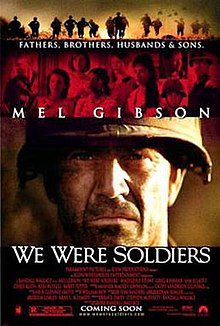
THE 100 BEST WAR MOVIES: #23. We Were Soldiers (2002)


                “We Were Soldiers” was based on the acclaimed best seller We Were Soldiers Once…And Young by Lt. Col. Harold Moore and journalist Joseph Galloway.  The book is a non-fiction account of the Battle of Ia Drang in the Vietnam War. It is considered the first American battle in the war.  The movie was written, directed, and produced by Randall Wallace of “Braveheart” and “Pearl Harbor” infamy. Wallace said that when he heard that Moore once said “"Every damn Hollywood movie got [the Vietnam war] wrong,” he was determined to get his movie right. (He should have said he was determined to make up for “Braveheart”.)  Moore did endorse the accuracy of the film. Galloway had to leave the theater for a while when he first saw it, but approved of the film. The movie had a $75 million budget and made around $115 million. Sam Elliott became so close with Basil Plumley that he sat in the front row at his funeral, next to his daughter. The 58-year-old actor participated in the boot camp for the actors.

            The film opens with a scene set in 1954 during the First Indochina War pre-Dien Bien Phu.  A French unit is ambushed in the Ia Drang Valley (the Valley of Death) by the Vietminh led by Nguyen Huu An and wiped out.  The action is graphic with “Saving Private Ryan” style cinematography (quick cuts, slo-mo, POV).  It’s a great opening and sets the theme of “how will the American experience be different?”

            The body of the film begins at Fort Benning, Ga (it was filmed on location) in 1964.  Back when America was innocent, naïve, and overconfident.  And clueless about nonconventional warfare in a jungle environment.  Moore (Mel Gibson) arrives with his idyllic family of supportive wife and perfect kids.  A 1950s TV family in a 2000s war movie that wants to be a John Wayne movie.

            Moore is in command of a new type of unit – air cavalry.  Helicopters will take the role of horses.  The unit is the 7th Cavalry and in case you don’t get the reference, the movie hammers the fact that the 7th was Custer’s unit and you know what happened to them!  We get the obligatory training montage.    The movie is an excellent study in command.  Moore is the classic “lead by example” commander.  He is also very hands-on in his leadership.  This includes counseling his young officers.  For instance, he has a talk with a new father named Lt. Geoghegan (Chris Klein) in a chapel.  The scene is cringe-inducing with overt religiousity and sappy dialogue.  Geoghegan is saintly (and thus doomed).  Moore offers a prayer that concludes with asking God to disregard the enemy’s prayers and help us kill the “little bastards”.  Hilarious!

            The movie makes a concerted effort to integrate the families into the narrative.  Moore tells his daughter that war is when some people in another country try to take the lives of people and then soldiers like daddy have to go over and try to stop them.  This is not a bad analysis of what the public was told the war was about in 1964.  The movie introduces us to the officers’ wives.  Julie Moore (Madeline Stowe) is the sorority mom.  When orders come, the men are enthusiastic about going off to test their manhood, the wives are stoically nervous.

            The unit is sent to the Central Highlands in 1965.  The air cavalry experiment is about to begin.  That experiment is simple – use mobility to “find the enemy and kill them”.  Their first mission is to land in an enemy area and provoke combat.  Hopefully not against ten to one odds.  Oops!  Hueys led by Maj. Crandall (Greg Kinnear) drop them in a clearing designated LZ X-Ray.  The tactics are realistic as the Americans come charging off the choppers guns blazing and immediately establish a perimeter.  The landing at LZ X-Ray was like kicking an ant pile.  It turns out there is a NVA battalion commanded by now Col. An stationed in the hills nearby and they are up for a fight.  Even against the vaunted U.S. Army.  The battle is a series of enemy assaults and Moore’s attempts to plug the holes with his courageous few.  Crandall’s helicopters participate by bringing in reinforcements and supplies and medevac the wounded under fire.  They also bring in an intrepid photojournalist named Joseph Galloway (Barry Pepper).  The movie intercuts with the home front where the wives are coping with separation, but not death.  Then the first telegrams arrive.  Julie Moore and Barbara Geoghegan (Keri Russell) take over delivering the death notices.  It’s extremely poignant and effective. 

ACTING:   B                 

ACTION:   A+  (9/10)

ACCURACY: B       

PLOT:  B                

REALISM:   A

CINEMATOGRAPHY:   B

SCORE:   B

SCENE:  broken arrow

QUOTE:  Moore:   I wonder what was going through Custer's mind when he realized that he'd led his men into a slaughter?

Plumley: Sir, Custer was a pussy. You ain't.

                This is a schizophrenic movie.  Parts of it are great and parts are not.  Not surprising for a movie that tries to be accurate and entertaining in equal measure.  Wallace insisted the movie was as accurate as possible (the same bull shit he spewed about “Braveheart”) and most of it is.  The parts that are aimed at the general audience make a war movie lover squirm.  The Moore family scenes are not pathetic, but it’s obvious Wallace meant to make the opposite of the unpatriotic, impious Vietnam flicks like “Platoon”, “Apocalypse Now”, “Full Metal Jacket”, and “The Deer Hunter”.  The pre-battle training sequence is simplistic and heavy in foreshadowing.  For instance, Herrick is a tightly-wound glory hound who is likely to get his men into a trap.   Sure ‘nuff.   The references to Custer’s Last Stand are too maladroit. 

            The trite pre-Vietnam scenes come to an abrupt end when the unit gets shipped overseas.  That scene is powerful with a building score and no dialogue.  In no time at all, they are in battle.  The action is consistently intense and some of the effects are spectacular.  This movie has more combat than a vast majority of war movies.  And yet, believe it or not, the actual battle was even more intense and violent than the movie.  The tactics are realistic for both sides.  The movie is excellent on helicopter participation in the fighting and air and artillery support.  The napalm shots are breathtaking (get it?).  There is even a “mad minute” moment to get the enemy to reveal their positions.  One problem I had was the lack of emphasis on the role of M-60s in holding off human wave attacks.  However, It could be argued that “We Were Soldiers” comes closest to accurately portraying a Vietnam battle.

            The movie is rolling along nicely until it jumps the shark with Moore going out in the dark to find Geoghegan.  It is inconceivable that a commander would risk his life in a situation like that.  The scene was obviously forced in to confirm Moore’s pledge not to leave any men behind.  More tears get jerked with the telegram for Barbara.  But Wallace saves his best for last with the abysmal bayonet charge topped off with the Crandall massacre of the remainder of the enemy.  Wallace forces a happy ending into what was a pretty level-headed narrative.  This reminded me a lot of “Pearl Harbor”.  Worse, the success of American grit and firepower in winning the battle dilutes the explicit moral that America will have a hard time in Vietnam.

            The last ten minutes of the movie prevent it from being a great movie, but it still ends up being very good and better than most Vietnam War movies.  The acting is good if a bit too earnest and the cast is able.  Mel Gibson is not aggravating and gets Moore’s personality right.  It’s obvious Gibson was comfortable playing a man as religious as he is.  Greg Kinnear is strong as Crandall and Pepper’s late appearance as Galloway gives the movie a second wind.  Making the most impact is Sam Elliot as Sgt. Major Plumley.  It’s acting in his sleep, but the character is a lot of fun, if clicheish.  He gets some great lines and provides some welcome humor without cracking a smile.  He does not say a lot, but it’s all quality.  Unfortunately, much of the dialogue could easily fit into a 1940s war film.  When Moore asks Galloway what he is doing there, Galloway says “because I knew these dead boys would be here.”  At one point,  Moore says “There’s nothing wrong except that there’s nothing wrong.”  Apparently, the dialogue is accurate, but it seems hokey.

            The movie is technically proficient as would be expected for a movie costing $75 million.  Wallace may be shaky as a screenwriter, but he does a good job directing.  The action scenes incorporate all the bells and whistles of modern war movies.  There are some hand-held shots.  There is some slo-mo.  Blood splatters on the camera lens.  It is a very violent movie.  The make-up crew did a remarkable job on some horrendous wounds.   Someone counted the number of KIAs – 305.  The sound effects are great.  The lighting in the night attacks is admirable.  The score is fine and restrained.

            The movie has some admirable goals.  Wallace wants the audience to get a feel for what military wives go through.  Having a military mother and having lived on a base while my father flew in Vietnam I can attest to the authenticity of the home front scenes.  The telegram scenes are not in the book and may be Hollywood, but they are refreshing for this macho genre.  We certainly did not need another stale romance or love triangle.  Stowe is great as Julie Moore.  WWS has a strong female vibe.  Another example of balance is the coverage of the enemy.  This is not “Black Hawk Down”.  The communists are not faceless.  Gen. An (Don Duong) is sympathetically rendered as are his men.   One soldier gets to keep a diary with his girl’s picture in it and then gets to try to bayonet Col. Moore.  They are brave but there is definitely a drone quality to them.  Wallace goes out of his way to cover their tactics and even implies they will win the war.

            Some people sneer at the unambiguous religiousity of the film and Gibson’s involvement in the film caters to this criticism.  However, my research shows that Moore is indeed a devout Catholic so the characterization is true to form although obviously forced into the film (probably at the insistence of Gibson).  Considering how a vast majority of war movies purposely ignore religion, we can excuse WWS for purposefully including God.  It has more scenes with religion than any ten war movies.  Hell, even An says a prayer. 

            In conclusion, “We Were Soldiers” could have been the best Vietnam War movie if Wallace had not pulled his punches in the end.  For someone who wanted to make the most accurate Vietnam War battle movie, it is infuriating that he would taint his admirable effort with a phony happy ending.  Especially when the truth would have fit his purpose so much better.  Still, if you overlook the bayonet charge, the battle is as good as you are going to get, the wives get their just due, the soldiers of both sides are positively depicted, the enemy is sympathetically portrayed, and the movie is an excellent study in command. 

Tuesday, November 11, 2014

HOLLYWOOD or HISTORY: We Were Soldiers


                I earlier reviewed “We Were Soldiers” and then reread We Were Soldiers Once… And Young by Harold Moore and Joseph Galloway.  The director and screenwriter of the movie, Randall Wallace, claimed the movie was as accurate as you could get.  But given his track record of “Braveheart” and “Pearl Harbor”, I was skeptical.  Here are some things that happened in the movie.  Which are true and which are Wallaceisms?

1.  The French Group Mobile 100 was ambushed in the Ia Drang Valley in 1954 and wiped out by a unit of Vietminh led by Nguyen Huu An
2.  During boot camp at Fort Bragg, a radio operator picked up a fire fight in Vietnam.
3.  Moore was a devout Catholic.
4.  Moore and Geogehegan had a heart to heart in a chapel after the birth of Geogehagen’s baby.
5.  Moore told his daughter that war was when some people in another country try to take the lives of other people and then soldiers like daddy have to go over and stop them.
6.  Moore’s unit was the 7th Cavalry – Custer’s old unit.

7.  Sgt. Plumley was a crusty veteran of WWII with a gruff personality and leadership style.
8.  The Lost Platoon got “lost” because Herrick chased after an enemy scout as soon as they landed.
9.  Herrick’s last words were:  “If I have to die. I’m glad to give my life for my country.”
10.  They blew up trees to create a new landing zone.
11.  Metzker was killed when he gave up his place on a medevac helicopter.
12.  Galloway arrived on the night of the first day.
13.  Mrs. Moore and Mrs. Geogehagen delivered the telegrams to the other wives.
14.  Moore prayed over the dead bodies.
15.  Geogehagen and a black soldier were killed out in front of the American lines.
16.  They peed on the mortar tubes to cool them down.
17.  Plumely told Galloway he could not take pictures lying down and soon after he told the wounded “Prepare to defend yourselves”.
18.  A soldier jumped on a grenade to save some of the woundeds lives.
19.  When the position was about to be overrun, Moore called for Broken Arrow.
20.  Jimmy Nakayama was mortally wounded by friendly napalm and never saw his new-born baby.  Some of his flesh came off in Galloway’s hands.
21.  The Lost Platoon was finally rescued when Nadal’s platoon fought its way to them.

22.  Westmoreland ordered Moore to leave the battlefield to brief him, but Moore refused.
23.  Moore went into no man’s land at night to recover Geogehagen’s body.
24.  Moore led a bayonet charge that forced the enemy to retreat and then helicopter gunships decimated the enemy before Moore’s men walked into a trap.
25.  Crandall took over medevacing the wounded because the assigned unit refused to come in under fire. 


 THE ANSWERS
 1.  The French Group Mobile 100 was ambushed in the Ia Drang Valley in 1954 and wiped out by a unit of Vietminh led by Nguyen Huu An.  HISTYWOOD  The French Mobile 100 was ambushed several times during the war but never was wiped out.  It is unclear whether An participated in any of these attacks.  An is a significant figure in Vietnamese history.  He ably commanded units in the siege of Dien Bien Phu and was in command in the Battle of Ia Drang.  He rose to generalship and was highly regarded by Giap.  His forces were instrumental in the capture of Saigon at the end of the war.
2.  During boot camp at Fort Bragg, a radio operator picked up a fire fight in Vietnam.  HISTYWOOD  They actually picked up a forward air controller directing an air strike.  This was apparently not omenous enough for Wallace.
3.  Moore was a devout Catholic.  HISTORY
4.  Moore and Geogehegan had a heart to heart in a chapel after the birth of Geogehagen’s baby.  HOLLYWOOD
5.  Moore told his daughter that war was when some people in another country try to take the lives of other people and then soldiers like daddy have to go over and stop them.  HISTORY
6.  Moore’s unit was the 7th Cavalry – Custer’s old unit.  HISTORY
7.  Sgt. Plumley was a crusty veteran of WWII with a gruff personality and leadership style.  HISTORY  “Old Iron Jaw” (which he is not called in the movie) served in WWII and made four combat jumps with the 82nd Airborne and another in the Korean War.  As far as I could tell, his personality is accurately depicted.
8.  The Lost Platoon got “lost” because Herrick chased after an enemy scout as soon as they landed.  HISTYWOOD  Fighting was already taking place when Herrick was sent into a support position and proceeded to chase several enemy.  Herrick was not killed as quickly as the movie indicates.  Sgt. Savage did take over leadership.
9.  Herrick’s last words were:  “If I have to die. I’m glad to give my life for my country.”  HISTORY  Most of the “cheesy” soldier lines were accurate.
10.  They blew up trees to create a new landing zone.  HISTORY
11.  Metzker was killed when he gave up his place on a medevac helicopter.  HOLLYWOOD  Metzker was killed as he was about to board Crandall’s ship.
12.  Galloway arrived on the night of the first day.  HISTORY  However, Moore had already met Galloway and had given him permission to come.
13.  Mrs. Moore and Mrs. Geogehagen delivered the telegrams to the other wives.  HISTORY  At least according to Wallace.
14.  Moore prayed over the dead bodies.  HISTORY  It’s unclear whether An did any praying.
15.  Geogehagen and a black soldier were killed out in front of the American lines.  HISTYWOOD  Geogehagen was not making a two man attack.  He was killed instantly when he got out of his fox hole to rescue a dead black soldier.
16.  They peed on the mortar tubes to cool them down.  HISTYWOOD  These types of things happened in warfare, but this incident was not mentioned in the book.
17.  Plumley told Galloway he could not take pictures lying down and soon after he told the wounded “Prepare to defend yourselves”.  HISTORY
18.  A soldier jumped on a grenade to save some of the wounded’s lives.  HISTORY  Sgt. Charlie McManus won the Medal of Honor for this act. 
19.  When the position was about to be overrun, Moore called for Broken Arrow.  HISTORY
20.  Jimmy Nakayama was mortally wounded by friendly napalm and never saw his new-born baby.  Some of his flesh came off in Galloway’s hands.  HISTORY
21.  The Lost Platoon was finally rescued when Nadal’s platoon fought its way to them.  HOLLYWOOD  The unit was actually reached by a reinforcing unit and there were no shots exchanged in getting to Savage and his men. 
22.  Westmoreland ordered Moore to leave the battlefield to brief him, but Moore refused.  HISTORY
23.  Moore went into no man’s land at night to recover Geogehagen’s body.  HISTYWOOD  Moore did find the body, but it was in daytime.
24.  Moore led a bayonet charge that forced the enemy to retreat and then helicopter gunships decimated the enemy before Moore’s men walked into a trap.  BULL CRAP  Moore did have the men fix bayonets before pushing the perimeter out after the battle was over and he did lead the movement, but there was no contact.  The whole movie charge and the intervention of Crandall is a painfully obvious attempt at a happy ending.  Keep in mind that a true ending would have included the ambushing of 2/7 as it marched to LZ Albany for egress after the fighting was seemingly over.  People who insist we never lost a battle in Vietnam conveniently overlook this disaster (which is covered in the book).  I do not insist that this downer of an ending should have finished the movie, but don’t substitute fantasy that is the total opposite.
25.  Crandall took over medevacing the wounded because the assigned unit refused to come in under fire.  HISTORY  Crandall started out bringing in troops, but switched to medevacing because of the circumstances.  He made a total of 14 trips and was awarded the DFC which was upgraded to the Congressional Medal Of Honor by Pres. G.W. Bush in 2007.  It is highly unlikely he pulled a pistol on another pilot like in the movie and he could not have led the counterattack because his chopper was unarmed.
RATING =   .72


 CONCLUSION:  ''We Were Soldiers" is above average in accuracy and surprisingly factual for a Randall Wallace and Mel Gibson.  This does not completely make up for their historical malpractice in "Braveheart", but at least shows they have some sense of shame.  However, it is most likely that what accuracy manages to sneak in is due to Moore and Galloway watching over their shoulders.  Unfortunately, nothing could stop Mel and Randall from tacking on the egregious happy ending that has John Wayne written all over it.  Hadn't we gotten past this type of jingoistic, crowd-sating trope by the 21st Century?   

Wednesday, March 26, 2014

84 Charlie Mopic (7) vs. We Were Soldiers (10)


VS.


ACTING
                “84 Charlie Mopic” is a low budget movie that has actors it could afford.  A couple of the cast went on to moderately successful TV careers and several were in “84 Charlie Mopic”.  All things considered, the guys do an excellent job.  Each does a good job developing his character and no one drains the momentum in the numerous moments when it’s just the camera and them.  The facial reactions (it is an intimate movie) are especially impressive.  Standouts are Nicholas Cascone as the impish RTO and Richard Brooks as the hard core OD.  This movie does death scenes well.  A

                “We Were Soldiers” is dominated by Mel Gibson as Col. Moore.  This happens to be a good Gibson performance.  He tones it down and does not insist on being tortured.  Sam Elliott has a lot of fun playing the crusty sergeant and injects some welcome humor.  Barry Pepper is solid as the photographer Joe Galloway.  Greg Kinnear is dashing as a helicopter pilot with balls of steel.  The rest of the cast carries water satisfactorily.  The movie stands out among Vietnam War movies in its depiction of the wives of the officers.  Madeline Stowe is excellent as the sorority mom and she is ably supported.  A

FIRST QUARTER SCORE
84 Charlie Mopic               9
We Were Soldiers             9

PLOT  
                “84 Charlie Mopic” is the story of a Long Range Reconnaissance Patrol with the twist that the unit is accompanied by a motion picture cameraman referred to as MoPic.  The Army wants a documentary of a typical mission.  To add to the abnormal dynamics, the tightly knit unit (with its tightly wound sergeant OD) has to cope with a green LT hoping to “punch his ticket” to higher command.  The routine mission turns out to be tragically less than routine.  Thank goodness or this would have been a pretty boring mission.  The plot is mostly exposition, but the dialogue flows well.  The action picks up after the characters have been developed to empathy level.  There is a nice buildup to the tense finale with a cool twisty ending.  A

                “We Were Soldiers” is based on the acclaimed book about the first major American battle of the war.  The plot covers the development of the air cavalry concept through training and then plunks the unit into a jungle clearing in “Indian territory”.  They are soon in the middle of a s*** storm.  Its “Zulu” without the buildings and with sympathetic coverage of the enemy.  The movie does a great job of intercutting with the wives back at the base in the States.  The plot follows the book admirably closely with the glaring exception of the ridiculous tacked-on happy Hollywood ending.  The plot also can be criticized for shoe-horning religion into the equation.   B

HALF TIME SCORE
84 Charlie Mopic               18
We Were Soldiers             17

COMBAT
                “84 Charlie Mopic” is really constrained by its low budget when it comes to depiction of combat.  This is partly alleviated by the unique POV perspective.  Although the combat is not balls to the wall, it is realistic to this type of patrol.  It does lead to some very poignant deaths.  B  

                “We Were Soldiers” has some of the most intense action of any Vietnam War movie. We get some breathers once the battle begins. This is welcome because the violence is draining.  Believe it or not, the battle is less frenetic than the actual Battle of Ia Drang.  The tactics of both sides are spot on.  There is no better film for understanding a conventional battle in Vietnam. There’s no surrealism.   Just turn it off before the feel-good ending.  A

THIRD QUARTER SCORE
84 Charlie Mopic               26
We Were Soldiers             26

REALISM
                “84 Charlie Mopic” puts you with a LRRP.  Granted, what is supposed to be a routine mission is far from it.  However, everything that happens could have happened on a mission like this.  The soldier behavior is authentic and the dialogue is not forced.  The dynamics are a strength of the film.  The squad has a bond in spite of their various backgrounds and personalities.  For instance, OD and Cracker are best buddies when in the World they would hardly have been so.  The jocularity of the soldiers is true to American warriors.  The relationship between the rookie LT and OD has been jazzed up but accurately reflects the role of veteran sergeants in leading units and the fact that many officers sought temporary combat to enhance their careers.  A+

                “We Were Soldiers” is a realistic depiction of conventional warfare in Vietnam.  It sticks to the basic facts of an actual battle until it goes off the track in the end.  The movie concentrates on Lt. Col. Moore and he was a technical advisor so we can assume he vetted the command decisions and Gibson’s portrayal.  Although the religiousity is pushy, it does match Moore’s strong faith and reflects the stronger religious beliefs of the Army in 1964.  The lack of cursing by the soldiers is unrealistic in spite of the supposed Kennedyesque innocence of the enlistees.  The movie saved the R material for the bloodshed.  Kudos to the realistic coverage of Moore’s Vietnamese counterpart Col. Anh.  The realism breaks down at the end when the movie sends a message that belies its theme that America was in for a load of trouble in Vietnam.  B

FINAL SCORE
84 Charlie Mopic     36
We Were Soldiers   34

ANALYSIS

                This was an awesome match-up for an opening round duel.  It is a shame one of them has to exit the tournament this early.  The films could not have been more different.  WWS is big budget, with an all-star cast, and covers an entire battle.  84 CM is small budget, no-name cast, and covers one mission.  Both do a great job achieving their cinematic goals.  WWS is a bit heavy-handed in parts and is hurt by the atrocious ending bayonet charge.  Contrast that with the unpredictable and somber ending of 84CM and you can see why it deserved to win.  Sometimes smaller is better, especially when smaller is the underdog.  Both movies are great history lessons, but you can read a book about the Battle of Ia Drang to get the historical facts whereas 84CM puts you in the boots of the soldiers.


watch the winner!