Wednesday, September 26, 2012

LIVE: Flyboys


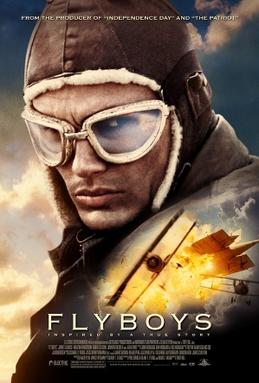
               Words on the screen tell us it’s 1916.  9 million are dead and the plane has become a weapon with pilots becoming heroes.  This movie is “inspired by a true story”.  Yeah, sure!  This will be a small unit movie.  Survivor? #1:  a cowboy (James Franco) who has to get the hell out of Dodge.  Survivor? #2:  clean-cut fiance of an all-American girl.  Survivor? #3:  black boxer fighting in Paris because the French are not racist.  Survivor? #4:  fat rich boy who is a disappointment to his father.  Survivor? #5:  who is this dude?  No back-story.  Mysterious or cutting room floor?  How many of the five will survive?  I’m guessing two (Franco plus whoever is black).

                They have joined the Lafayette Escadrille – an all-American fighter unit in the French air force.  (It really existed!)  They are based at Verdun and housed in a chateau.  No mud for these “knights of the air”.  The seasoned veteran is an ace who is cynical due to seeing all his buddies go down in flames.  He is not exactly welcoming to the dead meat newbies.  He has a pet lion named “Whiskey”.  Cowboy starts typically cocky, but soon turns all sensitive and role modelish.  Rich boy doesn’t like blacks.  Will he learn to respect Boxer?  Seems likely.

                First trip to the canteen for our virgins results in your clicheish “get your non-bloodstained asses out of here” moment.  Training montage.  Mystery Guy crashes and he and Cowboy end up in a brothel where Cowboy meets a whore with a heart of gold.  New replacements arrive so more characters can get killed.  One is a holy roller.  Jesus is his co-pilot.  They paint nose art and nick-names.  Did they do that in WWI? 

                First mission.  Pep talk from Cynical Vet:  here’s a pistol, shoot yourself instead of burning to death.  Good CGI flak.  Dogfight.  Good thing we have that nose art to tell who’s who!  One newnewbie gets shot down but lands safely.  He is ecstatic and yells “I made it, I’m all right.”  Has he ever seen a war movie?  Strafe-bait for  Evil German (in the only black tri-plane in their air force).  Hiss!  I hope this guy gets his.  Seems likely.  CGI dogfighting is okay and boy can they fly close when the computer has the controls.  Back at the base, the canteen door is open for our blooded warriors.  Everyone is morose about the friends they lost that day.  Just kidding.  Singing and getting drunk is what the dead would want us to do.

                Hey, the whore is not a whore!  She’s a country girl.  Language barrier doesn’t deter Cowboy.  Throw in some cute kids.  Franco rides a horse.  Is there anything he can’t do?  (Don’t say “act” – that would be cruel.)

                Attack on a bomber.  Holy roller is singing hymns.  Good German decides not to kill cowboy when he is a sitting duck.  Chivalry is not dead.  Will Cowboy get a chance to return the favor?  Seems likely.  Is Mystery Guy a German spy?  It’s obvious to Rich Boy because he has a German name, knows a lot about German planes, and he always misses.  Turns out he had no back-story because he’s on the lam from a botched bank robbery.  His mates support him because everyone wants to see if he will ever hit anything.  Seems likely.  Meanwhile, Clean-Cut draws the straw labeled “crack up”.  Will he get a chance to redeem himself?  Seems likely.

                Cool German strafing attack results in our boys riding to the rescue.  Cowboy gets the chance to return the favor to Good German, but later has to shoot him down to save Rich Boy.  War sucks.  No-longer-Mystery-Guy crashes in no man’s land.  It would be insane for Cowboy to land nearby (not to mention impossible), but guess what?  Cowboy runs a gauntlet of bullets with everyone purposely missing because they recognize it’s James Franco.  Cowboy amputates Unsure-Shots (otherwise known as Mystery Guy) trapped arm with an entrenching tool.  (James Franco will later use this experience.)  Looks like the war’s over for him.  Seems unlikely.

                An introspective Cynical Vet tells Cowboy the war won’t change anything.  He’s fighting to avenge his dead buddies.  He won’t rest until he shoots down Evil German.  Franco keeps his mouth shut although he clearly knows Evil German is reserved for him.

                Some romantic suspense as Cowboy rescues French Girl and cute kids from advancing Germans.  Rape is implied.  He lands a WWI biplane after dark in a French field – twice!  (Hell, anyone who can land in No Man’s Land…)   It’s a close call (are there any other types of calls in war movies?)  She is wounded and he is given a medal in lieu of a court-martial for disobeying orders.  In war movies, it’s okay to disobey orders as long as you’re heroic and successful.

                Attack on the Zeppelin.  Omenous Zeppelin music.  All the German planes are red except you know boo.  Man, you can do impossible aerobatics with CGI!  Cynical Vet plays machine-gunning chicken with Evil German.  Bad guy wins duel, but cynic has the last laugh as he crashes into the blimp.  Explosions!!  The torch is passed to Cowboy, but he won’t have to tone down his cockiness since he lost it long ago.  Last meeting with Frenchette.  We’ll meet in Paris and live happily ever after.  Seems likely.

                Attack on the ammo dump (the same one as in “The Dawn Patrol”?).  One-Handed (otherwise known as Mystery Guy or Unsure-shot) is going, but not Clean-Cut.  Wait, what about his redemption?  Is the movie suddenly going all realistic on us?  Seems unlikely.  Rich Guy’s plane catches on fire.  He remembers the pep talk from cynical.  See you in Hell, Dad.  Unsure-shot shoots surely to save Black Guy.  Lots of bomb explosions on the depot.  Hollywood!  Suddenly the sky is clear.

                Cowboy challenges Bad German.  Come up and play, if you dare.  Another chicken head-on attack except this time they approach upside down!  Cowboy is ambushed by two of EGs henchmen, but who comes to his rescue?  None other than the redeemed Clean-Cut!  Cowboy gets the two lackeys to run into each other, but EG still swiss- cheeses him and pulls alongside to gloat as Snidely Whiplash would.  Remember that pistol Cynical gave him in case of fire?  Well, he is a cowboy and does what a cowboy would do.  Audience cheers.  He is joined by his surviving mates and they fly off into the sunset – I kid you not!  For those of you of the intelligentsia that think the movie was predictable – Cowboy does not hook up with French Girl and live happily ever after.  This was either a “take that” move by the director or they ran out of film (which seems more likely).

HISTORICAL ACCURACY

                Why do you want to know?   It said it was inspired by a true story didn’t it?  Being the jerk that I am I decided to check up on it.  Here’s the good news:  there was a unit of American volunteers in the French air corps called the Lafayette Escadrille and it did have a pet lion named “Whiskey”.  Inspirational!  End of accuracies.

                The movie purports to use real people for its characters, but changes the names.  Cynical Vet is based on the famous Raoul Lufbery and Cowboy is obviously meant to be Frank “Balloon Buster” Luke.  Problem is that very little in the characters relates to the real person.  For instance, the most memorable thing about Lufbery is his death from jumping out of a burning air plane.  He didn’t use the pistol.  Luke is memorable for shooting down balloons which Cowboy does not even see an observation balloon in the movie.  Is CGI not capable rendering a balloon?  As far as Mystery Guy and Rich Boy being based on actual persons – balderdash!  However, kudos for giving some recognition to Eugene Bullard (the black guy).  He was an ex-patriate boxer in France, but joined the Escadrille after fighting in the trenches and being decorated for bravery.

                Red triplanes were not the sole aircraft in the German air force.  They were not even the most common. Some planes had squadron insignia (like the “Hat in the Ring” Squadron), but I found no evidence that individual pilots had insignia.

POST-WATCHING

                The movie did not do well at the box office which is ironic because most of the bull shit was aimed at the core audience of historical morons and to hell with people like me.  It’s not a terrible movie, it’s just easy to make fun of.  The score is stirring and not bad for a film of its nature.  The acting is satisfactory with Martin Henderson as Reed Cassidy (aka Cynical Vet).  Franco is merely adequate.  There is some chemistry in the romance.  The movie is bogged down by clichĂ©s and implausibilities.  It gets more ridiculous as it goes on.   The CGI is okay and makes for exciting action.  Technology should make air combat films awesome, but unfortunately it is usually carried too far by depicting aerobatics that are impossible.  Pilots must really loathe movies like this.

Grade = C+

Friday, September 21, 2012

WATCHALONG: Johnny Got His Gun

I am participating in a Watchalong hosted by my peer at All About War Movies Watchalong .  The movie we are jointly watching is "Johnny Got His Gun" which is based on the famous anti-war novel by Dalton Trumbo.  Please join in.  I have provided the link-up to the You Tube full movie.  Enjoy and be vocal!

Thursday, September 20, 2012

SHOULD I READ IT? The Cranes Are Flying


               “The Cranes Are Flying” is a Soviet film directed by the acclaimed Mikhail Kalatozov and released in 1957.  It won the Palme D’Or at Cannes in 1958 and is still the only Russian movie to win that prestigious award.  It is set on the home front during the Great Patriotic War (World War II on the Eastern Front).

                The movie opens with the heroine Veronika (Tatiana Samoilova) and her fiancĂ© Boris watching a flight of cranes before traipsing through the streets of their Soviet city.  Their wedding has to be postponed because Boris does his patriotic duty and volunteers when the Germans invade.  In a remarkable tour de force by cinematographer Sergei Urusevsky, we follow Veronika through the crowd as she tries to say goodbye to Boris at the train station.  The military band, the tears of loved ones, and the excitement that comes with war are all apparent.  Veronika does not make contact with Boris which is an inkling that this will be a post-Stalin movie that will allow its audience to mourn their losses along with Veronika.

                Veronika’s family is stock Russians including the typical grandmother.  During an air raid, Veronika takes refuge in the subway, but her parents refuse to abandon their apartment and you can guess the rest.  What can’t be anticipated is the shot of Veronika running up the stairs and opening the door to find only the grandfather clock left.  Awesome.

                Veronika moves in with Boris’ family.  His cousin Mark is in love with her.  During an air raid (didn’t she learn her lesson?), they are alone in the apartment and he apparently rapes her in spite of numerous nyets and slaps.  I assume this because the scene fades with him carrying her off and next thing you know, they’re married.  No one is happy about this (except Mark) as Boris’ family feels she has abandoned Boris.  Meanwhile, Boris gets killed rescuing a friend.  He gets a great death scene where he fast-forwards to their joyous wedding.  No word arrives about his death.

                The family relocates and Veronika is working in a military hospital with Boris’ father who is a doctor.  As though she is not depressed enough being married to a rapist and cheater, the doctor makes an impassioned speech against Russian women who do not remain loyal to their soldier boyfriends.  I'm looking at you, Veronika.  She runs away in a wild scene and plans to commit suicide, but instead ends up saving a little boy from being run over by a truck.  His name is Boris!  Go figure.  She brings him home.  Mark gets kicked out when the doctor discovers he lied about his exemption and in fact bribed his way out of being drafted.  Good riddance.

                Veronika does not get closure until the war ends.  In a mirror of the leaving scene, Veronika works her way through a crowd to Boris’ friend Stepan.  Stepan gives her the bad news and makes a speech to the audience telling them to remember the dead and move on with their lives.  Veronika gives her bouquet to other soldiers.  Cranes fly over.  Get it?

                This movie was a pleasant surprise.  I am not a big fan of Soviet war movies because they can be pretentious.  Kalatosov keeps the avante-garde elements to a minimum.  The movie is not overly propagandistic or preachy, but it definitely has a patriotic message to convey.  Ladies, stand by your soldier man.  People, it’s okay to mourn your dead and move on.  The movie goes beyond these trite themes into uncharted territory for a Soviet film.  Not coincidentally, with the death of Stalin, the film boldly does not focus on the greatness of the regime.  It bravely covers draft dodging, war profiteering, and the black market for the first time in a Soviet film.

                This is a director’s movie.  It’s one of those films where you are aware of the craft that went into it.  This is mainly apparent from the astounding cinematography.  There are several scenes that should be film school staples – the bombed apartment, the death of Boris, Veronica’s attempted suicide, the departure and return of the soldiers.  There is one shot where Urusevsky uses a hand-held camera to track Veronika from a bus into a crowd and then suddenly he is on a crane ascending above the crowd!

                The acting is better than most Soviet movies.  The cast is solid, but Samojlova dominates.  It made her a celebrity.  She is not hard on the eyes.  Unfortunately, the Soviet government pressured her to turn down offers to go West.  The characters are pretty stereotypical – the stern father, the loving boyfriend, the cad – but they are not caricatures.  The plot is the standard war-parts-the-lovers-and-their-lives-change-for-the-worse plot.  As such, it is better than most, including American and British equivalents.

                “The Cranes Are Flying” is a must see for all war movie lovers and cinephiles, but it will not make my 100 Best.  However, I’m glad I watched it.  It impressed me more than similar Soviet films like "Ballad of a Soldier" and "Come and See".

grade =  B+
 
POSTER:  Terrible!  Is that because it's Soviet and their poster technology was inferior to that of the West?  It provides absolutely no inkling what the movie is about.
 
the trailer
 
 
the stairs scene


 TRAILER:  Great.  Even if you can't understand the Russian, you can understand the mastery of the cinematography.  A

Saturday, September 15, 2012

CRACKER? Born on the Fourth of July


               “Born on the Fourth of July” is the second in Oliver Stone’s Vietnam trilogy.  It was released in 1989.  It is sandwiched between “Platoon” and “Heaven and Earth”.  The film shares eleven actors with “Platoon”.  It is based on the memoir by Ron Kovic who wrote the script with Stone.  Kovic was on set to counsel Cruise.  Interestingly, the two veterans (Kovic and Stone) both won Bronze Stars and Purple Hearts.  Kovic gave his Bronze Star to Cruise at the end of the film.  Stone also produced and directed the film.  It was a huge success at the box office and with critics.  It was nominated for eight Oscars and won for Director and Film Editing.

                The movie opens symbolically with a young Kovic playing war – an American rite of passage.  This flows into a Fourth of July parade featuring crippled veterans (including the real Kovic).  Next, he listens to an inspiring speech by JFK.  This trio of images establishes the template of pre-disillussioned ("Leave it to Beaver") America.

                Kovic is recruited by the Marines and seduced by the desire to “find out if you got what it takes.”  He doesn’t want to miss the chance to go toe to toe with Communism.   In a twist, his veteran father (Raymond Barry) is not thrilled, but his mother (Caroline Kava) is supportive.

he's not playing war now
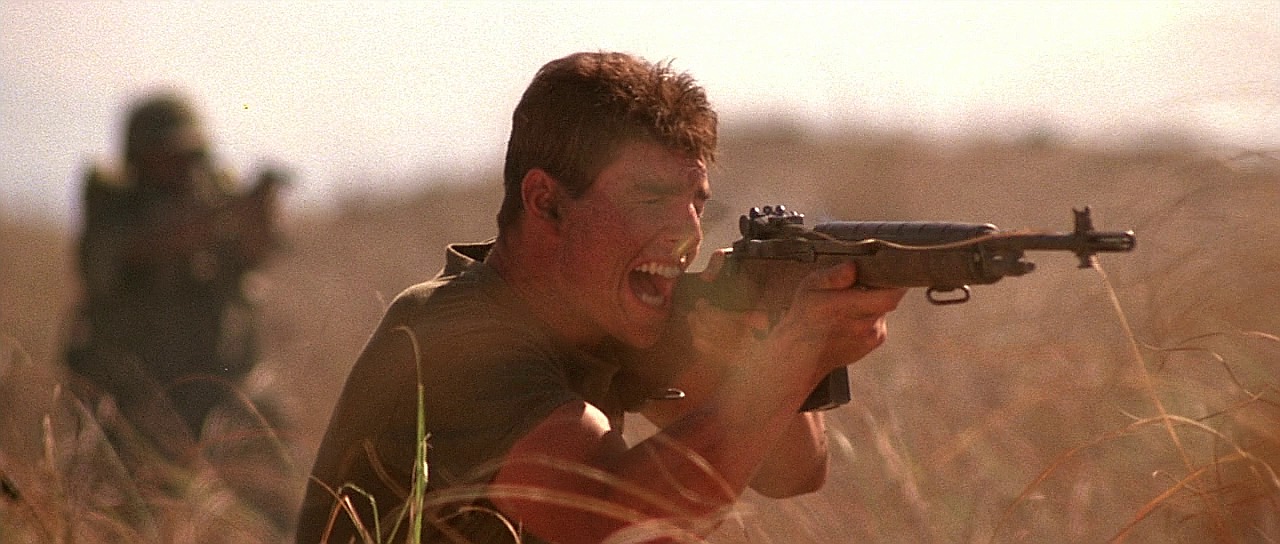
                The movie jumps abruptly forward to Kovic’s second tour in Vietnam.  The viewer is wrenched out of their comfort zone as is Kovic.  His unit is attacking a village and find a whole family slaughtered accidentally by the Marines.  The combat is visceral and graphic.  In the chaotic retreat, Kovic kills one of his men named Wilson in a friendly fire incident.  When he tries to accept responsibility, his CO brushes the incident under the rug  (standard operating procedure).  This adds to Kovic’s anguish and creates an ominous vibe.  Sure enough, in the next combat set piece, Kovic is badly wounded in the assault on another ville.  The action is intense and frenetic.  Both scenes evidence the “fog of war”.  Tragically, the military hospital is more hellish than the front line.  He is given last rites, but survives to end up in the Bronx Veterans’ Hospital.

the tannish tinged lensing
                The hospital is like Purgatory.  Viewers eyes are opened to how our warriors were treated by the system they fought for.  Rats, filth, uncaring staff, drug abuse, faulty equipment.  (This makes it even more damning that some similar examples of mistreatment greeted veterans of Iraq!)  In spite of this, Kovic remains a hawk and rails against anti-war protestors.  “America, love it or leave it!”  Kovic's athletic competitiveness makes him believe that he will walk again.  A broken leg ends his optimism and begins his descent into depression.  He will be in a wheelchair the rest of his life.

                His return home does not slow the descent.  The detached
atmosphere is similar to what faced Paul Baumer on leave in "All Quiet" and Michael coming home in "The Deer Hunter".  He is full of self-pity. The America he was proud to fight for is indifferent to his sacrifice.  He starts drinking heavily and who can blame him?  The family is dysfunctional with an anti-war brother to quarrel with and a mother who cannot deal with the broken copy of her golden boy.  The movie comes full circle with another Fourth of July parade.  Although predictable with its hippies causing trouble, the scene is a great bookend.  Even the requisite PTSD flinching at the fireworks and the failed speech with flashbacks do not feel clicheish.

                The worm turns when Kovic is caught up in a protest at Syracuse University.  During a speech by Abbie Hoffman, the police wade into the crowd with tear gas and billy clubs. This leads to a drunken rant against his mother and the heart-rending “who’s gonna love me, dad?”  This movie packs an emotional wallop.  He has to leave home now. 

                The third stage of his life takes him to a seedy town in Mexico inhabited by other mentally and physically damaged veterans.  It’s a life of frustrated whoring and binge drinking.  Kovic poignantly falls in love with a “whore with a heart of gold”  only to discover it’s just a job to her.  He leaves this “home” with his friend Charlie (Willem Dafoe) only to end up at rock bottom in a wheel chair fight on a deserted highway.  It’s more powerful than pathetic.

                The fourth stage begins with a soul-cleansing visit to Wilson’s family to tell them the truth about their son’s death.  Their reaction is genuine and sincere and very Middle American.  A weight has been lifted and Kovic begins his career as a fixture in the anti-war movement.  The climax of this evolution from naĂŻve patriot to patriotic dissenter comes at the 1972 Republican Convention where Kovic and others disrupt Nixon’s speech and get violently throw out of the hall.

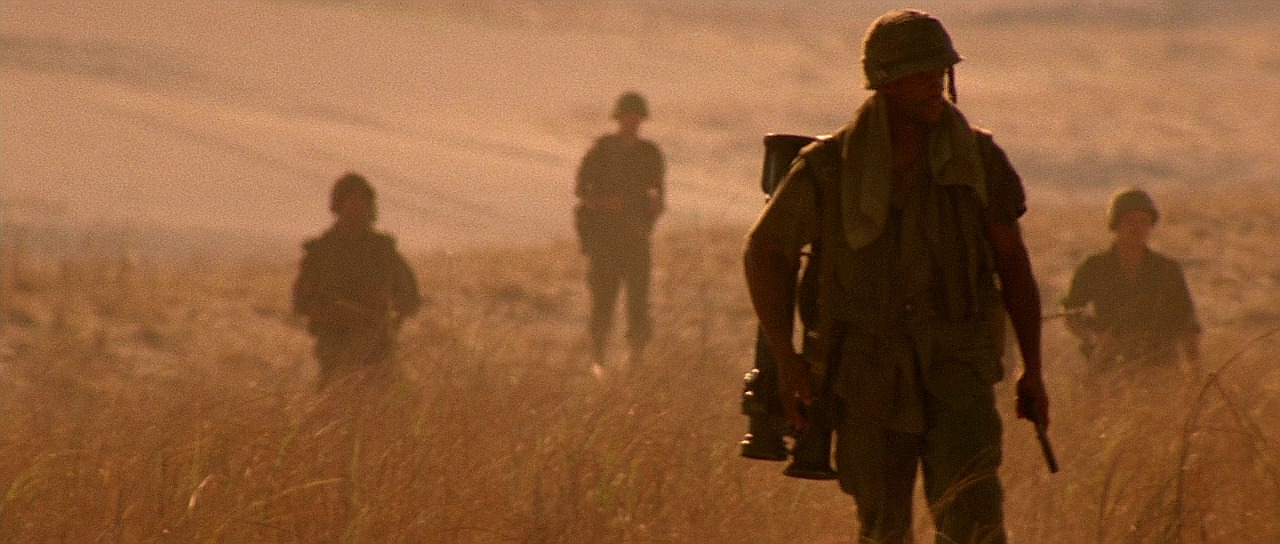
                Here’s a clichĂ© for you;  “I’m not a big Tom Cruise (Oliver Stone) fan, but…”  How often do you hear that?  This is one of those movies where both men are at their best.  I had not seen it in years and did not look forward to reviewing it with relish.  I was wrong.  It is a very impressive movie.  There are few weaknesses.  Stone controls himself (you know how he can be) and deserved the Oscar as Best Director.  It is astounding that the movie lost to “Driving Miss Daisy”.  You can definitely argue that was more egregious than the infamous “Shakespeare in Love” win over “Saving Private Ryan”.  The cinematography of Robert Richardson mixes chromes to match the moods.  For instance, the combat scenes have a tannish tinge.  (It lost to “Glory”.)  The two combat scenes stand out for me, of course.  Richardson uses a hand-held and gets the you-are-there feel that has become common in modern war films.  The soundtrack by John Williams was also nominated (losing to “The Little Mermaid”!).  It matches the mood perfectly. 

                The acting is outstanding.  Cruise is amazing and must have finished second to Daniel Day-Lewis.  He is fully into a role that took great physical commitment.  Leave your feelings about him at the door and admire his performance.  The other standout is Defoe.  Their scenes together are highlights.  You can easily imagine Charlie as Elias from "Platoon" if he had survived the war.

                  In less capable hands, the movie could have been maudlin and heavy-handed.  Stone is obviously sending a message, but he does not bludgeon us with it.  The overall theme is simple: the evolution of a patriotic warrior to a disillusioned pacifist.  The arc is realistic mainly because it’s a true story.  Kovic’s role in the production gives it cred.  It makes it difficult to doubt the accuracy.  However, the two protest scenes (Syracuse and the Convention) are up-violenced for understandable reasons.  These are not major flaws.

                  Although Stone struck out with “Heaven and Earth”, the first two in his trilogy are important films.  “Platoon” has lost luster for many war movie fans (not me), but the fact is that it opened the Vietnam combat experience to many Americans for the first time.  Its theme is the effects of war on the young and naive.   On the other hand, “Born” opened people’s eyes to the plight of the wounded veteran.  Its theme is the effects of the post-war on the naively patriotic.  This theme is rarer with the inferior “Coming Home” the obvious competitor.  "Birdy" is a similarly themed film that you might want to check out.  The sad thing is the limited impact it had on treatment of future veterans.  It also should be mentioned that the movie did the service of bringing Ron Kovic to public recognition.  For the Vietnam War, it is appropriate that we get a crippled, but resilient hero to replace Col. Kirby of “The Green Berets” (a movie that is the polar opposite of this movie).
 
                 Does it crack the 100 Best?  Definitely!  "Platoon" is #9 and although I still believe it is the better film, "Born on the Fourth of July" is not that far behind.  It is hard to imagine how it did not make Military History magazine's Greatest 100 list.
 
Grade = A
 
the trailer
 
 
the wounding
 
 
TRAILER -  Excellent.  Great use of the song "Stop, Hey What's That Sound".  Gives a clear impression of the plot arc.  grade = A
 
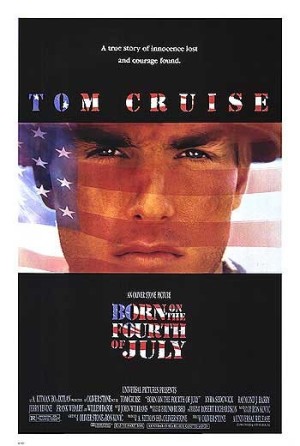
POSTER -  A little too simplistic.  Makes it look like a regular war movie.  Does have the flag which appropriate because its a recurring motif in the film.  grade =  C